Quick answer: MiniMax H3-Image vs Nano Banana 2.1 comes down to control versus convenience. Pick MiniMax H3-Image if you want open weights, up to 16 reference images and the lower list price per 4K image ($0.06879 vs $0.113). Pick Nano Banana 2.1 if you want conversational multi-turn editing, Google Search grounding and a managed API with no license terms to read.
MiniMax H3-Image vs Nano Banana 2.1 at a glance
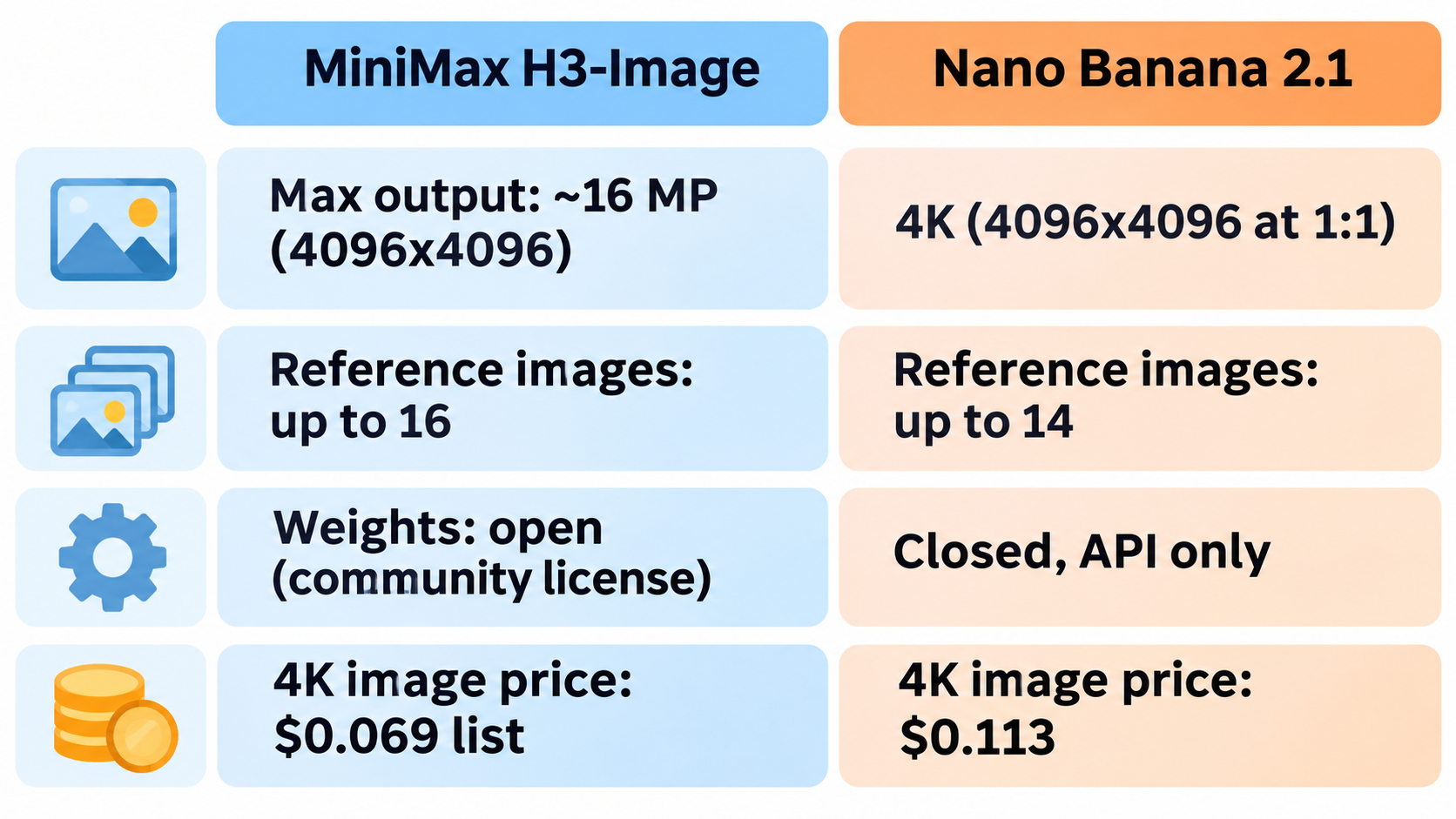
MiniMax H3-Image is an open-weight text-to-image and editing model that outputs about 16 megapixels and accepts up to 16 reference images. Nano Banana 2.1 (gemini-nano-banana-2.1) is Google’s closed image model in the Gemini API, built for conversational editing with 1K, 2K and 4K output and up to 14 reference images.
| MiniMax H3-Image | Nano Banana 2.1 | |
|---|---|---|
| Released | November 10, 2026 | October 6, 2026 |
| Weights | Open, under a community license | Closed, API only |
| Max output | About 16 MP (4096 x 4096 at 1:1, 6272 x 2688 at 21:9) | 4K (4096 x 4096 at 1:1, 5504 x 3072 at 16:9) |
| Reference images | Up to 16 per edit | Up to 14 (10 objects, 4 characters) |
| Speed claim | “4K image generation in 10 seconds” | “Flash-level speed,” no number published |
| 4K price (list) | $0.06879 per 1:1 text-to-image result | $0.113 per image |
| Free API tier | None listed | “Not available” |
| Watermark | Not stated in the API reference | SynthID on every image |
Sources, checked November 11, 2026: MiniMax pricing, the H3-Image model card, Gemini API pricing and Google’s image generation guide.
Resolution and output size
Both models top out near 16 megapixels on a square image, so “4K” doesn’t separate them. How you ask for a size does:
- MiniMax H3-Image takes a free-form
sizesuch as2720x1536, between 655,360 and 20,000,000 pixels with an aspect ratio between 1:3 and 3:1. Or you setaspect_ratioandarea(1K,2Kor4K) and let the API pick. The model card says results are best around 16 MP. - Nano Banana 2.1 takes one of three
image_sizetiers and a ratio from a fixed table. That table includes extreme banners such as 8:1, which comes out at 12288 x 1536 in 4K.
Need an exact pixel size? H3-Image saves you a crop. Need very wide strips? Nano Banana 2.1 goes past H3-Image’s 3:1 custom-size limit.
Speed: what each company claims
MiniMax says H3-Image makes a 4K image in about 10 seconds, helped by distillation to 6 sampling steps with no classifier-free guidance. It doesn’t name the hardware, so treat that as a claim.
Google gives no seconds figure for Nano Banana 2.1. It describes “Flash-level speed” and lets you trade quality for latency with thinking levels minimal, medium (default) and high. The model may also draw up to two interim “thought” images first.
Neither is a benchmark. If latency decides your choice, measure it with the test below.
Editing and reference images
MiniMax H3-Image edits through a separate endpoint, POST /v1/images/edits. You send 1 to 16 reference images as public URLs, uploaded file IDs or data URIs (up to 64 MiB per request), and refer to them in the prompt as <Picture 1>, <Picture 2> and so on. MiniMax’s guide lists what it doesn’t support: masked edits, transparent backgrounds and preview images.
Nano Banana 2.1 edits inside a conversation. You describe the region in words (“change only the sofa”) instead of uploading a mask, and each follow-up builds on the previous turn, so a product or character stays consistent. References cap at 14: 10 objects and 4 characters.
So the rule of thumb:
- Many inputs, one composite (a room built from 15 furniture shots, a character sheet): H3-Image’s 16-image limit fits.
- Iterative tweaks to one image (swap a label, translate an infographic, nudge a color): Nano Banana 2.1’s multi-turn editing fits.
- Images that depend on current facts (a chart of today’s weather, a recent event): only Nano Banana 2.1 offers Google Search grounding, including image search as visual context.
Our Nano Banana 2.1 API guide walks through the multi-turn and grounding calls, and the MiniMax H3-Image API guide covers the edits endpoint.
Open weights vs closed API
MiniMax H3-Image ships its weights on Hugging Face under the MiniMax-H3-Image Community License. You can self-host it; Nano Banana 2.1 offers no such option. The license sets real limits:
- It excludes the European Union, the United Kingdom, the Republic of Korea and the United States from the default grant.
- Companies above $1 million in annualized revenue, or anyone offering the model as a hosted service, need written authorization from MiniMax.
- Commercial products must show “MiniMax-H3-Image” in the interface, and you can’t use outputs to train other models.
Self-hosting is heavy too: a 33.1B-parameter transformer and roughly 137 GB of weights, as the what is MiniMax H3-Image explainer details.
Nano Banana 2.1 is simpler to reason about: a paid Gemini API key, Google’s terms, and a SynthID watermark on every image.
Price per image
Both bill by tokens, but each publishes per-image equivalents. List prices, standard tier, checked November 11, 2026:
| Output | MiniMax H3-Image | MiniMax H3-Image-Highspeed | Nano Banana 2.1 |
|---|---|---|---|
| 1K (1024 x 1024) | $0.02179 | $0.03529 | $0.0336 |
| 2K (2048 x 2048) | $0.02333 | $0.03622 | $0.0504 |
| 4K (4096 x 4096) | $0.06879 | $0.13001 | $0.113 |
A few details change the math:
- Launch discount. MiniMax takes 50% off the total request cost on both H3 models when the delivered image has at least 16,600,000 pixels, until November 17, 2026, at 16:00 UTC. That puts a standard 4K result at $0.03439 during launch week. Smaller images don’t qualify.
- Batch. Google prices Nano Banana 2.1 image output at $15 per million tokens through the Batch API, half the standard $30.
- Extras. Nano Banana 2.1 also bills text and thinking output at $7.50 per million tokens. MiniMax counts its default prompt enhancement as input text tokens;
disable_prompt_enhanced: trueturns it off. - Retries. MiniMax’s endpoint isn’t idempotent: a retry after a timeout generates and charges again.
On list prices, H3-Image standard is cheaper at every tier shown, by a factor of about two at 2K.
Run your own test with Apidog CLI
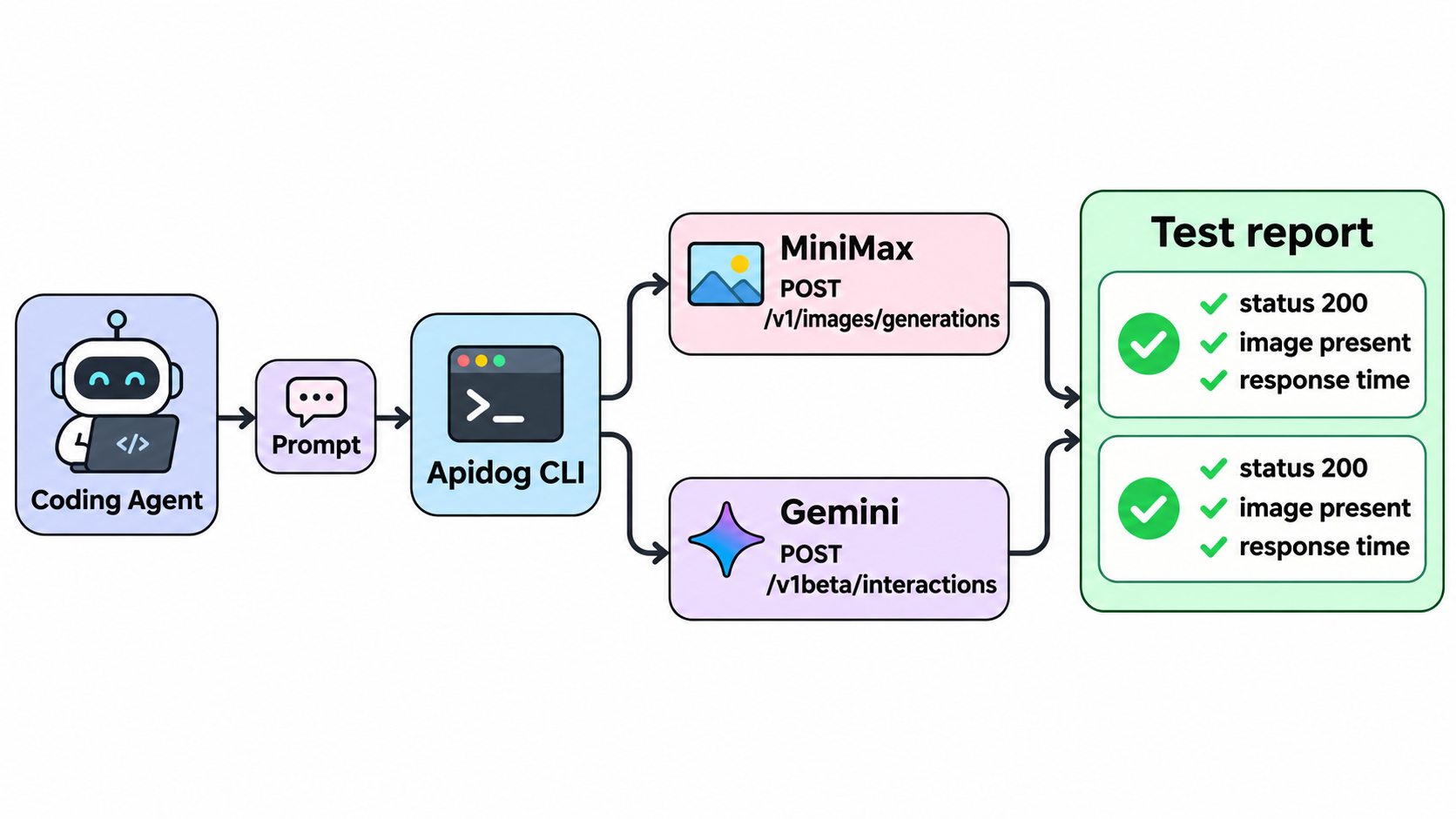
The fair test is the same prompt to both APIs, run a few times, with status, image field and response time recorded per call. Let your coding agent build it with Apidog CLI instead of scripting two SDKs by hand.
Set up the CLI once:
npm install -g apidog-cli@latest
apidog login --with-token <YOUR_APIDOG_TOKEN>
apidog skill install
The skill teaches Claude Code, Codex, Cursor or another agent the CLI’s commands. Then give it one prompt:
In Apidog project <projectId>, set up a head-to-head image test.
1. Environment "minimax", base URL https://api.minimax.io. Endpoint
   POST /v1/images/generations with Bearer {{MINIMAX_API_KEY}}.
   Body: model MiniMax-H3-Image, size 1024x1024, n 1,
   disable_prompt_enhanced true, response_format url.
2. Environment "gemini", base URL https://generativelanguage.googleapis.com.
   Endpoint POST /v1beta/interactions with header x-goog-api-key {{GEMINI_API_KEY}}.
   Body: model gemini-nano-banana-2.1, response_format type image,
   aspect_ratio 1:1, image_size 1K.
3. Use the same prompt in both: "A ceramic coffee mug on a walnut desk,
   morning window light, the word APIDOG printed on the mug."
4. One test case per endpoint. MiniMax asserts status 200, data[0].url exists
   and data[0].error is absent. Gemini asserts status 200 and an image output
   block is present (read the Gemini docs for the response path).
5. Run each case 3 times and compare status, assertions and response times.
The agent turns that into a short run of apidog commands. Every flag below comes from apidog <command> --help on Apidog CLI 2.2.12:
apidog environment create minimax --project <projectId> --base-url https://api.minimax.io
apidog environment create gemini --project <projectId> --base-url https://generativelanguage.googleapis.com
apidog cli-schema get endpoint-create
apidog cli-schema validate endpoint-create --file ./h3-endpoint.json
apidog endpoint create --project <projectId> --file ./h3-endpoint.json
apidog endpoint create --project <projectId> --file ./nb21-endpoint.json
apidog test-case category --project <projectId>
apidog test-case create --project <projectId> --file ./h3-case.json
apidog test-case create --project <projectId> --file ./nb21-case.json
apidog run --test-case <h3CaseId> --project <projectId> -e <minimaxEnvId> \
  --env-var "MINIMAX_API_KEY=$MINIMAX_API_KEY" -n 3 -r cli,json
apidog run --test-case <nb21CaseId> --project <projectId> -e <geminiEnvId> \
  --env-var "GEMINI_API_KEY=$GEMINI_API_KEY" -n 3 -r cli,json
cli-schema validate checks each JSON file before anything is written. -n 3 repeats each case three times, so one slow call doesn’t decide your verdict. The CLI prints a pass or fail summary and writes a JSON report the agent reads to compare the runs; add --upload-report to view them in Apidog.
At 1K, six calls cost about $0.07 on MiniMax and $0.10 on Nano Banana 2.1 at list prices, plus any thinking tokens on the Gemini side. Then compare the images: the word on the mug checks text rendering, which Google lists as a 2.1 improvement. We didn’t run this test for this article, so the numbers are yours to find. More on the pattern is in the Apidog CLI agent workflow guide, and Apidog’s Free plan covers up to 4 users.
Which image model should you use?
Choose MiniMax H3-Image when:
- You need self-hosting and the license’s territory and revenue terms fit you.
- Your edits combine many inputs, up to 16 references.
- You render a lot of 1K and 2K images and want the lower list price.
- You need exact pixel sizes instead of fixed tiers.
Choose Nano Banana 2.1 when:
- You refine one image over several turns and need it to stay consistent.
- Your images depend on current facts and benefit from Google Search grounding.
- You need extreme banner ratios such as 8:1, or you can batch jobs at half the output price.
Comparing more options? See the GPT Image 2.6 API, Qwen-Image 2.1 and Nano Banana 2.1 vs 2 vs Pro. For zero-cost routes, see MiniMax H3-Image for free and how to use Nano Banana 2.1 for free.
FAQ
Is MiniMax H3-Image better than Nano Banana 2.1? No head-to-head benchmark exists. H3-Image leads on open weights, reference count and list price; Nano Banana 2.1 leads on multi-turn editing and search grounding.
Which is cheaper per image? At list prices, MiniMax H3-Image standard: $0.02179 vs $0.0336 at 1K, $0.02333 vs $0.0504 at 2K and $0.06879 vs $0.113 at 4K. MiniMax’s Highspeed tier costs more than Nano Banana 2.1 at 1K and 4K.
Can I run Nano Banana 2.1 locally? No. Google serves it only as a hosted model. MiniMax H3-Image is the one you can download and self-host, within its community license.
Is the 10-second speed claim verified? No. It’s MiniMax’s figure, with no hardware named. Measure both models with your own requests.
Does either model add a watermark? Google adds a SynthID watermark to every Nano Banana 2.1 image. MiniMax’s API docs don’t mention one, but its license requires you to disclose that published content is machine-generated.