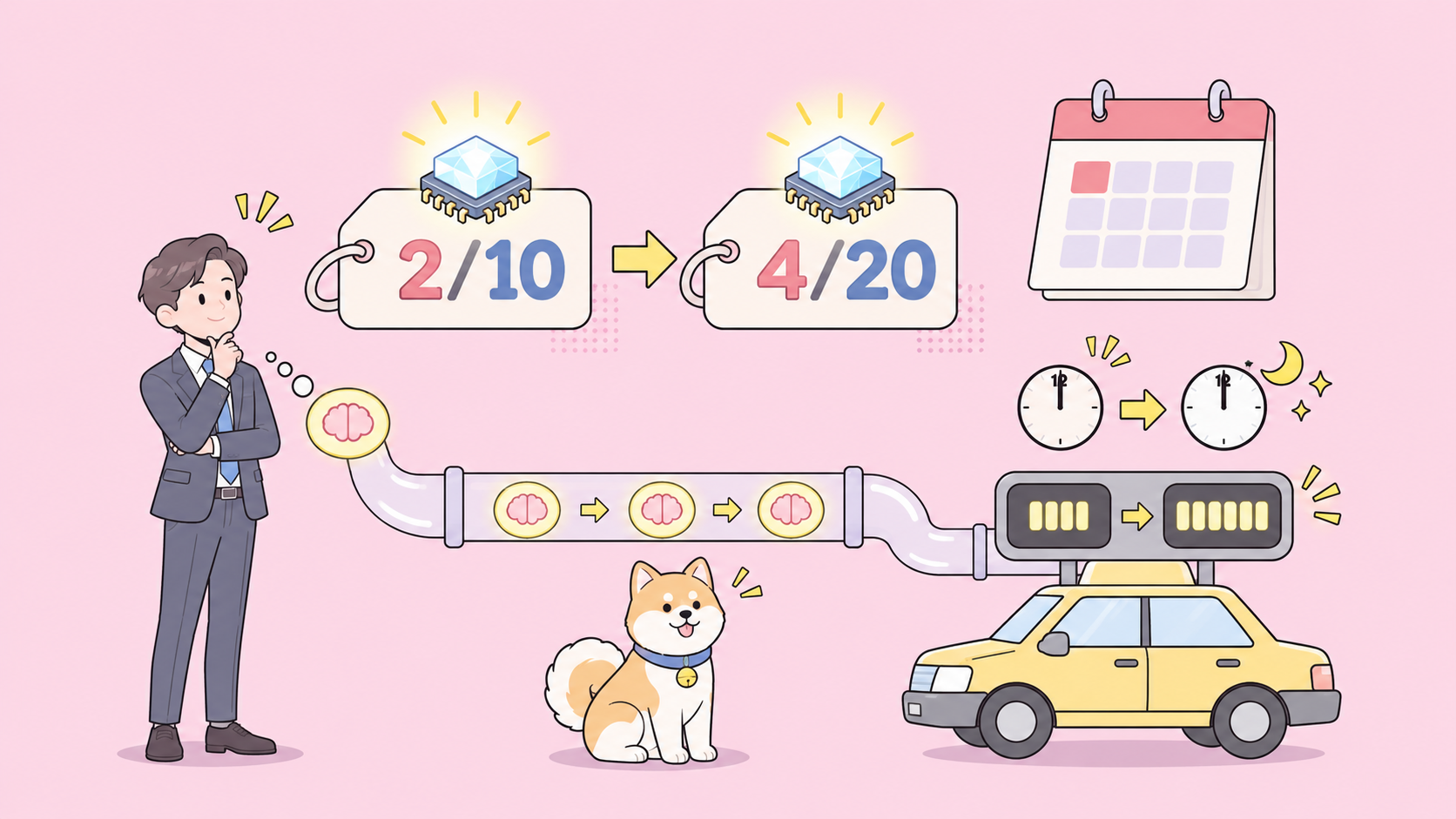
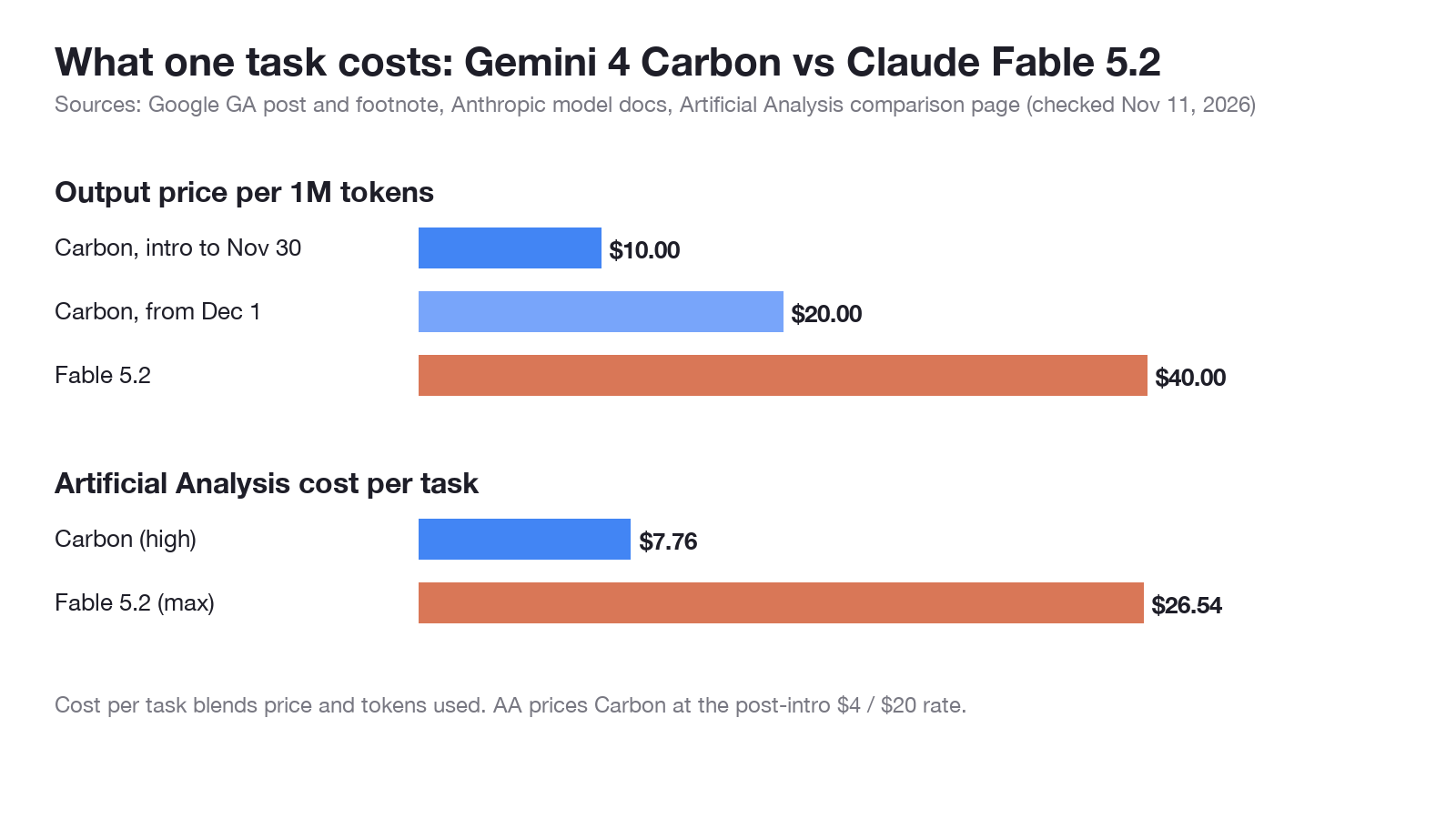
As of November 11, 2026, Google’s Gemini 4 Carbon is the cheaper model and Claude Fable 5.2 is the stronger one on most published coding and agent benchmarks. Carbon lists at $2 / $10 per 1M input/output tokens until November 30 (then $4 / $20), Fable 5.2 at $8 / $40, and Artificial Analysis puts the cost of one task at $7.76 versus $26.54.
The two launched one day apart (Fable 5.2 on November 9, Carbon GA on November 10), and each vendor’s table favors its own model. This guide splits every number by who measured it, then shows how to A/B both on your own requests.
Gemini 4 Carbon vs Claude Fable 5.2: the quick verdict
Pick Gemini 4 Carbon when cost per task matters most, for business automation flows, or for security work. Pick Claude Fable 5.2 when you need the highest score on hard coding, terminal and computer-use tasks and can pay roughly 3.4x more per task. For everyday engineering, both vendors point you to a cheaper default first.
Google’s GA post says “Argon remains the ideal choice for the majority of software engineering and knowledge work,” and positions Carbon for harder tasks where it spends more tokens exploring and verifying. Anthropic’s model docs say the same thing in their own words: start with Claude Opus 5.5 for most workloads and move to Fable 5.2 for demanding reasoning and long-horizon agentic work.
So you reach for either one after your default falls short. Still choosing a default? Read Gemini 4 Carbon vs Argon first.
How do Gemini 4 Carbon and Claude Fable 5.2 compare on price and specs?
Here are the facts each vendor publishes, with the source for every row.
| Spec | Gemini 4 Carbon | Claude Fable 5.2 | Source |
|---|---|---|---|
| Model ID | gemini-4-carbon |
claude-fable-5-2 |
Google, Anthropic |
| Release | GA Nov 10, 2026 | Nov 9, 2026 | Google, Anthropic |
| Input price per 1M tokens | $2 until Nov 30, then $4 | $8 ($16 in fast mode) | Google footnote, Anthropic |
| Output price per 1M tokens | $10 until Nov 30, then $20 | $40 ($80 in fast mode) | Google footnote, Anthropic |
| Context window | 1M tokens | 1M tokens | AI Studio model card, Anthropic docs |
| Max output | 65K / 1M listed [VERIFY] | 128K tokens | AI Studio model card, Anthropic docs |
| Thinking | Configurable thinking level | Adaptive, always on, default effort high |
Google quickstart, Anthropic docs |
| Where to get it | Gemini API paid tier, AI Studio, Android Studio, Gemini for business, Antigravity, CodeMender, Google AI Ultra | Claude Platform, Amazon Web Services, Google Cloud, Microsoft Azure | Google, Anthropic |
| Free API tier | None stated | None stated | Google, Anthropic |
Google’s GA post doesn’t name Vertex AI, Gemini CLI or GitHub Copilot, so don’t plan around those yet. Carbon’s intro price matches Argon’s, which makes November the cheapest month to run your evaluation.
For full rate cards, see Claude Fable 5.2 pricing and Google’s Gemini 4 Carbon announcement.
Which model wins on benchmarks?
It depends on whose table you read, so here are three tables kept apart.
Anthropic’s table (published with Fable 5.2)
Anthropic’s Fable 5.2 launch post includes a Gemini 4 Carbon column. The page doesn’t say who ran the Carbon numbers, so treat them as vendor-reported.
| Benchmark (Anthropic’s table) | Fable 5.2 | Gemini 4 Carbon |
|---|---|---|
| FrontierSWE v2 | 69.9% | 61.2% |
| FrontierCode 2.0 | 49.1% (xhigh effort) | 41.1% (medium effort) |
| Terminal-Bench-Science 0.1 | 74.6% | 64.8% |
| OSWorld 2.1 (offline set, partial) | 89.3% | 81.5% |
| AA-Briefcase v1.1 (rubric) | 66.1% | 61.8% |
| Chartography (no tools) | 73.4% | 72.5% |
| AutomationBench | 51.4% | 53.9% |
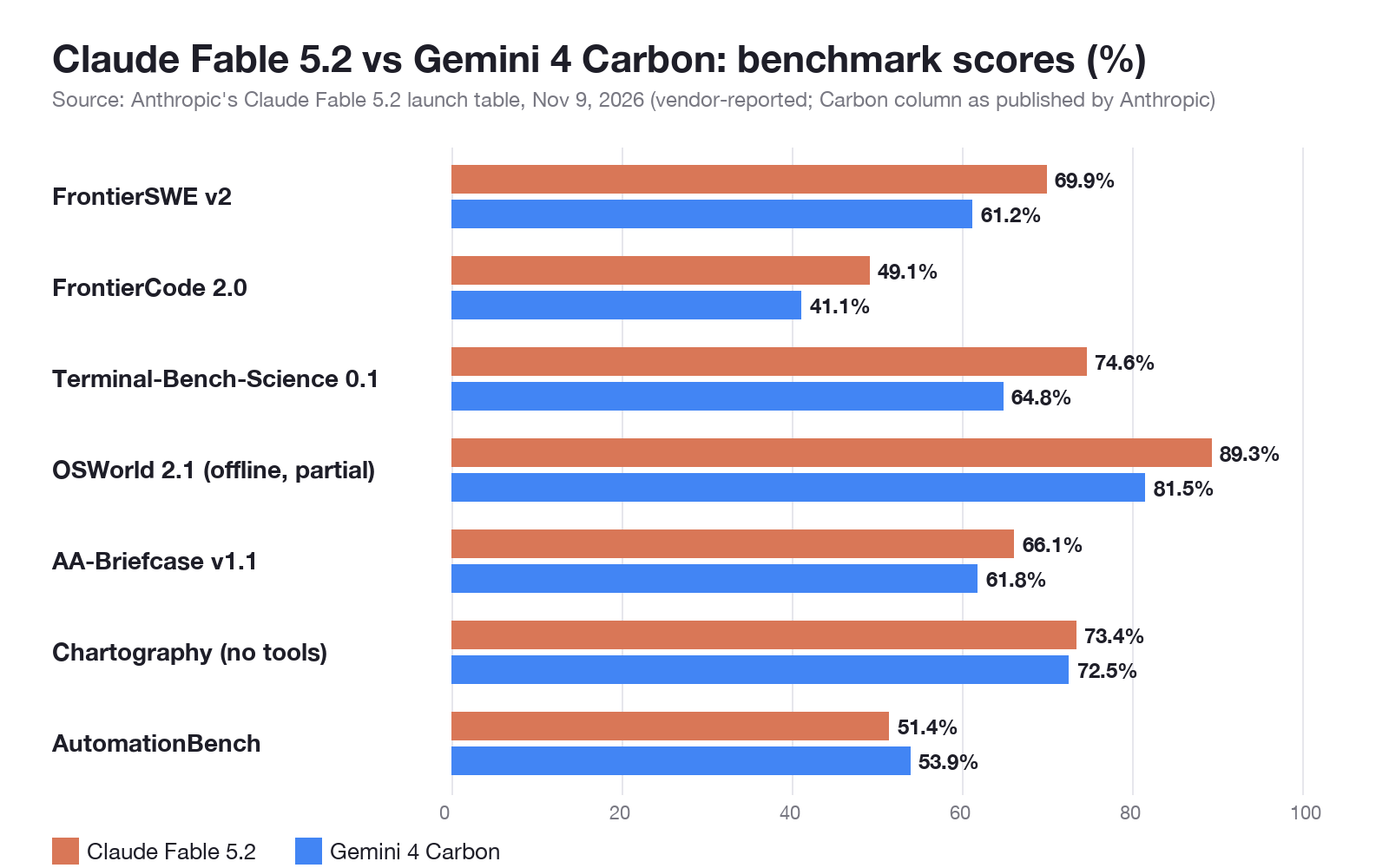
Notice the FrontierCode row: Fable ran at xhigh effort and Carbon at medium. That gap in settings matters as much as the gap in scores.
Google’s table (published with Carbon GA)
Google doesn’t print a head-to-head with Fable 5.2. It reports partner leaderboards instead: Carbon ranks first on CursorBench 4.0, Perplexity’s WANDR and Zapier’s AutomationBench “at more than 2X lower cost per task compared to the next best external model.” It ranks second on the Multimodal Knowledge Agent benchmark at more than 6x lower average cost per task than the top model. Google doesn’t name the rival models in those claims.
Artificial Analysis (independent)
The Artificial Analysis comparison page runs both models through the same Intelligence Index v5.0.1:
| Metric (Artificial Analysis) | Fable 5.2 (max) | Gemini 4 Carbon (high) |
|---|---|---|
| Intelligence Index | 65 | 60 |
| Cost per task | $26.54 | $7.76 |
| Cost to run the full index | $22,191 | $8,240 |
| Output speed | 103 tokens/s | 82 tokens/s |
Fable 5.2 (max) holds the top spot on that index today. Carbon scores 5 points lower at about 29% of the cost per task. Artificial Analysis prices Carbon at $4 / $20, the post-November rate, so its cost figures already reflect the December price.
Where does Claude Fable 5.2 win?
Fable 5.2 wins on the hardest coding and computer-use tasks, by Anthropic’s numbers:
- Repository-scale coding: 69.9% vs 61.2% on FrontierSWE v2.
- Terminal and research work: 74.6% vs 64.8% on Terminal-Bench-Science 0.1.
- Computer use: 89.3% vs 81.5% on OSWorld 2.1.
- Independent index: 65 vs 60 on Artificial Analysis, the one score neither vendor ran.
- Output length: a documented 128K max output per request.
If a failed task costs an engineer’s afternoon, an 8-point FrontierSWE gain can outweigh the token bill. For setup, see the Claude Fable 5.2 API guide.
Where does Gemini 4 Carbon win?
Carbon wins on cost per task and on the workloads Google built it for:
- Cost per task: $7.76 vs $26.54 on Artificial Analysis, about 3.4x cheaper.
- Business automation: 53.9% vs 51.4% on AutomationBench, in Anthropic’s own table.
- Security: leads on SEC-bench Pro, ExploitGym and CWE-bench v1 per Google, and a gated Carbon for cyber model for defenders through the Fairwind Program.
- Price in November: $2 / $10 until November 30, a quarter of Fable’s rate on both input and output.
- Agent teams: the /swarm preview in Google Antigravity turns one prompt into a coordinated team, with Carbon planning and auditing while lighter models work in parallel.
New to the model? Start with what Gemini 4 Carbon is.
What does one task actually cost?
List price tells you the rate, not the bill. A task’s cost is price times the tokens the model chooses to spend, and Google says Carbon spends more tokens exploring and verifying.
Take one request with 50,000 input tokens and 10,000 output tokens:
- Carbon, intro rate: (0.05 x $2) + (0.01 x $10) = $0.20
- Carbon, from December 1: (0.05 x $4) + (0.01 x $20) = $0.40
- Fable 5.2: (0.05 x $8) + (0.01 x $40) = $0.80
That assumes both emit 10,000 tokens. They won’t. If Carbon writes 30,000 tokens of reasoning where Fable writes 10,000, Carbon’s December cost rises to $0.80 and the gap closes. Artificial Analysis measured the real thing across its whole suite and still found Carbon about 3.4x cheaper per task, which is the strongest signal you have until you measure your own.
How do you A/B Gemini 4 Carbon and Claude Fable 5.2 on your own requests?
Benchmarks are someone else’s tasks. The fair test sends the same prompt to both APIs and records tokens and latency side by side.
Both calls are plain HTTP. Here’s Carbon’s request, built from Google’s quickstart for the Interactions API, with the model name in a variable:
MODEL="gemini-4-carbon"
curl "https://generativelanguage.googleapis.com/v1beta/interactions" \
  -H "x-goog-api-key: $GEMINI_API_KEY" \
  -H "Content-Type: application/json" \
  -H "Api-Revision: 2026-05-20" \
  -d "{\"model\": \"$MODEL\", \"input\": \"Review this diff and list the bugs.\"}"
Fable 5.2 goes through Anthropic’s Messages API with claude-fable-5-2 as the model.
Let your coding agent run the A/B with Apidog CLI
Running request pairs by hand gets old fast. Let Claude Code, Codex or Cursor drive Apidog CLI instead. Setup takes three commands:
npm install -g apidog-cli@latest
apidog login --with-token <YOUR_APIDOG_TOKEN>
npx -y skills add https://apidog.com   # pick your agent when prompted
Then give your agent one prompt:
In Apidog project <PROJECT_ID>, create two test cases: one that sends
our code-review prompt to gemini-4-carbon through the Gemini API, and
one that sends the same prompt to claude-fable-5-2 through the Claude
Messages API. Keep both API keys in private environment variables.
Assert a 200 status and a non-empty answer, record token usage and
response time, run each case 5 times and summarize cost per run.
Validate every payload before you write it.
The agent checks the schema, writes the cases and runs them. The flags below come from apidog run --help on CLI 2.2.12:
apidog cli-schema get test-case-create
apidog cli-schema validate test-case-create --file carbon-case.json
apidog test-case create --project <PROJECT_ID> --file carbon-case.json
apidog test-case create --project <PROJECT_ID> --file fable-case.json
apidog run --test-case <CARBON_CASE_ID> --project <PROJECT_ID> \
  -e <ENV_ID> -n 5 -r cli,json --out-dir ab-results
apidog run --test-case <FABLE_CASE_ID> --project <PROJECT_ID> \
  -e <ENV_ID> -n 5 -r cli,json --out-dir ab-results
-n 5 repeats each case five times, so one slow response doesn’t decide the result. Add --upload-report to view the runs in the Apidog app. This is a workflow template; we haven’t run it against Carbon from this machine. The Apidog CLI in Claude Code guide covers the agent setup, and the Gemini 4 Argon API guide covers the Gemini request side.
Apidog’s Free plan covers up to 4 users, which is enough to run this comparison.
FAQ
Is Gemini 4 Carbon better than Claude Fable 5.2?
Not across the board. Fable 5.2 scores higher on most of Anthropic’s benchmarks and on the Artificial Analysis index (65 vs 60). Carbon wins on cost per task ($7.76 vs $26.54) and on AutomationBench.
How much cheaper is Gemini 4 Carbon than Claude Fable 5.2?
At list price, Carbon is 4x cheaper until November 30, 2026 ($2 / $10 vs $8 / $40 per 1M tokens) and 2x cheaper from December 1 ($4 / $20). Measured per task by Artificial Analysis, it’s about 3.4x cheaper.
Do both models have a 1M token context window?
Yes. Google’s AI Studio model card lists 1M tokens for Carbon and Anthropic’s docs list 1M tokens for Fable 5.2. Fable’s max output is 128K tokens; check Google’s developer guide for Carbon’s exact output limit.
Is there a free tier for Gemini 4 Carbon or Claude Fable 5.2 on the API?
Neither vendor states one. Carbon sits on the Gemini API paid tier and in Google AI Ultra apps; Fable 5.2 is billed per token.
Should I switch my default model to either one?
Probably not. Google says Argon stays the right choice for most software engineering and knowledge work, and Anthropic recommends Opus 5.5 for most workloads. Route only the tasks your default fails to Carbon or Fable, then compare the results on your own requests.