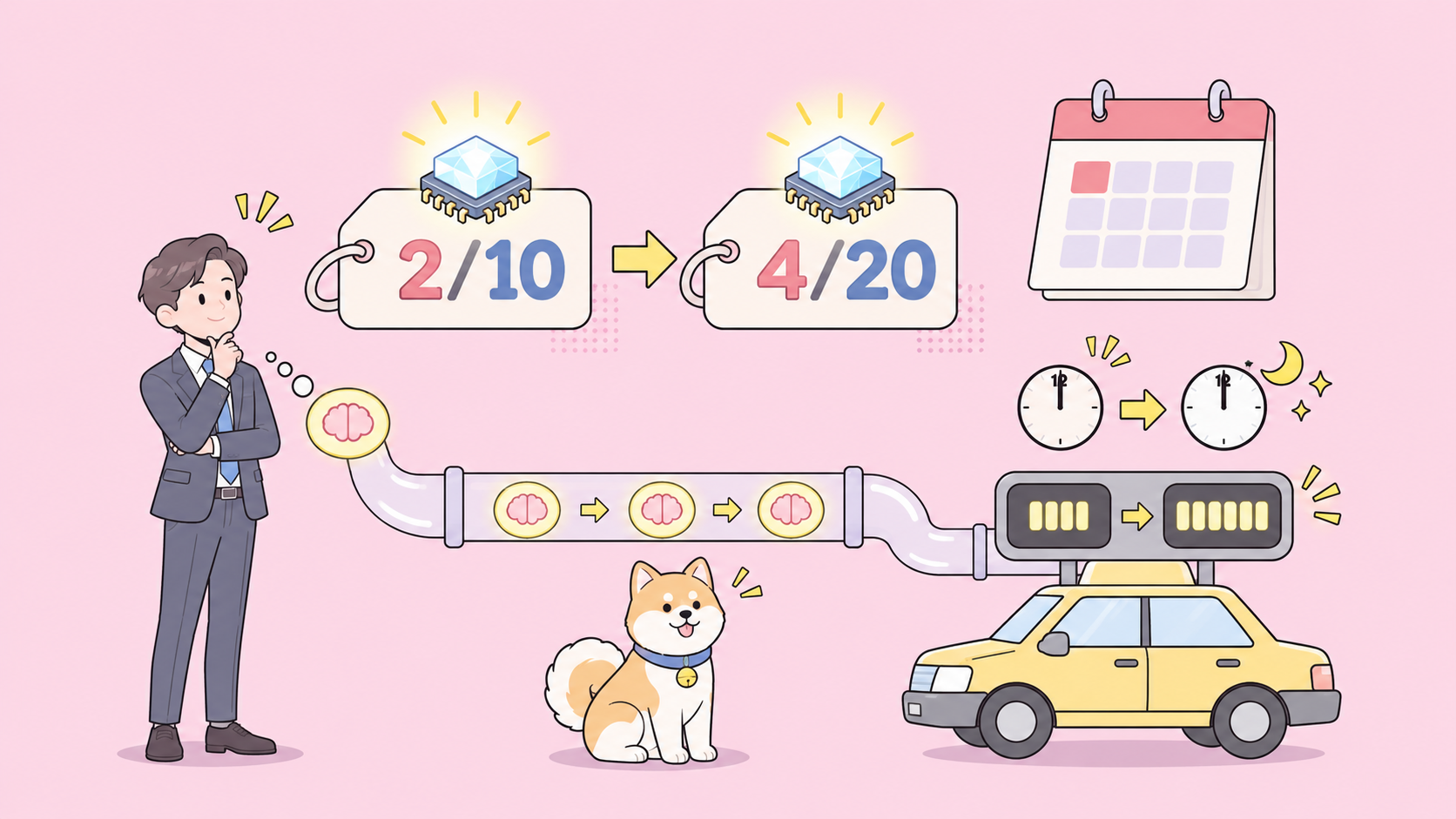
As of November 11, 2026, Google’s Gemini 4 Carbon costs $2 per 1M input tokens and $10 per 1M output tokens on the Gemini API, an introductory price that ends on November 30, 2026. From December 1, Google’s Gemini 4 Carbon pricing doubles to $4 input and $20 output per 1M tokens, and thinking tokens bill at the output rate.
Your real bill depends on how many tokens Carbon spends thinking, and Carbon spends a lot. Below: the full price table, worked examples at both prices, the cost gap against Argon and rivals, and a way to log your true cost per request. New to the model? Start with what Gemini 4 Carbon is.
How much does Gemini 4 Carbon cost per 1M tokens?
Gemini 4 Carbon (model ID gemini-4-carbon) is a paid-tier model. Google’s pricing page lists four tiers, each with an introductory price through November 30, 2026 and a new price from December 1, 2026:
| Tier | Input (to Nov 30) | Input (from Dec 1) | Output incl. thinking (to Nov 30) | Output incl. thinking (from Dec 1) | Cached input (to Nov 30 / from Dec 1) | Source |
|---|---|---|---|---|---|---|
| Standard | $2.00 | $4.00 | $10.00 | $20.00 | $0.10 / $0.20 | |
| Batch | $1.00 | $2.00 | $5.00 | $10.00 | $0.05 / $0.10 | |
| Flex | $1.00 | $2.00 | $5.00 | $10.00 | $0.05 / $0.10 | |
| Priority | $3.60 | $7.20 | $18.00 | $36.00 | $0.18 / $0.36 |
All prices are per 1M tokens. A few details on the same page matter for your budget:
- No free tier. Google’s page says “Gemini 4 Carbon is not available on the Free tier.”
- Thinking is billed. “Every token the model processes is counted and billed, including thinking tokens.”
- Implicit caching only. Explicit caching isn’t supported, so you get the cached rate when Google’s implicit cache matches a repeated prompt prefix.
Google’s launch post states the switch in a footnote: “After the introductory period expires on November 30, 2026, the price of $4 per 1M input tokens and $20 per 1M output tokens will apply. Applies to the Carbon model intended for public access only.”
What changes on December 1, 2026?
Every rate doubles. Standard input moves from $2 to $4, output from $10 to $20, and the cached rate from $0.10 to $0.20. Batch and Flex double too, so the 50% batch discount stays in place.
The footnote has no carve-out for early adopters, and nothing on the pricing page suggests existing projects keep the intro rate. Budget every token sent on or after December 1 at $4/$20.
Gemini 4 Argon follows the same schedule; see our Gemini 4 Argon pricing guide.
How are Gemini 4 Carbon thinking tokens billed?
Thinking tokens are billed at the output rate: $10 per 1M through November 30, then $20. The Interactions API reports them in a separate field, so a response’s usage object looks like this example from Google’s docs:
"usage": {
  "total_tokens": 530,
  "total_input_tokens": 62,
  "total_output_tokens": 171,
  "total_thought_tokens": 297
}
The model thought for 297 tokens to write 171, and you pay output rates for text you never see. Carbon defaults to thinking_level “medium” and also accepts “low” and “high”, per Google’s thinking guide.
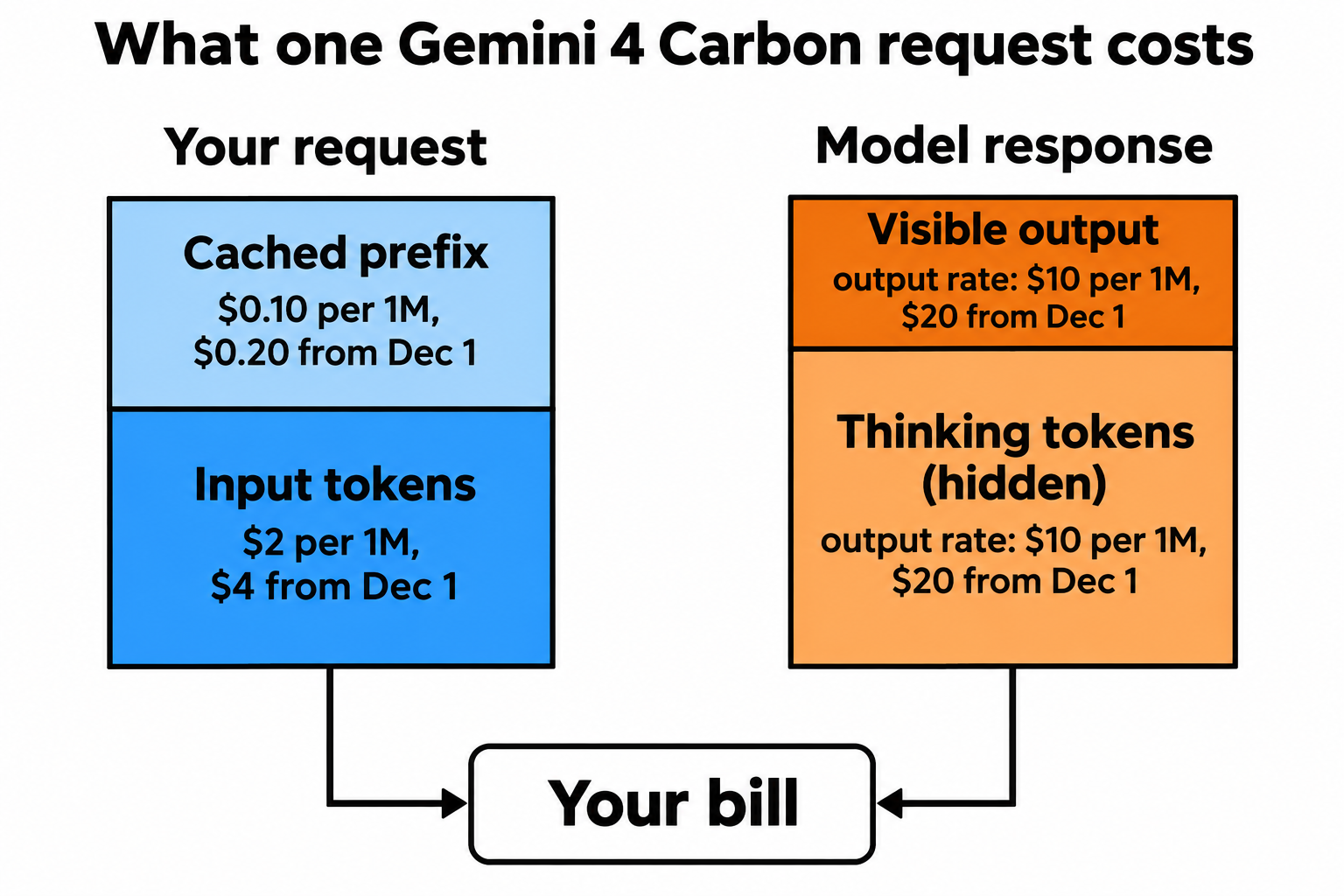
The formula for one request is:
cost = (uncached_input x input_rate)
     + (cached_input x cached_rate)
     + ((thought + output) x output_rate)
What does one Gemini 4 Carbon call cost?
The two examples below are illustrative token counts, not measurements. Swap in the numbers from your own usage object.
Example 1: a single chat call. 1,500 input tokens, 2,500 thinking tokens, 800 output tokens.
| Line | To Nov 30 | From Dec 1 |
|---|---|---|
| Input (1,500) | $0.0030 | $0.0060 |
| Thinking + output (3,300) | $0.0330 | $0.0660 |
| Total per call | $0.036 | $0.072 |
| 10,000 calls a month | $360 | $720 |
Example 2: a long agent run with heavy thinking. An agent loop takes 40 turns. Because it re-sends the conversation each turn, it reads 1.2M input tokens in total, and 900K of those hit the implicit cache. It thinks for 300K tokens and writes 60K tokens of code and tool calls.
| Line | To Nov 30 | From Dec 1 |
|---|---|---|
| Uncached input (300K) | $0.60 | $1.20 |
| Cached input (900K) | $0.09 | $0.18 |
| Thinking + output (360K) | $3.60 | $7.20 |
| Total per run | $4.29 | $8.58 |
| Same tokens at Batch or Flex rates | $2.15 | $4.29 |
In the agent run, 84% of the bill is thinking and output, so lowering the thinking level saves more than trimming the prompt. The request code is in our Gemini 4 Carbon API guide.
Is Gemini 4 Carbon more expensive than Gemini 4 Argon?
Per token, no: both cost $2/$10 now and $4/$20 from December 1. Per task, yes, usually. Google says Carbon handles harder tasks “using more tokens than Argon to explore thoroughly, reason deeply, and run extended verification loops,” and that “Argon remains the ideal choice for the majority of software engineering and knowledge work.”
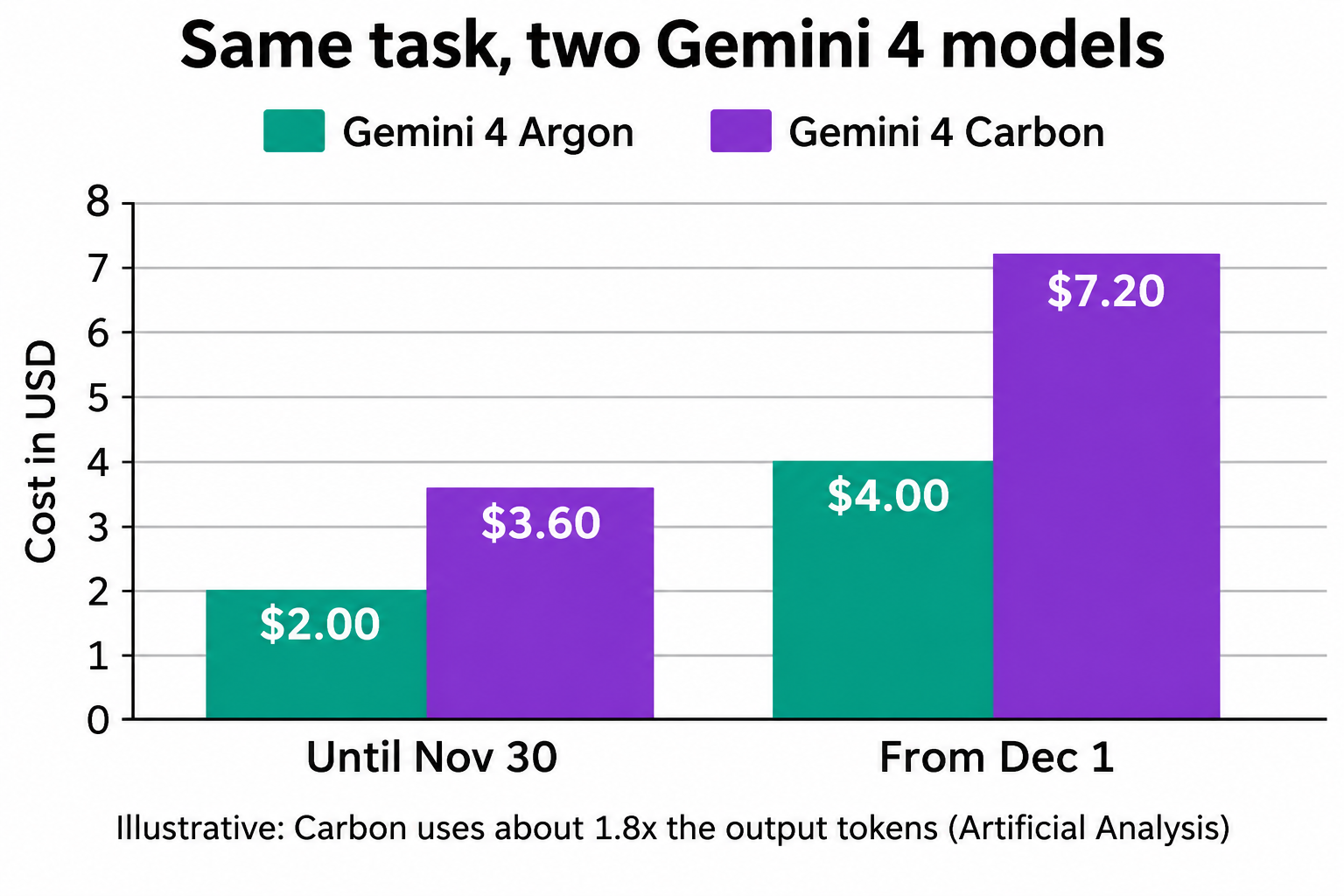
Artificial Analysis puts a number on it. Running its Intelligence Index, Gemini 4 Carbon (high) produced 205M output tokens, against 113M for Gemini 4 Argon. That’s about 1.8x the output tokens for the same set of tasks, and it bought a higher score: 60 for Carbon against 50 for Argon.
Apply that ratio to a task where Argon spends 200K output tokens:
| Model | Output tokens | Cost to Nov 30 | Cost from Dec 1 |
|---|---|---|---|
| Gemini 4 Argon | 200,000 | $2.00 | $4.00 |
| Gemini 4 Carbon (about 1.8x) | 360,000 | $3.60 | $7.20 |
So route by difficulty: hard debugging, architecture and security audits to Carbon, everyday coding to Argon. Our Gemini 4 Carbon vs Argon comparison covers which tasks justify the extra tokens.
How does Gemini 4 Carbon pricing compare with Claude Fable 5.2, Opus 5.5 and GPT-6.1 Sol?
Here are the standard API rates per 1M tokens, each read from the vendor’s pricing page on November 11, 2026:
| Model | Input | Output | Cached input | Source |
|---|---|---|---|---|
| Gemini 4 Carbon (to Nov 30) | $2.00 | $10.00 | $0.10 | |
| Gemini 4 Carbon (from Dec 1) | $4.00 | $20.00 | $0.20 | |
| Gemini 4 Argon (to Nov 30) | $2.00 | $10.00 | $0.10 | |
| Claude Fable 5.2 | $8.00 | $40.00 | $0.20 (cache hit) | Anthropic |
| Claude Opus 5.5 | $4.00 | $20.00 | $0.20 (cache hit) | Anthropic |
| GPT-6.1 Sol | $2.00 | $10.00 | $0.10 | OpenAI |
| GPT-6 Astra | $10.00 | $50.00 | $1.00 | OpenAI |
From December 1, Carbon’s per-token price equals Claude Opus 5.5’s and stays half of Claude Fable 5.2’s. Anthropic charges extra for cache writes; Google lists no write fee for implicit caching. OpenAI’s Sol price covers prompts up to 272K input tokens.
Sticker prices don’t settle it, because each model thinks a different amount. Artificial Analysis publishes a cost figure for each model on its Intelligence Index: $7.76 for Gemini 4 Carbon (high) with a score of 60, and $26.54 for Claude Fable 5.2 (max) with a score of 65. Fable 5.2 also produced more output tokens on the index (275M against Carbon’s 205M). Treat these as one benchmark’s view; your workload will differ. For the full head-to-head, see Gemini 4 Carbon vs Claude Fable 5.2, and the Claude Fable 5.2 API guide for Anthropic’s side.
How can you cut your Gemini 4 Carbon bill?
- Use Batch or Flex for work that can wait. Both are half the standard price.
- Lower the thinking level. “low” on routine turns, “high” only where accuracy pays.
- Route easy turns to Argon. Same per-token price, far fewer output tokens.
- Keep a stable prompt prefix so implicit caching bills repeated input at $0.10 per 1M (then $0.20).
- Finish big jobs before December 1, when the same run costs twice as much.
Log your real Gemini 4 Carbon cost per request with Apidog CLI
Your bill comes from token counts, and those change every time you edit a prompt or a thinking level. The fastest way to see real numbers is to let your coding agent (Claude Code, Codex, Cursor) run your actual prompts through Apidog CLI and log the usage object for each one.
Set it up once:
npm install -g apidog-cli@latest
apidog login --with-token <YOUR_TOKEN>
npx -y skills add https://apidog.com   # pick your agent when prompted
Put 10 to 20 of your real prompts in prompts.csv with columns prompt and thinking_level. Then give your agent one prompt:
In Apidog project <projectId>, create a test case for
POST https://generativelanguage.googleapis.com/v1beta/interactions
with the x-goog-api-key header read from GEMINI_API_KEY in environment
<envId>. Send model {{model}} (default "gemini-4-carbon"), input {{prompt}}
and generation_config.thinking_level {{thinking_level}}. In a post-processor,
read usage.total_input_tokens, total_thought_tokens and total_output_tokens,
compute cost at $2/$10 and at $4/$20 per 1M, and log both. Assert status is
"completed". Run it once per row of prompts.csv and give me a table of
tokens and cost per prompt, plus the totals.
The agent checks the payload shape before it writes anything, then runs every row:
apidog cli-schema get test-case-create
apidog cli-schema validate test-case-create --file case.json
apidog test-case category --project <projectId>
apidog test-case create --project <projectId> --file case.json
apidog run --test-case <caseId> --project <projectId> -e <envId> \
  -d prompts.csv -r cli,json --out-file carbon-cost-{GENERATE_TIME}
The JSON report keeps a dated record of tokens per prompt. Re-run with --env-var "model=gemini-4-argon" and you get the Argon numbers for the same prompts, which is the cleanest way to decide which model each task deserves. Add -r junit and the same command runs in CI, where a cost assertion can fail the build; the Apidog CLI CI/CD guide shows the pipeline, and Apidog CLI in Claude Code covers the agent setup. Apidog’s Free plan covers up to 4 users.
A shortcut: tell your agent “Read https://apidog.com/apidog-cli-installation-guide.md and set up Apidog CLI.”
FAQ
Is Gemini 4 Carbon free? Not on the API: Carbon isn’t on the Free tier, so you need a paid key. Scientists can apply to Google for six months of free access on Antigravity. Our Gemini 4 Carbon free guide covers every route.
Does Google AI Ultra include Gemini 4 Carbon? Google says Carbon is rolling out to AI Ultra subscribers in the Gemini app, AI Mode in Search and Antigravity. API calls bill separately, per token, on the paid tier.
Does the price go up for existing users on December 1? Google’s footnote names no exception for existing users. Budget for $4 input and $20 output per 1M tokens on all Carbon usage from December 1, 2026.
Is Gemini 4 Carbon cheaper than Claude Fable 5.2? Per token, yes: $4/$20 from December 1 against Fable 5.2’s $8/$40. On Artificial Analysis’s Intelligence Index, Carbon’s cost figure was $7.76 against $26.54 for Fable 5.2 (max), though Fable scored higher, 65 to 60.