As of October 29, 2026, Google’s Gemini 4 Carbon is the company’s strongest AI model, announced on October 28 with an introductory price of $2 per million input tokens and $10 per million output tokens. It scores 59 on the Artificial Analysis Intelligence Index v5.0, ranked first, but only a subset of cyber defenders can use it today.
That last part matters more than the benchmark chart. You can read every number and run the price math below, but you can’t send Gemini 4 Carbon a request yet. Google hasn’t published a model ID, a context window or an API date. What you can do today is build on Gemini 4 Argon, which has the same intro price and is generally available on the paid Gemini API.
Last verified: Oct 29, 2026, against Google’s launch post and the Gemini API pricing page.
What is Gemini 4 Carbon?
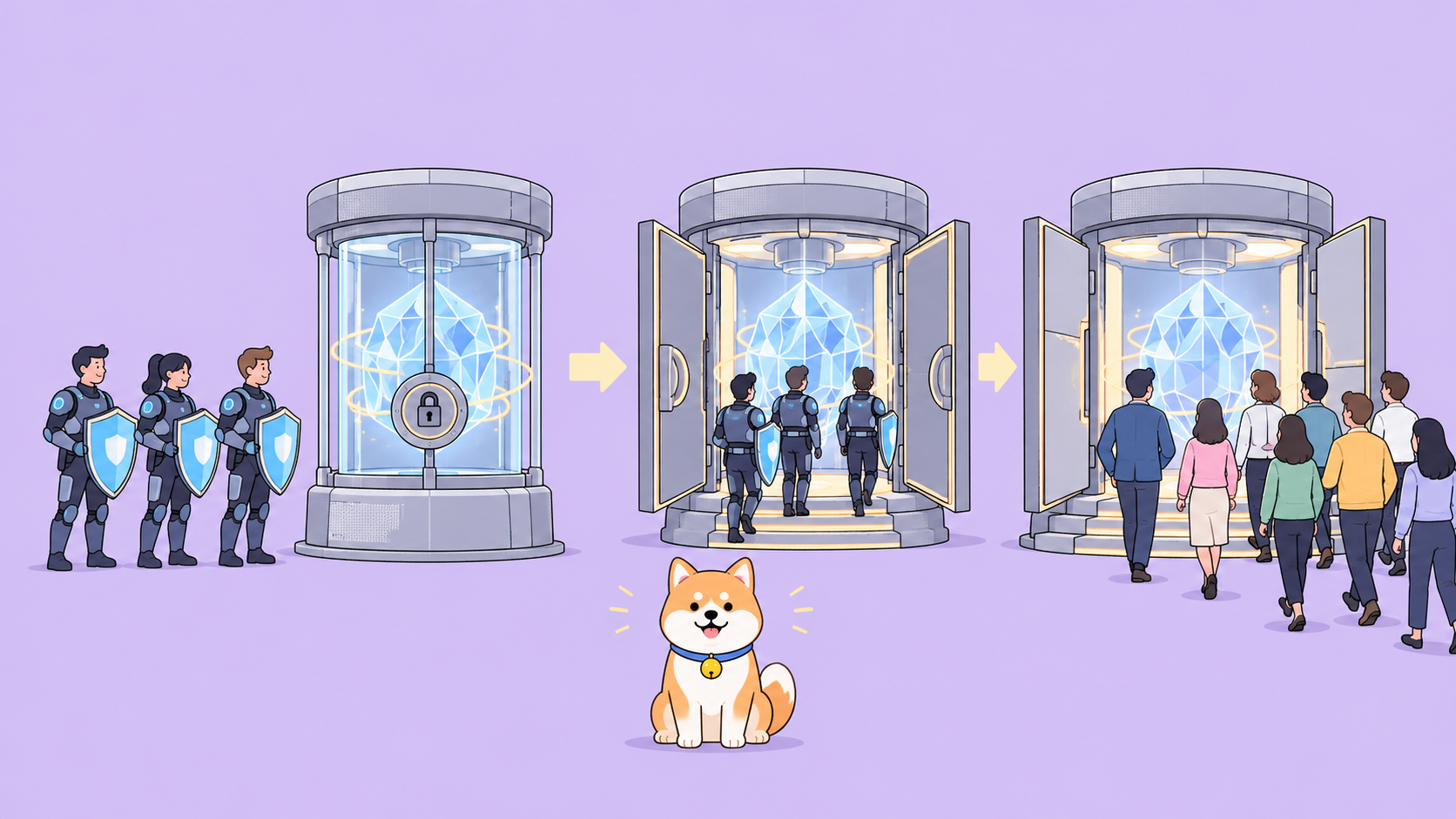
Gemini 4 Carbon is a frontier model from Google DeepMind that Google calls “our strongest model with state-of-the-art cybersecurity and long horizon capabilities.” Koray Kavukcuoglu announced it on October 28, 2026, two weeks after Gemini 4 Argon went GA. Access starts with vetted cyber defenders and widens through Google’s Fairwind Program.
Here is everything Google has confirmed, and what it hasn’t:
| Item | Value | Source |
|---|---|---|
| Announced | October 28, 2026, by Koray Kavukcuoglu | Google launch post |
| Positioning | Strongest Google model; cybersecurity and long-horizon focus | Google launch post |
| Access now | “A subset of cyber defenders” | Google launch post |
| Next | Trusted partners via the Fairwind Program | Google launch post |
| Developers, businesses, consumers | “As soon as possible”, no date | Google launch post |
| Intro price | $2 input / $10 output per 1M tokens | Google launch post |
| Cached input | 95% off the input price | Google launch post |
| Price after intro | $4 input / $20 output per 1M tokens | Google launch post |
| Intro length | Not stated | Google launch post |
| Model ID, context window, output limit | Not published | Google launch post |
| API, AI Studio, Vertex AI, Gemini app | Not mentioned | Google launch post |
| Government testing | In the US voluntary pre-release testing process | Google launch post |
| Internal checkpoint | Spotted on Google’s internal Jetski platform | Reported by Business Insider, Oct 9 |
If a site sells you a “Gemini 4 Carbon API” today, it’s a placeholder page. Google’s own models list has no Carbon entry as of this writing.
Gemini 4 Carbon vs Argon: where it sits in the lineup
Carbon sits above Argon. Google describes Argon as its flagship reasoning model for developers and Carbon as the stronger model that follows it, with the same introductory price. Google hasn’t said how either relates to its Pro or Flash lines, so don’t assume Carbon replaces anything.
The practical split as of today:
- Gemini 4 Argon: model ID
gemini-4-argon, stable on the paid Gemini API since October 13, roughly 1M-token unified context, $2/$10 through November 30 and $4/$20 from December 1. Not on the free tier. - Gemini 4 Carbon: no public model ID, restricted access, $2/$10 intro and $4/$20 after, intro length unstated.
The Gemini 4 Argon API guide covers Argon’s endpoints in depth, and the Argon pricing breakdown covers its cost tiers. For a side-by-side on which one to plan around, read Gemini 4 Carbon vs Argon.
Gemini 4 Carbon benchmarks: the full table
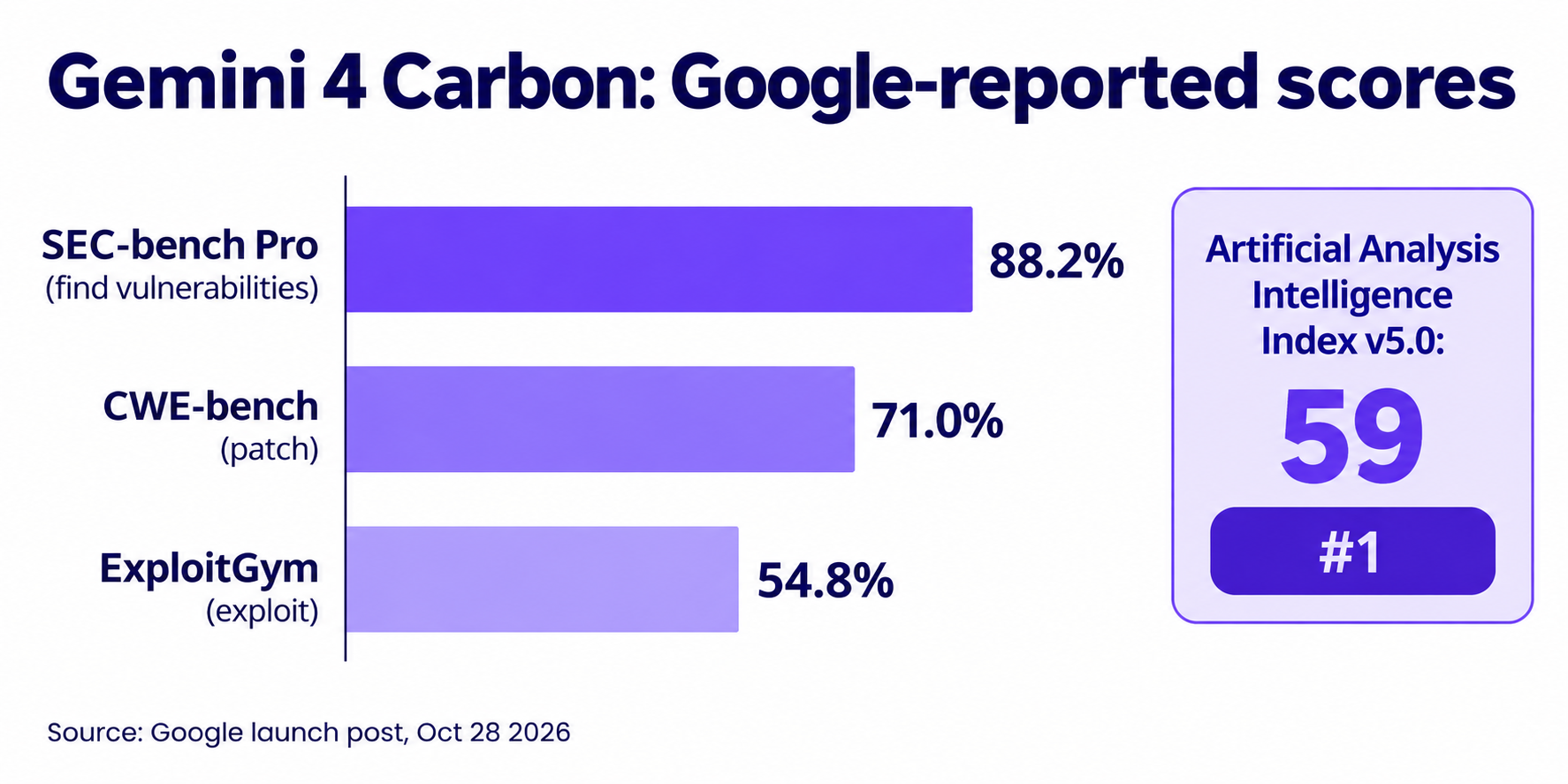
Gemini 4 Carbon’s headline benchmark is first place on the Artificial Analysis Intelligence Index v5.0 at 59. Its security results are the bigger story: 88.2% on SEC-bench Pro and 54.8% on ExploitGym, both claimed as state of the art. Every number below comes from Google’s launch post.
| Benchmark | What it measures | Gemini 4 Carbon | Comparison Google gave |
|---|---|---|---|
| Artificial Analysis Intelligence Index v5.0 | Composite intelligence | 59, ranked #1 | None in the post |
| SEC-bench Pro | Finding vulnerabilities | 88.2% | Claimed state of the art |
| ExploitGym | Exploiting vulnerabilities | 54.8% | Claimed new state of the art |
| CWE-bench (Collinear) | Patching vulnerabilities | 71.0% | None in the post |
| WebDev Arena | Web app building, human votes | #4, 1768 Elo | +89 Elo |
| Internal secure-code benchmark | Writing secure code | More than 2x Argon’s success rate | vs Argon |
| Chrome team patch test | Generating high-quality patches | More than 10x better | vs “another lab’s large frontier model” |
| Wiz web pentest benchmarks | Web penetration testing | “Leading” | No number given |
The Artificial Analysis comparison isn’t apples to apples yet. Google’s post doesn’t give Argon’s v5.0 score. Artificial Analysis listed Argon (High) at 53 on October 15, before the v5.0 update, so treat “59 vs 53” as indicative, not a measured gap. The Argon benchmarks post has Argon’s full 19-row table.
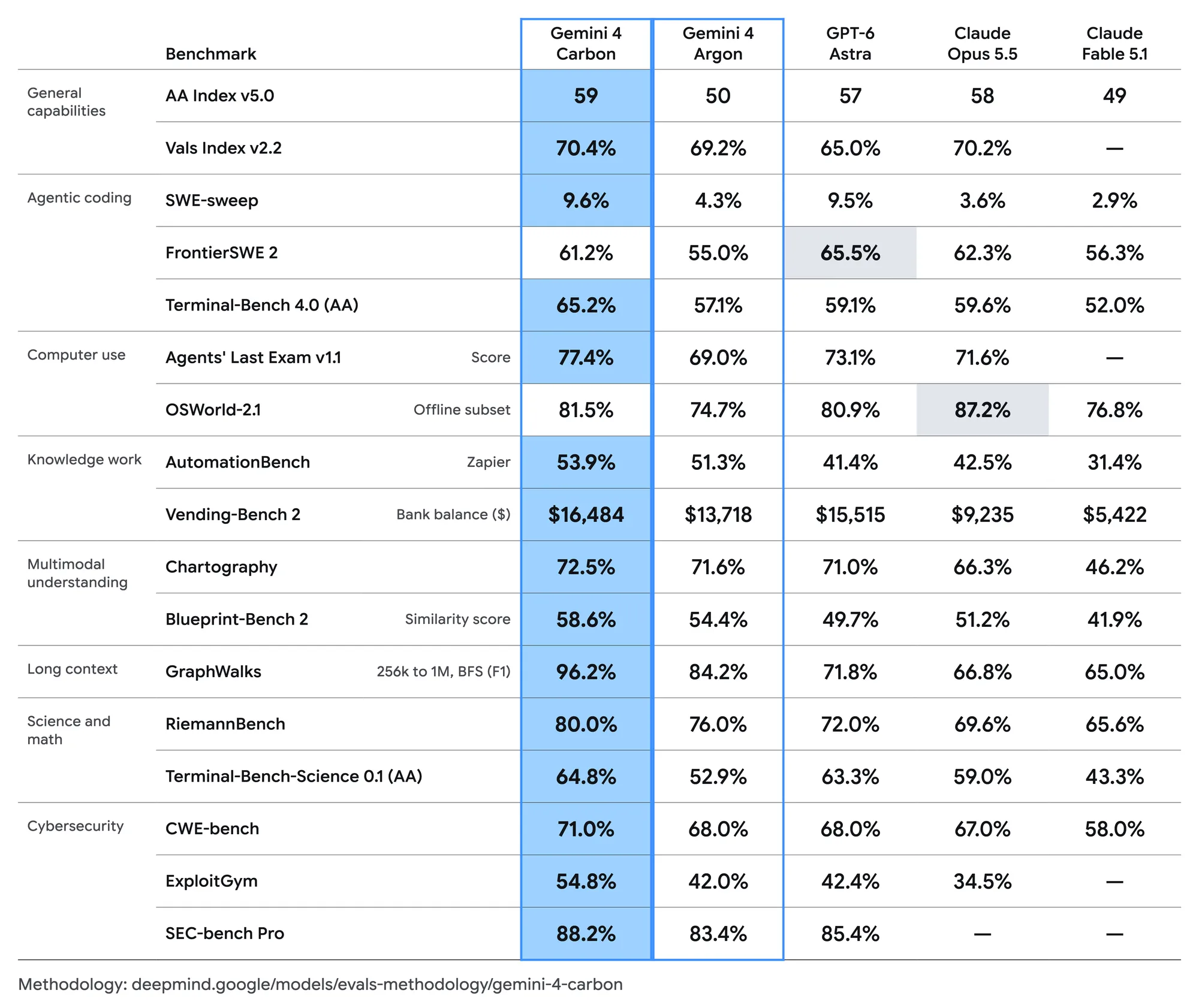
The Chrome and secure-code numbers are internal, and the Chrome comparison names no competitor, so you can’t reproduce them.
Google’s post also links no model card and no Carbon-specific evaluation PDF. It links the Gemini 4 safety report, which covers Argon’s alignment results, and says Carbon uses the same multi-layer safety stack. If a Carbon model card appears, it will be the first independent place to check these figures.
Early testers add some color, but treat it as reported, not measured: TestingCatalog’s early test notes say Carbon beats Argon at 3D work, is weaker at frontend and UI, and runs slower but is “less lazy.”
Gemini 4 Carbon safety and behavior numbers
Google’s behavior numbers target the failure modes that hurt long agent runs most: cheating on tests, overreaching, and claiming work it didn’t do. All of these come from Google’s internal testing except Gray Swan.
| Measure | Gemini 4 Carbon | vs Argon |
|---|---|---|
| Terminal-Bench 4.0 successful cheating | 0.0% | Not given |
| Terminal-Bench 4.0 cheating attempts | 0.4% | Not given |
| High-severity misalignment alerts, live coding environments | Down almost 80% | Relative drop |
| Unsupported claims | About 2x fewer | Relative drop |
| Overreach | Down 26% | Relative drop |
| Under-service | Down 29% | Relative drop |
| Gray Swan indirect prompt injection attack success | 0.0% | Argon 0.7% |
The 0.0% injection rate matters most to API builders: if your agent reads web pages, tickets or emails, indirect prompt injection is how an attacker steers it. One benchmark at 0.0% isn’t zero risk in your app, so keep your own guardrails and tests.
Gemini 4 Carbon pricing: what a long run costs
Gemini 4 Carbon costs $2 per million input tokens and $10 per million output tokens during the intro period, then $4 and $20. Cached input is 95% off, which works out to $0.10 per million at intro and $0.20 after. Those are the same rates Argon charges today.
Carbon is pitched at long-horizon work, so price a long run. Take an agent session that reads 2M input tokens, 1.6M of them served from cache because the agent re-sends the same repo context, and writes 300K output tokens:
| Line item | Intro ($2 / $10) | Standard ($4 / $20) |
|---|---|---|
| Uncached input, 0.4M tokens | $0.80 | $1.60 |
| Cached input, 1.6M tokens | $0.16 | $0.32 |
| Output, 0.3M tokens | $3.00 | $6.00 |
| Total with caching | $3.96 | $7.92 |
| Same run, no caching | $7.00 | $14.00 |
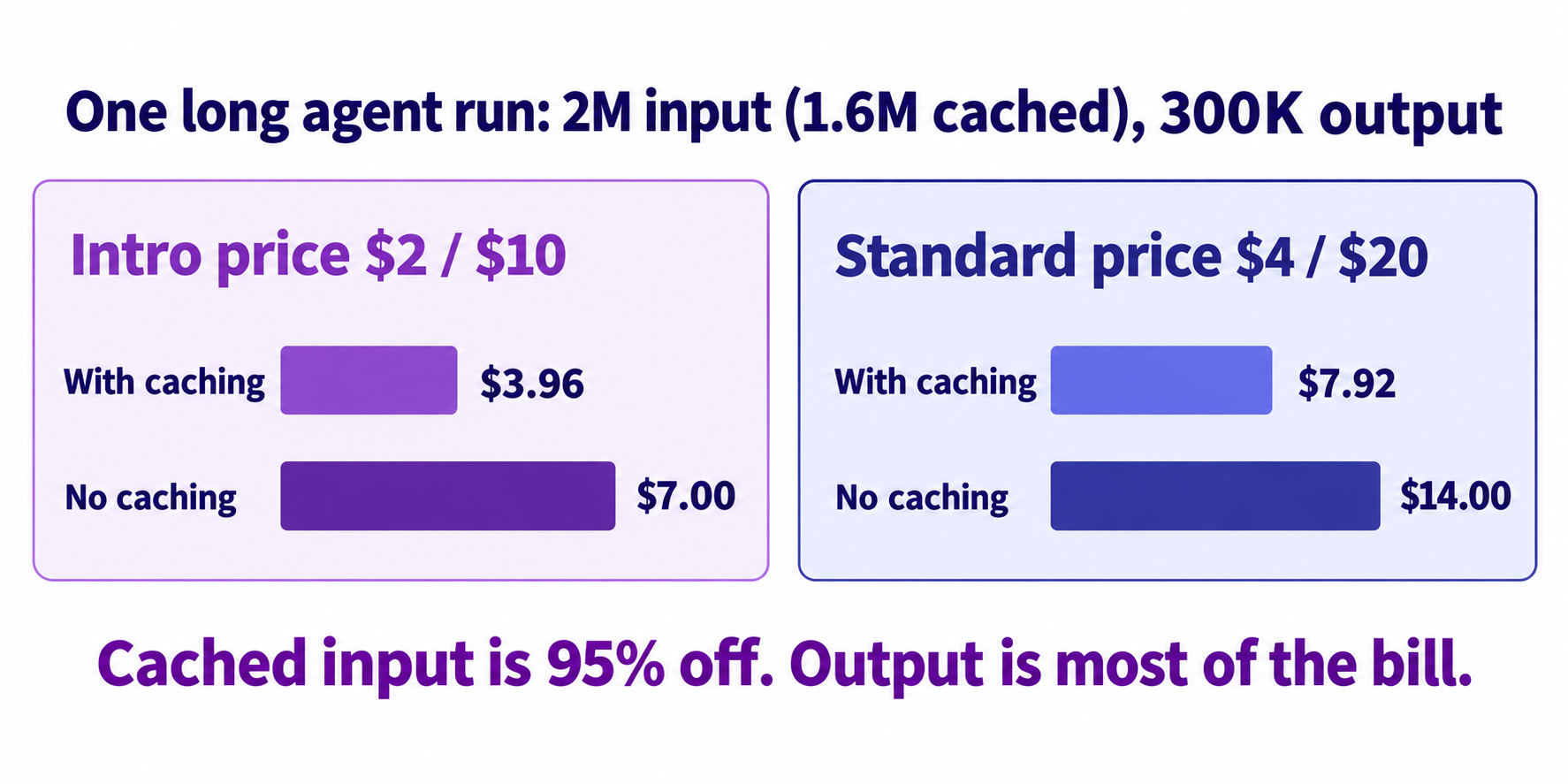
Two takeaways. Output dominates the bill, so a model that writes less filler saves more than any input trick. And caching cuts this run by 43%, so structure prompts with a stable prefix. Google hasn’t said how long the Carbon intro lasts; Argon’s ends November 30, after which its prices double.
Who can use Gemini 4 Carbon right now?
Only a subset of cyber defenders, with trusted partners added gradually through the Fairwind Program; developers get it “as soon as possible,” per Google. The Gemini 4 Carbon release date guide tracks the rollout, and Is Gemini 4 Carbon free? covers the $0 routes.
Build on Argon today with Apidog CLI and your coding agent
You don’t need Carbon access to get your integration ready. Write your client against gemini-4-argon with the model name in a variable, and when Carbon ships you change one value. This request follows Google’s documented generateContent format. We haven’t run it for this post; you need a paid Gemini API key:
MODEL="${GEMINI_MODEL:-gemini-4-argon}"   # swap in the Carbon ID once Google publishes it

curl -s "https://generativelanguage.googleapis.com/v1beta/models/${MODEL}:generateContent" \
  -H "x-goog-api-key: $GEMINI_API_KEY" \
  -H "Content-Type: application/json" \
  -d '{"contents": [{"parts": [{"text": "List three checks a CI job should run on a security patch."}]}]}'
Then let your coding agent build the regression tests, so the model swap later is a test run, not a guess. Apidog CLI gives Claude Code, Codex, Cursor or OpenCode a command-line way to create and run API tests. Set it up once:
npm install -g apidog-cli@latest
apidog login --with-token <YOUR_TOKEN>
npx -y skills add https://apidog.com   # pick your agent when prompted
Give your agent one prompt:
In Apidog project <id>, create an environment for the Gemini API with a MODEL
variable set to gemini-4-argon. Add a test case for POST /v1beta/models/{MODEL}:generateContent
that asserts HTTP 200, a non-empty candidates[0].content.parts[0].text, and
usageMetadata.candidatesTokenCount under 2000. Run it and summarize failures.
The agent creates the environment, checks the test case payload against its schema, then runs it:
apidog environment create gemini-api --project <id> --base-url https://generativelanguage.googleapis.com
apidog cli-schema get test-case-create
apidog cli-schema validate test-case-create --file case.json
apidog test-case create --project <id> --file case.json
apidog run --test-case <caseId> --project <id> -e <envId> --env-var "MODEL=gemini-4-argon" -r cli,json
When Carbon’s ID goes public, rerun the same case with --env-var "MODEL=<carbon-id>" and compare token counts and failures side by side. Put the same apidog run ... -r junit in CI with the Apidog CLI CI/CD guide, or start from Apidog CLI in Claude Code. Apidog’s Free plan covers up to 4 users.
FAQ
Is Gemini 4 Carbon available in the Gemini API? Not yet. As of October 29, 2026, Google lists no Carbon model in its API docs and gives no date for developer access.
How much does Gemini 4 Carbon cost? $2 per million input tokens and $10 per million output tokens during the intro period, then $4 and $20. Cached input is 95% off.
What is Gemini 4 Carbon’s context window? Google hasn’t published one. Argon’s unified context is about 1M tokens, but don’t assume Carbon matches it.
Is Gemini 4 Carbon better than Argon? On Google’s numbers, yes: 59 on the Artificial Analysis index, more than 2x Argon on secure code, and 0.0% vs 0.7% on Gray Swan prompt injection. Independent results aren’t out yet.
What is the Fairwind Program? It’s Google DeepMind’s trusted-partner program for early Carbon access, starting with cyber defenders. Google hasn’t published how developers apply.