As of October 29, 2026, there’s no public Gemini 4 Carbon release date: Google announced the model on October 28 and is giving it first to “a subset of cyber defenders,” then to trusted partners through its Fairwind Program. Developers, businesses and consumers get Google’s Gemini 4 Carbon “as soon as possible,” with no date, no model ID and no API docs yet.
Below: the best evidence for when it might land (Argon’s rollout), who can apply to Fairwind, what’s published for the API, and how to get your code ready on gemini-4-argon today.
What is Gemini 4 Carbon?
Gemini 4 Carbon is Google DeepMind’s newest frontier model, announced October 28, 2026 by Koray Kavukcuoglu as “our strongest model with state-of-the-art cybersecurity and long horizon capabilities.” It follows Gemini 4 Argon, which launched two weeks earlier, and ships at the same $2 input / $10 output introductory price per million tokens.
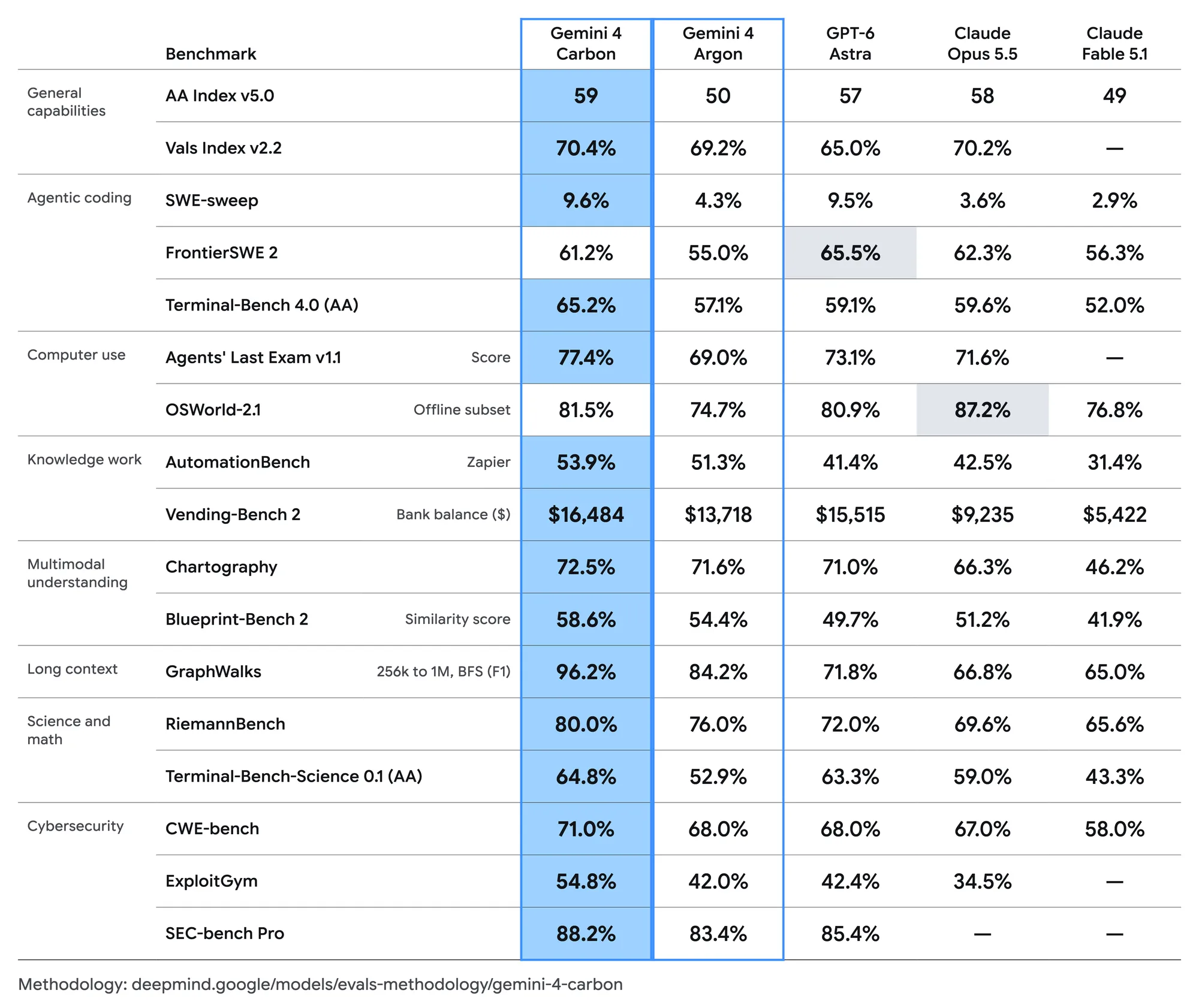
The full benchmark table and price math live in What is Gemini 4 Carbon?. This post sticks to access and timing.
Gemini 4 Carbon release date: what Google actually said
Every access and timing fact Google has published, with its source:
| Item | What’s known (Oct 29, 2026) | Source |
|---|---|---|
| Announced | October 28, 2026 | Google launch post |
| Who has it now | “A subset of cyber defenders,” starting the week of launch | Google launch post |
| Next in line | “Additional trusted partners” through the Fairwind Program, gradually | Google launch post |
| Developers, businesses, consumers | “As soon as possible,” no date | Google launch post |
| Price at launch | $2 per 1M input, $10 per 1M output, cached input 95% off | Google launch post |
| Price after intro | $4 per 1M input, $20 per 1M output; intro length not stated | Google launch post, footnote 1 |
| Model ID | Not published | Gemini API models page lists no Carbon entry |
| API release | Not announced | Gemini API changelog has no Carbon entry |
Google’s own wording points to a staged rollout: “We’re continuing to gather feedback and iterate on guardrails before making Carbon available to developers, businesses, and consumers via our product surfaces as soon as possible.”
So the honest answer is “not yet scheduled.” Any site printing a specific day is guessing.
The Argon precedent: 13 days from Fairwind to GA
The best evidence for Carbon’s timing is what Google did with Argon a month earlier: same program, same price, same staged language. It’s a precedent, not a promise.
- September 30, 2026: Google announced Gemini 4 Argon and rolled it out only to a set of Fairwind Program partners. No model ID, no public API.
- October 13, 2026: The Gemini API changelog lists
gemini-4-argonas generally available. Paid API customers got it 13 days after the announcement. - Through November 30, 2026: Argon bills at $2 / $10 per million tokens on the paid tier, per the Gemini API pricing page. From December 1 it’s $4 / $20.
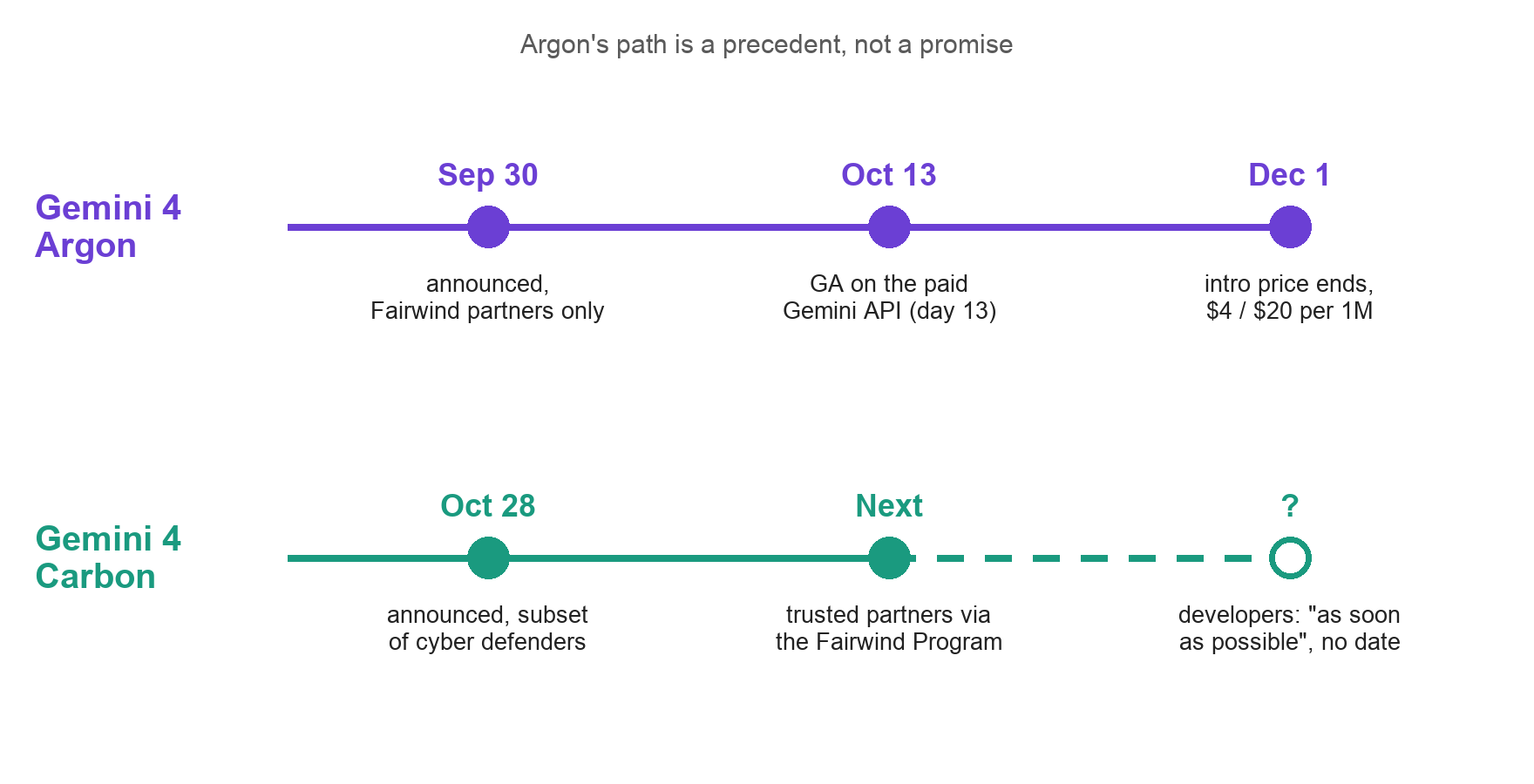
At the same pace, a public API would land around mid-November. Two things could stretch it: Google says it’s in the US government’s voluntary pre-release testing process and still iterating on guardrails, and Carbon’s cyber scores are higher than Argon’s. Plan for “weeks, maybe longer.” Our Gemini 4 Argon release date post shows how that rollout played out in detail.
Fairwind Program: who qualifies and how to apply
The Fairwind Program is Google DeepMind’s early-access track for cyber defenders and the only named route to Carbon before public release. One caveat: as of October 29, the Fairwind Program page still describes exclusive access to Gemini 4 Argon with cybersecurity defense capabilities and doesn’t mention Carbon yet.
Who Google prioritizes, per the Fairwind FAQ:
- Governments and national cyber authorities
- Critical infrastructure operators: healthcare, telecommunications, energy and financial networks
- Core technology platforms that secure widely used software
- Academic labs focused on defensive benchmarking (students are pointed to CodeMender on Google Cloud instead)
Google says it works with over 650 partners globally and vets every applicant’s security history and record of ethical operations.
How to apply:
- Open the Fairwind Program page and click “Apply now.”
- Fill in the interest form for your organization.
- Wait. Google says it will “review and respond to eligible partners who meet our criteria as soon as we can.” No processing time is published.
Terms you’d sign up for (from the Fairwind page, written for Argon):
- Only defensive dual-use tasks: authorized threat simulation, reverse engineering and malware analysis for defensive and academic research. Creating malware isn’t allowed.
- User-level authentication, phishing-resistant MFA and access controls.
- Access only for internal cybersecurity, incident response or penetration testing teams, with employee access tracked.
- No sharing, reselling or redistributing access.
Building a coding tool at a startup? You almost certainly don’t qualify. Your route is the public release.
Gemini 4 Carbon API: what’s published and what isn’t
Third-party “Gemini 4 Carbon API” pages are placeholders. Google hasn’t shipped an endpoint, so nobody can resell one. Don’t pay any site promising Carbon API access right now.
| Published by Google | Not published (Oct 29, 2026) |
|---|---|
| Name: Gemini 4 Carbon | Model ID |
| Intro price: $2 / $10 per 1M tokens | Context window |
| Standard price: $4 / $20 per 1M tokens | Max output tokens |
| Cached input: 95% off | Gemini API, AI Studio or Vertex AI availability |
| Same safety stack as Argon | Gemini app plans |
| Access: cyber defenders, then Fairwind | Free tier |
| Benchmarks and behavior numbers | Thinking levels or parameters |
When Carbon ships, check its models-page row before assuming it matches Argon, whose GA removed explicit caching, ignored temperature and set a unified 1,048,576-token context. Our Gemini 4 Argon API guide covers what those changes meant for Argon.
Gemini Carbon vs Argon: what you can use today
Price is a tie at launch, access isn’t. Google’s numbers, three rows:
| Gemini 4 Argon | Gemini 4 Carbon | |
|---|---|---|
| Who can use it | Paid Gemini API, GA since Oct 13 | Subset of cyber defenders |
| Price (intro) | $2 / $10 per 1M through Nov 30 | $2 / $10 per 1M, length not stated |
| Model ID | gemini-4-argon |
Not published |
The full side-by-side is in Gemini 4 Carbon vs Argon, and if you’re hunting for a $0 route, read Is Gemini 4 Carbon free?.
Gemini 4 Carbon benchmark claims and why they matter for timing
The cyber numbers explain the gate. Google reports 88.2% on SEC-bench Pro, a state-of-the-art 54.8% on ExploitGym (exploitation) and 71.0% on Collinear’s CWE-bench (patching). A model that’s better at exploitation needs more guardrail work before it goes public. The Gemini 4 Argon benchmarks post has Argon’s baseline for comparison.
Early testers quoted by TestingCatalog reportedly found Carbon better than Argon at 3D work, weaker at frontend UI, and slower but “less lazy.” Treat that as reported, not measured.
Get your code ready on gemini-4-argon
Build on gemini-4-argon now with the model name in a variable, so the release becomes a config change. This request follows Google’s documented Interactions API format. We haven’t run it for this post; it needs a paid Gemini API key, since Argon isn’t on the free tier.
export GEMINI_MODEL="gemini-4-argon"   # Carbon's ID isn't published yet

curl -s "https://generativelanguage.googleapis.com/v1beta/interactions" \
  -H "x-goog-api-key: $GEMINI_API_KEY" \
  -H "Content-Type: application/json" \
  -X POST \
  -d "{\"model\": \"${GEMINI_MODEL}\", \"input\": \"Review this diff for injection bugs.\", \"generation_config\": {\"thinking_level\": \"medium\"}}"
Read the model from config, log token usage per request (Carbon’s output length per task may differ even at the same price), and raise client timeouts: Google’s Argon guide says hard prompts can take minutes.
Let your coding agent watch for the Carbon release with Apidog CLI
Don’t check Google’s blog every morning. Hand it to your coding agent. Apidog CLI lets Claude Code, Codex, Cursor or OpenCode create and run API tests from the terminal, so the agent can build one test that hits the Gemini models list endpoint and one that runs your real prompt, then rerun both the day Carbon appears.
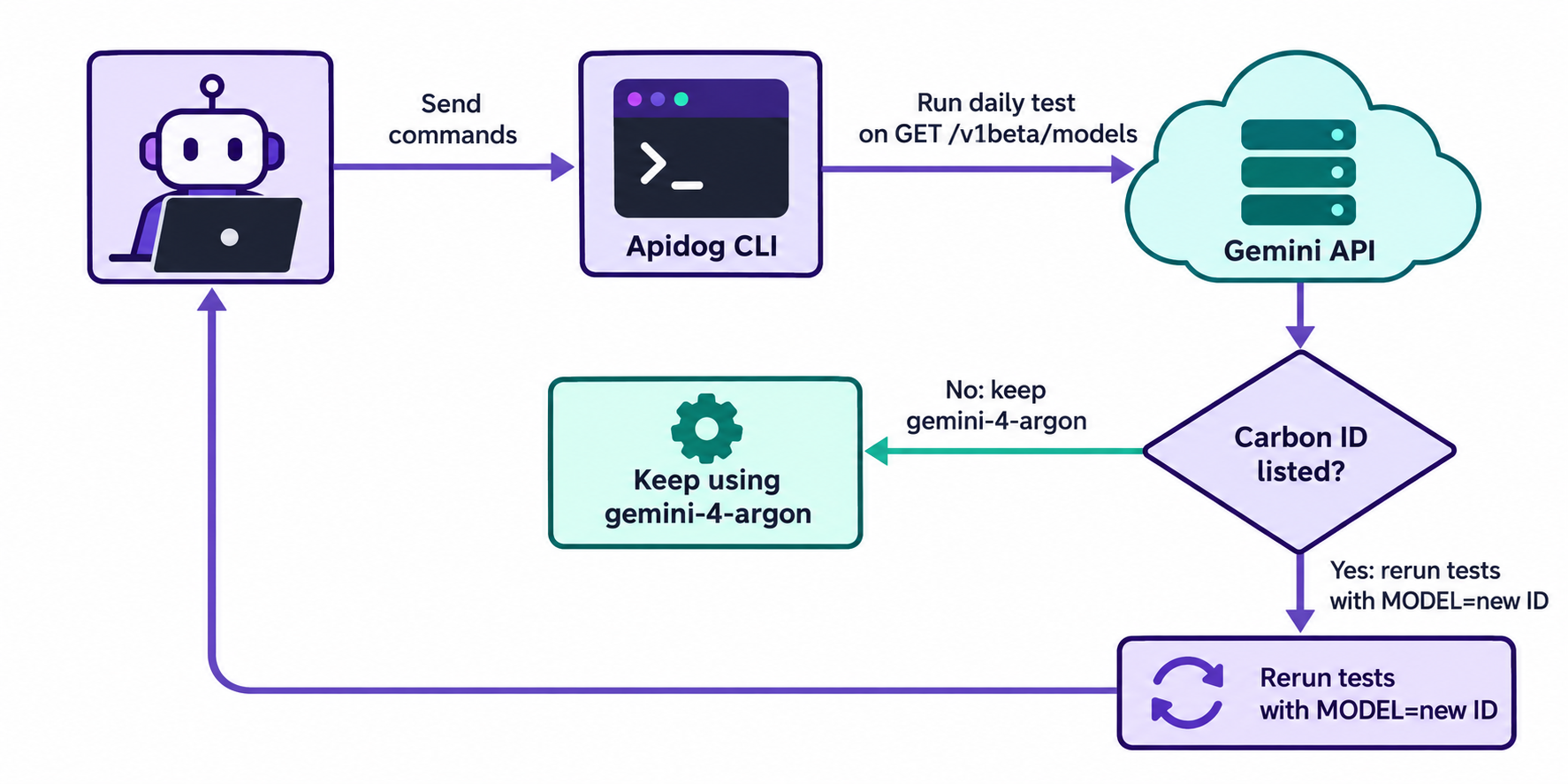
Set it up once:
npm install -g apidog-cli@latest
apidog login --with-token <YOUR_TOKEN>
npx -y skills add https://apidog.com   # pick your agent when prompted
Then give your agent one prompt:
In Apidog project <id>, create a Gemini API environment with GEMINI_MODEL=gemini-4-argon.
Add two test cases: (1) GET /v1beta/models that passes while no model name contains
"carbon" and fails loudly when one does; (2) POST /v1beta/interactions using
{{GEMINI_MODEL}} that asserts HTTP 200 and non-empty output text. Run both and
summarize the results.
The agent checks each payload against its schema before writing anything, then runs the cases:
apidog environment create gemini-api --project <id> --base-url https://generativelanguage.googleapis.com
apidog cli-schema get test-case-create
apidog cli-schema validate test-case-create --file models-watch.json
apidog test-case create --project <id> --file models-watch.json
apidog run --test-case <caseId> --project <id> -e <envId> -r cli,json
When the watch case fails, Carbon’s ID is live. Rerun your prompt case with --env-var "GEMINI_MODEL=<carbon-id>" and compare the output and token counts against Argon. To run the watch daily, have the agent read apidog cli-schema get scheduled-task-create and create a scheduled task, or put the same apidog run ... -r junit in CI with the Apidog CLI CI/CD guide. New to the CLI? Start with Apidog CLI in Claude Code. Apidog’s Free plan covers up to 4 users.
FAQ
What is the Gemini 4 Carbon release date? There isn’t one. Google announced it October 28, 2026; cyber defenders have it now, Fairwind partners next, developers “as soon as possible.”
Can I use the Gemini 4 Carbon API today? Not unless you’re in the initial cyber defender cohort or Fairwind. As of October 29 there’s no model ID and no Carbon entry on the models page or changelog.
How long did Argon take to go public? 13 days: announced September 30, 2026 for Fairwind partners, GA on the paid Gemini API October 13. A precedent, not a commitment.
How much will Gemini 4 Carbon cost? $2 per million input tokens and $10 per million output tokens at launch, with cached input 95% off. After an introductory period Google hasn’t dated, it’s $4 and $20.
Should I wait for Carbon or build on Argon now? Build on gemini-4-argon now. The launch price is the same, and the switch becomes a config change plus a test run.