Keploy gives you something most testing tools cannot: zero-effort test creation from real traffic. You point it at your running app, it watches the network layer, and it hands back test cases plus mocks for your dependencies. No SDK, no test code. That is genuinely useful, and it is also why people start looking for a Keploy alternative the moment their setup does not fit the model.
What Keploy is
Keploy is an open-source (Apache-2.0) platform for creating isolated testing sandboxes for API, integration, and end-to-end testing. It has two workflows.
The first is record and replay. Keploy captures real API interactions and their dependencies (database queries, network calls, streaming events) at the network layer using eBPF. It then replays them deterministically on your machine or in CI. From that captured traffic it auto-generates both test cases and the mocks/stubs for every dependency the request touched. Because capture happens at the eBPF layer, it is code-less and language-agnostic. You change nothing in your application.
The commands are short:
curl --silent -O -L https://keploy.io/install.sh && source install.sh
keploy record -c "CMD_TO_RUN_APP"
keploy test -c "CMD_TO_RUN_APP" --delay 10
The second workflow is AI test generation. Keploy can build validated API test suites from an OpenAPI spec, a Postman collection, a cURL command, or a live endpoint, with automatic cleanup and dependency mocking.
It covers a wide stack: Go, Java, Node.js, Python, Rust, C#, C/C++, and TypeScript; gRPC, GraphQL, HTTP/REST, Kafka, and RabbitMQ; PostgreSQL, MySQL, MongoDB, and Redis. The full picture lives in the Keploy docs and the Keploy GitHub repo.
Why teams look for a Keploy alternative
Keploy is strong, but the model has trade-offs.
- eBPF leans on Linux and elevated privileges. Network-layer capture wants a Linux kernel and the permissions to attach probes. That is fine on a Linux CI runner. It is more friction on a locked-down laptop or a Windows/macOS dev box.
- Recorded tests need curation. Tests generated from real traffic carry whatever the traffic carried: timestamps, tokens, one-off IDs, noise. You review and prune before those become a stable suite.
- It is test generation, not a full platform. Keploy creates and replays tests. It is not where you design APIs, write documentation, run a mock server for front-end teams, or collaborate on a shared API contract.
- Some teams want authored suites. Captured tests describe what happened. They do not describe what should happen. If you want assertions you wrote on purpose, version-controlled and readable a year later, recorded tests are a starting point, not the destination.
None of this makes Keploy wrong. It tells you what to look for in a replacement. So here are the alternatives, with honest pros and cons.
1. Apidog CLI (best for authored, maintainable suites inside a full platform)
Apidog is an all-in-one API platform that covers design, debugging, mocking, documentation, and testing. The Apidog CLI (apidog run) executes the test scenarios and collections you author in the app, from your terminal or CI/CD.
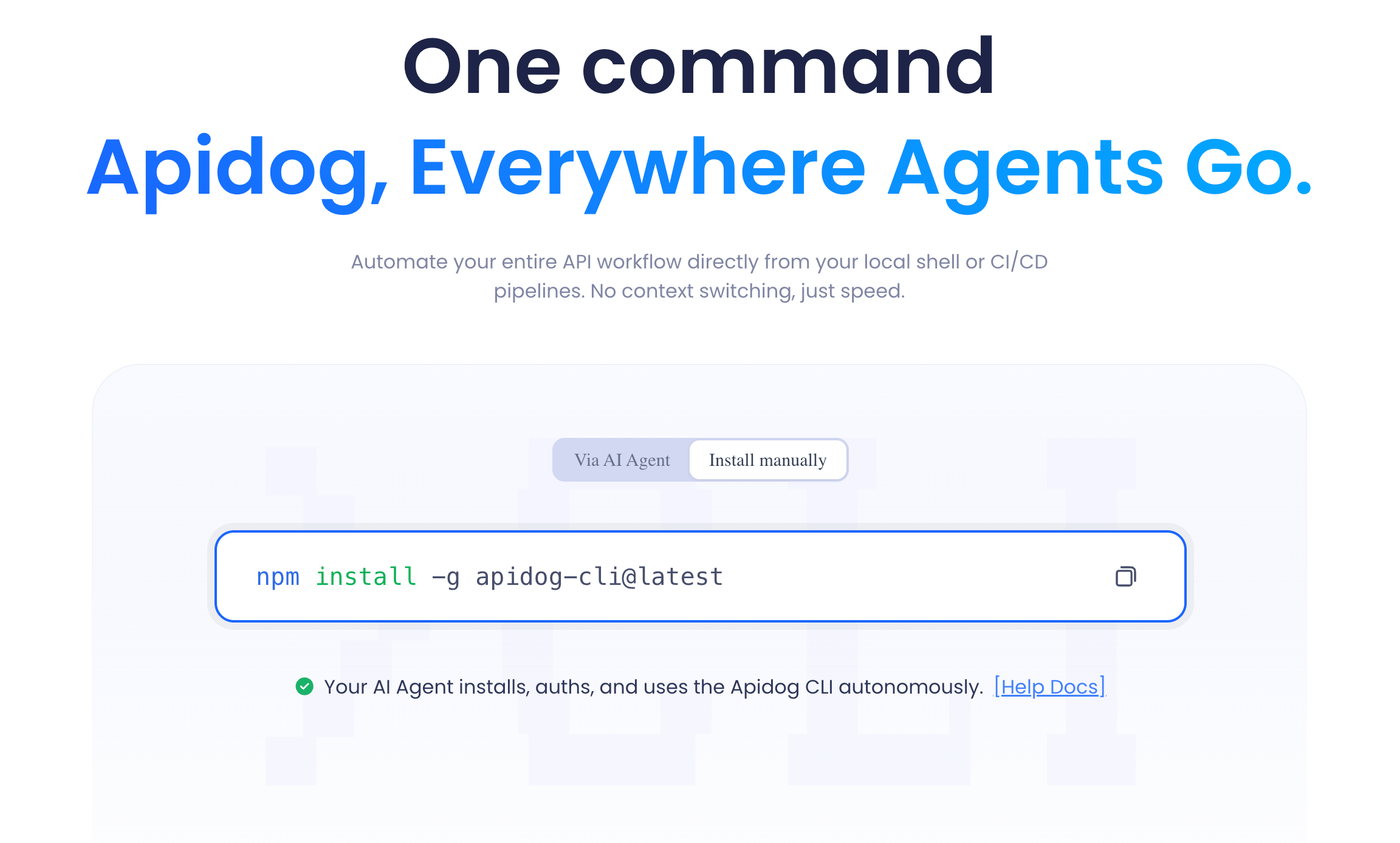
Where Keploy captures behavior, Apidog has you design it. You build a scenario once, add assertions you control, and run it everywhere. The CLI does data-driven testing with -d (CSV or JSON), switches environments with -e, emits reports in CLI, HTML, and JSON formats, and pushes cloud reports with --upload-report. It can import OpenAPI and manage endpoints, schemas, branches, and merge requests as code. Apidog also has AI test-case generation from your API schema and endpoints, authored inside the app, which is the overlap point with Keploy’s spec-based generation.
Here is the honest line, because the two tools sit in different categories. Apidog does not capture live traffic via eBPF, and it does not auto-generate tests by recording production calls plus database mocks. That record-and-replay-from-real-traffic capability is Keploy’s distinct strength. If zero-code capture of runtime behavior is the whole job, Apidog is not a swap for it. If you want a maintainable test suite plus design, mocking, and docs in one place, that is exactly where Apidog fits.
Start with the Apidog CLI complete guide, then the installation guide. For deeper workflows there is data-driven testing, test reports, CI/CD pipelines, and GitHub Actions. The AI angle is covered in AI-powered test case generation and generating test scripts from OpenAPI. If you are weighing the two directly, see Apidog CLI vs Keploy and the migration guide.
Pros: Authored, readable, version-friendly tests. Full lifecycle (design, mock, document, test). Data-driven runs, multiple report formats, CI-ready. AI test generation from your spec. Cons: No eBPF traffic capture and no auto-mock-from-real-traffic. You author scenarios rather than record them. No standalone OpenAPI linter in the CLI.
2. Postman / Newman
Postman is the most widely known API client, and Newman is its CLI runner. You build requests and test scripts in Postman, then run the collection headless with Newman in CI.
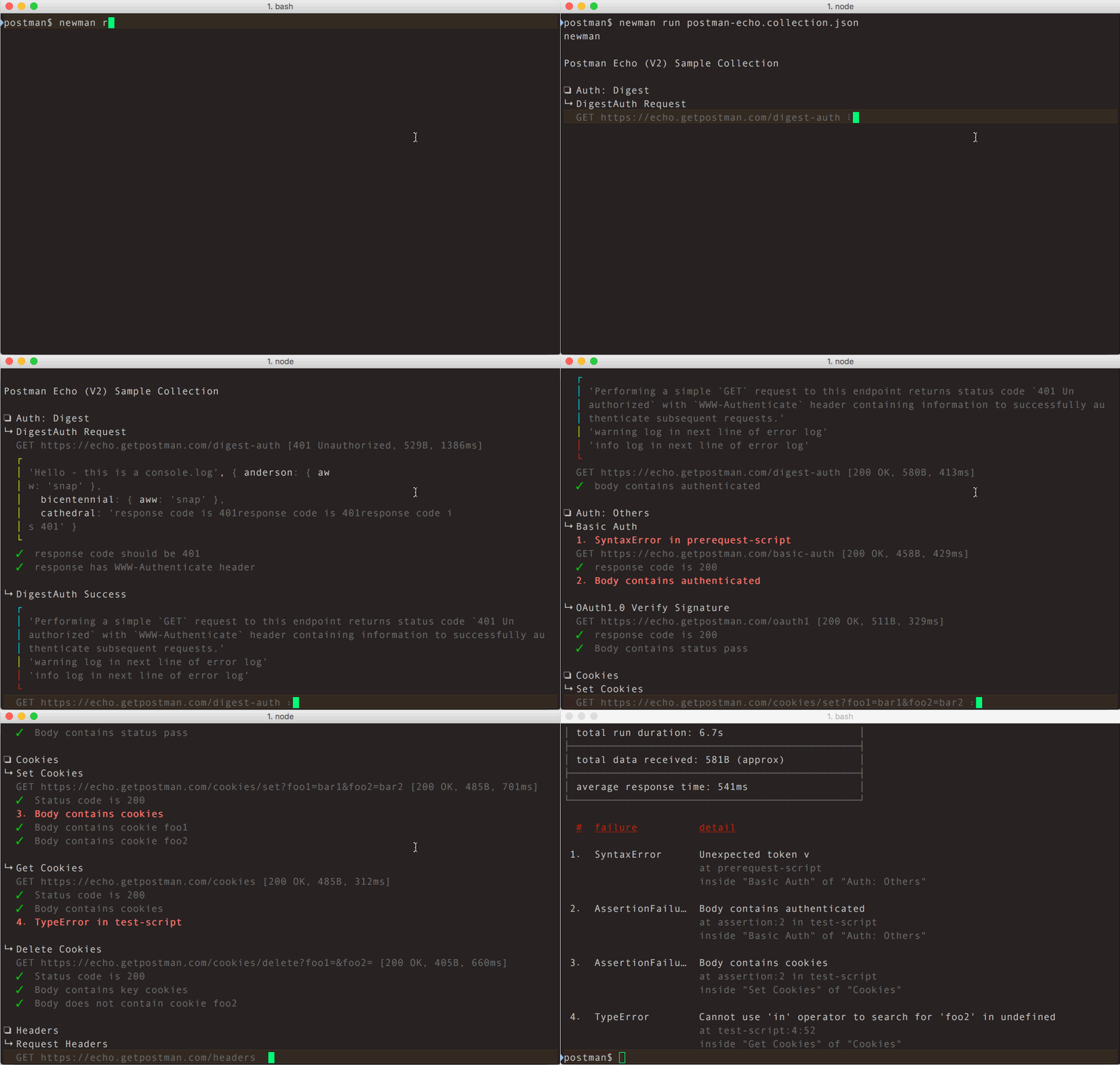
This is the closest peer to the authored-suite model. If your team already lives in Postman, Newman is the path of least resistance for command-line and pipeline runs.
Pros: Huge ecosystem, familiar UI, mature collection format, strong community. Cons: Tests are JavaScript snippets attached to requests, which sprawl as suites grow. Data-driven runs and reporting are more manual than in a purpose-built CLI. Like Apidog, it does not record real runtime behavior the way Keploy does. See the side-by-side in Apidog CLI vs Newman.
3. Hoppscotch CLI
Hoppscotch is an open-source, lightweight API client, and its CLI runs your saved collections from the terminal. It is a clean fit for small teams and open-source projects that want something fast and free without a heavy install.
Pros: Open source, lightweight, quick to pick up, good for simple collection runs. Cons: Thinner on advanced testing, reporting, and lifecycle features than the bigger platforms. Like the other authored-test tools, no traffic capture or dependency mocking from real runs. Compared in Apidog CLI vs Hoppscotch CLI.
4. Schemathesis (property-based fuzzing)
Schemathesis is a different animal, and that is the point. Instead of running tests you wrote, it reads your OpenAPI or GraphQL schema and generates a flood of inputs to probe for crashes, schema violations, and undefined behavior. This is property-based fuzzing, not example-based testing.
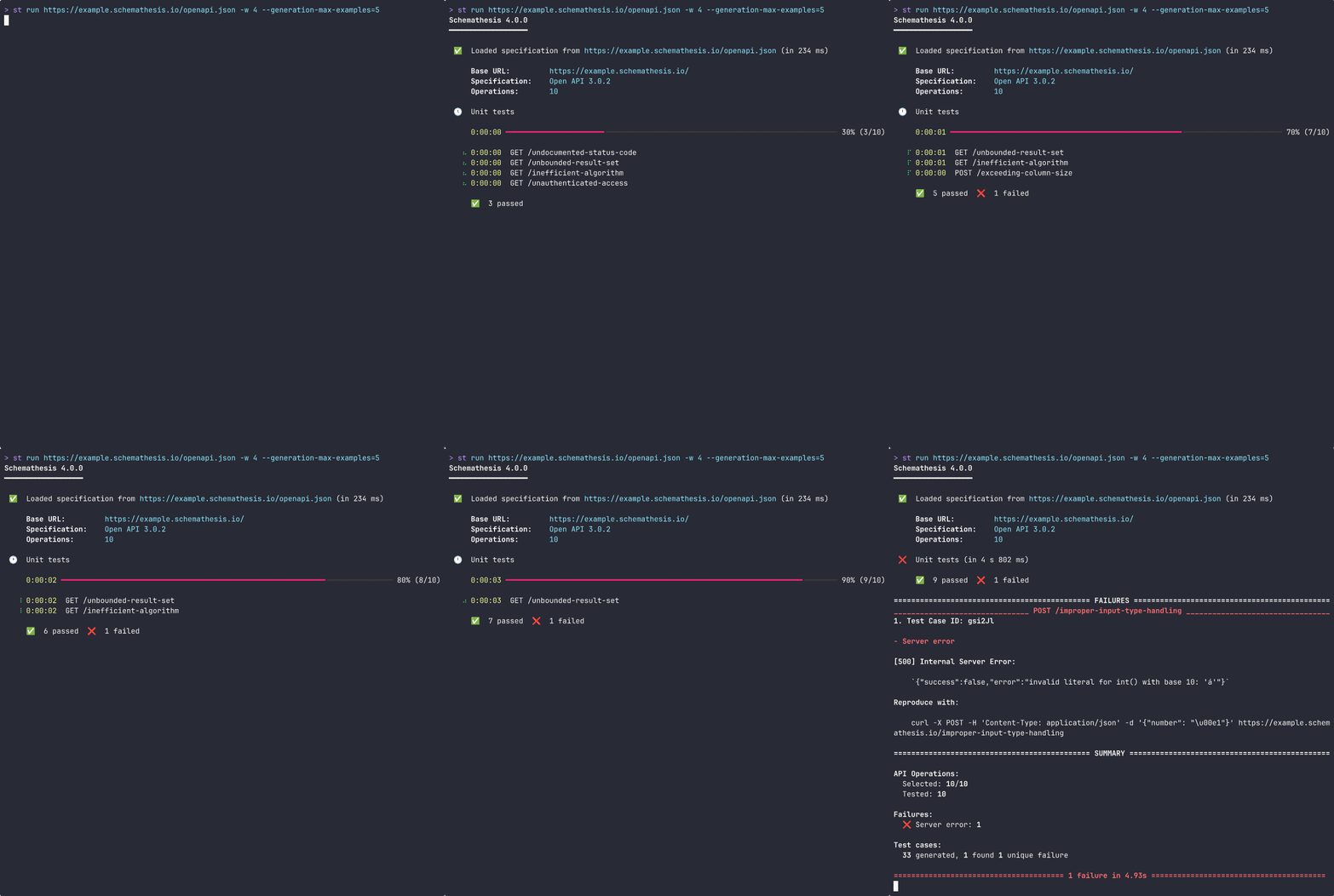
It answers a question neither Keploy nor the authored-suite tools answer well: does my API hold up against inputs I never thought to try? Many teams run Schemathesis alongside their main suite rather than instead of it.
Pros: Finds edge cases humans miss. Schema-driven, so it scales with your spec. Strong for hardening and contract conformance. Cons: Fuzzing surfaces noise you triage. It validates against the schema, so a wrong-but-valid response can slip through. It is a complement, not a full test strategy. For where this fits, see contract testing and mocking tools and the broader API test automation tools roundup.
5. VCR / Mountebank-style record-replay and mocking
This is the category closest to Keploy in spirit. Library-based VCR tools (VCR for Ruby, vcrpy for Python, and their cousins) record HTTP interactions into “cassette” files and replay them in tests. Mountebank is a standalone tool that records and stubs out service dependencies over the wire.
If the appeal of Keploy is “capture real calls and replay them,” these give you a slice of that without eBPF. The difference matters: VCR records at the HTTP-client layer inside your code (you add the library), and Mountebank sits as a proxy. Neither captures database queries or kernel-level dependency behavior the way Keploy’s eBPF capture does. They record application-level HTTP, not the full runtime picture.
Pros: True record-replay for HTTP without Linux/eBPF requirements. Mature, well-understood, language-specific options exist. Cons: Code-level integration (VCR) or a proxy you operate (Mountebank). HTTP-layer only, so no database or streaming-dependency capture. More setup than Keploy’s code-less probe. See OpenAPI schemas and mock data generation for the mocking side.
Comparison table
| Tool | Approach | Auto-capture real traffic | DB/dependency mocks from traffic | Full API platform | License |
|---|---|---|---|---|---|
| Keploy | eBPF record-replay + AI test-gen | Yes (eBPF, no code) | Yes | No (test-gen) | Apache-2.0 |
| Apidog CLI | Authored scenarios + AI test-gen from spec | No | No | Yes | Commercial (free tier) |
| Postman / Newman | Authored collections + JS tests | No | No | Partial | Commercial (free tier) |
| Hoppscotch CLI | Authored collections | No | No | Partial | Open source |
| Schemathesis | Property-based fuzzing from schema | No | No | No | Open source |
| VCR / Mountebank | HTTP record-replay + stubbing | HTTP only | HTTP only | No | Open source |
How to choose
Match the tool to the need, not the hype.
- You want zero-code capture of real runtime behavior, including database mocks, and you run on Linux. Keploy is the right tool. None of the alternatives replicate eBPF capture across DB and streaming dependencies. Be honest with yourself here: if that is the requirement, do not switch.
- You want a partial version of record-replay without eBPF, at the HTTP layer. VCR-style libraries or Mountebank get you there with some setup.
- You want tests you author, read, and maintain, plus design, mocking, and docs in one place. Apidog CLI is the strongest fit, and it adds AI test generation from your spec. Postman/Newman and Hoppscotch CLI are lighter authored-test options.
- You want to harden an API against inputs nobody planned for. Add Schemathesis on top of whatever else you run.
For most teams the real answer is two tools, not one. Capture or fuzz to find what breaks, then author a maintainable suite to lock the behavior in. That is the workflow Apidog is built for, and you can download Apidog and run authored scenarios from the CLI in a few minutes. If Keploy is your starting point, the best Keploy alternative breakdown and what is Keploy give you the full background.