Gemini 4 Hydrogen is Google’s fast, lower-cost Gemini 4 model, released on November 12, 2026, and built for everyday coding and agent work. It costs $1.50 per million input tokens and $7.50 per million output tokens across a 1M-token context, offers four thinking levels (low, medium, high, xhigh), and is available on the Gemini API free tier.
If you run Gemini 3.8 Flash, Hydrogen is Google’s recommended upgrade. If you pay for Carbon or Argon on routine steps, Hydrogen is meant to take those over. Here’s what shipped, how it fits, and what’s still unknown.
What is Gemini 4 Hydrogen?
Gemini 4 Hydrogen (gemini-4-hydrogen) is the speed tier of Google’s Gemini 4 family. Google calls it the “daily driver for agentic workflows”: a model that writes code, calls tools, runs tests and reads documents quickly, either on its own or as the execution engine under a frontier model like Gemini 4 Carbon.
The quick facts, from Google’s launch post and the AI Studio “What’s new” guide:
| Spec | Gemini 4 Hydrogen |
|---|---|
| Model ID | gemini-4-hydrogen |
| Released | November 12, 2026 |
| Paid price | $1.50 / 1M input, $7.50 / 1M output (flat across the full context) |
| Cached input | $0.075 / 1M tokens via implicit caching |
| Context window | 1,048,576 tokens, shared by input, thinking and output |
| Output per request | 65,536 tokens synchronous; up to 1M with background execution |
| Thinking levels | low, medium, high (default), xhigh |
| Inputs | Text, images, PDFs, spreadsheets, charts, audio, video |
| Free tier | Yes, rate-limited, in AI Studio and the Gemini API |
| APIs | generateContent and the Interactions API |
Output tokens include thinking tokens, so a request at xhigh costs more than the same request at low even when the visible answer is the same length.
Hydrogen vs Carbon vs Argon: where it fits
All three Gemini 4 models share the same 1M unified context, long-decode design and built-in tools. They differ in how much each thinks per turn and what it costs.
| Hydrogen | Argon | Carbon | |
|---|---|---|---|
| Role | Fast execution, everyday coding | Most long-horizon tasks, fewer tokens than Carbon | Strongest frontier model |
| Default thinking | high |
medium |
medium |
| Highest thinking | xhigh |
high |
high |
| Non-streaming hop | 65,536 tokens | 32,768 tokens (REST) | 32,768 tokens (REST) |
| Google’s advice | Upgrade path from 3.8 Flash | Advanced long tasks | Hard architecture, security, science |
Google’s own guidance is to pair them: let Carbon plan interfaces or untangle a hard bug, then hand code edits, parallel subagent work and test runs to Hydrogen. Switching models inside one conversation works through previous_interaction_id in the Interactions API, with no request schema changes.
For a deeper split between the two frontier models, read Gemini 4 Carbon vs Argon. For their costs, see the Carbon pricing and Argon pricing breakdowns.
The four thinking levels
Hydrogen’s thinking level is your main control over speed, quality and spend. It’s set with the thinking_level field, and Google recommends you start at the default and move only when your evals tell you to.
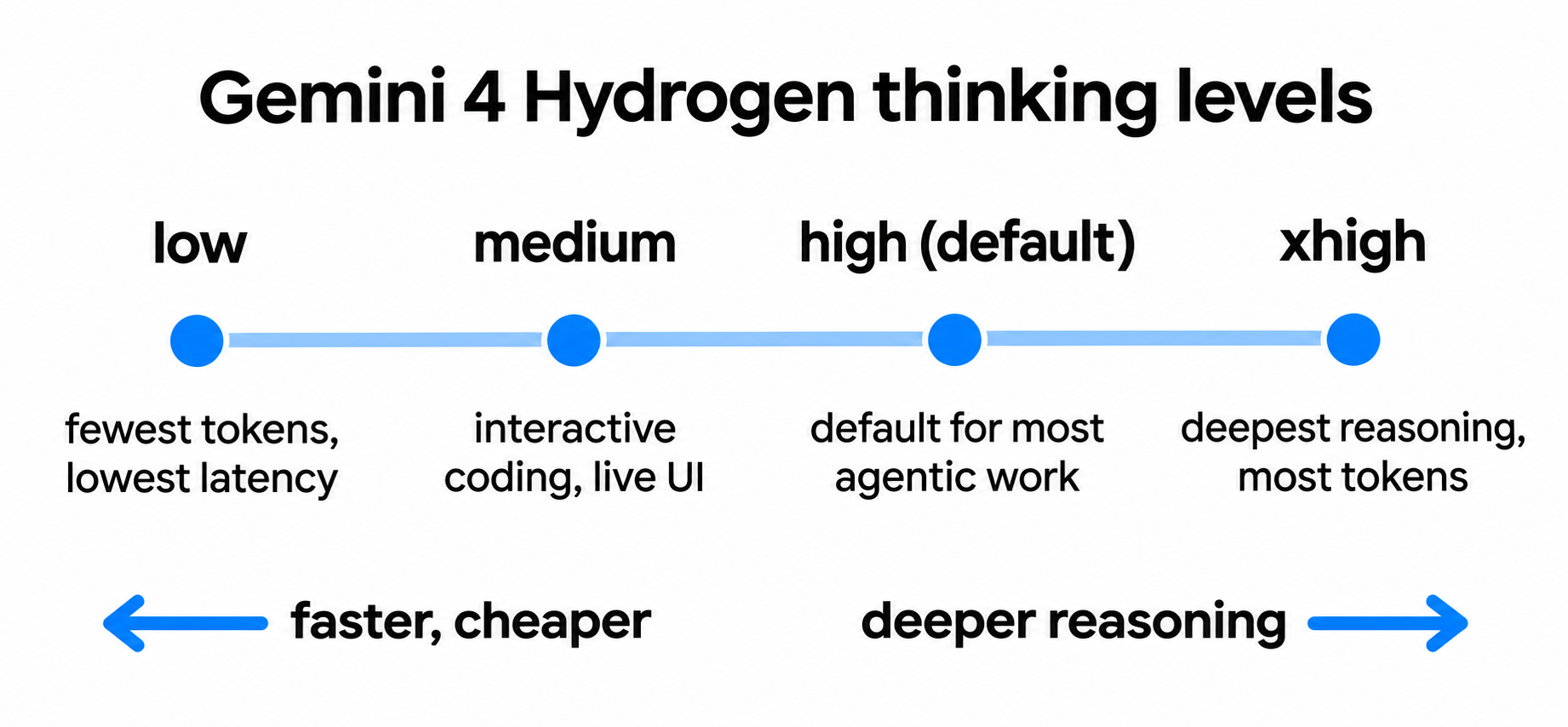
low: fewest tokens, lowest latency. Fast chat and high-throughput processing.medium: interactive coding, live UI prototyping and latency-sensitive tool calls.high(default): complex coding, agentic execution, tool calling and multimodal document work.xhigh: new with Hydrogen. Hard multi-step problems wherehighfalls short.
Google warns that xhigh can overthink simple prompts, adding latency and tokens without a better answer. Its advice: run your eval suite at all four levels with a generous max_output_tokens, then pick the lowest level that meets your quality bar. If you’re migrating from 3.8 Flash, note that Hydrogen rejects minimal with an error and defaults to high rather than medium. The Hydrogen pricing guide works through what each level costs.
Gemini 4 Hydrogen benchmarks
All the numbers below are Google’s, published at launch. Independent replication was thin a day after release, so treat them as the vendor’s claims.
Against Argon and its own settings
- Artificial Analysis Intelligence Index: 51 at
high, ahead of Argon’s 50, and 54 atxhigh.
Against Gemini 3.8 Flash
- 2.5x faster at the
highdefault. - Terminal-Bench 4.1: 57% vs 18.2%.
- More than 5x fewer fabricated claims.
- Launch partners report 2x to 2.8x faster runs and 12% to 23% fewer tokens on graph, SQL and data-heavy workloads.
Agentic and domain work
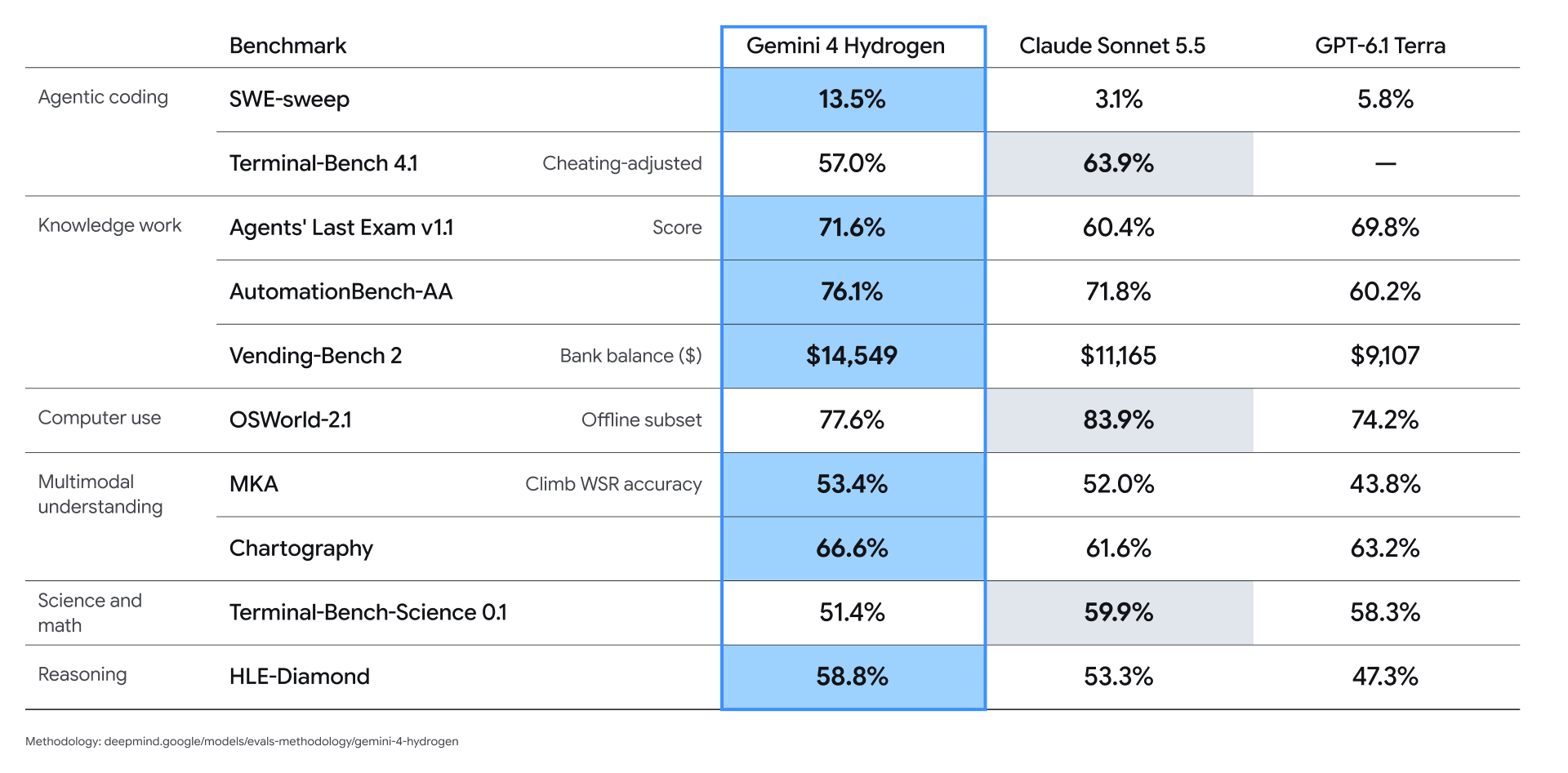
- HLE-Diamond: 58.8%, which Google says leads its class.
- Vals Tax Agent Bench: ranked #1 at 52.3%.
- Vals Legal Research Bench: tied for #1 at 55.8%.
- Agent Arena (arena.ai): #5.
- Multimodal Knowledge Agent (MKA): 53.4%.
- Agents’ Last Exam v1.1: 71.6%.
Safety, per Google
- Up to 81% less overreach and up to 79% less under-service in agentic tasks.
- 12x fewer misaligned actions and task shortcuts across tool-use and coding evals.
- 96.7% on Google’s internal agent honesty evaluation.
- More than 2.3x more resilient to indirect prompt injection on the Gray Swan IPI benchmark.
The pattern matters more than any single score: Hydrogen roughly matches Argon on general intelligence and is a large jump over 3.8 Flash on agentic coding. Test it on your workload before you trust it. The model card has Google’s full evaluation notes.
Where you can use Gemini 4 Hydrogen today
Google rolled Hydrogen out across developer, business and consumer products on launch day:
- Gemini API, Google AI Studio and Android Studio: all tiers, free and paid. The free tier is rate-limited; the Hydrogen free guide covers what you get without a card.
- Gemini for business: through the API, the model dropdown, Antigravity, and Gemini in Google Sheets for eligible business plans.
- Gemini app: in the model dropdown. Free users get Hydrogen only through auto model selection, when Gemini decides it fits the prompt.
- Google Search: powering responses for all users.
- Google Sheets: starting with Google AI Pro and Ultra subscribers.
- Google Antigravity: for paid Google AI Pro and Ultra subscribers.
Hydrogen is also now the default model behind the Antigravity agent in Gemini Managed Agents, so anyone calling that agent through the API is already on Hydrogen unless they configure another model.
Orchestrator: Hydrogen and Carbon in one session
Orchestrator is a new model option in Google Antigravity that switches between Carbon and Hydrogen inside one task, in both directions. Carbon explores and plans, Hydrogen writes edits, updates packages and runs tests, and when Hydrogen hits friction it hands control back to Carbon to repair the plan. It replaces the static router that guesses difficulty once from your first prompt.
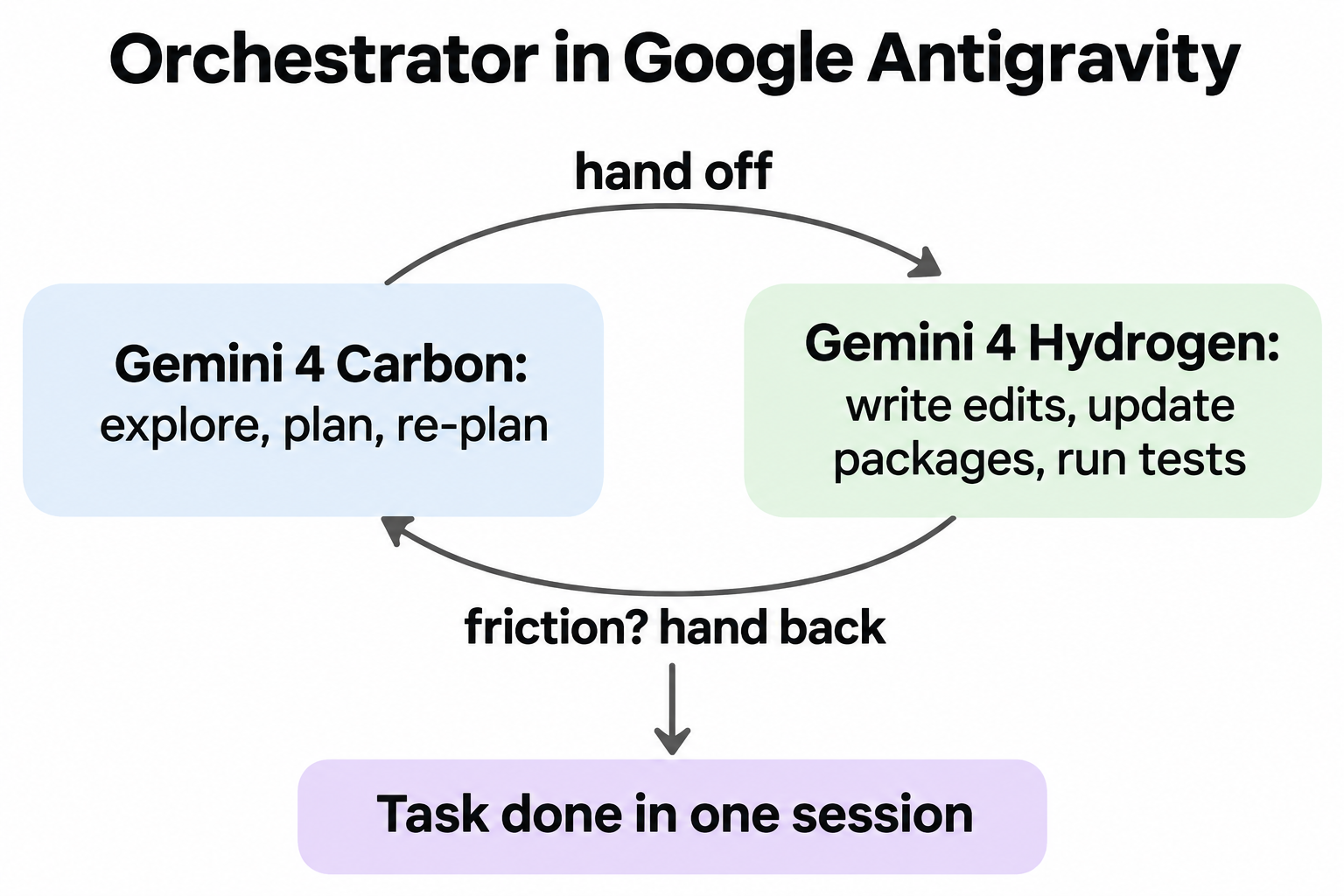
On Terminal-Bench, Google says Orchestrator reached near-Carbon success rates while using 24% less quota and finishing 19% faster on average. Note that Google’s two launch posts cite different versions of the benchmark for this result (4.0 in the main post, 4.1 in the Antigravity post).
Availability is tiered. Ultra subscribers get Orchestrator (Carbon) and Orchestrator (Argon); paid Pro subscribers get Orchestrator (Argon). If you’d rather wire the roles yourself, the Antigravity SDK lets you assign Hydrogen and Carbon agents explicitly. The Gemini 4 Hydrogen Orchestrator guide goes deeper.
Limits and open questions
A day after launch, plan around these:
- Benchmarks are self-reported. Every number above comes from Google or its launch partners.
- No explicit caching.
cachedContentsandcaches.createaren’t supported; only the implicit cache on prompts of 4,096+ tokens applies. - Sampling parameters are ignored.
temperature,top_pandtop_khave no effect, so you can’t tune randomness that way. - Free-tier limits live on a separate page. Google points to its rate limits page rather than listing Hydrogen’s numbers in the launch guide.
- Orchestrator is Antigravity-only. There’s no API-level Orchestrator; in your own code you route models yourself.
Test Gemini 4 Hydrogen with Apidog CLI and your coding agent
To decide if Hydrogen can replace 3.8 Flash, run the same request against both and compare. Let your coding agent do it, so the swap becomes a test result, not a guess. This request follows Google’s documented generateContent format; we haven’t live-run it for this post:
MODEL="${GEMINI_MODEL:-gemini-4-hydrogen}"

curl -s "https://generativelanguage.googleapis.com/v1beta/models/${MODEL}:generateContent" \
  -H "x-goog-api-key: $GEMINI_API_KEY" \
  -H "Content-Type: application/json" \
  -d '{"contents": [{"parts": [{"text": "List three checks a CI job should run before a release."}]}]}'
Apidog CLI gives Claude Code, Codex, Cursor or OpenCode a command-line way to create and run API tests. Set it up once:
npm install -g apidog-cli@latest
apidog login --with-token <YOUR_TOKEN>
npx -y skills add https://apidog.com   # pick your agent when prompted
Then give your agent one prompt:
In Apidog project <id>, create an environment for the Gemini API with a MODEL
variable set to gemini-4-hydrogen and a GEMINI_API_KEY variable. Add a test case
for POST /v1beta/models/{MODEL}:generateContent that asserts HTTP 200, a non-empty
candidates array, and that usageMetadata is present. Run it for gemini-4-hydrogen
and gemini-3.8-flash and compare response time and token counts.
The agent creates the environment, validates the test case payload against its schema, then runs it once per model:
apidog environment create gemini-api --project <id> --base-url https://generativelanguage.googleapis.com
apidog cli-schema get test-case-create
apidog cli-schema validate test-case-create --file case.json
apidog test-case create --project <id> --file case.json
apidog run --test-case <caseId> --project <id> -e <envId> --env-var "MODEL=gemini-4-hydrogen" -r cli,json
apidog run --test-case <caseId> --project <id> -e <envId> --env-var "MODEL=gemini-3.8-flash" -r cli,json
Put the same apidog run ... -r junit into CI with the Apidog CLI CI/CD guide, or start from Apidog CLI in Claude Code. For full request examples, see the Gemini 4 Hydrogen API guide. Apidog’s Free plan covers up to 4 users.
FAQ
Is Gemini 4 Hydrogen free? Yes, within limits. Google lists Hydrogen on the free tier of the Gemini API and in Google AI Studio, rate-limited. Paid use costs $1.50 per million input tokens and $7.50 per million output tokens.
What is the Gemini 4 Hydrogen model ID? gemini-4-hydrogen. It works with both generateContent and the Interactions API.
Is Gemini 4 Hydrogen better than Gemini 4 Argon? On Google’s numbers, Hydrogen scores 51 on the Artificial Analysis Intelligence Index at high against Argon’s 50, and 54 at xhigh. Argon is still pitched for most advanced long-horizon tasks, so test both on your own workload.
What is the xhigh thinking level? It’s a fourth thinking level, new with Hydrogen, above the default high. It spends the most tokens for the deepest reasoning. Google recommends it only for hard multi-step problems where high falls short.
Does Gemini 4 Hydrogen replace Gemini 3.8 Flash? Google calls it the recommended upgrade from 3.8 Flash. Change the model ID, raise any low max_output_tokens caps, remove explicit caching and sampling parameters, and retest your thinking level.
Can I use Orchestrator through the Gemini API? No. Orchestrator is a model option inside Google Antigravity for paid AI Pro and Ultra subscribers. In the API, you route between Carbon and Hydrogen yourself, for example with previous_interaction_id across turns.