Gemini 4 Hydrogen pricing is $1.50 per 1M input tokens and $7.50 per 1M output tokens on the Gemini API’s Standard paid tier, flat across the whole 1M-token context window. Thinking tokens bill at the output rate, cached input costs $0.075 per 1M, and Batch or Flex cut every rate in half.
Hydrogen, released November 12, 2026, is the fast member of the Gemini 4 family. Unlike Carbon and Argon, it has no introductory price that doubles later, and it’s on the Free tier. Below: the price table, worked cost examples, how thinking levels move your bill, and how to measure your own cost. New to the model? Start with what Gemini 4 Hydrogen is.
How much does Gemini 4 Hydrogen cost per 1M tokens?
Gemini 4 Hydrogen (model ID gemini-4-hydrogen) has four paid tiers on Google’s pricing page. All prices are per 1M tokens:
| Tier | Input | Output incl. thinking | Cached input | Free tier |
|---|---|---|---|---|
| Standard | $1.50 | $7.50 | $0.075 | Free of charge |
| Batch | $0.75 | $3.75 | $0.0375 | Not available |
| Flex | $0.75 | $3.75 | $0.0375 | Not available |
| Priority | $2.70 | $13.50 | $0.135 | See pricing page |
Three details on the same page shape your budget:
- Thinking is billed. “Every token the model processes is counted and billed, including thinking tokens.”
- Implicit caching only. Explicit caching isn’t supported; you get the cached rate when Google’s implicit cache matches a repeated prompt prefix.
- Grounding is extra. Google Search grounding includes 5,000 free requests a month, then $14 per 1,000.
Free tier usage is marked “Used to improve our products: Yes” on the page. Our Gemini 4 Hydrogen free guide walks through every $0 route.
What does “flat to 1M tokens” mean?
It means one price for every prompt size. Google’s launch post says Hydrogen “is priced flat across its entire 1 million-token context window at $1.50 per million input tokens and $7.50 per million output tokens.” A 5K-token prompt and a 900K-token prompt bill at the same per-token rate.
Not every Gemini model works this way: Gemini 3.1 Pro Preview charges $2.00/$12.00 per 1M up to 200K tokens and $4.00/$18.00 above it.
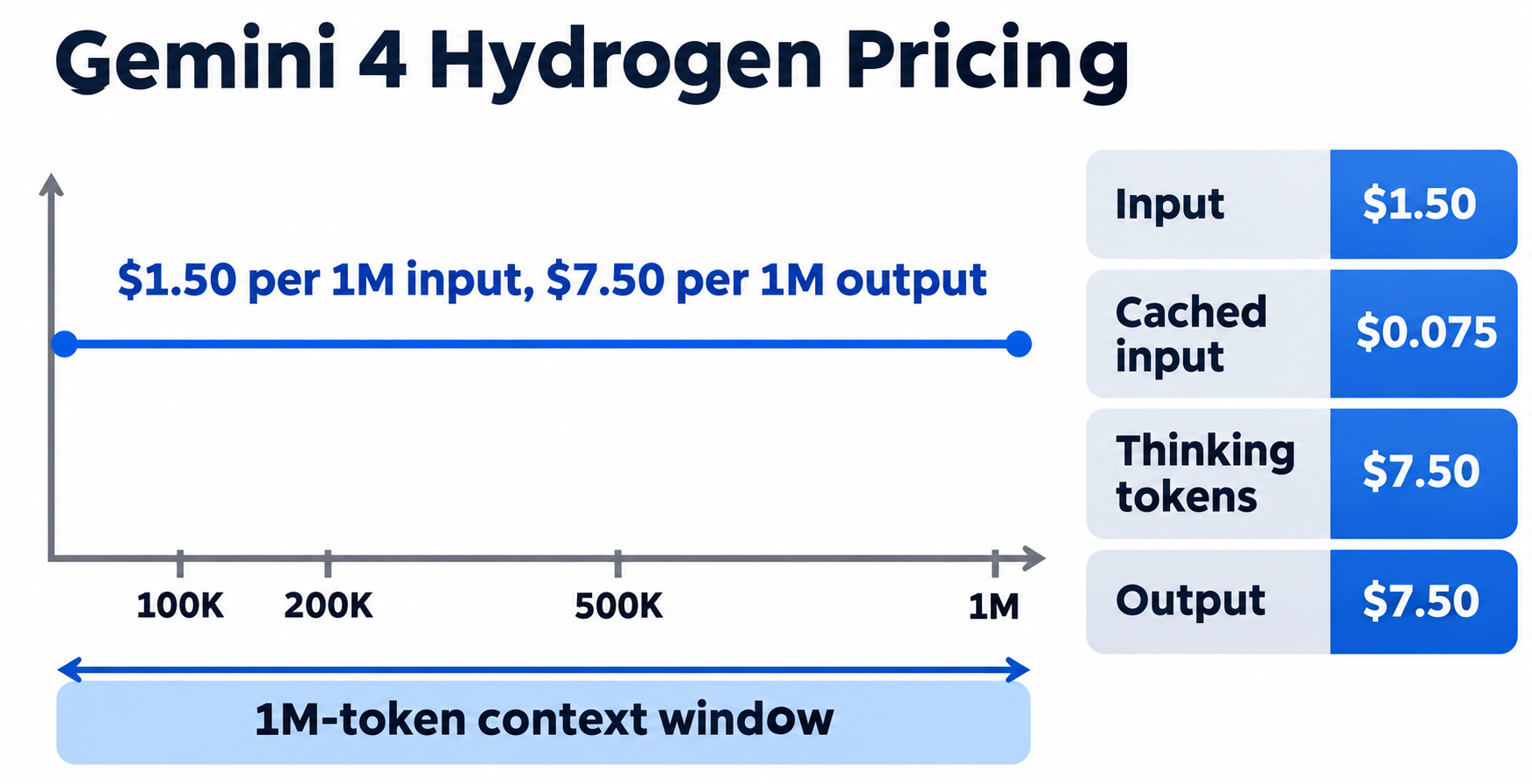
Two numbers make it concrete:
- A 900K-token prompt (a large codebase or a stack of PDFs) costs $1.35 in input on Standard, or $0.0675 when the implicit cache hits.
- The context window is unified: input, thinking and output share 1,048,576 tokens. A 900K prompt leaves about 148K tokens for thinking and answer combined.
Synchronous responses cap at 65,536 tokens. Longer output runs through long decode, still at $7.50 per 1M.
How do thinking levels change your Gemini 4 Hydrogen bill?
Hydrogen supports four thinking levels: low, medium, high (the default) and a new xhigh. You set it with generation_config.thinking_level. The per-token price never changes; the number of thinking tokens does, and those bill at the output rate.
Artificial Analysis ran its Intelligence Index at each level. Here’s what it reported:
| Thinking level | Index score | Tokens generated on the index | Cost per index task |
|---|---|---|---|
| low | 27 | 20.3M | $0.29 |
| medium | 41 | 54.4M | $0.80 |
| high (default) | 51 | 110M | $1.87 |
| xhigh | 54 | 304M | $3.16 |
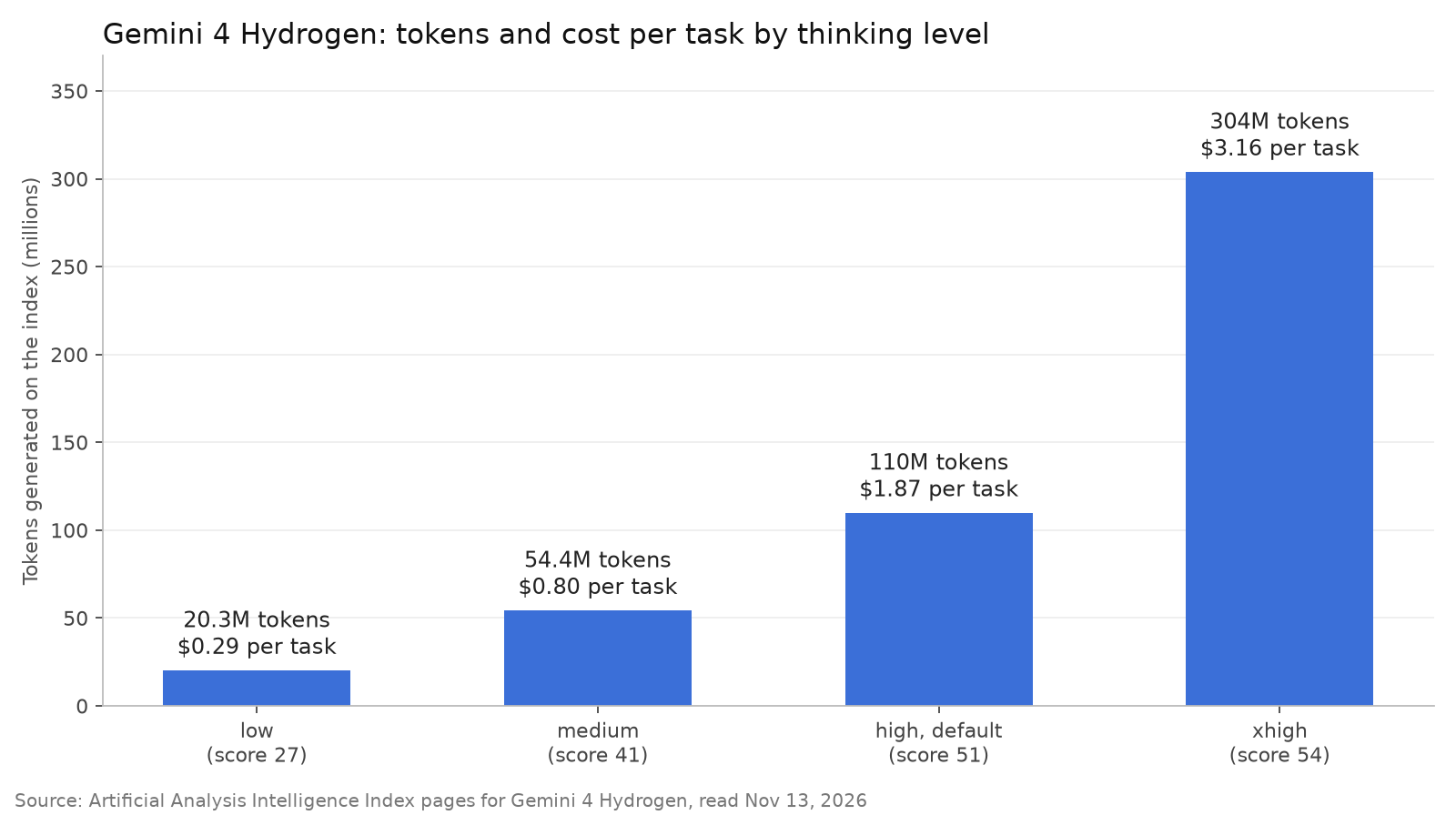
Read the table as ratios. Going from high to xhigh generated about 2.8x the tokens and raised the cost per task by about 1.7x, for 3 more index points. Dropping from high to low cut tokens to under a fifth.
Google’s What’s new in Gemini 4 Hydrogen page warns that xhigh “can cause overthinking on simpler prompts” and recommends picking “the lowest thinking_level that meets your quality bar.” Note that max_output_tokens caps thinking and output combined.
What does one Gemini 4 Hydrogen call cost?
Every request follows one formula. Pull the token counts from the usage object in the response (total_input_tokens, total_cached_tokens, total_thought_tokens, total_output_tokens):
cost = (uncached_input x $1.50 / 1M)
     + (cached_input   x $0.075 / 1M)
     + ((thought + output) x $7.50 / 1M)
The two examples below use illustrative token counts, not measurements. Swap in your own.
Example 1: a chat call at high. 2,000 input tokens, 1,500 thinking tokens, 600 output tokens.
| Line | Standard | Batch or Flex |
|---|---|---|
| Input (2,000) | $0.0030 | $0.0015 |
| Thinking + output (2,100) | $0.0158 | $0.0079 |
| Total per call | $0.0188 | $0.0094 |
| 10,000 calls a month | $187.50 | $93.75 |
Example 2: an agent loop. A coding agent runs 40 turns. It re-sends the conversation each turn, so it reads 1.2M input tokens in total, and 900K of those hit the implicit cache. It thinks for 200K tokens and writes 60K tokens of code and tool calls.
| Line | Standard | Batch or Flex | Priority |
|---|---|---|---|
| Uncached input (300K) | $0.45 | $0.23 | $0.81 |
| Cached input (900K) | $0.07 | $0.03 | $0.12 |
| Thinking + output (260K) | $1.95 | $0.98 | $3.51 |
| Total per run | $2.47 | $1.23 | $4.44 |
About 79% of the Standard bill is thinking and output, so the thinking level matters more than trimming your prompt. The request code for both examples is in our Gemini 4 Hydrogen API guide.
How does Hydrogen pricing compare with Carbon, Argon and Gemini 3.8 Flash?
Here are Standard paid-tier rates per 1M tokens from Google’s pricing page, read November 13, 2026:
| Model | Input | Output | Cached input | Free tier |
|---|---|---|---|---|
| Gemini 4 Hydrogen | $1.50 | $7.50 | $0.075 | Yes |
| Gemini 4 Carbon (to Nov 30) | $2.00 | $10.00 | $0.10 | No |
| Gemini 4 Carbon (from Dec 1) | $4.00 | $20.00 | $0.20 | No |
| Gemini 4 Argon (to Nov 30) | $2.00 | $10.00 | $0.10 | No |
| Gemini 4 Argon (from Dec 1) | $4.00 | $20.00 | $0.20 | No |
| Gemini 3.8 Flash (to Dec 31) | $0.75 | $3.75 | $0.075 | Yes |
| Gemini 3.8 Flash (from Jan 1, 2027) | $1.50 | $7.50 | $0.15 | Yes |
Run the Example 2 agent loop’s token counts through each price and you get $2.47 on Hydrogen, $3.29 on Carbon or Argon this month and $6.58 from December 1, and $1.27 on Gemini 3.8 Flash until December 31. Once Flash’s price rises on January 1, 2027, the same tokens cost $2.54 on Flash, slightly more than Hydrogen because Flash’s cached rate doubles to $0.15. For the details on the frontier models’ price change, see our Gemini 4 Carbon pricing and Gemini 4 Argon pricing guides.
Same tokens isn’t the real comparison, though, because each model spends a different number of tokens per task. Artificial Analysis’s Intelligence Index pages give one view:
| Model (thinking level) | Index score | Tokens generated | Cost per index task |
|---|---|---|---|
| Gemini 4 Hydrogen (high) | 51 | 110M | $1.87 |
| Gemini 4 Hydrogen (xhigh) | 54 | 304M | $3.16 |
| Gemini 4 Argon (high) | 50 | 113M | $4.97 |
| Gemini 4 Carbon (high) | 60 | 205M | $5.48 |
| Gemini 3.8 Flash (high) | 31 | 126M | not compared here |
On this benchmark, Hydrogen at its default matched Argon’s score at about 38% of Argon’s cost per task, while Carbon scored highest. Treat it as one benchmark’s view. Google also says Hydrogen finishes tasks 2.5x faster than Gemini 3.8 Flash at the high setting.
The practical split: Hydrogen for everyday coding and agents, Carbon for hard architecture, debugging and security reviews. In Antigravity, the Orchestrator option switches between Carbon and Hydrogen inside one run. Our Gemini 4 Carbon vs Argon comparison covers the frontier side.
How can you cut your Gemini 4 Hydrogen bill?
- Use Batch or Flex for work that can wait. Both are half price.
- Pick the lowest thinking level that passes your evals.
mediumused about half the tokens ofhigh. - Save
xhighfor the hard turns. - Keep a stable prompt prefix so implicit caching bills repeated input at $0.075 per 1M, a 95% discount.
- Prototype on the Free tier.
Measure your real Gemini 4 Hydrogen cost with Apidog CLI
Your bill comes from your own prompts. The quickest way to get real numbers is to let your coding agent (Claude Code, Codex, Cursor) run your prompts at every thinking level through Apidog CLI and log the usage object for each run.
Set it up once:
npm install -g apidog-cli@latest
apidog login --with-token <YOUR_TOKEN>
npx -y skills add https://apidog.com   # pick your agent when prompted
Put 5 to 10 of your real prompts in levels.csv, one row per prompt and thinking level, with columns prompt and thinking_level (low, medium, high, xhigh). Then give your agent one prompt:
In Apidog project <projectId>, create a test case for
POST https://generativelanguage.googleapis.com/v1beta/interactions
with the x-goog-api-key header read from GEMINI_API_KEY in environment
<envId>. Send model "gemini-4-hydrogen", input {{prompt}} and
generation_config.thinking_level {{thinking_level}}. Assert status 200,
status "completed", non-empty output, and a usage object that includes
total_input_tokens and total_output_tokens. In a post-processor, read
total_input_tokens, total_cached_tokens, total_thought_tokens and
total_output_tokens, compute cost at $1.50 input, $0.075 cached and
$7.50 output per 1M, and log it. Run every row of levels.csv and give me
a table of tokens and cost per prompt and thinking level.
The agent checks the payload shape before it writes anything, then runs every row:
apidog cli-schema get test-case-create
apidog cli-schema validate test-case-create --file case.json
apidog test-case create --project <projectId> --file case.json
apidog run --test-case <caseId> --project <projectId> -e <envId> \
  -d levels.csv -r cli,json --out-file hydrogen-cost-{GENERATE_TIME}
The JSON report shows what each thinking level costs on your workload. Add -r junit and the same command runs in CI, where a token-budget assertion can fail the build. The Apidog CLI CI/CD guide shows the pipeline, and Apidog CLI in Claude Code covers the agent setup. Apidog’s Free plan covers up to 4 users.
A shortcut: tell your agent “Read https://apidog.com/apidog-cli-installation-guide.md and set up Apidog CLI.”
FAQ
Is Gemini 4 Hydrogen free? On the API, yes, within Free tier rate limits: Google lists Standard input and output as “Free of charge” on the Free tier. Batch, Flex and Search grounding need a paid key. See our Gemini 4 Hydrogen free guide.
Will Gemini 4 Hydrogen’s price go up like Carbon’s? Google’s pricing page lists a single $1.50/$7.50 rate for Hydrogen, with no introductory period or end date. Carbon and Argon carry dated intro prices; Hydrogen doesn’t.
Are thinking tokens billed for Gemini 4 Hydrogen? Yes, at the output rate of $7.50 per 1M on Standard. The response’s usage object reports them separately as total_thought_tokens.
Is Gemini 4 Hydrogen cheaper than Gemini 3.8 Flash? Not this year: Flash costs $0.75/$3.75 until December 31, 2026. From January 1, 2027, Flash rises to $1.50/$7.50, the same per-token rate as Hydrogen, and Hydrogen scored 51 to Flash’s 31 on Artificial Analysis’s index.