Qwen4-Max benchmarks, in one line: Alibaba’s chart puts Qwen4-Max ahead of Qwen3.8-Max on every one of the 15 tests where both appear, and first overall on 4 of 16, but most of those numbers come from Alibaba’s own runs. On Work360 it scores 52.69 against 47.74, and average cost per task falls from $4.43 to $1.67.
A benchmark is only as useful as the answer to “who ran it, and how?” This guide covers every score Alibaba published on November 16, 2026, sorts them into self-reported and third-party, and ends with a way to run your own check against the Qwen4-Max API. For the basics, start with what Qwen4-Max is and how to get access.
Qwen4-Max benchmark scores at a glance
Alibaba’s launch post compares Qwen4-Max with Qwen3.8-Max-0902, Opus 5.5, GPT-6.1 Sol, GPT-6 Astra and Kimi K3.1 on 16 benchmarks.
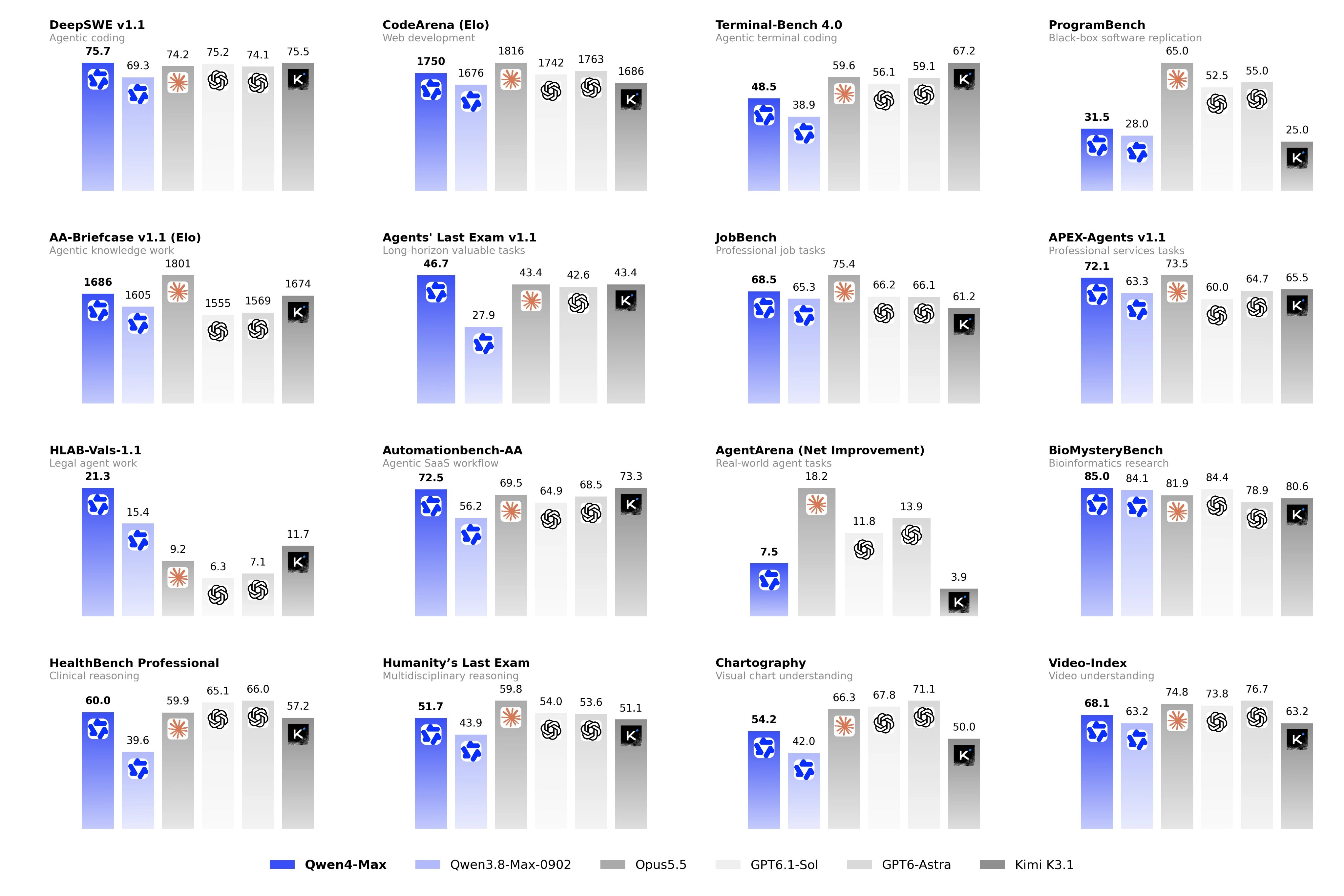
Bold marks the top score in the chart. “Alibaba” means the footnotes cite no outside leaderboard for that test, so treat it as Alibaba’s own run (the JobBench and Chartography footnotes only describe Alibaba’s setup).
Self-reported vs third-party: who ran each test
Ten of the 16 scores are self-reported. Six are cited from public leaderboards run by someone else. That split is the most useful filter you can apply.
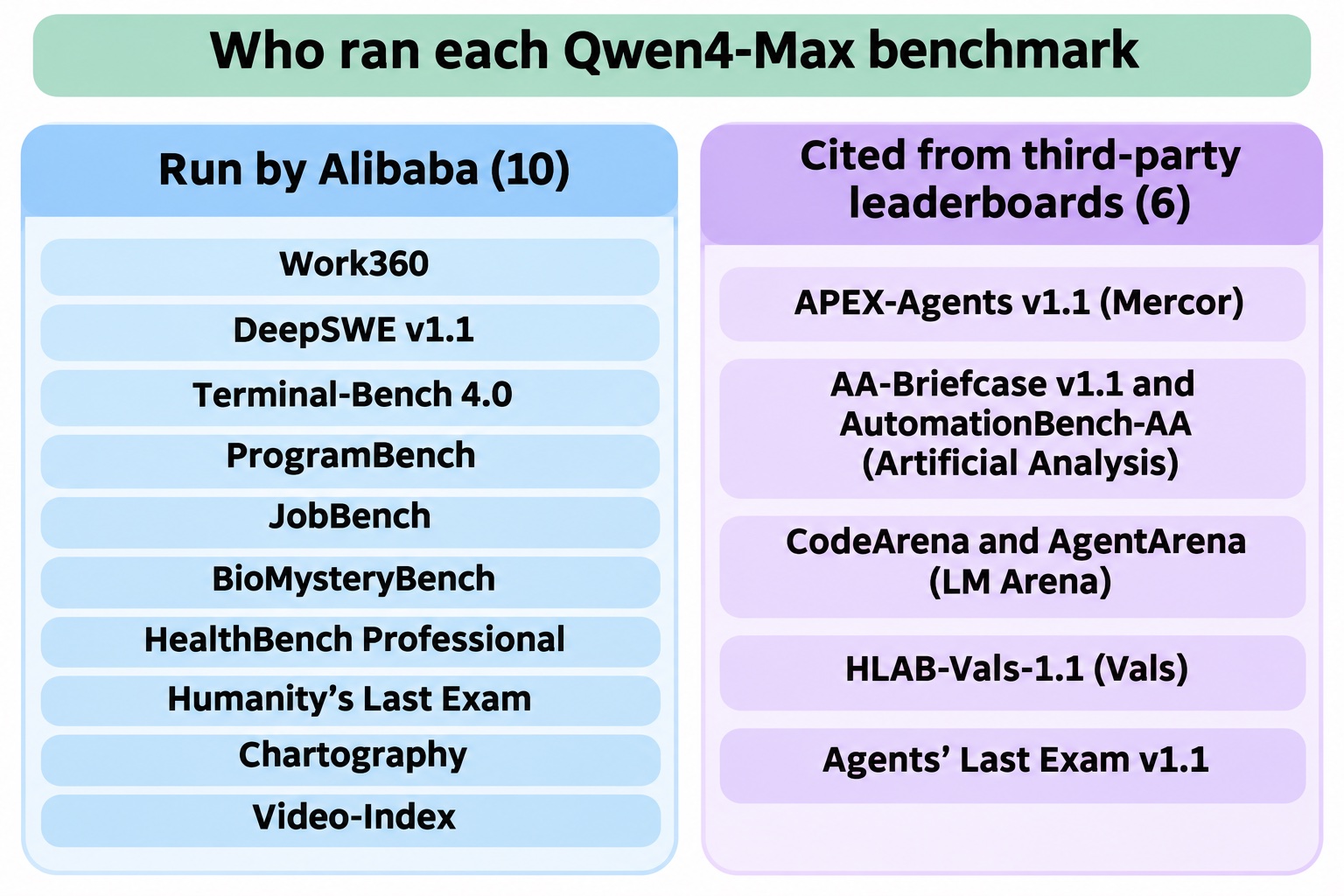
The third-party group, per the launch post’s footnotes:
- APEX-Agents v1.1: cited from the Mercor APEX-Agents leaderboard
- AA-Briefcase v1.1 and AutomationBench-AA: cited from Artificial Analysis
- CodeArena and AgentArena: cited from LM Arena
- HLAB-Vals-1.1: cited from the Vals Index
- Agents’ Last Exam v1.1: cited from its own leaderboard
One independent number you can check today: the Vals Index (version 2.2, updated November 15, 2026) lists Qwen 4 Max at 63.20% overall, rank 11, at $9.33 per test. That puts it behind ten models, led by Claude Fable 5.2 at 71.31%, and just ahead of Kimi K3.1 Pro (62.52%) and Qwen 3.8 Max 0902 (59.05%). It’s a more modest picture than the headline chart.
Work360: Alibaba’s own work benchmark
Work360 is Alibaba’s benchmark for complex industry tasks, spanning 26 domains, 182 subdomains and 721 specialized fields. Qwen4-Max scored 52.69, up from 47.74 for Qwen3.8-Max.
Read it with care: Alibaba designed the benchmark and ran the models, its published comparison covers only Qwen4-Max and Qwen3.8-Max, and there’s no public leaderboard for it yet. It’s a generation-over-generation number, not a ranking against other labs.
What Work360 does give you is a cost figure: average cost per task dropped from $4.43 to $1.67, a 62% cut, from fewer tokens per task and lower prices together. Qwen4-Max lists at $1.50 per 1M input tokens and $4.50 per 1M output tokens on the QwenCloud model page. Full breakdown in our Qwen4-Max pricing guide.
Terminal-Bench 4.0 and token efficiency
Terminal-Bench measures agents completing real tasks in a terminal. Alibaba reports 48.5 for Qwen4-Max on version 4.0, up from 38.9 for Qwen3.8-Max. On Alibaba’s own chart, the four non-Qwen models land between 56.1 and 67.2, all above it.
The bigger claim is efficiency. Alibaba says token use drops by about 48% at Xhigh effort and 49% at High effort on Terminal-Bench 4.0, and by about 24% (Xhigh) and 35% (High) on Work360. Its score-vs-tokens chart shows the shape of it:
- On Work360, Qwen4-Max at High effort already edges past Qwen3.8-Max at Xhigh, at roughly 96K tokens per task against roughly 165K (read off the chart, so approximate).
- On Terminal-Bench 4.0, Qwen4-Max at Xhigh reaches 48.5 at roughly 150K tokens per task, while Qwen3.8-Max at Xhigh reaches about 38 at roughly 290K.
Fewer tokens for a better score is the right direction if you pay per token. It’s also self-reported.
A check worth knowing: the public Terminal-Bench leaderboard now defaults to version 4.1, and Qwen4-Max isn’t listed there as of November 16. Qwen3.8-Max-0902 shows 27.0% on 4.1 (run with Claude Code at max effort), compared with 38.9 on Alibaba’s 4.0 chart. Different version and harness, so don’t subtract one from the other, but it shows how much a score moves with the setup.
Where Qwen4-Max leads, and where it trails
Against the other frontier models in the chart, the picture is mixed:
Leads (4 of 16): DeepSWE v1.1 (75.7, a 0.2-point edge over Kimi K3.1), Agents’ Last Exam v1.1 (46.7), HLAB-Vals-1.1 (21.3) and BioMysteryBench (85.0, under a point clear of GPT-6.1 Sol).
Close second: APEX-Agents v1.1 (72.1 vs 73.5), AutomationBench-AA (72.5 vs 73.3) and AA-Briefcase (1686 vs 1801 Elo).
Clearly behind: ProgramBench (31.5 vs 65.0), Terminal-Bench 4.0 (48.5 vs 67.2), AgentArena (7.5 vs 18.2), Chartography (54.2 vs 71.1) and Humanity’s Last Exam (51.7 vs 59.8).
Two of the four leads, Agents’ Last Exam and HLAB-Vals, come from third-party leaderboards, which makes them the strongest claims on the chart. Coding splits: a narrow DeepSWE lead, wide gaps on ProgramBench and Terminal-Bench. If you run long terminal agents, test before you switch. For what changed since the last generation, see Qwen4-Max vs Qwen 3.8.
Secure coding and pre-training numbers
Secure coding. On Last Secure Code Bench, in the “code reconstruction without security hint” setting with both functionality and vulnerabilities checked, the function-level pass rate rose from 22.0% for Qwen3.8-Max to 31.8%. The share of code that passed at all three levels (function, file and repository) rose from 8% to 14.7%. About two thirds of function-level outputs still fail a check, so security review stays your job.
Pre-training. On in-house evaluations across knowledge, code, QA and STEM, Qwen4-Max-Base shows about 5% to 13% lower bits per byte than Qwen3.8-Max-Base while activating 25% fewer parameters. Alibaba notes that two checkpoints in that comparison (GLM-5.3 and Kimi-K3.1-Pro) are post-trained, which may skew it.
What’s still missing
- Evaluation settings for most tests. The launch post doesn’t say which effort level (High or Xhigh) or which agent harness produced each bar.
- Variance. No error bars or run counts. Leaderboards like Terminal-Bench report margins of about 3 to 4 points, larger than some of the gaps above.
- Independent Terminal-Bench and Work360 runs. Neither is on a public leaderboard yet.
Run your own Qwen4-Max benchmark with Apidog CLI
No public benchmark uses your prompts or your schemas. The fastest honest check is a small suite of your own requests, run the same way every time, with token usage recorded so you can compute your own cost per task.
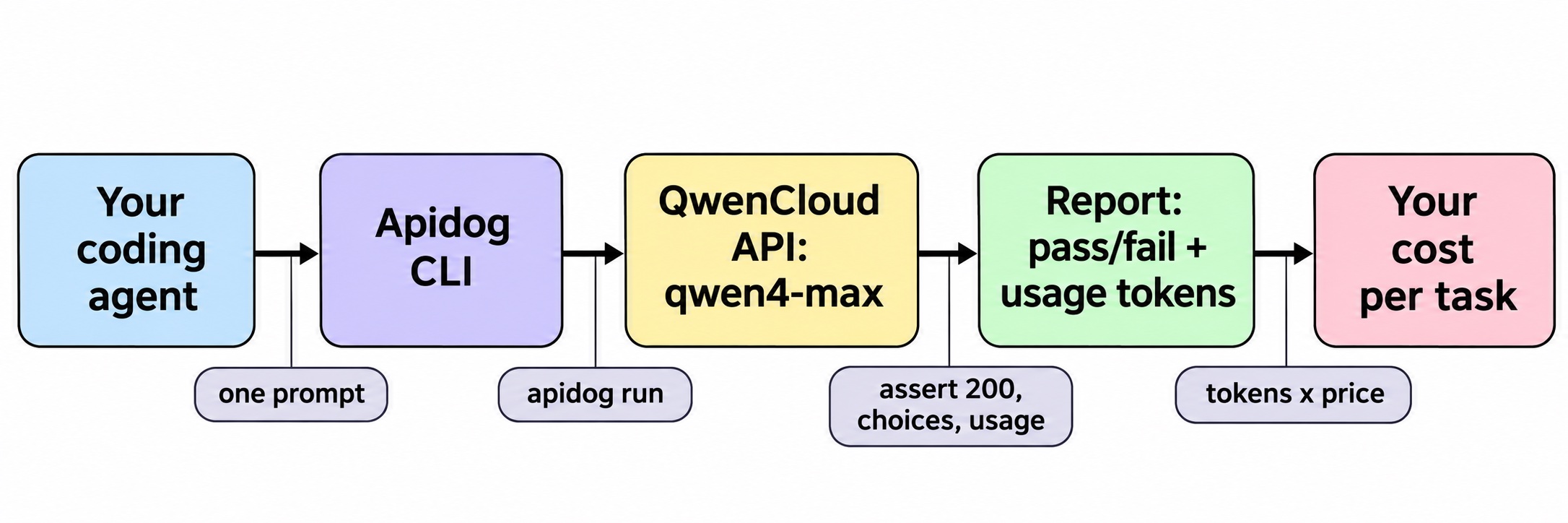
Let your coding agent do the setup with Apidog CLI. Install it once:
npm install -g apidog-cli@latest
apidog auth login --with-token <YOUR_APIDOG_TOKEN>
apidog skill install
apidog skill install teaches your agent the CLI; the installation guide covers tokens. Then give it one prompt:
In Apidog project <projectId>, add POST /chat/completions for the QwenCloud
OpenAI-compatible API (model qwen4-max, Bearer auth from {{DASHSCOPE_API_KEY}}).
Create an environment "qwencloud-sg" with base URL
https://ap-southeast-1.maas.qwencloudapi.com/compatible-mode/v1.
Create a test case that asserts status 200, a non-empty choices array and a
usage object. Run it once per row of ./prompts.csv, save a JSON report, and
give me pass rate plus total prompt and completion tokens.
The agent checks each payload shape before it writes anything. Every flag below comes from apidog <command> --help on Apidog CLI 2.2.12:
apidog cli-schema get endpoint-create
apidog cli-schema validate endpoint-create --file ./qwen-chat.json
apidog endpoint create --project <projectId> --file ./qwen-chat.json
apidog environment create qwencloud-sg --project <projectId> --base-url https://ap-southeast-1.maas.qwencloudapi.com/compatible-mode/v1
apidog cli-schema get test-case-create
apidog cli-schema validate test-case-create --file ./case.json
apidog test-case create --project <projectId> --file ./case.json
apidog run --test-case <caseId> --project <projectId> -e <envId> -d ./prompts.csv --env-var "DASHSCOPE_API_KEY=$DASHSCOPE_API_KEY" -r cli,json
-d runs one iteration per row of your prompt file, and --env-var passes the key at run time so it never sits in the project. The agent reads each usage block from the JSON report in apidog-reports. Multiply prompt tokens by $1.50 and completion tokens by $4.50 per million and you have your own cost per task to set against Alibaba’s $1.67.
Swap the environment to run the same suite against your current model, and repeat it two or three times to see the variance the launch chart doesn’t show. The same apidog run line goes into CI with -r junit; see the CI/CD guide. For a step-by-step agent setup, see Apidog CLI in Claude Code. Apidog’s Free plan covers up to 4 users.
FAQ
Are the Qwen4-Max benchmarks independent? Mostly not. Ten of the 16 scores in Alibaba’s chart are its own runs. Six are cited from third-party leaderboards: APEX-Agents (Mercor), AA-Briefcase and AutomationBench-AA (Artificial Analysis), CodeArena and AgentArena (LM Arena), HLAB-Vals (Vals) and Agents’ Last Exam.
What is Work360? Alibaba’s own benchmark for complex industry tasks across 26 domains. Qwen4-Max scored 52.69 against 47.74 for Qwen3.8-Max; only those two models appear in its published comparison.
How does Qwen4-Max do on Terminal-Bench 4.0? Alibaba reports 48.5, up from 38.9, with about half the tokens. Other frontier models in the chart score 56.1 to 67.2.
Is Qwen4-Max cheaper to run than Qwen3.8-Max? On Alibaba’s Work360 evaluation, average cost per task fell from $4.43 to $1.67. List prices are $1.50 input and $4.50 output per 1M tokens. See the Token Plan guide for subscription options and Qwen4-Max for free for no-cost routes.
What is Live Delivery in the Qwen4-Max launch? An agent workflow that ships a usable first version early and improves it while you steer. It isn’t a benchmark. Our Qwen Live Delivery plugin guide covers it.