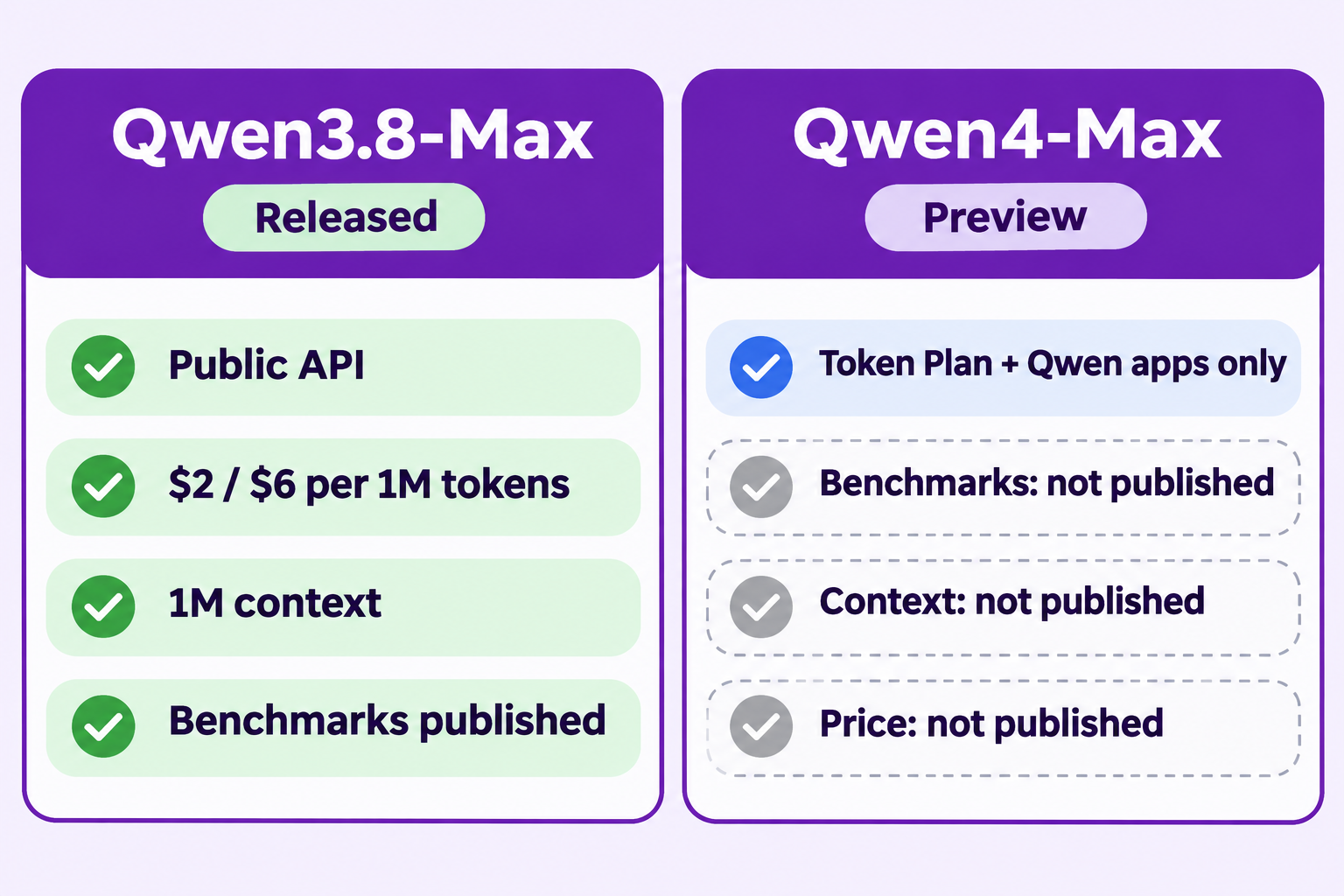
Qwen4-Max vs Qwen 3.8 comes down to this: Qwen4-Max is a preview you can only use through Alibaba’s Token Plan and its own apps, with no benchmarks, context length or per-token price published. Qwen3.8-Max is a released model with a public API at $2/$6 per million tokens, a 1M-token context and a 131K output limit. Pick Qwen 3.8 for production. Test Qwen4-Max on your own work.
That’s the picture on November 11, 2026, the day Alibaba’s Qwen team put Qwen4-Max into preview. Below: what’s new, what you can verify, what you can’t yet, and a hands-on test. New to either model? Start with what Qwen4-Max is and what Qwen 3.8 is.
Qwen4-Max vs Qwen 3.8 at a glance
Every row comes from Alibaba’s own pages, checked November 11, 2026.
| Qwen4-Max (preview) | Qwen3.8-Max | |
|---|---|---|
| Status | Preview, announced Nov 11, 2026 | Released, generally available since August 2026 |
| Model ID | qwen4-max-preview (Token Plan) |
qwen3.8-max |
| Pay-per-token API | Not published | Yes, OpenAI- and Anthropic-compatible |
| Per-token price | Not published | $2 input / $6 output per 1M tokens |
| Context window | Not published | 1M tokens |
| Max output | Not published (Qwen Code default: 32,768) | 131K tokens |
| Inputs | Text and images (Token Plan tags) | Text, images and video |
| Parameters | Not published | 2.4T total, Mixture-of-Experts |
| Official benchmarks | None | Vendor table published at launch |
| On Token Plan | Yes, “Limited-Time 80% Off” | Yes, “40% Off Nights” |
Sources: the Qwen3.8-Max model page and the Token Plan pricing page. Qwen4-Max has no model page yet; its URL returned a 404 when we checked.
What Alibaba says changed in Qwen4-Max
The announcement on X opens with “Qwen4 is coming” and lists four improvements. These are the Qwen team’s claims, not measured results:
- Deeper knowledge. Better answers on specialist topics.
- Richer world understanding. Better reasoning about real-world context.
- Stronger coding and agentic capabilities. Better planning, tool use and multi-step work.
- Built for real-world tasks. The post names “complex coding and knowledge work,” “front-end builds” and “professional software workflows.”
Notice how close that is to Qwen 3.8’s own pitch. The Qwen3.8-Max model page already describes “a comprehensive leap in coding and professional work” and autonomous projects “spanning 10+ days.” The direction hasn’t changed; Qwen4-Max claims to go further down the same road. The post closes with “Put it to the test on a real problem,” which is fair, because no spec sheet exists yet.
What you can actually compare today
Five differences are verifiable today.
1. Release stage. Qwen3.8-Max is a released model with documented rate limits (2,000,000 tokens per minute on its model page). Qwen4-Max is a preview. Its behavior, limits or ID can change before general release.
2. How you call it. Qwen 3.8 runs on Qwen Cloud’s standard pay-as-you-go API, so you can put it behind a production backend. Qwen4-Max runs only through Token Plan endpoints and Alibaba’s apps. The Token Plan FAQ says the Individual plan is for “personal interactive development through designated tools” and bans production automation, batch scripts and background scheduled tasks.
3. Output length in practice. Qwen3.8-Max lists a 131K max output. For Qwen4-Max, the only number on record is a client default: the Qwen Code setup guide says qwen4-max-preview defaults to a 32,768-token output limit, which you can raise with generationConfig.samplingParams.max_tokens. That’s a tool setting, not a model ceiling.
4. Input types. Token Plan tags Qwen4-Max with Text Generation, Reasoning Model and Visual Understanding. Qwen3.8-Max’s model page lists text, image and video input.
5. API features. Qwen3.8-Max documents function calling, structured outputs, context caching, batch files and fine-tuning. None of that is documented for Qwen4-Max yet.
What you can’t compare yet
Four comparisons people will want aren’t possible on November 11, 2026.
- Benchmarks. Alibaba published no Qwen4-Max scores. For Qwen 3.8’s vendor numbers, see our Qwen 3.8 benchmarks breakdown.
- Context window. Some reports say Qwen4-Max has a 1M-token context. Alibaba’s own pages don’t, and Kie.ai’s deep dive notes the 1M figure belongs to Qwen3.8-Max.
- Per-token price. No pay-as-you-go listing exists, so nothing sits beside Qwen 3.8’s $2/$6. Token Plan doesn’t say how many Credits a Qwen4-Max request costs.
- Size and architecture. Alibaba hasn’t published a parameter count for Qwen4-Max. Qwen3.8-Max is a 2.4T-parameter Mixture-of-Experts model.
Treat any article that fills these cells as speculation. For access details, see how to use Qwen4-Max.
Access and pricing: Qwen4-Max vs Qwen 3.8
Token Plan is the one plan that carries both models. On November 11, 2026, its Singapore-region page showed these Individual monthly prices in US dollars:
| Plan | Event price | List price | Credits per month | Concurrent agents |
|---|---|---|---|---|
| Lite | $3.00 | $8.00 | 20,000 | 1-2 |
| Essential | $5.00 | $16.00 | 45,000 | 2-3 |
| Standard | $18.00 | $25.00 | 80,000 | 3-4 |
| Pro | $43.00 | $51.00 | 200,000 | 6-8 |
The event price is for new customers, and the page says the final price is whatever checkout shows after login. Both models draw from the same Credit pool. qwen4-max-preview carries a “Limited-Time 80% Off” tag, and qwen3.8-max carries “40% Off Nights.”
Qwen 3.8 has a full pay-as-you-go price sheet: $2 input, $6 output, $0.25 for implicit cache hits, and $1 / $3 for batch files, per million tokens. For the full Qwen 3.8 cost math, read our Qwen 3.8 API guide.
For a backend that calls a model, Qwen 3.8 is the only option of the two. For you coding with an agent, Token Plan lets you try both on one subscription.
Run your own Qwen4-Max vs Qwen 3.8 test
With no official benchmark, your own test is the best evidence. API work fits well, because an endpoint either passes its tests or it doesn’t.
The Qwen Code guide’s sample config already lists both models on the same Token Plan endpoint, so switching between them is one menu choice:
{
  "$version": 4,
  "env": { "QWENCLOUD_TOKEN_PLAN_API_KEY": "YOUR_API_KEY" },
  "modelProviders": {
    "openai": [
      { "id": "qwen4-max-preview", "baseUrl": "https://token-plan.maas.qwencloudapi.com/compatible-mode/v1", "envKey": "QWENCLOUD_TOKEN_PLAN_API_KEY" },
      { "id": "qwen3.8-max", "baseUrl": "https://token-plan.maas.qwencloudapi.com/compatible-mode/v1", "envKey": "QWENCLOUD_TOKEN_PLAN_API_KEY" }
    ]
  }
}
Put that in ~/.qwen/settings.json. Then set up the fair test:
- Write the contract once. Create one
openapi.jsonfor a small API, for examplePOST /ordersandGET /orders/{id}with validation and auth rules. Neither model writes the spec, so neither model grades its own homework. - Make two empty folders,
build-qwen4andbuild-qwen38, each with a copy of the spec. - Send the identical build prompt in each folder, with
qwen4-max-previewselected in one andqwen3.8-maxin the other: “Implement the API in openapi.json with Express. Run it on port 3001 (or 3002). Don’t change the spec.” - Record the basics: time to a running server, files written, and whether you had to step in.
Then test both builds against the same suite. That’s where Apidog CLI comes in.
Score both builds with Apidog CLI
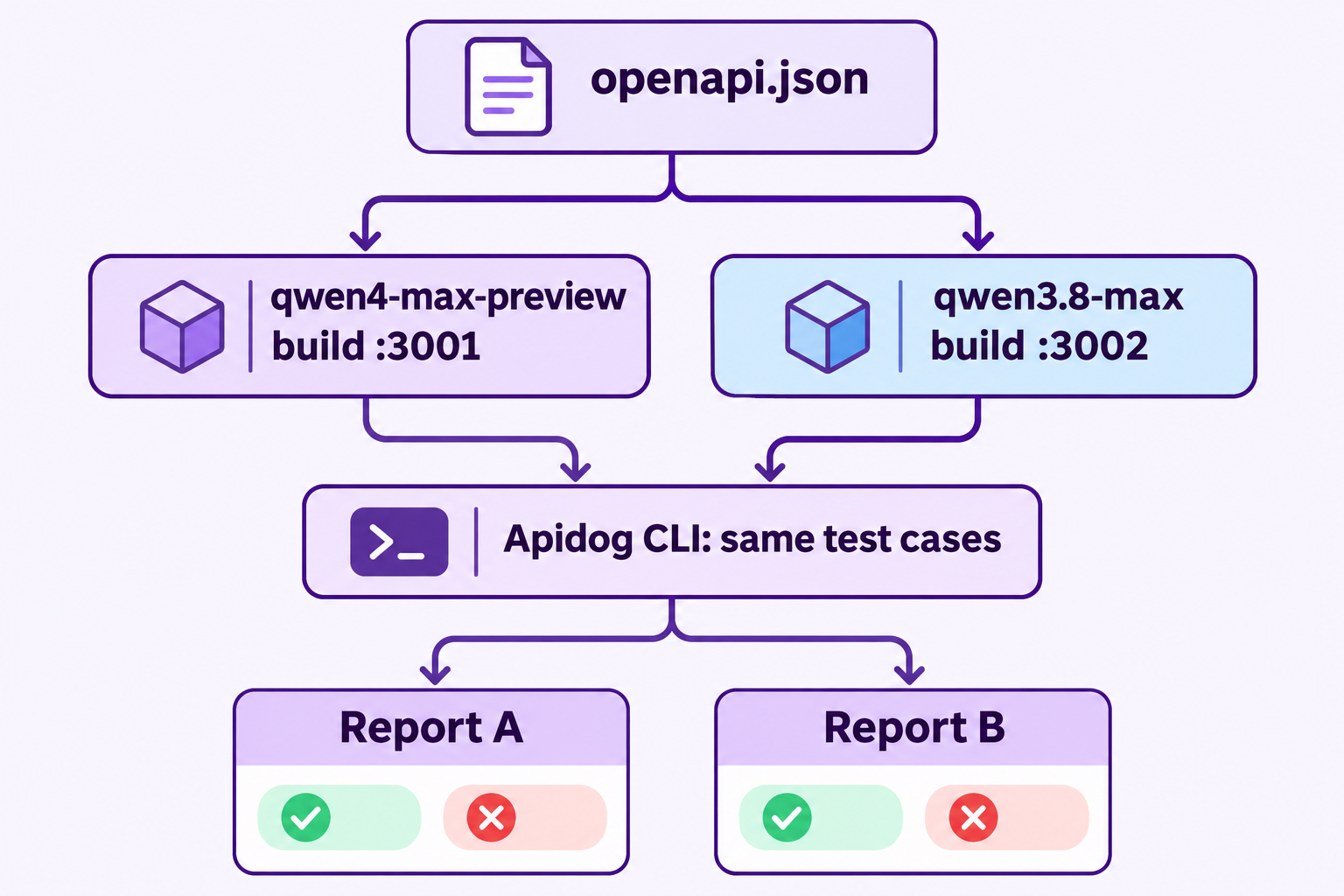
Your coding agent drives Apidog CLI: it imports the shared spec, creates one set of test cases from it, and runs that set against each build. Same tests, two targets, two reports.
Set up Apidog CLI once
npm install -g apidog-cli@latest
apidog auth login --with-token <YOUR_APIDOG_TOKEN>
apidog skill install
apidog skill install teaches your agent the CLI. The installation guide covers tokens.
Give your agent one prompt
Any agent can referee; it doesn’t have to be a Qwen model.
Import ./openapi.json into Apidog project <projectId>. Create two environments:
qwen4 at http://localhost:3001 and qwen38 at http://localhost:3002. From the spec,
create test cases for POST /orders: 201 on a valid order, 400 on a missing
customerId, 401 without a token, plus a GET /orders/{id} 404 case. Run every case
against both environments, save JSON reports, and give me a pass/fail table per model.
Don't modify either build.
The apidog commands it runs
Every flag below comes from apidog <command> --help on Apidog CLI 2.2.12:
apidog import --project <projectId> --format openapi --file ./openapi.json
apidog environment create qwen4 --project <projectId> --base-url http://localhost:3001
apidog environment create qwen38 --project <projectId> --base-url http://localhost:3002
apidog cli-schema get test-case-create
apidog cli-schema validate test-case-create --file ./case-201.json
apidog test-case create --project <projectId> --file ./case-201.json
apidog run --test-case <caseId> --project <projectId> -e <qwen4EnvId> -r cli,json --out-file qwen4-{GENERATE_TIME}
apidog run --test-case <caseId> --project <projectId> -e <qwen38EnvId> -r cli,json --out-file qwen38-{GENERATE_TIME}
cli-schema get hands the agent the exact JSON shape for a test case, and cli-schema validate checks each file before anything is written. The agent repeats test-case create and the two apidog run lines for each case. The cli reporter prints a pass/fail summary, and json saves a report in apidog-reports, which the agent reads to build its table. Add --upload-report to view a run in the Apidog app.
What to read in the reports
Count three things per model: cases passed on the first build, fix rounds needed to reach all green, and any case where the model changed the contract instead of the code. Run the whole thing two or three times, since one run of a preview model tells you little. For more agent-driven patterns, see the Apidog CLI agent workflow and Apidog CLI in Claude Code. Apidog’s Free plan covers up to 4 users.
Which should you use today?
Match the model to the job:
- Production app or backend: Qwen 3.8. It has a public API, a published price and documented limits. Token Plan rules rule out Qwen4-Max here.
- Coding with an agent: try both on Token Plan. Run the test above on a task from your real backlog, not a toy.
- Decisions that need numbers: wait. Benchmarks, context length and price for Qwen4-Max aren’t out yet.
Keep the model ID in one config value, so the stable Qwen4-Max ID is a one-line change. See also Qwen 3.8 for coding and our guide to the best Qwen models.
FAQ
Is Qwen4-Max better than Qwen 3.8? Alibaba says it has deeper knowledge and stronger coding and agentic skills, but it hasn’t published benchmarks. No official data proves it yet, so test both on your own task.
Can I call Qwen4-Max through the API like Qwen 3.8? Not on pay-as-you-go. Qwen4-Max is available through Token Plan endpoints with the ID qwen4-max-preview, for interactive use in coding tools. Qwen3.8-Max (qwen3.8-max) has a standard API.
Does Qwen4-Max have a 1M-token context like Qwen 3.8? Alibaba hasn’t said. Qwen3.8-Max has a documented 1M context. The 1M figure for Qwen4-Max comes from third-party reports only.
How much does Qwen4-Max cost compared with Qwen 3.8? Qwen 3.8 costs $2 input and $6 output per million tokens. Qwen4-Max has no per-token price yet. Through Token Plan, both share a Credit pool on plans from $3 (Lite event price, list $8) a month.
Should I switch my app from Qwen 3.8 to Qwen4-Max? Not yet. A preview can change without notice, and Token Plan bans production automation. Keep Qwen 3.8 in production and run Qwen4-Max side by side in development.