
Qwen4-Max is the first model of Alibaba’s Qwen4 generation, released as a preview on November 11, 2026. The Qwen team pitches it at coding, agentic work, front-end builds and professional software workflows. You can try it today through Alibaba’s Token Plan subscription and in four of Alibaba’s own apps. There’s no public pay-per-token API, published price or official benchmark yet.
What is Qwen4-Max?
Qwen4-Max is Alibaba’s new flagship large language model and the top tier of the Qwen4 family. The Qwen team announced it on November 11, 2026 as a preview. It’s a reasoning model with text generation and visual understanding, aimed at complex coding, knowledge work, front-end builds and agent-driven software workflows.
The announcement came from the official Qwen account on X with a short headline: “Qwen4 is coming.” In other words, Qwen4-Max is the first public piece of a larger release. The rest of the family hasn’t shipped yet.
If you’ve followed the previous generation, Qwen4-Max sits where Qwen3.8-Max sat. It’s the largest and most capable model in the lineup, served through Alibaba’s cloud rather than as downloadable weights. For background on that generation, see what Qwen 3.8 is and the roundup of the best Qwen models.
What Alibaba says changed in Qwen4-Max
The announcement lists four improvements. Read them as the Qwen team’s own claims, because no benchmark or model card backs them yet:
- Deeper knowledge. It’s meant to answer more accurately on specialist topics.
- Richer world understanding. It should reason better about real-world context, not just text patterns.
- Stronger coding and agentic capabilities. It’s built to plan, call tools and finish multi-step tasks.
- Real-world task focus. The post names “complex coding and knowledge work,” “front-end builds” and “professional software workflows” as the target jobs.
The post ends with: “Put it to the test on a real problem. Show us what you build.” It’s a hands-on trial for developers, not a finished product with a spec sheet.
The Token Plan page adds one hard detail. It lists the model as qwen4-max-preview with three capability tags: Text Generation, Reasoning Model and Visual Understanding. So the model accepts images as input, not just text.
What “preview” means for Qwen4-Max
A preview release means the model is live but not final. For you, that has four practical effects:
- Behavior can change. Alibaba can update the weights or settings behind
qwen4-max-previewwithout notice. Results you get this week may differ next week. - The model ID is temporary. The
-previewsuffix suggests a stable ID will replace it at general release. Don’t hard-code it anywhere you can’t change quickly. - Access is limited. It’s available through a subscription and Alibaba’s own apps, not through the standard pay-per-token API.
- The paperwork comes later. Model cards, benchmarks, context limits and per-token prices usually ship with the general release.
It’s fine for trying the model. Don’t build production systems on it yet.
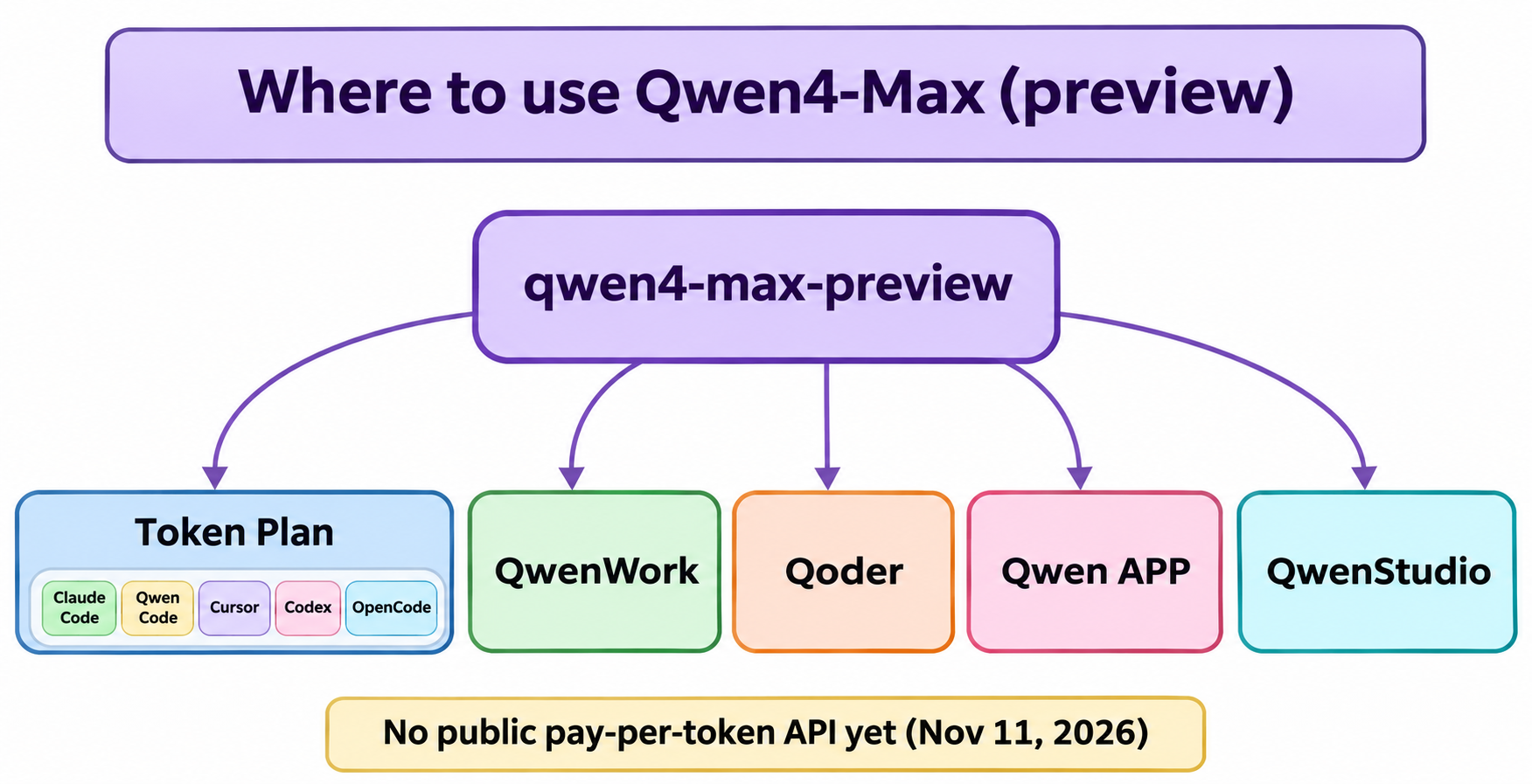
Where you can use Qwen4-Max today
Alibaba named five places to use Qwen4-Max as of November 11, 2026:
| Where | What it is | Best for |
|---|---|---|
| Token Plan | Qwen Cloud subscription with credits across many models | Using Qwen4-Max inside Claude Code, Qwen Code, Cursor, Codex, OpenCode, Cline and similar tools |
| QwenWork | Alibaba’s AI productivity app for desktop and browser | Turning a goal into reports, slides or web pages |
| Qoder | Alibaba’s agentic coding platform (IDE, CLI, JetBrains plugin) | Coding inside an editor or terminal |
| Qwen APP | The Qwen chat app | Quick chat tests |
| QwenStudio | A Qwen web interface named in the announcement | Trying prompts without setup |
The announcement calls the four apps “early access,” so availability inside each one may roll out gradually. If you’re a developer, Token Plan is the route that matters most, because it lets you use Qwen4-Max as the model behind the coding agent you already use.
Qwen4-Max on the Token Plan
Token Plan is Qwen Cloud’s subscription for AI coding tools. You pay monthly, get a pool of credits, and spend them on any supported model through OpenAI-compatible and Anthropic-compatible endpoints. On November 11, 2026, the Singapore-region Token Plan page showed:
- Model ID:
qwen4-max-preview, tagged “Limited-Time 80% Off” on credit usage. - Plans: Lite, Essential, Standard and Pro, each with a monthly credit allowance (Lite lists 20,000 credits a month, Pro lists 200,000).
- Prices: shown in US dollars, with a new-customer promotion starting from $3 and a note that the final price is set at checkout.
- Supported tools: Qwen Code, Cline, Claude Code, Cursor, OpenCode, Codex, Kilo CLI and OpenClaw.
Setup is short. Subscribe, copy your API key and base URL from the API Keys page, and enter both in your tool. The Token Plan tool guide lists the Anthropic-compatible base URL as https://token-plan.maas.qwencloudapi.com/apps/anthropic and the OpenAI-compatible one as https://token-plan.maas.qwencloudapi.com/compatible-mode/v1. Then set the model to qwen4-max-preview.
One rule matters more than the price. The Token Plan FAQ says the service is “for interactive use in compatible AI programming and agent tools only” and “cannot be used for automated scripts or application backends.” The tool guide also excludes API testing tools and automation platforms, and warns that a plan key used outside that scope can be suspended. So use Qwen4-Max in your coding agent, not in your app’s backend.
For plan-by-plan detail, read our Qwen4-Max Token Plan guide. For a step-by-step setup, see how to use Qwen4-Max.
What’s still unknown about Qwen4-Max
Here’s what Alibaba has and hasn’t published, checked on November 11, 2026:
| Question | Status |
|---|---|
| Public pay-per-token API | Not published. Qwen Cloud’s model marketplace has no Qwen4-Max page yet |
| Per-token price | Not published |
| Official benchmarks | None published |
| Context window | Not published by Alibaba |
| Parameter count and architecture | Not published |
| Open weights | Not announced |
| Stable model ID | Not published; preview ID is qwen4-max-preview |
| General release date | Not announced |
Be careful with numbers you see elsewhere. Several reports quote a 1M-token context window for Qwen4-Max. AlphaSignal’s write-up traces that figure to a default setting in the Qwen Code client, which doesn’t confirm the server’s limit. Until Alibaba publishes a spec, treat 1M as unconfirmed.
The same goes for benchmark scores. Any chart you see now is either from Qwen3.8-Max or from independent testers. Qwen3.8-Max did support a 1M context window per its Qwen Cloud model page, so a similar or larger window for Qwen4-Max is plausible. Plausible isn’t published, though.
For a broader look at what the Qwen4 family may look like, Kie.ai’s deep dive collects what was shown at Alibaba’s September conference. For a side-by-side with the current generation, see Qwen4-Max vs Qwen 3.8 and our Qwen 3.8 benchmarks.
Put Qwen4-Max to the test on your own API with Apidog CLI
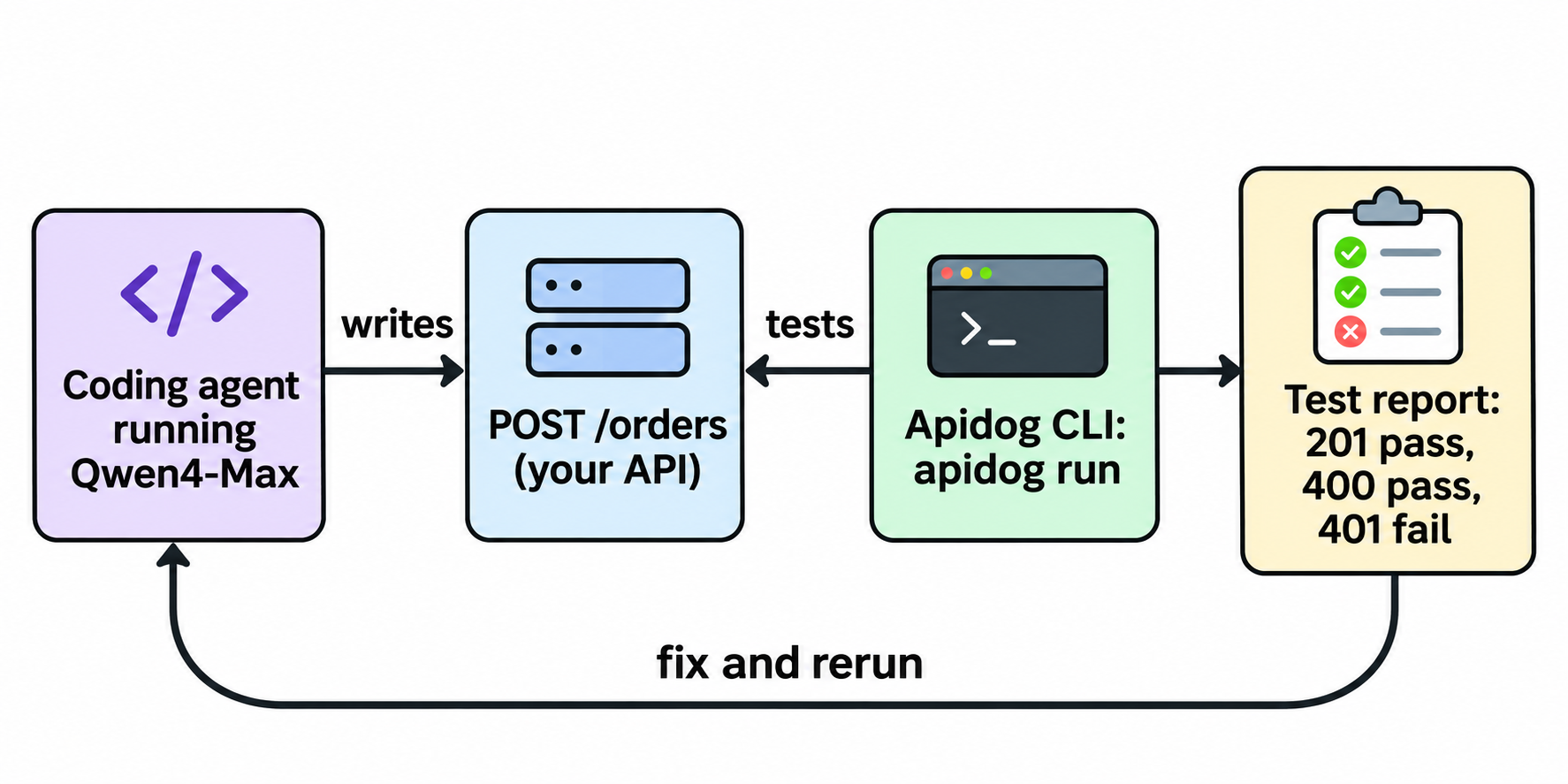
Alibaba asked developers to test Qwen4-Max “on a real problem.” Building or fixing an API endpoint is a good one, because you can check the result objectively. The model writes the code, and a test run tells you whether it works.
You don’t need to write those tests by hand. Your coding agent, running on Qwen4-Max through Token Plan, can drive Apidog CLI to create test cases for the endpoint it just built and run them. That’s interactive use inside your coding tool, which is what Token Plan allows. The tests hit your own API, not Qwen’s endpoint.
Set up Apidog CLI once:
npm install -g apidog-cli@latest
apidog login --with-token <YOUR_APIDOG_TOKEN>
apidog skill install
The skill teaches your agent the CLI’s commands. Then give your agent one prompt:
You just built POST /orders in this repo. Export its OpenAPI spec, import it into
Apidog project <projectId>, then create test cases that check a 201 on a valid order,
a 400 on a missing customerId, and a 401 without a token. Run them against the
local environment <envId>, fix any failures in the code, and run them again.
The agent turns that into a short sequence of apidog commands. Every flag below comes from apidog <command> --help on Apidog CLI 2.2.12:
apidog import --project <projectId> --format openapi --file ./openapi.json
apidog cli-schema get test-case-create
apidog cli-schema validate test-case-create --file ./case-201.json
apidog test-case create --project <projectId> --file ./case-201.json
apidog run --test-case <caseId> --project <projectId> -e <envId> -r cli,json
cli-schema get gives the agent the exact JSON shape for a test case, and cli-schema validate checks its file before anything is written. apidog run prints a pass/fail summary in the terminal and saves a JSON report the agent reads to decide what to fix. Add --upload-report to view the same run in the Apidog app.
This loop is also a fair way to judge the preview. Count how many fix-and-rerun rounds Qwen4-Max needs before every case passes, then try the same prompt on the model you use today. For more on the pattern, see the Apidog CLI agent workflow and Apidog CLI in Claude Code. Apidog’s Free plan covers up to 4 users.
Should you try Qwen4-Max now?
It depends on what you need:
- Try it now if you already pay for a coding agent workflow and want an early read on Alibaba’s next flagship. The 80% credit discount makes experiments cheap while it lasts.
- Wait if you need an API for an app backend. Token Plan rules forbid it, and no pay-per-token listing exists yet. Our Qwen 3.8 API guide covers the current model you can call directly.
- Wait if your decision depends on benchmarks, context length or price. None of those are published.
Whatever you choose, keep the model ID in one config value. When the stable ID and API arrive, you’ll change one line.
FAQ
Is Qwen4-Max available through an API? Only through Token Plan’s compatible endpoints, and only inside supported AI coding and agent tools. As of November 11, 2026, Qwen Cloud’s model marketplace has no Qwen4-Max listing for pay-per-token API use.
What is the Qwen4-Max model ID? On Token Plan it’s qwen4-max-preview. Expect a different stable ID at general release, so keep it configurable.
How much does Qwen4-Max cost? No per-token price is published. Through Token Plan you pay a monthly subscription and spend credits; the plan page lists Qwen4-Max usage at a limited-time 80% discount. Check the live page for current plan prices.
Does Qwen4-Max have a 1M-token context window? Alibaba hasn’t said. The 1M figure in some reports comes from a client default in Qwen Code, not an official spec.
Is Qwen4-Max open source? No open weights have been announced for Qwen4-Max. Alibaba has released open-weight models in earlier Qwen generations, but nothing confirms that for this one.
Can Qwen4-Max read images? Yes. The Token Plan page tags qwen4-max-preview with Visual Understanding alongside Text Generation and Reasoning Model.