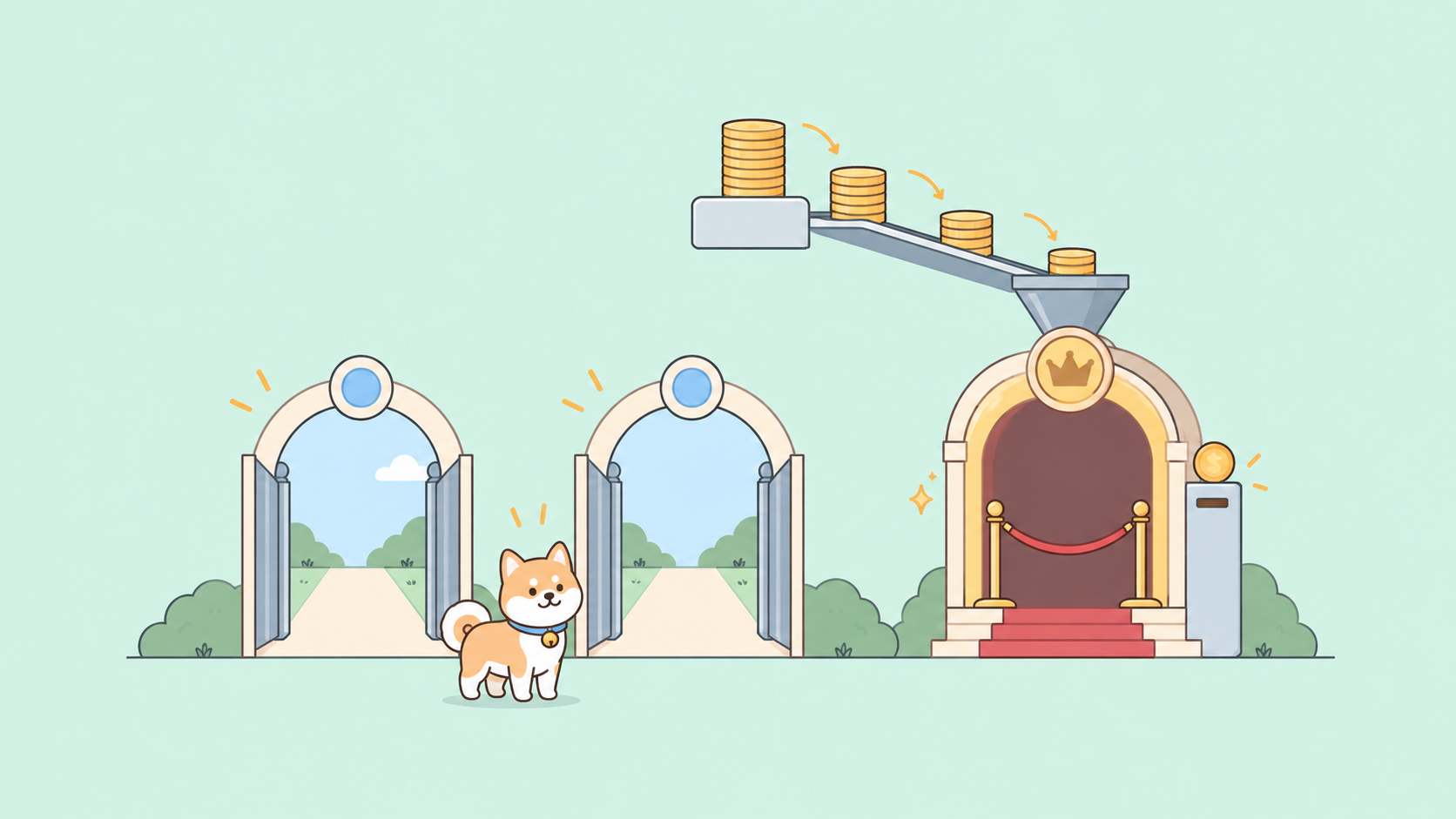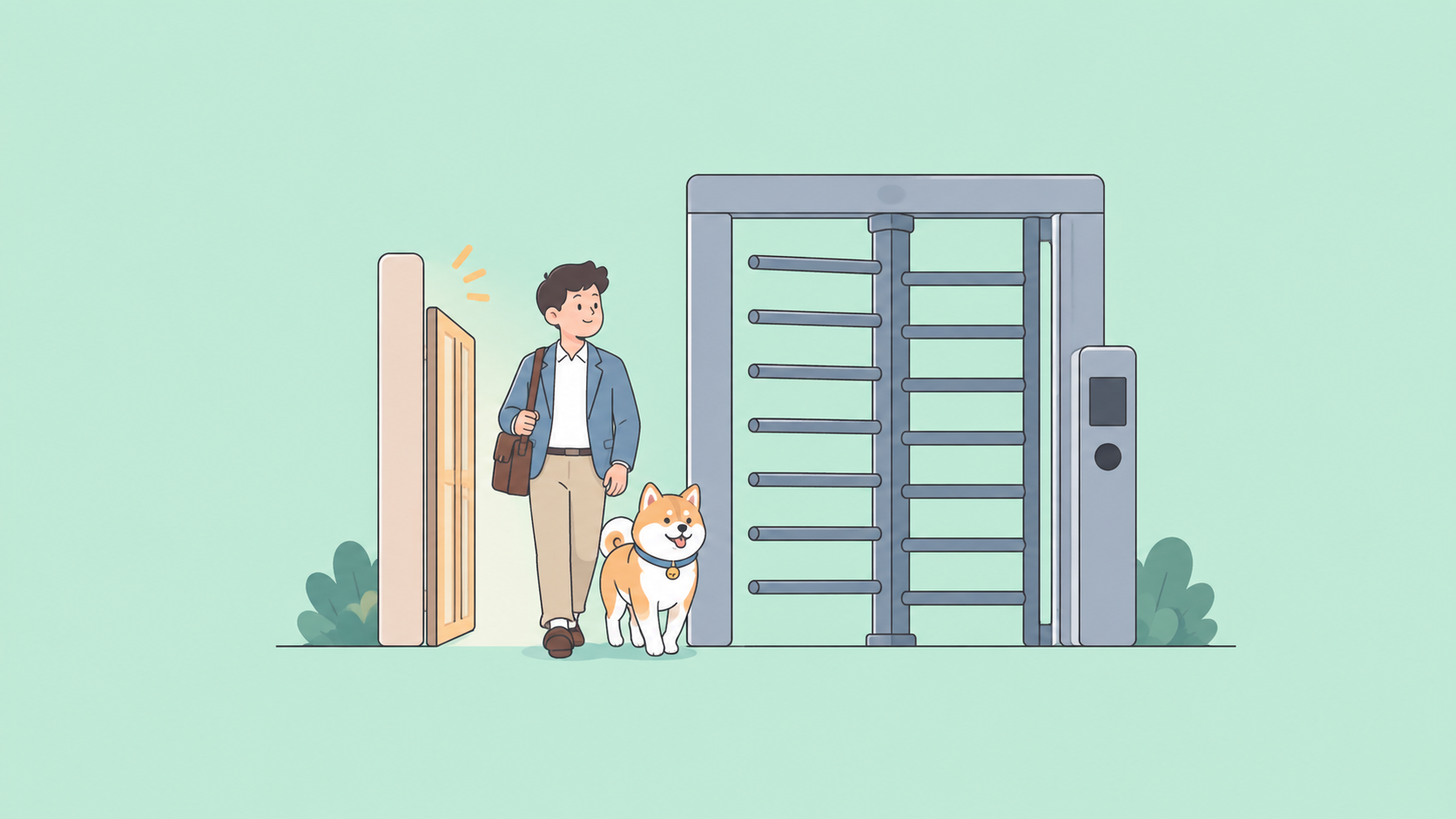
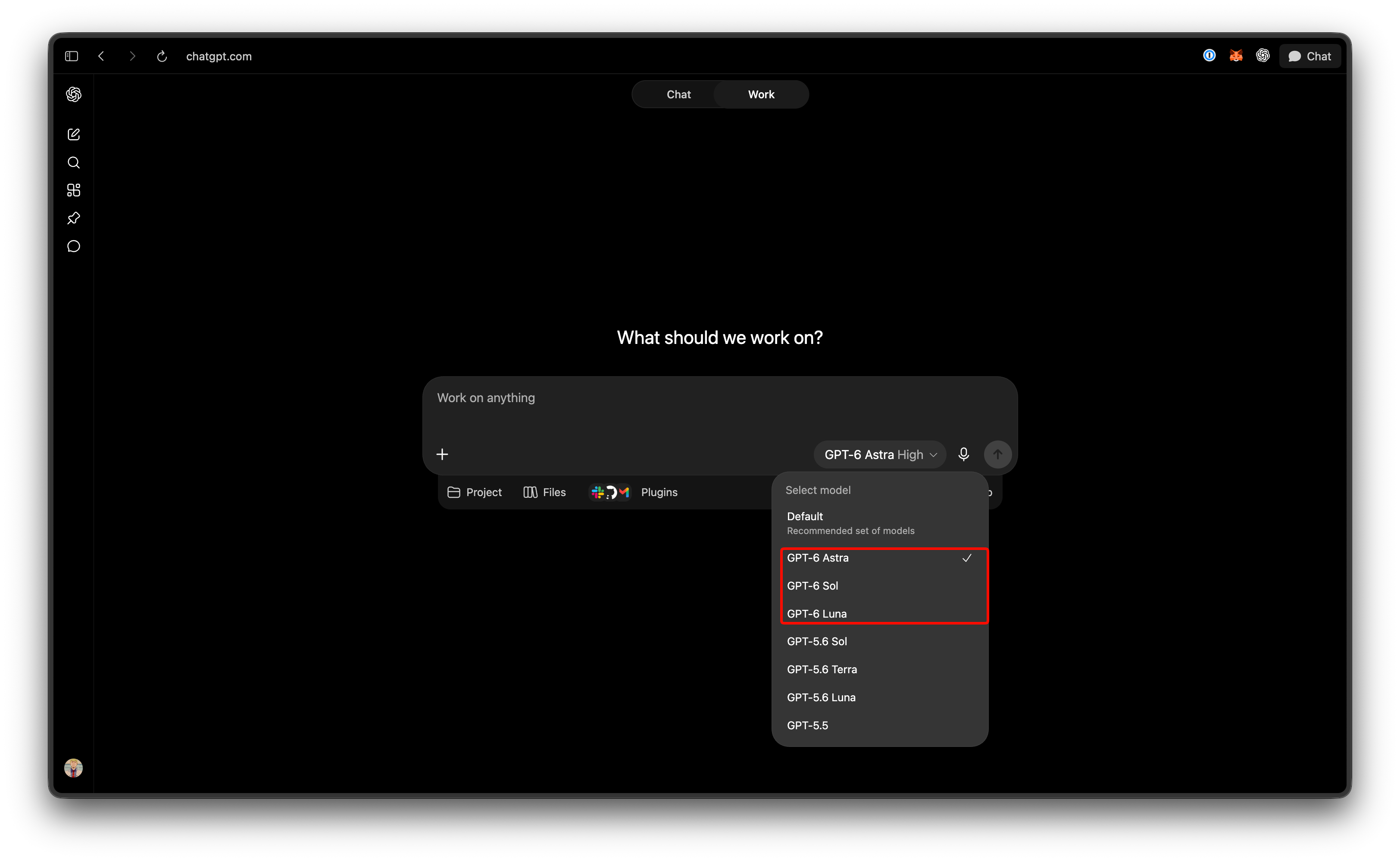
No. GPT-6 Sol is not free on any surface OpenAI shipped at launch. The availability sentence in OpenAI’s own announcement is unambiguous: Sol and Luna are in ChatGPT Work and Codex for Plus, Pro, Business, Enterprise and Edu users, and Free and Go users can access GPT-6 Luna in the desktop app. Sol is absent from that free line. Neither model is in Chat yet. On the API, gpt-6-sol is pay as you go at $2 per million input tokens and $10 per million output tokens.
Here is the part worth your time. There is a genuinely free GPT-6 model, it launched the same day, and for a large share of what people want Sol for it is the honest answer. GPT-6 Luna runs at no cost in the desktop app for Free and Go accounts, and it is not a toy: 1M token context, and 66.6% on DeepSWE 1.1 at max effort against Sol’s 68.8%. If you landed here because you wanted frontier-adjacent work without a subscription, go there first. We wrote up that route separately in how to use GPT-6 Luna for free.
This article covers the three things that are actually true: who gets Sol and how, which free routes exist and what they run out of, and what the cheapest paid path to gpt-6-sol looks like once you accept that you are paying for it.
Who gets GPT-6 Sol, at a glance
| Surface | GPT-6 Sol | GPT-6 Luna |
|---|---|---|
| ChatGPT Free | No | Yes, desktop app |
| ChatGPT Go | No | Yes, desktop app |
| ChatGPT Plus, Pro, Business, Enterprise, Edu | Yes, in Work and Codex | Yes, in Work and Codex |
| Chat | Not yet | Not yet |
| API | Pay as you go, gpt-6-sol |
Pay as you go, gpt-6-luna |
Two details in that table get misread constantly. First, “in the desktop app” is a real limit on the Luna free route, not marketing filler. Second, Work and Codex are where the paid access lives, so a Plus subscription does not put Sol in the Chat surface you may be used to.
The free route that genuinely exists
GPT-6 Luna costs $0.10 per million input tokens and $0.50 per million output on the API, and nothing at all in the desktop app on Free and Go. Its Artificial Analysis Intelligence Index score is 37 against Sol’s 48, so it is a step down, but look at where the step lands. On DeepSWE 1.1 at max effort Luna scores 66.6%, which OpenAI describes as comparable to Claude Opus 5 and Claude Fable 5 at medium effort, at 93% less per task than Opus 5 and 96% less than Fable 5. On OSWorld 2.0 offline, Luna at max beats GPT-5.6 Sol at medium for roughly a tenth of the cost. On factuality, Luna at higher effort matches GPT-5.6 Sol at about a hundredth of the cost.
Be precise about what the free half of that sentence covers. The Free and Go entitlement is interactive use of Luna inside the ChatGPT desktop app. It is not an API key and cannot drive a script, a CI job, or an automated agent run. Anything programmatic goes through the API at Luna’s $0.10 and $0.50 rates, cheap but not zero.
Read that as a shopping guide rather than a scoreboard. If your work is code edits, agentic loops over a repository, document processing, classification, or anything you would previously have handed to a mid-tier model, Luna is not a compromise you are apologizing for. Sol earns its price on the harder end: 33.2% on AutomationBench 1.0.6 at extra-high effort, 56.4% on Agents’ Last Exam V1 at max, and about half the factual errors of its predecessor.
Full spec sheets are in what is GPT-6 Sol and what is GPT-6 Luna, and the tier decision on cost per task is in Luna vs Sol vs Astra.
API trial and cloud promotional credits
The second honest free route is credits, with one property you should internalize before planning around it: a credit balance runs down and then stops. It is a trial, not a tier.
- New OpenAI API account credits. New accounts typically start with a small balance, enough to confirm an integration works and measure real token counts before a card is attached.
- Cloud promotional credits. New accounts on the major cloud platforms often include promotional credits spendable against model usage. Before planning around that, check whether the platform you are on carries
gpt-6-solat all: the launch surfaces we can source are OpenAI’s own API, ChatGPT Work and Codex, not a third-party cloud. Read each platform’s current terms directly as well, because the amounts and eligibility rules change often enough that any figure printed here would be stale within weeks.
Spend those credits on measurement, not on production traffic. Run your real prompts, read the usage block off each response, and you will know your own cost per task before you commit a budget. That is worth more than the credits themselves.
There is no free unlimited path to gpt-6-sol
Worth saying flatly, because this question attracts dishonest answers. No free tier of the OpenAI API gives you unmetered gpt-6-sol calls. No proxy, key pool, or reseller legitimately grants free frontier-model access. Those schemes break the provider’s terms, get revoked, and route your prompts through infrastructure you do not control. Once trial or promotional credits are spent, you pay per token or you stop.
The cheapest paid path
Base rate is $2 input and $10 output per million tokens. OpenAI describes that as 50% cheaper than GPT-5.6, and the qualifier in their own wording matters: it is 50% cheaper than GPT-5.6 promotional pricing, not list. The levers below move the bill much further than the headline does.
Lever 1: caching, which is the largest single discount
GPT-6 shipped with a real prompt caching release. Cached input reads are discounted 90%, which puts Sol’s effective input rate at $0.20 per million tokens on the cached portion of a prompt. That is a bigger cut than the price cut everyone wrote about.
Three things changed alongside the discount, and each removes a reason caches used to miss:
- Hit rates are higher by default.
- Changing reasoning effort or tool availability no longer invalidates the cache, so an agent that switches effort mid-run keeps its prefix.
- Explicit breakpoints let you choose where a cached prefix ends, instead of hoping the provider picks the same boundary you would.
There is also a caching dashboard and a diagnostics tool, so hit rate is now something you observe rather than infer. GitHub reports more than 50% fewer prompt tokens needing fresh processing across billions of requests. One gap to respect: our sources do not state a cache write rate for GPT-6, so do not model writes as free. The mechanics are in GPT-6 prompt caching.
Lever 2: reasoning effort, the real cost axis
Every benchmark row OpenAI published pairs a score with an effort level, and that is not decoration. Effort trades tokens for accuracy, and tokens are the bill. Sol at xhigh scores 33.2% on AutomationBench at $0.27 per task; the same model at a lower effort costs less and scores lower. A cheaper setting that needs three attempts is not cheaper, so the only way to pick correctly is to run your own evaluation at two settings and compare cost per completed task, not cost per call.
Lever 3: output tokens, which bill at five times input
At $2 in and $10 out, a response is worth five input tokens per output token. Long, chatty answers are where small bills become large ones. Ask for the shape you want, cap the response where the task allows it, and prefer structured output over prose when a machine is reading the result.
What a small credit balance actually buys
Here is the arithmetic, done on the rates above rather than on anything OpenAI printed. Take one ordinary agent step: a 40,000 token prompt and a 2,000 token completion.
| Configuration | Cost per call | Calls per $5 of credit |
|---|---|---|
| GPT-6 Sol, no cache hits | $0.100 | 50 |
| GPT-6 Sol, 32k of the prompt cached | $0.042 | 118 |
| GPT-6 Luna, no cache hits | $0.005 | 1,000 |
| GPT-6 Luna, 32k of the prompt cached | $0.0021 | 2,358 |
The cached Sol row is 32,000 tokens at $0.20 per million plus 8,000 at $2.00 plus 2,000 output at $10.00. Caching more than doubles what a fixed balance buys, and moving the same workload to Luna multiplies it by twenty.
Against agent work the unit is different again. Sol at extra-high effort costs $0.27 per task on OpenAI’s AutomationBench harness, so a $5 balance is roughly eighteen tasks of that shape before it stops. That is enough to measure with and nowhere near enough to run on, which is precisely the point of a trial balance.
For context on scale, OpenAI disclosed that its median internal researcher spends more than $600 a day on coding agents, with the 90th percentile at $7,000 a day. These rates were designed for that pattern, not for a free tier.
The cheap path is not the fast path
One trade sits underneath all of this. Artificial Analysis, a third party rather than the vendor, measures the max reasoning variant of GPT-6 Sol at 115.2 output tokens per second with a time to first token of 102.15 seconds, and Luna’s max variant at 153.9 tokens per second with 124.23 seconds to first token. [VERIFY] High effort means a long silent pause before anything arrives. If a user is waiting, or if something downstream has a timeout, drop the effort level or pick a different tier. We take that apart in GPT-6 Sol latency.
Measure it before you budget it
Vendor cost tables are measured on vendor harnesses against vendor workloads, and yours will differ. Four checks are worth running before any of this becomes a number in a spreadsheet:
- Send real production prompts and read
usageoff the response rather than estimating from character counts. - Run the same prompt against
gpt-6-solandgpt-6-lunaand compare cost per completed task, not per call. The Luna row above is only a saving if the answer is good enough. - Run two effort levels and record tokens and wall-clock time for both.
- Measure cached and uncached cases separately. A 90% discount on the wrong half of a prompt is worth very little.
That is ordinary HTTP request testing. Build the calls, save the Sol and Luna variants as separate requests, assert on response shape and watch the timings in Apidog instead of in a scratch script you throw away. Kept as a saved collection, the comparison re-runs itself the next time a price moves, which on current evidence will be soon.
The short version
GPT-6 Sol is not free, and no honest article can tell you otherwise. Free and Go accounts get GPT-6 Luna in the desktop app, which is the real answer for most people who came here looking for one. Trial and cloud promotional credits will get you measurement, not production. And if you are paying, the 90% cached-read discount and a correctly chosen effort level will do more for your bill than the launch price cut did.
Where this sits in a week that also brought Claude Opus 5.5 is covered in the September 2026 model price war, and the full rate breakdown is in GPT-6 Sol pricing.