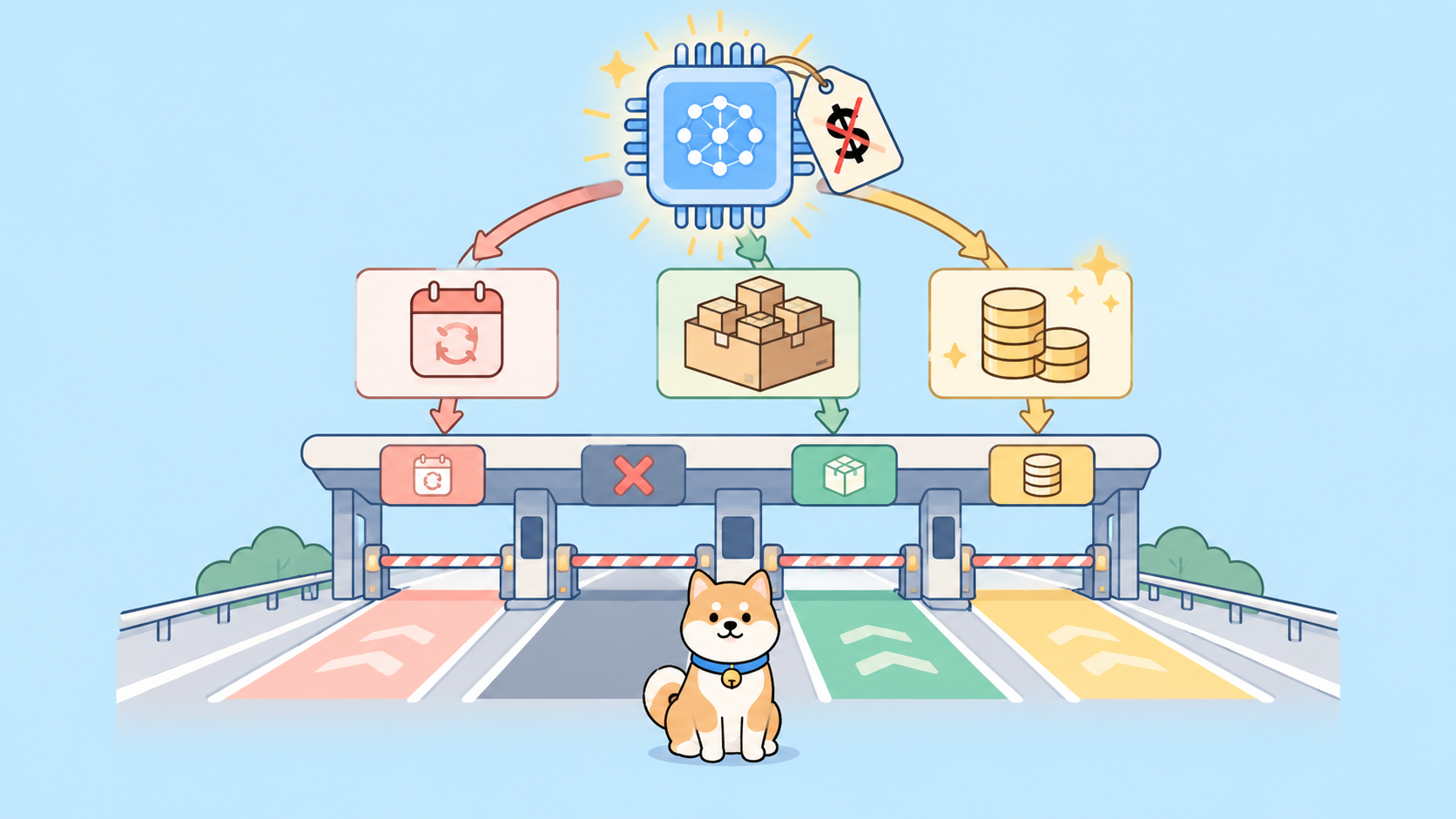
You swapped gpt-6-astra for gpt-6-sol because the token price dropped from $10 and $50 per million to $2 and $10. The invoice looks great. Then your p95 response time crosses two minutes, your load balancer starts handing back gateway timeouts, and support fills up with people asking why the page hangs.
Nothing is broken. You changed the shape of the workload, not just its price.
Artificial Analysis measures GPT-6 Sol at 115.2 output tokens per second with a time to first token of 102.15 seconds. GPT-6 Luna measures 153.9 output tokens per second at 124.23 seconds to first token. Those two numbers carry heavy caveats, which is the first half of this article. The second half is what to do about them: how to measure first-token latency honestly on your own workload, and the four design changes that keep a 100 second model from taking your API down with it.
For the wider context of three frontier launches in two days, see the September 2026 model price war.
The number, and everything wrong with quoting it
Read the caveat column before the figures column.
| Measurement | GPT-6 Sol | GPT-6 Luna | Caveat |
|---|---|---|---|
| Time to first token | 102.15s | 124.23s | Third party, “max” reasoning variant |
| Output speed | 115.2 tok/s | 153.9 tok/s | Third party, “max” reasoning variant |
| Input price per million | $2 | $0.10 | OpenAI |
| Output price per million | $10 | $0.50 | OpenAI |
| Context window | 872,000 | 1,000,000 | OpenAI |
Three things that column is telling you.
These are Artificial Analysis figures, not OpenAI’s. OpenAI published price, context, availability and a stack of benchmark scores at launch. It did not publish a latency number in the material we read. So the 102.15 seconds is a third party running its own harness on its own network, and you should treat it as directional rather than as a specification. Mark it in your own docs the way we mark it here.
They describe the “max” reasoning variant. Effort labels appear all over both vendors’ benchmark tables at launch: low, medium, high, xhigh, max. Max is the top of that ladder, and reasoning effort is the single largest lever on first-token latency. A measurement of the slowest configuration is not a measurement of the configuration you will run in production.
They are measurements of one provider’s endpoint at one moment. Serving capacity, routing and queue depth move. A launch-week figure taken during a traffic spike is a worst case masquerading as a constant.
What survives all three caveats is the direction, and the direction is the point of this article. The cheap model is not the fast model. Sol costs a fifth of Astra per token and Luna costs a twentieth of Sol, and neither of those discounts buys you a faster first byte. On this measurement the cheapest model in the family was the slowest to start.
Time to first token is the wrong name for what you are measuring
On a non-reasoning model, time to first token is roughly network plus queue plus prefill. It scales with prompt length and it lands in the hundreds of milliseconds.
On a reasoning model it is a different quantity wearing the same label. The model does its thinking before it emits anything you asked for, so the gap before the first visible token contains the entire reasoning phase. That phase has no relationship to your prompt length. It has a relationship to how hard the model decides the problem is.
Two consequences follow, and both of them bite in production.
The first is that a fast token rate does not rescue you. Sol emits at 115.2 tokens per second once it starts, which is quick. It does not matter much, because almost the whole wall clock is spent before the first token.
| Output length | Time to first token | Generation time | Total | Share spent waiting |
|---|---|---|---|---|
| 500 tokens | 102.15s | 4.3s | 106.5s | 96% |
| 2,000 tokens | 102.15s | 17.4s | 119.5s | 85% |
| 8,000 tokens | 102.15s | 69.4s | 171.6s | 60% |
Generation time is output length divided by 115.2 tokens per second, so that table is arithmetic on the two measured figures rather than a fresh measurement. Shortening your responses barely moves the total. Trimming a verbose answer from 2,000 tokens to 500 saves thirteen seconds off a two minute call.
The second consequence is that the ranking flips depending on response length. Luna has the faster token rate and the slower start. Run the two lines against each other and they cross at roughly 10,100 output tokens: below that, Sol finishes first despite generating more slowly, and above it Luna’s rate finally pays for its longer wait. Almost nothing you serve to a user is a 10,000 token response, so for most workloads the slower-starting model is simply the slower model.
What breaks first
The failure is rarely the model call itself. It is everything wrapped around it that was sized for a fast API.
Idle timeouts. Load balancers, reverse proxies, API gateways and serverless platforms all cap how long a connection may sit without bytes flowing. Plenty of those defaults sit well under two minutes. Do not trust a number you read in a blog post, including this one: go and read your own configuration. The fix is usually one directive, such as proxy_read_timeout on nginx, plus the matching setting on every hop in front of it, including the client SDK’s own timeout.
Retries. A retry policy that made sense at 300 milliseconds is dangerous at 100 seconds. Three attempts with backoff is now a five minute request, and a burst of retries during a slow period puts more concurrent work on the exact endpoint that was already struggling. Cap attempts, keep a circuit breaker, and make every call idempotent so a retry cannot double-charge or double-write.
Concurrency, which is the one people miss. Little’s Law says the number of requests in flight equals arrival rate times time in system. At one request per second and a 120 second call you need 120 concurrent in-flight requests just to keep up. Those connections occupy sockets, threads or function invocations for two minutes each, and none of that shows up on the token bill. A model that is cheap per call can still be expensive per second of held capacity.
The user interface. No spinner survives 102 seconds. If the reasoning phase is on your synchronous request path, the fix is architectural, not cosmetic.
How to measure it on your own workload
Vendor and third party numbers are a starting hypothesis. Your prompt, your region, your effort setting and your traffic pattern decide the real figure.
Start with the transport-level view, which takes one command:
curl -N -s -o /dev/null \
  -w 'dns=%{time_namelookup} connect=%{time_connect} first_byte=%{time_starttransfer} total=%{time_total}\n' \
  https://api.openai.com/v1/responses \
  -H "Authorization: Bearer $OPENAI_API_KEY" \
  -H "Content-Type: application/json" \
  -d '{"model":"gpt-6-sol","input":"Summarise this OpenAPI operation.","stream":true}'
Then read first_byte with suspicion. On a streaming endpoint the first bytes are usually a stream-open event, not a content token, so time_starttransfer measures when the server started talking rather than when the model started answering. That gap is exactly the thing you are trying to size, which is why a naive harness reports a flattering number.
Timing the first content delta is the measurement that matters:
import time
from openai import OpenAI

client = OpenAI(timeout=600)

t0 = time.perf_counter()
first_content = None

with client.responses.stream(
    model="gpt-6-sol",
    input=PROMPT,
    reasoning={"effort": "low"},
) as stream:
    for event in stream:
        if event.type == "response.output_text.delta" and first_content is None:
            first_content = time.perf_counter() - t0
    total = time.perf_counter() - t0

print(f"ttft={first_content:.2f}s total={total:.2f}s")
Field and event names in these snippets come from the current OpenAI API shapes rather than from the GPT-6 launch announcement, so check them against the reference before you ship. The measurement discipline is what carries over: record time to first content token and total time as separate metrics, keep them per model and per effort level, and report p95 rather than an average. First-token latency on a reasoning model has a long tail, and an average hides precisely the requests that time out.
Run that as a scheduled check rather than a one-off. Save the streaming request in Apidog, assert on response time, and run the scenario on a schedule in CI so a provider-side regression or an effort-level change shows up as a failing test instead of as a support ticket. The same project gives frontend work a way around the wait: point the client at an Apidog mock of your own endpoint so nobody is blocked for two minutes per iteration while the real integration is still being built. If you want the fundamentals behind the metrics, our guide to API latency covers the vocabulary.
Four changes that actually help
Get the reasoning call off the synchronous path. Accept the request, return 202 Accepted with a job id immediately, and deliver the result by polling or webhook. This is the single change that makes every other problem smaller, because the 102 seconds stops living inside an HTTP request that something upstream is waiting on.
Route by effort, not by model. The measured figures describe max reasoning. Most traffic does not need it. Classify the task first, send the routine majority at low effort, and reserve the expensive setting for the cases that earn it. OpenAI’s own launch benchmarks are reported per effort level for exactly this reason, so the setting is a first-class design decision rather than a tuning detail.
Stream, and show the wait honestly. If a human is watching, stream the response and say what is happening. A progress state that reflects reality beats a spinner that suggests something is wrong.
Budget wall clock separately from tokens. Cost per task and latency per task are independent axes, and the September launches moved one of them hard. Keep a latency budget per endpoint next to the cost budget, and treat a regression in either as a release blocker.
One thing not to assume: GPT-6’s prompt caching release cuts the price of cached input reads by 90% and raises hit rates, and it is a real saving. Neither vendor published a latency claim for it, so treat any first-token improvement from caching as something to measure rather than something to plan around.
The cheap model is not the fast model
GPT-6 Sol at $2 and $10 per million tokens is a genuine price move, and the benchmark results behind it are strong. None of that makes it quick to start. On the only public latency measurement available, the model that saves you 80% on Astra’s token price asks for more than a minute and a half before it says a word, and its cheaper sibling asks for longer still.
Price is on the invoice. Latency is in your architecture. Measure the second one yourself, with a harness that times the first content token rather than the first byte, before you promote a cheaper model into a request path that was built for a faster one.