GPT-6.1 Terra costs $1 per million input tokens, $0.05 per million cached input tokens and $5 per million output tokens on OpenAI’s API. Batch and Flex halve those rates, Fast mode doubles them, and prompts over 272K input tokens cost more. OpenAI says that’s “50% lower” than GPT-5.6 Terra. For output, the line that usually dominates an agent’s bill, the real cut is 58%, and against GPT-5.6 Terra’s launch price it’s 67%.
This guide lays out every rate, the price history, what a typical call costs on Terra and its neighbors, and how to cut the bill further. For the model itself, see what GPT-6.1 Terra is.
The full GPT-6.1 Terra rate card
Per million tokens, prompts up to 272K input tokens:
| Tier | Input | Cached input | Cache write (30 min) | Cache write (12 h) | Output |
|---|---|---|---|---|---|
| Standard | $1.00 | $0.05 | $1.25 | $2.50 | $5.00 |
| Batch / Flex | $0.50 | $0.025 | n/a | n/a | $2.50 |
| Fast mode (2x) | $2.00 | $0.10 | n/a | n/a | $10.00 |
Rules that change the bill, all from OpenAI’s GPT-6.1 Terra model page and pricing page:
- Over 272K input tokens: the full request bills at 2x input and cache rates and 1.5x output. On Standard that’s $2 input, $0.10 cached and $7.50 output.
- Regional processing: a 10% premium where data residency is available.
- Reasoning tokens bill as output, so the effort setting moves your output line.
- Batch and Flex are 50% off Standard. Batch is asynchronous; Flex runs normal requests more slowly and can return 429s.
OpenRouter’s openai/gpt-6.1-terra endpoints match these rates: flex $0.50/$2.50, standard $1/$5 and fast $2/$10, with the same higher rates above 272K. There’s no free endpoint and no free API tier. Our guide to whether GPT-6.1 Terra is free covers the plan routes.
The real cut vs GPT-5.6 Terra
OpenAI’s announcement calls Terra “a significant step up over GPT-5.6 Terra, with 50% lower standard API prices.” Here’s the lineage behind that sentence:
| Input | Cached input | Output | |
|---|---|---|---|
| GPT-5.6 Terra at launch (July 2026) | $2.50 | n/a | $15.00 |
| GPT-5.6 Terra today | $2.00 | $0.20 | $12.00 |
| GPT-6.1 Terra | $1.00 | $0.05 | $5.00 |
| Cut vs today’s price | 50% | 75% | 58% |
| Cut vs launch price | 60% | n/a | 67% |
Input is exactly half. Everything else fell further. An agent that reuses a big cached prefix and writes a lot of output pays well under half of what it paid on GPT-5.6 Terra. GPT-5.6 Terra’s launch coverage has the original rates.
Terra vs the rest of the market
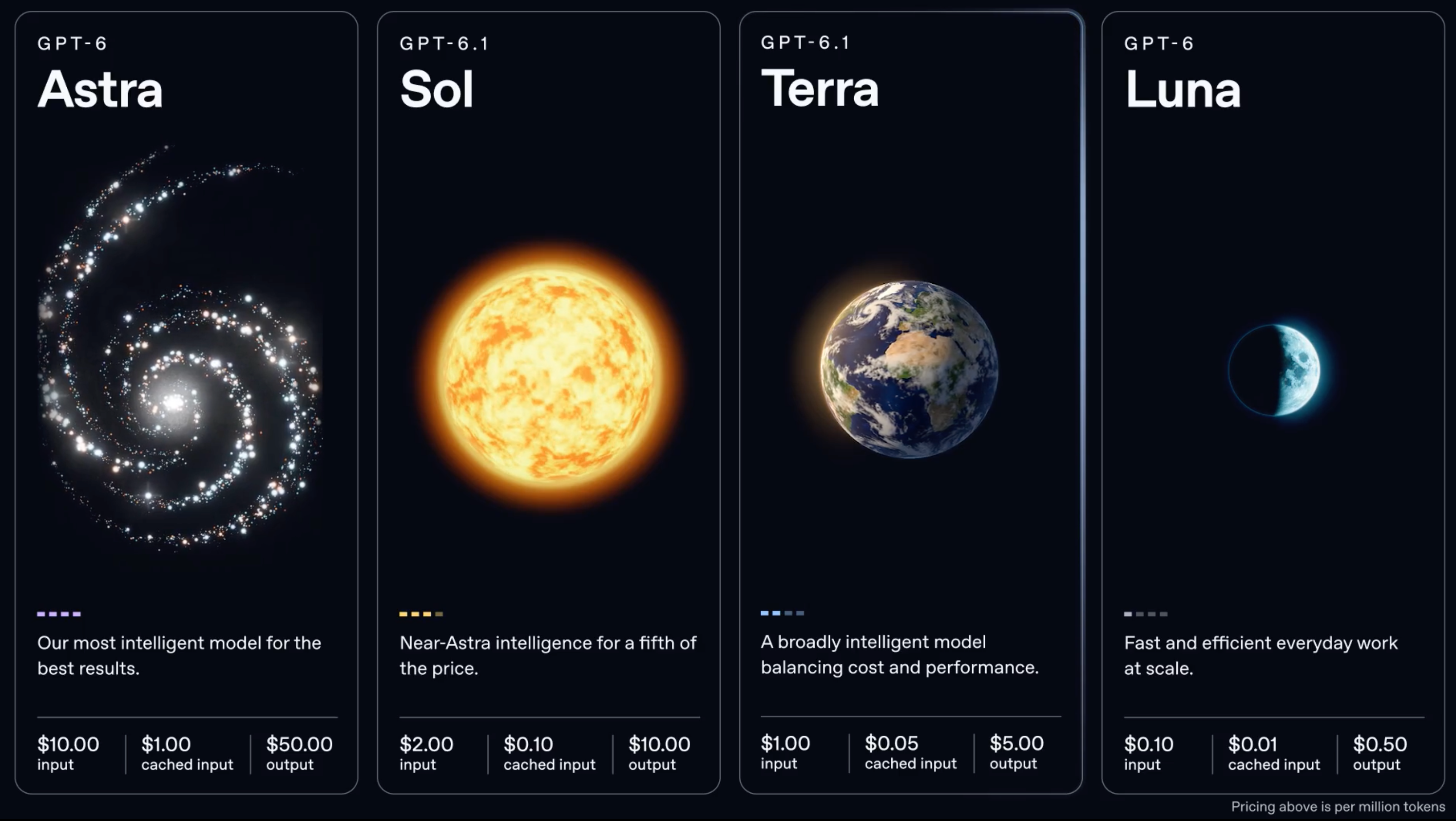
| Model | Input | Cached input | Output |
|---|---|---|---|
| GPT-6 Astra | $10.00 | $1.00 | $50.00 |
| GPT-6.1 Sol | $2.00 | $0.10 | $10.00 |
| Claude Sonnet 5.5 | $2.00 | $0.10 | $10.00 |
| GPT-6.1 Terra | $1.00 | $0.05 | $5.00 |
| GPT-6 Luna | $0.10 | $0.01 | $0.50 |
| Claude Haiku 5.5 (up to 100K) | $0.10 | $0.01 | $0.50 |
Terra is half of GPT-6.1 Sol and Claude Sonnet 5.5 on every line, and ten times GPT-6 Luna and Claude Haiku 5.5. Nothing else in this table sits at the $1/$5 point. Its competition is the decision to drop down to a budget model or step up to a $2/$10 one.
Note the different long-prompt rules: Terra and Luna get more expensive above 272K input tokens, while Haiku 5.5 moves to $0.50/$2.50 above 100K.
What a typical call costs
Take one agent step: a 100,000-token prefix that’s cached (system prompt, tool schemas, repo context), 8,000 new input tokens and 2,000 output tokens, reasoning included.
On GPT-6.1 Terra Standard:
- Cached input: 100,000 x $0.05 / 1,000,000 = $0.0050
- New input: 8,000 x $1.00 / 1,000,000 = $0.0080
- Output: 2,000 x $5.00 / 1,000,000 = $0.0100
- Total: $0.0230
The same call across models and tiers:
| Model and tier | Per call | Per 10,000 calls |
|---|---|---|
| GPT-6 Luna, Standard | $0.0028 | $28 |
| GPT-6.1 Terra, Batch / Flex | $0.0115 | $115 |
| GPT-6.1 Terra, Standard | $0.0230 | $230 |
| GPT-6.1 Sol, Standard | $0.0460 | $460 |
| GPT-5.6 Terra, Standard (today’s price) | $0.0600 | $600 |
| GPT-6.1 Terra, Fast mode | $0.0460 | $460 |
| GPT-6 Astra, Standard | $0.2800 | $2,800 |
On GPT-5.6 Terra the call costs $0.020 cached + $0.016 new input + $0.024 output = $0.060, so moving to 6.1 Terra saves 62% on this workload. Fast mode on Terra costs the same as Standard on Sol, which makes it a fair question whether you want Terra faster or Sol smarter.
The table assumes the same token counts on every model. In practice they differ: a model that reasons longer or writes more spends more output tokens. Artificial Analysis measured Terra at $0.40 per task at max effort on its benchmark suite against $1.40 for GPT-5.6 Terra, which captures token use and price together.
The two levers that matter most
Your cache hit rate. With no cache hit, the call above bills all 108,000 input tokens at $1: $0.108 plus $0.010 output, $0.118 in total. That’s five times the cached cost. Caching is automatic for prompts of at least 1,024 tokens, but only a stable prefix gets reused. Put the system prompt and tool schemas first and the per-request content last. Our GPT-6 prompt caching guide goes deeper.
Staying under 272K. At 280,000 input tokens, the whole request jumps to the long-context rates. A call with 280K fresh input and 2K output costs $0.56 + $0.015 = $0.575 instead of the $0.29 the base rates would suggest. If retrieval pushes you near the line, cut chunks before you cross it.
Then use Batch or Flex for anything that can wait (evaluations, backfills, nightly summaries) to halve the rest. The OpenAI Batch API guide walks through it.
ChatGPT plan pricing
In ChatGPT, Terra isn’t billed per token. It’s included for Plus, Pro, Enterprise and Edu users in ChatGPT Work and Codex, and OpenAI says your usage allowance “goes further” with Terra than with GPT-5.6 Terra, and much further than with GPT-6.1 Sol or GPT-6 Astra. Free and Go users get GPT-6 Luna in the desktop app instead. None of these plans comes with an API key.
Let your coding agent track the real cost with Apidog CLI
The math above uses example token counts. Your prompts decide the actual bill, and your coding agent can measure them on every change with Apidog CLI.
Set up once:
npm install -g apidog-cli@latest
apidog auth login --with-token <YOUR_TOKEN>
apidog skill install
Then give your agent one prompt:
In Apidog project <id>, create a test case for POST https://api.openai.com/v1/responses
using model gpt-6.1-terra and the prompt in prompts/agent-step.txt. Assert status 200,
usage.input_tokens under 272000, and usage.input_tokens_details.cached_tokens greater
than 0 on the second iteration. Run 2 iterations against the <env> environment and
report the cost per call at $1 input, $0.05 cached and $5 output per million tokens.
The agent checks the schema, creates the case and runs it:
apidog cli-schema get test-case-create
apidog cli-schema validate test-case-create --file case.json
apidog test-case create --project <id> --file case.json
apidog run --test-case <caseId> --project <id> -e <envId> -n 2 -r cli,json
The two assertions guard the two levers: a prompt that grows past 272K or stops hitting the cache fails the test. Add the run to CI with -r junit (see our Apidog CLI CI/CD guide) and a costly prompt change shows up in the pull request, not on the invoice. For setup in a specific agent, read Apidog CLI in Claude Code.
FAQ
How much does GPT-6.1 Terra cost? $1 per million input tokens, $0.05 cached input and $5 output on Standard, for prompts up to 272K input tokens.
Is GPT-6.1 Terra cheaper than GPT-5.6 Terra? Yes. Input is 50% lower ($1 vs $2), cached input 75% lower ($0.05 vs $0.20) and output 58% lower ($5 vs $12) than GPT-5.6 Terra’s current price.
How does Terra’s price compare with GPT-6.1 Sol? Exactly half on every line. Sol is $2 input, $0.10 cached and $10 output.
What does Fast mode cost? Double Standard: $2 input and $10 output per million tokens.
What happens above 272K input tokens? The entire request bills at 2x input and cache rates and 1.5x output: $2, $0.10 and $7.50 per million on Standard.
Bottom line
GPT-6.1 Terra is the cheapest capable model OpenAI sells: half of Sol and Sonnet 5.5, and under half of the Terra it replaces once output and caching are counted. The two things that move your bill most are the cache hit rate and the 272K line, so keep a test on both. Start with the GPT-6.1 Terra API guide, and if you’re choosing between tiers, read GPT-6.1 Terra vs GPT-6.1 Sol.