
GPT-6.1 Terra costs half as much as GPT-6.1 Sol on every line of the rate card: $1/$5 per million tokens against $2/$10. OpenAI says Terra finishes tasks more than three times faster on average. Sol is still the stronger model, by 6 points on Artificial Analysis’s Coding Agent Index (54 vs 48), and OpenAI itself recommends Sol or GPT-6 Astra for the most complex coding and in-depth research.
So the question isn’t which is better. It’s whether your workload needs the gap. This comparison puts the specs, prices, benchmarks and API differences side by side and ends with a routing rule you can use. For background on each model, see what GPT-6.1 Terra is and what GPT-6.1 Sol is.
Side by side
| GPT-6.1 Terra | GPT-6.1 Sol | |
|---|---|---|
| API model ID | gpt-6.1-terra |
gpt-6.1-sol |
| Released | October 26, 2026 | September 29, 2026 (DevDay) |
| Input / cached / output (per 1M) | $1.00 / $0.05 / $5.00 | $2.00 / $0.10 / $10.00 |
| Cache write, 30 min | $1.25 | $2.50 |
| Context window | 1,050,000 | 1,050,000 |
| Max input / output | 922,000 / 128,000 | 922,000 / 128,000 |
| Reasoning effort | none to max |
low to max (no none) |
| Endpoints | Responses, Chat Completions, Batch | Responses, Chat Completions, Batch |
| Speed (OpenAI) | Over 3x faster on average | Baseline |
| OpenAI’s positioning | Fast, efficient: writing, visual understanding, computer use | Strong all-rounder for hard coding and research |
Prices are Standard rates for prompts up to 272K input tokens, from OpenAI’s pricing page. Both models share the same long-prompt rule: above 272K input tokens the whole request bills at 2x input and cache rates and 1.5x output.
Price: Terra is exactly half
Every Terra rate is half of Sol’s. That makes the cost comparison simple: for the same token counts, Terra costs 50% less. Take an agent step with a 100,000-token cached prefix, 8,000 new input tokens and 2,000 output tokens:
| GPT-6.1 Terra | GPT-6.1 Sol | |
|---|---|---|
| Cached input (100K) | $0.0050 | $0.0100 |
| New input (8K) | $0.0080 | $0.0160 |
| Output (2K) | $0.0100 | $0.0200 |
| Per call | $0.0230 | $0.0460 |
| Per 10,000 calls | $230 | $460 |
Token counts won’t be identical in practice: the model that reasons longer spends more output. But Terra being faster suggests it isn’t buying its speed with extra tokens. Artificial Analysis measured $0.40 per task for Terra at max effort on its suite. Our GPT-6.1 Terra pricing guide has the full rate card and its Batch, Flex and Fast variants.
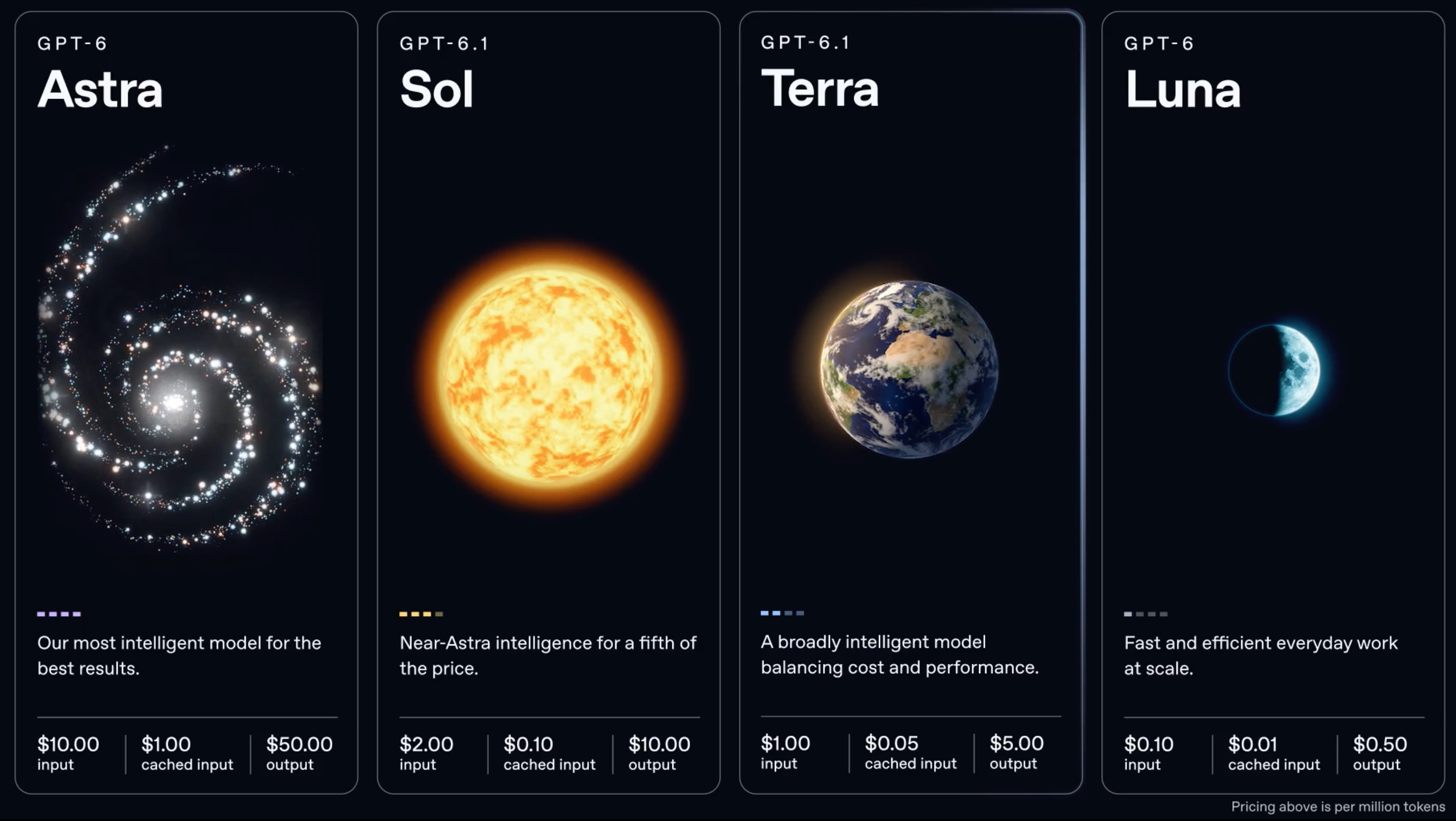
One more data point: Terra in Fast mode costs $2/$10, exactly Sol’s Standard price. If you’re paying Sol prices, you can choose between Sol’s extra capability and Terra at a higher speed.
Benchmarks: a narrow gap
| Benchmark | GPT-6.1 Terra | GPT-6.1 Sol | Source |
|---|---|---|---|
| Coding Agent Index v2.0 | 48 | 54 | Artificial Analysis |
| Intelligence Index, max effort | 4 points below Sol | Baseline | Artificial Analysis |
| Terminal-Bench 4.0, max effort | 50.3% | Rivaled by Terra at max | OpenAI; Artificial Analysis |
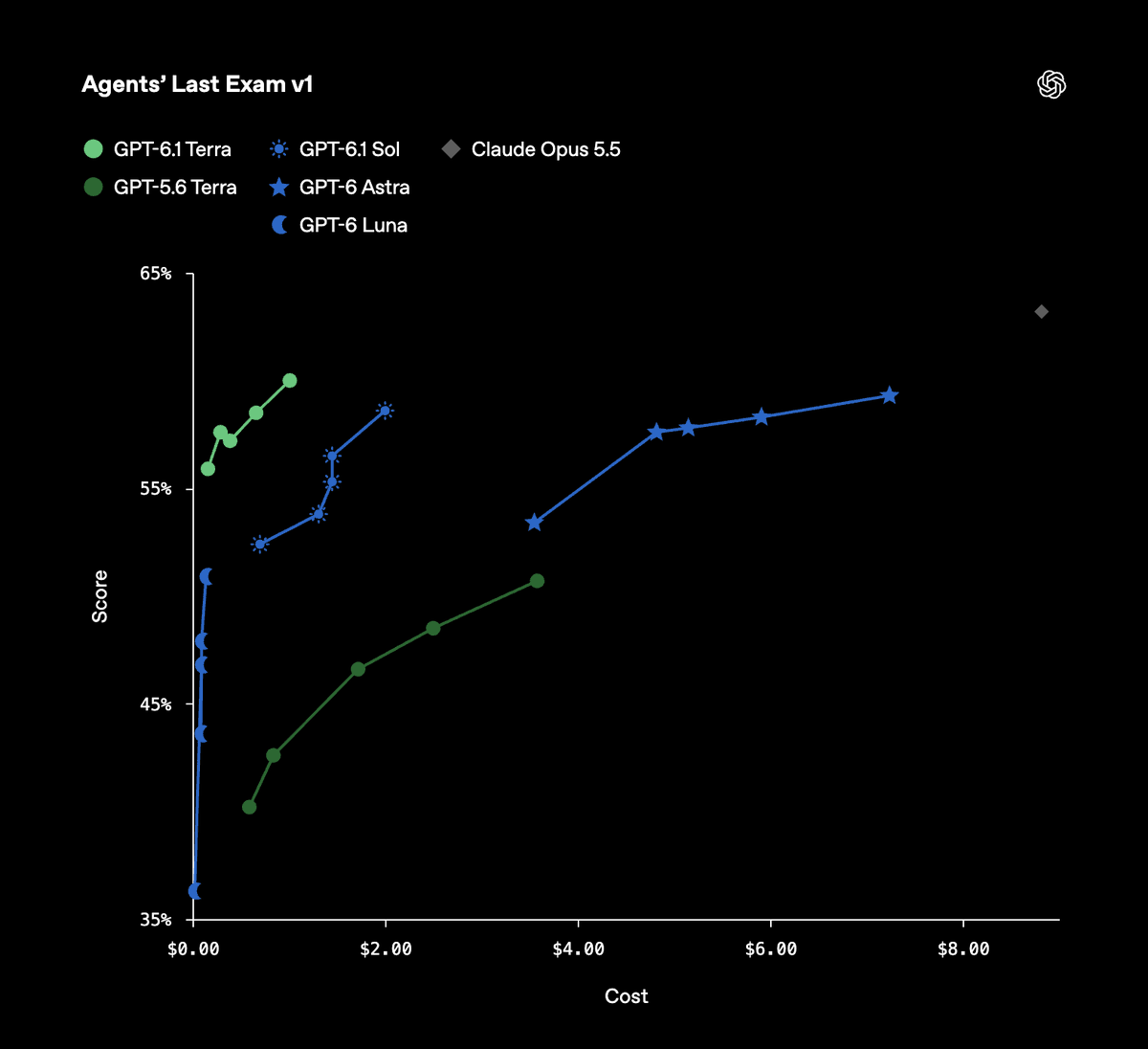
| Agents’ Last Exam | On par with GPT-6 Astra per OpenAI | n/a | OpenAI |
| Task speed | Over 3x faster on average | Baseline | OpenAI |
The figures come from OpenAI’s launch materials and Artificial Analysis. Artificial Analysis says Terra’s Terminal-Bench 4.0 score “now rivals” GPT-6.1 Sol at max effort. No source we found publishes both models’ scores on the same chart for every benchmark, so treat the table as the gap’s direction and size, not an exact ranking.
The pattern is consistent across sources: Sol leads, by single digits, on the hardest agentic coding work. On terminal tasks and general agent work, Terra is close. For a sense of scale, Terra sits 10 points above GPT-6 Luna on the same Intelligence Index, so the Sol-to-Terra step is less than half the Terra-to-Luna step.
Reliability
Terra’s biggest single improvement is in hallucinations. Artificial Analysis measured a 38% hallucination rate on its AA-Omniscience test, down from 88% for GPT-5.6 Terra. On OpenAI’s internal factuality test, Terra’s error rate at max effort is 4.3%, which OpenAI says “nearly” matches GPT-6 Astra and GPT-6.1 Sol. At low effort it’s 16.7%.
The takeaway: at high effort, Terra and Sol make a similar share of factual errors on OpenAI’s test. Sol’s edge is in harder reasoning, not basic accuracy.
API differences that affect your code
Most code runs on either model with only the model ID changed. Three differences matter:
noneeffort. Terra supportsreasoning.effort: "none"; Sol doesn’t. A developer on OpenAI’s community forum reports thatnoneon Terra also lets you settemperatureandtop_p. If you moved a classification job off GPT-6 Sol because 6.1 Sol droppednone, Terra brings it back.- Cache economics. Cached input is $0.05 on Terra and $0.10 on Sol. Agents that reuse long prefixes save proportionally more on Terra.
- Speed-sensitive logic. If your UI streams to a user or your agent runs many sequential steps, Terra’s speed changes the experience. OpenAI’s 3x figure is an average across its tasks; measure your own.
Both support the same hosted tools on the Responses API, including computer_use, web_search, file_search, code_interpreter and mcp. The GPT-6.1 Terra API guide and GPT-6.1 Sol API guide cover setup for each.
In ChatGPT and Codex
Both are in ChatGPT Work and Codex for paid plans, and neither is on Free or Go. For Terra, OpenAI lists Plus, Pro, Enterprise and Edu. The practical difference is usage: OpenAI says your Work and Codex allowance goes “far more” with Terra than with GPT-6.1 Sol or GPT-6 Astra. If you hit Codex limits on Sol, running routine tasks on Terra (codex -m gpt-6.1-terra, Codex CLI 0.159.0 or later) stretches the same plan. Our Codex usage limits guide explains how the allowance works.
Which should you use?
Use GPT-6.1 Terra for:
- Computer use: clicking through apps, reading screens, filling forms. It’s the headline use case.
- Writing and drafting, summaries, replies.
- Coding tasks of ordinary difficulty: single-file changes, tests, scripts, reviews.
- Agent loops with many steps, where speed and cost per step add up.
- Extraction and classification that need more than Luna can give, especially with
noneeffort.
Use GPT-6.1 Sol for:
- Large, multi-file refactors and architecture work.
- Long research chains where one wrong step derails the result.
- Tasks where Terra has already failed. OpenAI itself steers the hardest coding to Sol or Astra.
A routing rule that works: default to Terra, and escalate to Sol when a task fails its checks or matches a known-hard category. On a 50/50 price split, even sending a third of your traffic to Sol leaves you paying about two thirds of an all-Sol bill. If you’re comparing across labs, our GPT-6.1 Sol vs Claude Sonnet 5.5 breakdown covers the $2/$10 tier.
Let your coding agent run the comparison with Apidog CLI
Benchmarks tell you about someone else’s tasks. The fastest way to decide is to run your own prompts on both models and compare, and your coding agent can do that with Apidog CLI.
Set up once:
npm install -g apidog-cli@latest
apidog auth login --with-token <YOUR_TOKEN>
apidog skill install
Then give Claude Code, Codex or Cursor one prompt:
In Apidog project <id>, create a test case for POST https://api.openai.com/v1/responses
that sends model {{MODEL}} at reasoning effort medium, iterating over the 20 prompts in
prompts.csv. Assert status 200 and that each output passes our JSON schema. Run it with
MODEL=gpt-6.1-terra and MODEL=gpt-6.1-sol against the <env> environment, then report
pass rate, average output tokens and estimated cost for each model.
The agent validates the payload, creates the case and runs both models over the same data:
apidog cli-schema validate test-case-create --file case.json
apidog test-case create --project <id> --file case.json
apidog run --test-case <caseId> --project <id> -e <envId> -d prompts.csv --env-var "MODEL=gpt-6.1-terra" -r cli,json
apidog run --test-case <caseId> --project <id> -e <envId> -d prompts.csv --env-var "MODEL=gpt-6.1-sol" -r cli,json
If Terra’s pass rate matches Sol’s on your prompts, you’ve halved the bill with evidence. If it doesn’t, the failing rows tell you which tasks to route to Sol. Keep the comparison in CI with -r junit (Apidog CLI CI/CD guide) and rerun it whenever either model updates. See Apidog CLI in Codex for the Codex setup.
FAQ
Is GPT-6.1 Terra better than GPT-6.1 Sol? No. Sol scores higher (54 vs 48 on Artificial Analysis’s Coding Agent Index). Terra is half the price and, per OpenAI, over 3x faster.
How much cheaper is Terra than Sol? Exactly 50% on every rate: $1 vs $2 input, $0.05 vs $0.10 cached, $5 vs $10 output.
Do Terra and Sol have the same context window? Yes: 1,050,000 tokens, 922,000 input and 128,000 output for both.
Which is better for coding? Sol for the hardest work, as OpenAI recommends. Terra for everyday coding, where it’s close on terminal tasks at half the price.
Can I switch between them without code changes? Mostly. Change the model ID; if you use reasoning.effort: "none", that only works on Terra.
Bottom line
GPT-6.1 Terra gets you most of GPT-6.1 Sol at half the price and a fraction of the wait. Default to Terra, keep Sol for the hard tail, and let your agent prove the split on your own prompts with Apidog CLI before you commit.