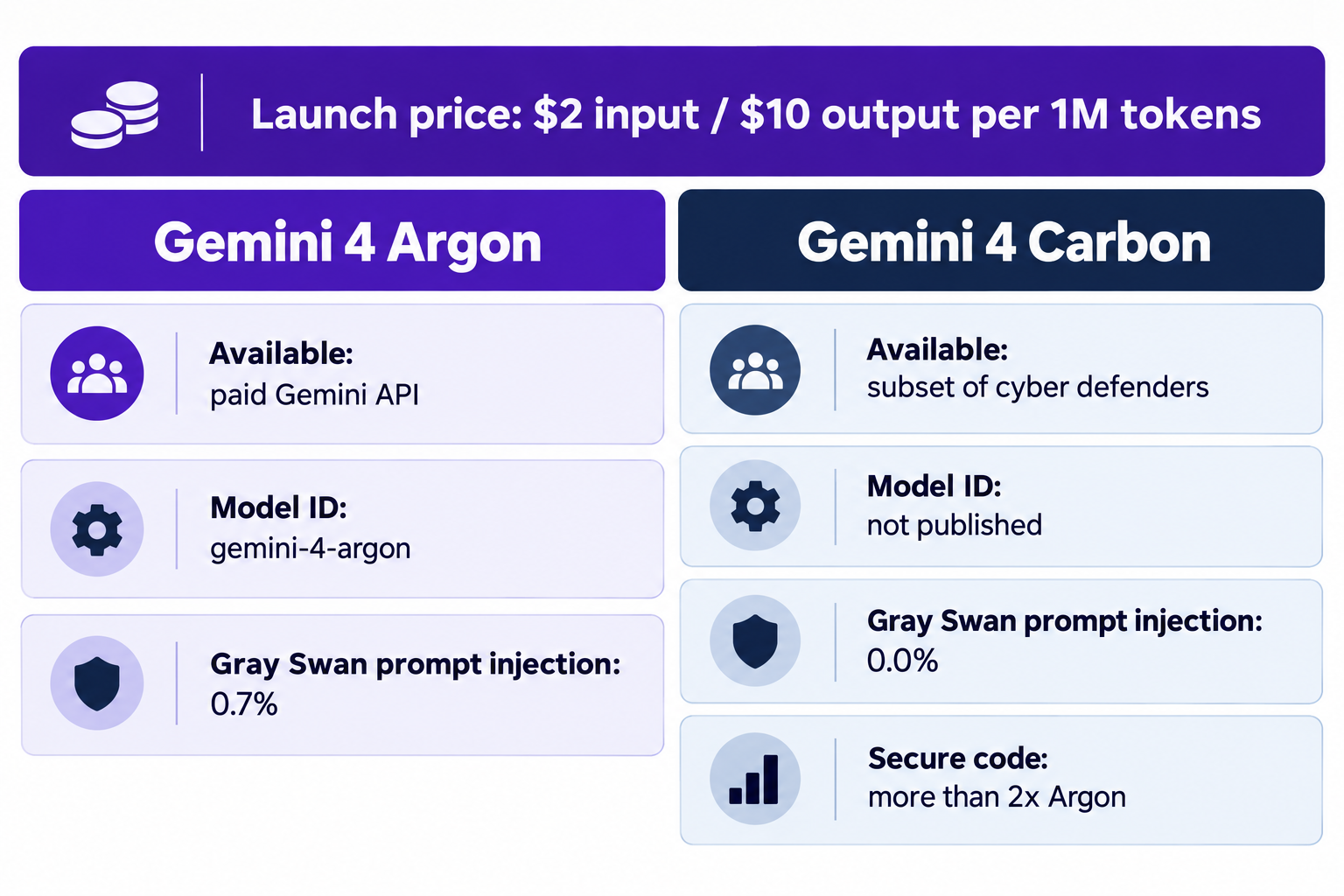
As of October 29, 2026, Google’s Gemini 4 Carbon beats Gemini 4 Argon on every benchmark Google published for both, at the same $2 input / $10 output launch price per million tokens. But Argon is the one you can actually call: Carbon is limited to “a subset of cyber defenders,” while gemini-4-argon has been generally available on the paid Gemini API since October 13.
So build on Argon today, keep the model name in config, and test Carbon the day it opens. Below: the side-by-side, where Carbon is reported weaker, what else ships today, and how to A/B the two with a coding agent.
What is Gemini 4 Carbon?
Gemini 4 Carbon is Google DeepMind’s newest frontier model, announced October 28, 2026 by Koray Kavukcuoglu as “our strongest model with state-of-the-art cybersecurity and long horizon capabilities.” It follows Argon by two weeks, keeps Argon’s safety stack and launches at Argon’s introductory price.
The full benchmark table and price math live in What is Gemini 4 Carbon?. If you’re new to Argon, start with What is Gemini 4 Argon?.
Gemini carbon vs argon: side-by-side
Only rows Google published for both models, or where the gap is the point.
| Gemini 4 Argon | Gemini 4 Carbon | Source | |
|---|---|---|---|
| Who can use it | Paid Gemini API, GA since Oct 13, 2026 | Subset of cyber defenders; Fairwind partners next | Carbon launch post, Gemini API models page |
| Model ID | gemini-4-argon |
Not published | Gemini API models page |
| Launch price per 1M tokens | $2 in / $10 out through Nov 30, 2026 | $2 in / $10 out, intro length not stated | Gemini API pricing, launch post |
| Price after intro | $4 / $20 from Dec 1, 2026 | $4 / $20, start date not stated | Same |
| Cached input | $0.10 per 1M (implicit caching only) | 95% off input ($0.10 at intro) | Same |
| Context window | 1M tokens, long decodes up to 1M | Not published | Gemini API models page |
| Free tier | No | Not published | Gemini API pricing |
| Artificial Analysis Index | Not given for v5.0 | 59, ranked #1 on v5.0 | Launch post |
| Gray Swan indirect prompt injection | 0.7% attack success | 0.0% | Launch post |
| Secure code generation (internal) | Baseline | More than 2x Argon’s success rate | Launch post |
| Unsupported claims (internal) | Baseline | About 2x fewer | Launch post |
The price tie is temporary. Argon’s $2 / $10 ends November 30, while Carbon’s intro period has no published length, so check both pricing rows on the day you switch.
On the Artificial Analysis row, Google didn’t give Argon a v5.0 score. Artificial Analysis listed Argon (High) at about 53 before the v5.0 update, so read “59 vs 53” as a direction, not a measured gap. Argon’s own 19-row table is in Gemini 4 Argon benchmarks.
Gemini 4 Carbon benchmark: where it pulls ahead
Carbon’s lead is in security and long-running agent work. Google reports these results, evaluated without guardrails:
- SEC-bench Pro: 88.2%, state of the art, for finding real vulnerabilities.
- ExploitGym: 54.8%, state of the art, for checking which vulnerabilities are exploitable.
- CWE-bench (Collinear): 71.0% for patching at the root cause.
- WebDev Arena: #4 at 1768, up 89 Elo points.
- Chrome team: more than 10x better patches than “another lab’s large frontier model,” which Google doesn’t name.
The behavior numbers matter more if you run agents unattended. On Terminal-Bench 4.0, Google says successful cheating fell to 0.0% and cheating attempts to 0.4%. In internal coding environments, high-severity misalignment alerts dropped by almost 80%. Overreach fell 26% and under-service 29%.
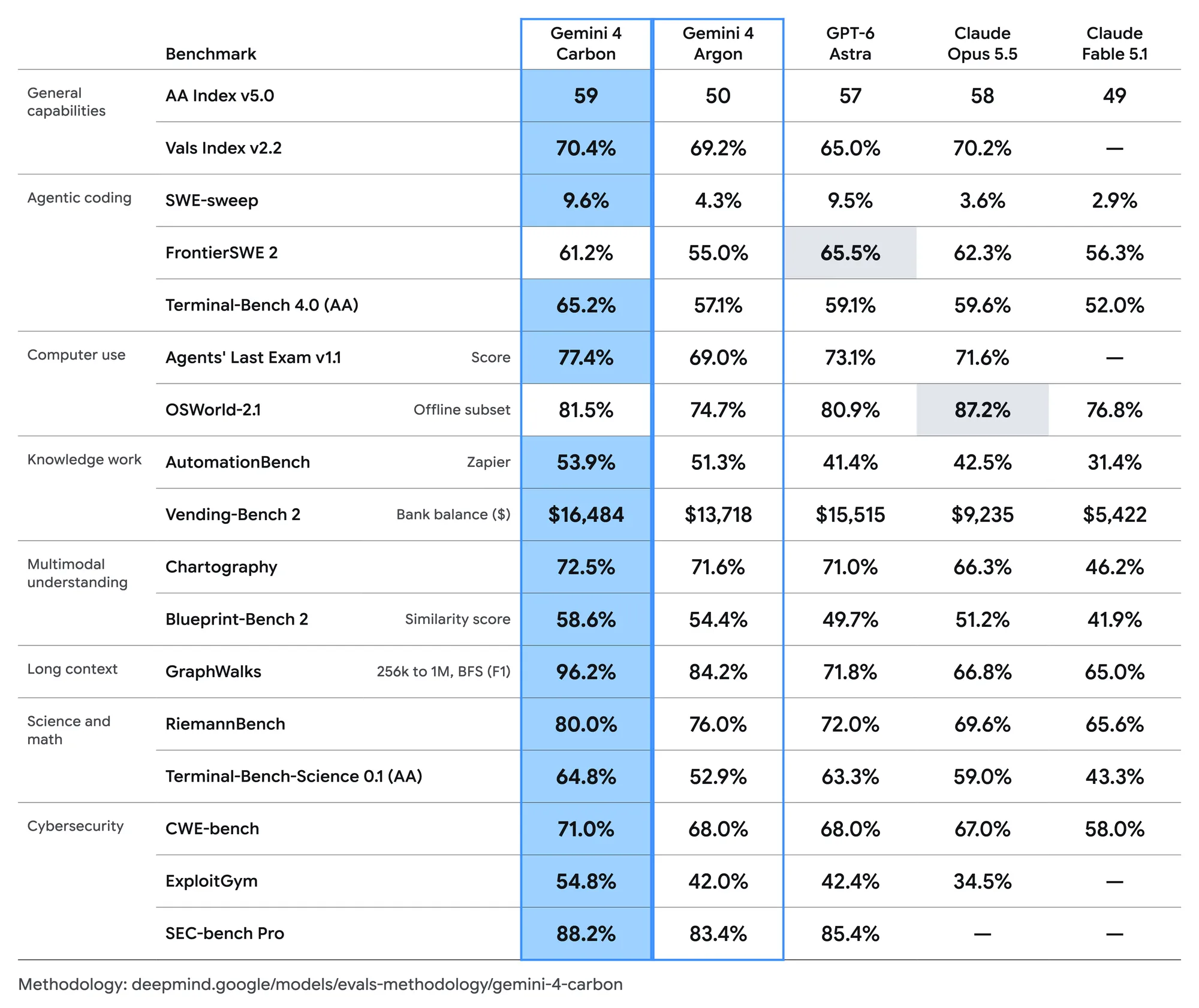
Google also says its teams have seen Carbon “run for days” on multi-step engineering tasks. These are internal numbers, not independent results.
Where Carbon is reported weaker
Google’s post doesn’t list weaknesses. Early testers do, and this is reported, not measured. According to TestingCatalog, one early-access tester described Carbon as “noticeably better” than Argon at 3D work, while “frontend/UI is still bad.” They also called it slower, though “less lazy.” Business Insider first reported the Carbon checkpoint on Google’s internal Jetski platform on October 9.
If your workload is mostly UI generation, the WebDev Arena jump and the tester reports disagree, so test your own prompts. And “slower” means timeouts matter: Google’s Argon guide already warns that hard prompts can take minutes.
One warning: third-party “Gemini 4 Carbon API” pages are placeholders. Google hasn’t shipped an endpoint, so nobody can sell you one.
Gemini 4 Carbon release date: when can you switch?
There isn’t one. Google says Carbon goes to “a subset of cyber defenders” first, then gradually to trusted partners through the Fairwind Program, and to developers, businesses and consumers “as soon as possible.” Google is also in the US government’s voluntary pre-release testing process.
Argon took 13 days from its Fairwind-only announcement to GA. That’s a precedent, not a promise. The timeline and Fairwind eligibility are covered in Gemini 4 Carbon release date, and if you’re hoping for a $0 route, read Is Gemini 4 Carbon free?.
Which should you use now?
Pick by what you need this week:
| Your situation | Use now | Why |
|---|---|---|
| Shipping a product on Gemini | gemini-4-argon |
Only Gemini 4 model with a public API |
| Security research team that qualifies | Apply to Fairwind | Only named route to Carbon before release |
| Mostly frontend or UI generation | Argon, then test Carbon | Testers report Carbon’s UI output as weak |
| Long-running coding agents | Argon now, Carbon on release | Carbon’s anti-cheating and misalignment numbers target this |
| Need a frontier model and don’t care about vendor | Compare the options below | Several ship today |
Ship-today options if you need frontier now
If you don’t need Gemini specifically, three vendors ship frontier models on public APIs today. Standard rates per million tokens, read from each vendor’s page on October 29, 2026.
| Model | Model ID | Input | Output | Cached input | Source |
|---|---|---|---|---|---|
| Gemini 4 Argon | gemini-4-argon |
$2.00 ($4.00 from Dec 1) | $10.00 ($20.00 from Dec 1) | $0.10 | Gemini API pricing |
| Claude Opus 5.5 | claude-opus-5-5 |
$4.00 | $20.00 | $0.20 (cache read) | Anthropic pricing |
| GPT-6.1 Sol | gpt-6.1-sol |
$2.00 | $10.00 | $0.10 | OpenAI pricing |
| GPT-6.1 Terra | gpt-6.1-terra |
$1.00 | $5.00 | $0.05 | OpenAI pricing |
Argon and GPT-6.1 Sol match Carbon’s launch price exactly. Claude Opus 5.5 costs what Argon and Carbon cost after their intro periods. For head-to-head results, see Gemini 4 Argon vs GPT-6 Astra vs Claude Opus 5.5, and for OpenAI’s API details, GPT-6.1 Sol API.
Keep the model in config so switching is one line
Build on gemini-4-argon with the model name in a variable. The day Carbon gets an ID, you change one value and rerun your tests. This request follows Google’s documented Interactions API format. We haven’t run it for this post; it needs a paid key, since Argon isn’t on the free tier (pricing details).
export GEMINI_MODEL="gemini-4-argon"   # Carbon's model ID isn't published yet

curl -s "https://generativelanguage.googleapis.com/v1beta/interactions" \
  -H "x-goog-api-key: $GEMINI_API_KEY" \
  -H "Content-Type: application/json" \
  -X POST \
  -d "{\"model\": \"${GEMINI_MODEL}\", \"input\": \"Find the root cause of this failing test and propose a patch.\", \"generation_config\": {\"thinking_level\": \"medium\"}}"
Log input and output tokens per request (same price per token doesn’t mean same cost per task) and set client timeouts in minutes, not seconds.
Don’t assume Carbon’s parameters match Argon’s. When Argon went GA it dropped explicit caching and ignored temperature. Our Gemini 4 Argon API guide covers those changes.
A/B Argon and Carbon with Apidog CLI and your coding agent
Benchmarks tell you about Google’s tasks, not yours. Let your coding agent run the comparison. Apidog CLI lets Claude Code, Codex, Cursor or OpenCode create and run API tests from the terminal, so the agent can build one test case against the Gemini Interactions endpoint and run it once per model.
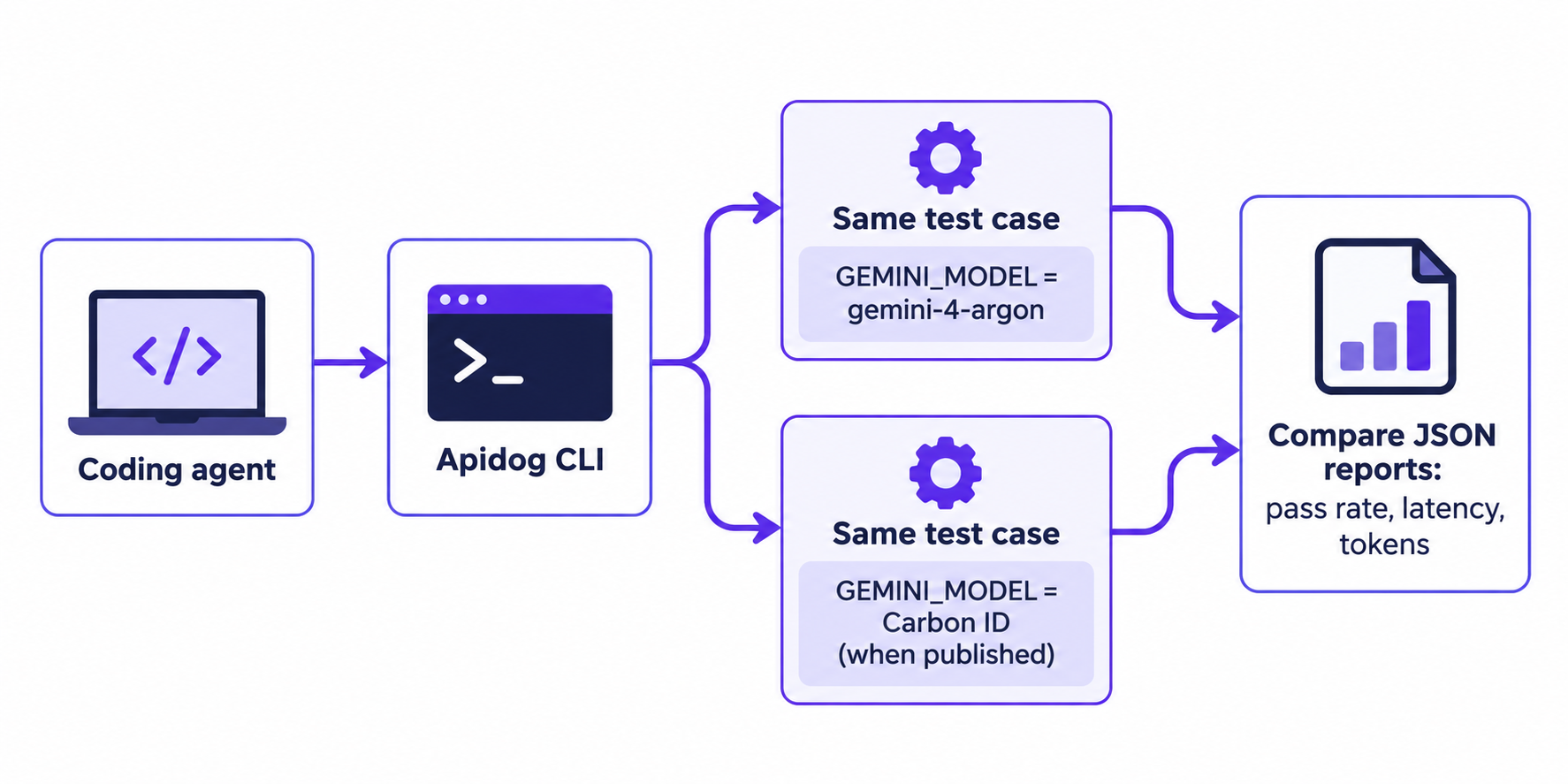
Set it up once:
npm install -g apidog-cli@latest
apidog login --with-token <YOUR_TOKEN>
npx -y skills add https://apidog.com   # pick your agent when prompted
Then give your agent one prompt:
In Apidog project <id>, create a Gemini API environment with GEMINI_MODEL=gemini-4-argon.
Add a test case: POST /v1beta/interactions using {{GEMINI_MODEL}} with my five real
prompts from prompts.csv, asserting HTTP 200 and non-empty output text. Run it with
Argon now. When Carbon has a model ID, run it again with that ID and compare pass rate,
response time and token usage per prompt.
The agent checks each payload against its schema before it writes anything, then runs the case:
apidog environment create gemini-api --project <id> --base-url https://generativelanguage.googleapis.com
apidog cli-schema get test-case-create
apidog cli-schema validate test-case-create --file gemini-ab.json
apidog test-case create --project <id> --file gemini-ab.json
apidog run --test-case <caseId> --project <id> -e <envId> -d prompts.csv --timeout-request 300000 -r cli,json --out-file argon
On release day, the agent reruns the same case with --env-var "GEMINI_MODEL=<carbon-id>" --out-file carbon and diffs the two JSON reports. Add --upload-report if you want the team to see both runs in the Apidog app. To run it in CI, follow the Apidog CLI CI/CD guide; new to the CLI, start with Apidog CLI in Claude Code. Apidog’s Free plan covers up to 4 users.
FAQ
Is Gemini 4 Carbon better than Argon? On Google’s published numbers, yes: 0.0% vs 0.7% on Gray Swan prompt injection, more than 2x Argon on internal secure-code tests, and #1 on the Artificial Analysis Index v5.0 at 59. Independent results aren’t out yet.
Do Gemini 4 Carbon and Argon cost the same? At launch, yes: $2 per million input tokens and $10 per million output tokens, cached input 95% off. Argon’s intro price ends November 30, 2026; Carbon’s intro length isn’t published.
Can I use Gemini 4 Carbon through the API today? No. As of October 29, 2026, Carbon has no public model ID and only a subset of cyber defenders can use it. Argon is on the paid Gemini API as gemini-4-argon.
Is Carbon worse than Argon at anything? Google doesn’t say so. Early testers reported Carbon as weaker at frontend and UI output and slower than Argon. That’s reported, not measured.
Should I wait for Carbon or build on Argon now? Build on Argon now with the model name in config. The launch price is the same, so switching becomes a one-line change plus a test run.