As of October 29, 2026, Google’s Gemini 4 Carbon is not free: Google prices it at $2 per million input tokens and $10 per million output tokens at launch, and only a subset of cyber defenders can use it. There’s no Gemini 4 Carbon free tier, no free API key route and no free Gemini app plan that includes it.
You can’t try Google’s newest model for free yet, but you can build on a free Gemini model today. This guide covers every free Gemini route Google confirms on its own pages, which models each covers, and how to stretch the quota without hitting 429 errors.
Is Gemini 4 Carbon free?
Gemini 4 Carbon is not free and isn’t open to the public. Google announced it on October 28, 2026 as “our strongest model” and gave access to a subset of cyber defenders first. Trusted partners follow through the Fairwind Program. Developers, businesses and consumers get it “as soon as possible”, with no date.
Here’s what Google has and hasn’t published:
| Item | Value | Source |
|---|---|---|
| Announced | October 28, 2026, by Koray Kavukcuoglu | Google launch post |
| Who can use it now | A subset of cyber defenders | Google launch post |
| Next in line | Trusted partners via the Fairwind Program | Google launch post |
| Developers and consumers | “As soon as possible”, no date | Google launch post |
| Intro price | $2 input / $10 output per 1M tokens | Google launch post |
| Price after intro | $4 input / $20 output per 1M tokens | Google launch post |
| Cached input | 95% off the input price | Google launch post |
| Free tier | Not mentioned | Google launch post, Gemini API pricing page |
| Model ID, context window | Not published | Gemini API models page (no Carbon entry) |
| Artificial Analysis Intelligence Index v5.0 | #1, score 59 | Google launch post |
The Gemini API pricing page doesn’t list Carbon, and the models page has no Carbon model ID, so no tier can call it today.
What Gemini 4 Carbon will cost
When it opens up, Carbon costs the same as Argon: $2/$10 per 1M tokens during an introductory period Google hasn’t dated, then $4/$20. Our what is Gemini 4 Carbon guide covers the full benchmark table and per-call price math.
Gemini 4 Carbon release date: will a free tier follow?
Google hasn’t announced a date or a free tier. The launch post says Google is in the US voluntary pre-release testing process and will phase access through the Fairwind Program before a wider release.
Argon took the same path, from Fairwind partners to general availability on October 13, and still has no free tier. Don’t plan around a free Carbon. Our Gemini 4 Carbon release date tracker covers each rollout stage.
Every free Gemini route that works today
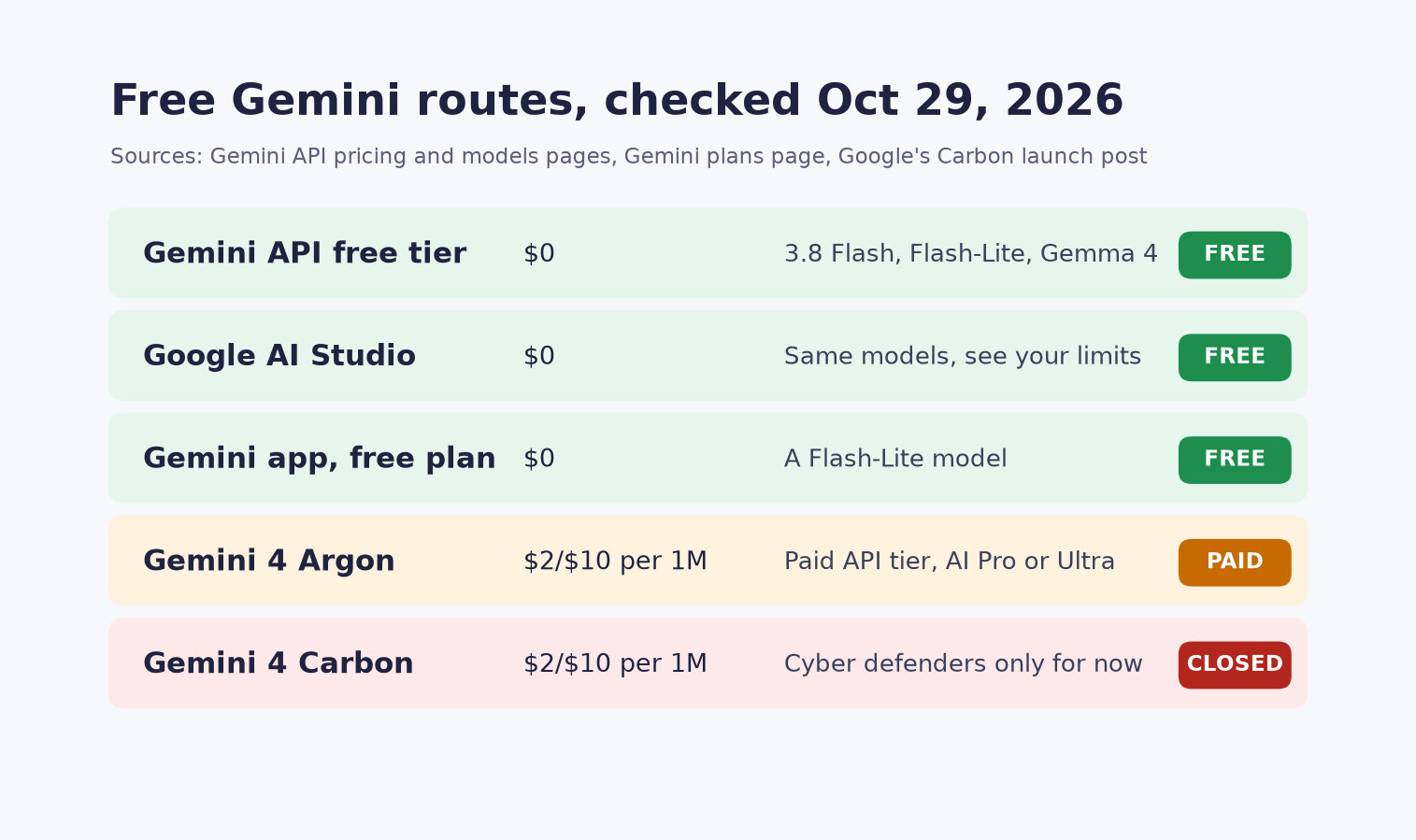
These are the $0 routes Google confirms on its own pages, checked October 29, 2026:
| Route | Cost | What you get free | Card needed? | Carbon? | Argon? |
|---|---|---|---|---|---|
| Gemini API free tier | $0 | Gemini 3.8 Flash, 3.6 Flash, 3.5 Flash-Lite, 3.1 Flash-Lite, Gemma 4, embeddings, TTS and Live models | Not mentioned; an active project is the listed requirement | No | No |
| Google AI Studio | $0 | The same free-tier models, plus your per-model limits on the rate-limit page | Same as above | No | No |
| Gemini app, free plan | $0 | “Access to our Flash-Lite model” | No | No | No |
| Gemma 4 on the API | $0 | Free input, output and context caching | Same as API free tier | No | No |
| Gemini CLI | Not free | Paid Gemini API or Agent Platform keys only since June 18, 2026 | Yes | No | Not confirmed |
The Gemini API free tier
The free tier is the best free route for developers. The pricing page marks Gemini 3.8 Flash as free of charge for input, output and context caching on the free tier, and lists the same for Gemini 3.6 Flash, the 3.5 and 3.1 Flash-Lite models and Gemma 4. (Gemini 2.5 models also show a free tier, but the models page limits 2.5 access to past users.) gemini-3.8-flash is a stable model with a 1,048,576-token input limit and 65,536 output tokens, per its model page.
Two catches: no Search grounding for 3.8 Flash on the free tier, and the pricing page marks free-tier content as “used to improve our products”, so keep confidential code and customer data off it. When you outgrow it, paid 3.8 Flash costs $0.75/$3.75 per 1M tokens through December 31, 2026, then $1.50/$7.50. Our Gemini 3.8 Flash free guide walks through the setup.
Google AI Studio
AI Studio is where you create the free key and test prompts. Google’s rate limits page says the free tier needs “an active project or free trial” and doesn’t mention a payment method. It doesn’t publish a fixed limit table either: limits vary by model, and you see your own on AI Studio’s rate-limit page.
The Gemini app free plan
For chat, the free Gemini app plan works, without Carbon or Argon. Google’s plans page (Singapore version, checked October 29) lists the free plan as “Access to our Flash-Lite model”. Argon appears under Google AI Pro and AI Ultra.
What isn’t a free route
- Gemini CLI. Since June 18, 2026, Gemini CLI no longer serves free, Pro or Ultra consumer accounts. It needs a paid key.
- “Free Gemini 4 Carbon API” sites. Google publishes no Carbon model ID, so any site selling or giving away Carbon access is unverified. Keep your keys and data off it.
Gemini Carbon vs Argon: is either one free?
Neither is free. Argon, gemini-4-argon, went generally available on October 13, 2026 and runs only on the paid API tier. The pricing page says “Gemini 4 Argon is not available on the Free tier.” It costs $2/$10 per 1M tokens through November 30, then $4/$20 from December 1, with a 1,048,576-token context window shared by input, thinking and output.
The difference is access, not price: you can call Argon today with a billed project, and Carbon at no price. Our Gemini 4 Argon free guide lists every paid Argon route, and Gemini 4 Carbon vs Argon covers which to pick once both are open. For Argon’s numbers, see Gemini 4 Argon pricing and Gemini 4 Argon benchmarks.
How to stretch the free quota and avoid 429s
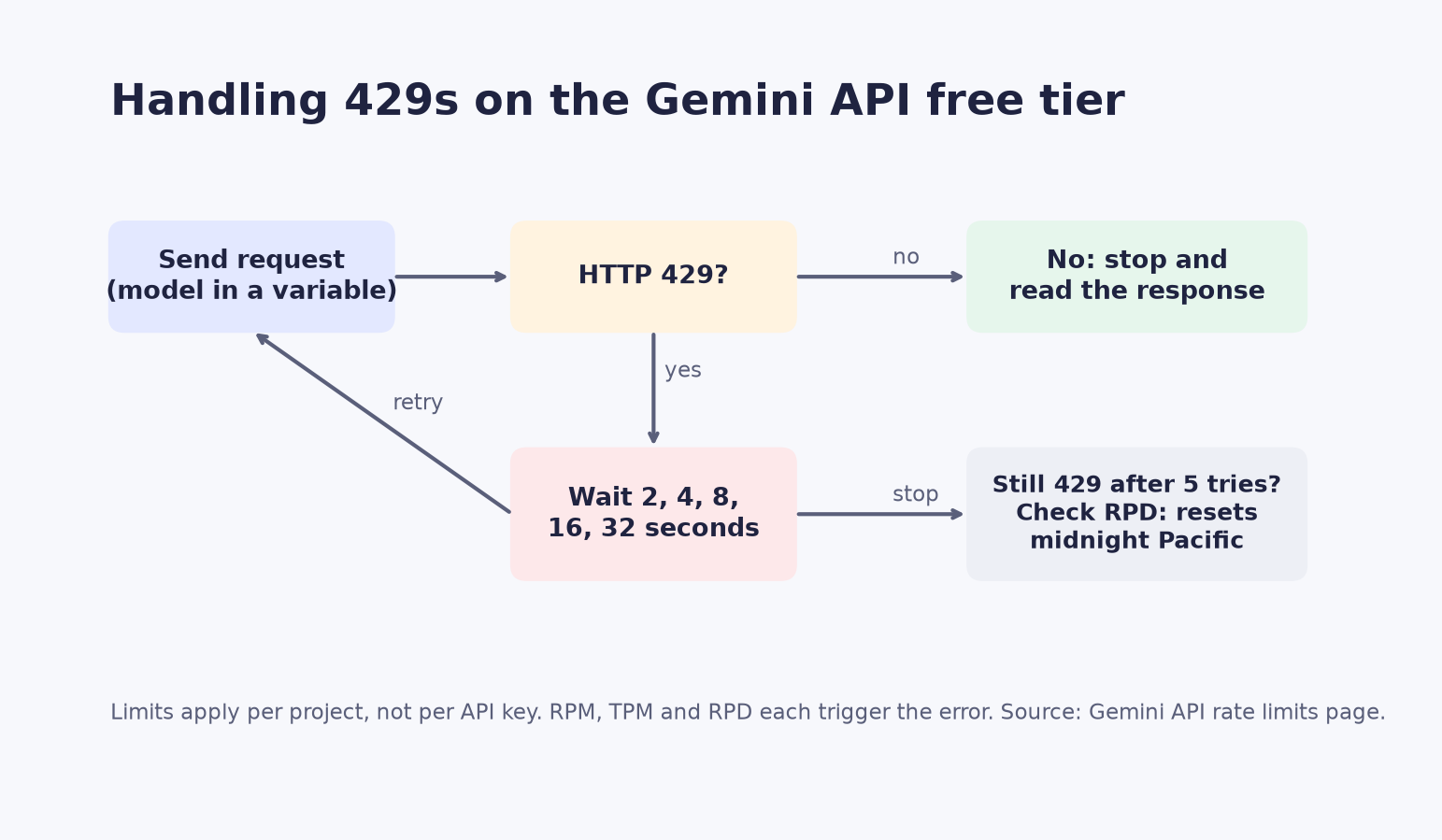
Free-tier limits cover requests per minute (RPM), input tokens per minute (TPM) and requests per day (RPD). Cross any one and you get a rate limit error. Five habits keep you under them:
- Read your real limits per model on AI Studio’s rate-limit page.
- Don’t add keys. Limits apply per project, not per API key.
- Plan around the reset. RPD quotas reset at midnight Pacific time.
- Route by difficulty. Short jobs go to Flash-Lite, harder ones to 3.8 Flash.
- Back off on 429s with exponential delay instead of a tight loop.
Here’s a minimal retry wrapper. The request shape follows Google’s REST quickstart in the Gemini 4 Argon developer guide, and the model name lives in a variable so the same script moves to a paid model later:
# Free key: gemini-3.8-flash. Paid key: GEMINI_MODEL=gemini-4-argon.
# Google hasn't published a Gemini 4 Carbon model ID yet.
MODEL="${GEMINI_MODEL:-gemini-3.8-flash}"

for attempt in 1 2 3 4 5; do
  code=$(curl -s -o out.json -w "%{http_code}" -X POST \
    "https://generativelanguage.googleapis.com/v1beta/interactions" \
    -H "x-goog-api-key: $GEMINI_API_KEY" \
    -H "Content-Type: application/json" \
    -d "{\"model\": \"$MODEL\", \"input\": \"Summarize this changelog in five bullets.\"}")
  [ "$code" != "429" ] && break
  sleep $((2 ** attempt))   # 2, 4, 8, 16, 32 seconds
done
echo "HTTP $code"; cat out.json
Moving to gemini-4-argon? Google’s checklist says drop temperature, top_p and top_k, remove explicit caching and raise client timeouts to 15 minutes. Our Gemini 4 Argon API guide covers the rest, and HTTP 429 Too Many Requests explains the status code.
Let your coding agent test it with Apidog CLI
Manual retries waste free quota. Let your coding agent build the request once, assert on the response and rerun it against your free Flash key now and a paid model later. Apidog CLI gives Claude Code, Codex or Cursor the commands to do it, and Apidog’s Free plan covers up to 4 users.
npm install -g apidog-cli@latest
apidog login --with-token <YOUR_TOKEN>
npx -y skills add https://apidog.com   # pick your agent when prompted
Then give your agent one prompt:
In Apidog project <id>, create a test case for POST
https://generativelanguage.googleapis.com/v1beta/interactions with the model
read from {{GEMINI_MODEL}} and the key from {{GEMINI_API_KEY}}. Assert HTTP 200
and a non-empty output. Run it against the "free-flash" environment with a
2-second delay between requests and summarize any failures, including 429s.
The agent reads the schema, validates its payload, writes the case and runs it:
apidog cli-schema get test-case-create
apidog cli-schema validate test-case-create --file case.json
apidog test-case create --project <id> --file case.json
apidog run --test-case <caseId> --project <id> -e <envId> \
  --delay-request 2000 --timeout-request 900000 -r cli,json
--delay-request keeps a batch under your RPM, and --timeout-request (milliseconds) matches Google’s 15-minute Argon timeout. To compare models, run the same case with --env-var "GEMINI_MODEL=gemini-4-argon" on a billed key. The Apidog CLI in Claude Code guide covers agent setup, and Apidog CLI in CI/CD puts the same run on every push.
FAQ
Is Gemini 4 Carbon free? No. As of October 29, 2026, Google prices it at $2/$10 per 1M tokens at launch and only a subset of cyber defenders can use it. There’s no free tier.
Can I use Gemini 4 Carbon in Google AI Studio? Not yet. Google hasn’t published a Carbon model ID, and neither the models page nor the pricing page lists it.
When will Gemini 4 Carbon be released to developers? Google says “as soon as possible” with no date. Access widens through the Fairwind Program first.
Is Gemini 4 Argon free? No. Argon runs only on the paid API tier: $2/$10 per 1M tokens through November 30, then $4/$20.
What’s the best free Gemini model today? Gemini 3.8 Flash on the Gemini API free tier, with a 1,048,576-token input limit. Google uses free-tier content to improve its products, so keep private data off it.
Build free now, swap the model later
Gemini 4 Carbon isn’t free or open yet, but you can build around it for $0: a free AI Studio key, gemini-3.8-flash in a variable, a 429 backoff and a test case your agent reruns. Download Apidog, and when Google publishes a Carbon model ID, one variable is the whole migration.