
Bruno won a loyal following by doing the opposite of Postman: collections live as plain-text files in your Git repo, requests execute on your machine, and there is no cloud account between you and your API. If you’re searching for a Bruno alternative, the reason is usually not philosophy. It’s the day your team needed a mock server, a hosted docs page, or a way to collaborate that doesn’t run through pull requests, and Bruno said no.
Here’s the direct answer: Apidog is the best Bruno alternative for teams that want Bruno’s local-first request execution plus the platform features Bruno deliberately leaves out. It adds schema-aware mocking, real-time team workspaces, published API documentation, and visual test orchestration, with a free plan for up to 4 users. This article covers what Bruno does well, where its design stops, and what changes when you switch.
What Bruno gets right
Credit first, because Bruno’s core ideas are good ones:
- Collections as code. Bruno stores every request in its own
.brufile. Your API collection lives next to your source, diffs cleanly, and goes through the same review flow as any other change. See Bruno’s docs for the format. - Offline and private by design. Requests execute locally, nothing syncs to a vendor cloud, and the open-source client costs nothing.
- A real business model. Bruno sells Pro at $6 and Ultimate at $11 per user per month, per Bruno’s pricing page, and the Ultimate tier now includes SSO (SAML), SCIM, external secret managers like HashiCorp Vault and AWS Secrets Manager, and audit logs. Anyone telling you Bruno has no enterprise story is out of date.
The gaps in Bruno are not bugs. They’re the price of a Git-only architecture, and whether that price is acceptable depends on what your team needs next.
Where the Git-only model runs out
No mock server
Bruno has no built-in mock server. When your frontend team needs fake endpoints while the backend is in progress, Bruno’s answer is to run a separate tool: JSON Server, WireMock, or something similar, each with its own config to maintain. We walked through the workarounds in does Bruno have a mock server? The short version: the workaround is another tool, which is exactly what a Bruno user was trying to avoid.
Collaboration means pull requests
Git sync is genuinely elegant for version history. It’s slower for the everyday loop of API work: a teammate tweaks a request, you want to see it now, and instead you wait for a commit, a push, and a pull. There is no hosted shared workspace and no real-time presence. For a two-person team with strong Git habits, that’s fine. For a squad iterating on an API during a sprint, the ceremony adds up; we covered the team-scale friction in Bruno for teams: cloud sync alternatives.
Docs stay on your laptop
Bruno can generate documentation from a collection, but publishing it means exporting HTML and hosting it yourself. There’s no hosted docs portal, no custom domain handling, no “try it” console for consumers. The OpenAPI spec is treated as an import/export format rather than the living center of the project, and on the Pro plan even OpenAPI syncs are metered at 5 per month.
The client is the whole product
Scheduled test runs, performance testing, online test reports, a browser client for the teammate who won’t install anything: none of these exist in Bruno. The CLI covers CI runs, and that’s the extent of the automation surface. If your testing needs are a folder of requests and some assertions, that’s enough. Past that, you’re assembling a toolchain again, the pattern we explored in looking for a Bruno alternative that does more than Git?
The answer: Apidog
Apidog is an API development platform used by over 500,000 developers. It covers design, debugging, testing, mocking, and documentation in one workspace, with the OpenAPI spec as the single source of truth.
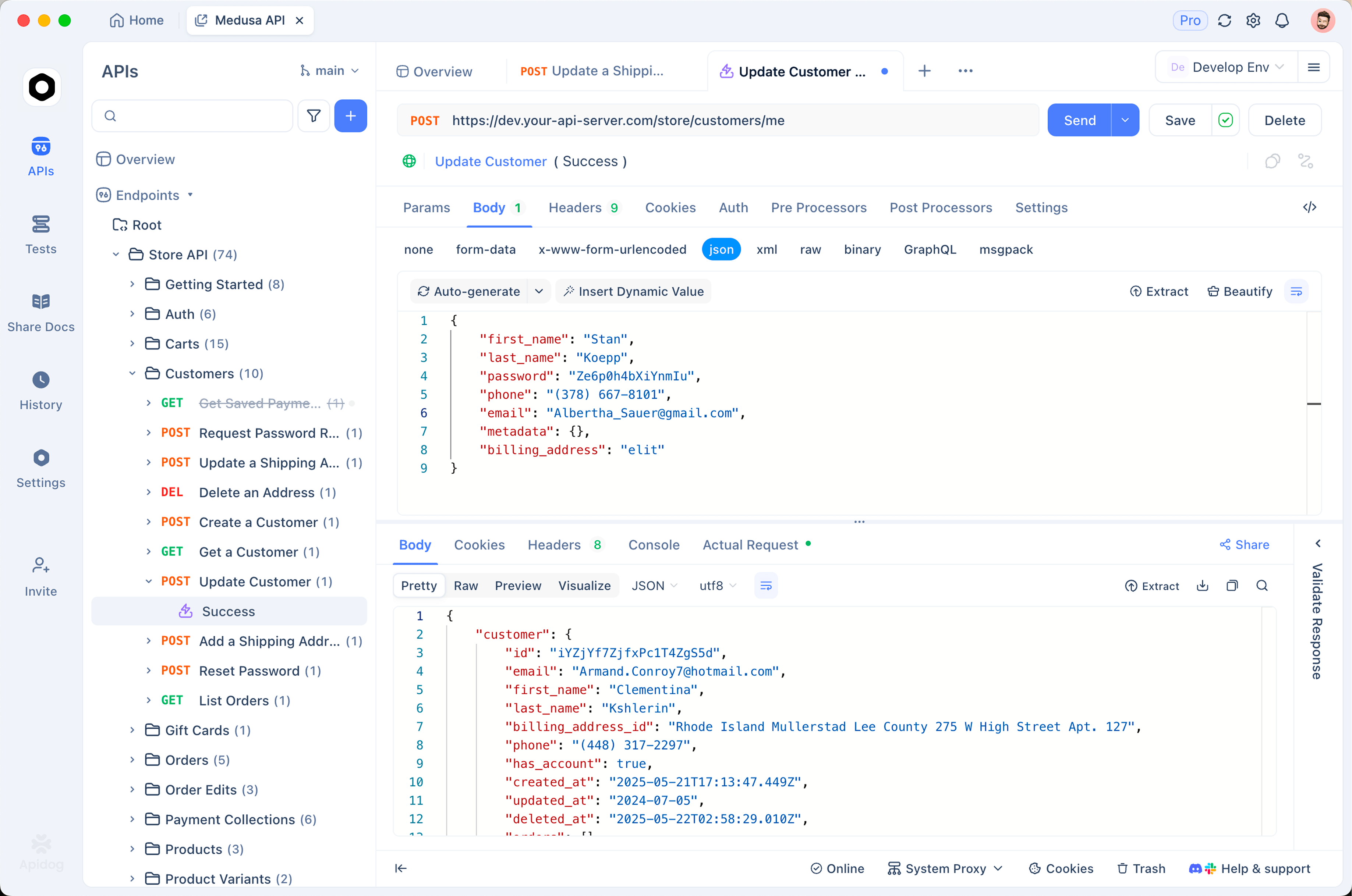
For someone leaving Bruno specifically, four points matter most:
- Requests still execute locally. The Apidog desktop client sends requests from your machine, the same as Bruno, so APIs behind a VPN or on localhost work without routing traffic through a vendor server. This is a property the two tools share, not a difference; it means you don’t give up local execution to gain the platform.
- The free plan supports 4 users with unlimited APIs, requests, projects, and test runs. Bruno’s free tier is genuinely free too, so the comparison isn’t about cost; it’s about what each free tier contains.
- Mocking, docs, and testing are built in, not left to a second and third tool.
- Real-time team workspaces replace the commit-push-pull loop. Changes appear for teammates as they’re made, and version history still exists at the platform level.
What you gain when you switch
A mock server that reads your schema
Apidog’s smart mock engine generates realistic responses straight from your API spec with zero configuration. A field named email returns an email address; a field named created_at returns a timestamp. Point the frontend at the mock URL and UI work starts before the backend exists. Self-hosted mock deployment is available when data can’t leave your network.
Documentation someone can actually visit
Apidog publishes interactive API docs from the same spec you test against: custom domain, versioning, Markdown pages, and a built-in “try it” console. When the spec changes, the docs change. Nobody exports HTML, and nobody’s docs are three commits behind the API.
Tests with orchestration, schedules, and reports
The visual test builder chains endpoints into scenarios, passes values between steps, and adds assertions without glue code. Scenarios run on a schedule, produce shareable online reports, and execute inside CI through the Apidog CLI:
npm install -g apidog-cli
apidog run scenario --scenario-id 12345 --env staging
Runs are unlimited on every plan, including free.
Responses checked against the spec automatically
Bruno asserts on what you tell it to assert on. Apidog additionally validates every response against the endpoint’s schema: status codes, required fields, data types, enums, ranges, and unexpected properties, with no custom scripts. When the backend drifts from the contract, you find out on the next request, not in a bug report. The full capability matrix is on the Apidog vs Bruno comparison page.
An AI-ready surface
Apidog ships an MCP server that exposes your API specs to coding agents, plus an MCP client for debugging MCP servers visually. If your team uses Claude Code or Cursor, the agent can read the spec, run requests, and update docs through Apidog’s MCP server. Bruno has no equivalent surface today.
Bruno vs Apidog at a glance
| Bruno | Apidog | |
|---|---|---|
| Price for teams | Pro $6 / Ultimate $11 per user/mo | Free up to 4 users, then $9 per user/mo |
| Local request execution | Yes | Yes (desktop client) |
| Collection storage | Git, plain-text .bru files |
Cloud workspace with version history |
| Real-time collaboration | No (Git sync) | Yes |
| Built-in mock server | No | Yes, schema-aware, self-hostable |
| Hosted docs with custom domain | No (self-hosted HTML export) | Yes |
| Scheduled tests + online reports | No | Yes |
| Performance testing | No | Yes |
| SSO / SCIM / audit logs | Yes, on Ultimate ($11/user/mo) | Yes, on Enterprise |
| Secret managers (Vault, AWS, Azure) | Yes, on Ultimate | Yes, Vault on Enterprise |
| MCP server for AI agents | No | Yes |
Two honest notes on this table. Bruno’s Ultimate tier is a real enterprise offering; SSO, SCIM, secret managers, and audit logs all exist there, so the enterprise column is a tie on features and Bruno is cheaper per seat. And Bruno’s Git-native storage is a genuine advantage if collections-in-repo is a hard requirement for your compliance or review process. Apidog’s answer to spec-review workflows is branch support in its visual designer, which covers the review use case differently.
Migrating from Bruno
Apidog imports Bruno collections directly; the migration guide on the comparison page calls it 1-click, and that’s the practical experience. The path:
- Import your Bruno collections into Apidog. Folder structure, headers, auth, and environments carry over. If you’d rather migrate from the contract side, OpenAPI import works too.
- Generate a spec from the imported requests. This is the step that changes the workflow: the spec becomes the source of truth, and mocks and docs derive from it automatically.
- Rebuild any CLI-based CI runs with the Apidog CLI, which outputs an HTML report per run.
- If part of your team still wants specs in the repo,
apidog spec synckeeps the spec synchronized with Git from the command line, so the Git habit survives the migration where it’s genuinely useful.
Most teams finish the mechanical part in an afternoon. The bigger change is that a spec edit now propagates to mocks, docs, and tests without a sync step.
When Bruno still makes sense
If your collections must live in Git for policy reasons, Bruno is built for exactly that and nothing else does it as cleanly. If you’re a solo developer or a small team that needs a fast local request runner and nothing more, Bruno’s free client is hard to argue with. And if your organization already bought Bruno Ultimate for its SSO and secret-manager integration, the per-seat price is lower than any comparable tier. The switch pays off when your team needs mocking, published docs, scheduled testing, or real-time collaboration; those are the features Bruno’s architecture rules out, not features it hasn’t gotten to yet.
Frequently asked questions
Is Apidog free like Bruno?
Bruno’s client is open source and free forever. Apidog’s free plan covers 4 users with unlimited APIs, requests, and test runs. For a team of 4 or fewer, both are $0; the difference is what the $0 includes: mocking, hosted docs, and scheduled tests on the Apidog side, Git-native storage on the Bruno side.
Does Apidog execute requests locally like Bruno does?
Yes. The Apidog desktop client sends requests from your machine, so localhost services and APIs on internal networks work the same way they do in Bruno.
Can I import my Bruno collections into Apidog?
Yes, directly: Apidog’s importer takes Bruno collections in 1 click, and requests, folders, auth, and environments arrive intact. Apidog can then generate a structured spec from them. OpenAPI import is also available if you prefer starting from the contract.
Does Bruno have SSO and audit logs?
Yes, on the Ultimate tier at $11 per user per month: SAML SSO, SCIM provisioning, external secret managers, and audit logs. If those are your only requirements, Bruno covers them. The features Bruno doesn’t offer at any price are a mock server, a hosted docs portal, real-time workspaces, and scheduled test runs.
What replaces Bruno’s Git review workflow in Apidog?
Apidog’s visual designer supports branches, so spec changes can be proposed, reviewed, and merged inside the platform. Version history is tracked at the workspace level rather than in your repo.
Try it with a real collection
The fastest way to evaluate the trade is to import one Bruno collection and turn on the mock server. Download Apidog, import, and point your frontend at the generated mock URL. If the schema-aware fake data and the published docs page save your team more time than Git-native storage was saving, the decision makes itself. The full feature matrix is on the Apidog vs Bruno comparison page.