Open Responses is an open specification, published as an OpenAPI 3.1 document, that describes one request and response shape for calling language models across providers. It is based on the OpenAI Responses API: you send model, input and optional tools to POST /v1/responses, and you get back typed items and semantic streaming events instead of a provider-specific format. OpenAI launched Open Responses on 2026-01-15, it is licensed under Apache 2.0, and on 2026-10-22 OpenAI contributed it to the Agentic AI Foundation (AAIF), the Linux Foundation body that also hosts MCP.
That last step is the news: the spec now has a technical charter, a steering committee and a neutral home. This post covers what it defines, who implements it, what the AAIF move changes, and how to check whether an endpoint you depend on conforms. If you’re new to the underlying API, start with how to use the OpenAI Responses API.
What Open Responses defines
The spec describes the problem plainly: providers have converged on the same building blocks (messages, tool calls, streaming, multimodal input) but each encodes them differently. Open Responses picks one encoding and writes it down.
The current OpenAPI document is version 2026-04-24 and covers a small surface:
| Operation | What it does |
|---|---|
POST /responses (createResponse) |
Create a response, streaming or not |
WebSocket on /responses |
Same response model over a persistent socket (added 2026-04-24) |
POST /responses/compact (compactResponse) |
Return a compacted input window for long conversations |
The request body accepts the fields you’d expect if you’ve used OpenAI’s API: model, input, instructions, tools, tool_choice, stream, store, previous_response_id, reasoning, text, truncation, temperature, top_p, max_output_tokens, prompt_cache_key and a few more. The response object (ResponseResource) carries id, status, output, usage, error and an echo of the settings you sent. The document defines 108 schemas in total, most of them item and streaming-event types.
Three ideas carry the design.
Items are the unit of context
Everything the model reads or produces is an item: a message, a function_call, a function_call_output, a reasoning item. Items are bidirectional, so the output of one turn can be fed straight back as input to the next. Each item type is discriminated by its type field and has its own schema.
Items are also state machines: each moves from in_progress to completed or incomplete (the token budget ran out), and an incomplete item must be the last one emitted, with the whole response marked incomplete. A status says nothing about whether the server stored the item; persistence is a separate concern.
Streaming is semantic events, not raw deltas
When you set stream: true, the server must answer with Content-Type: text/event-stream and a defined event sequence. An output item opens with response.output_item.added; text inside it arrives as response.content_part.added, then repeated response.output_text.delta events, then response.output_text.done and response.content_part.done; the item closes with response.output_item.done. The stream must end with a terminal event: response.completed, response.failed or response.incomplete. A trailing [DONE] is optional, and clients must handle a stream that ends without it.
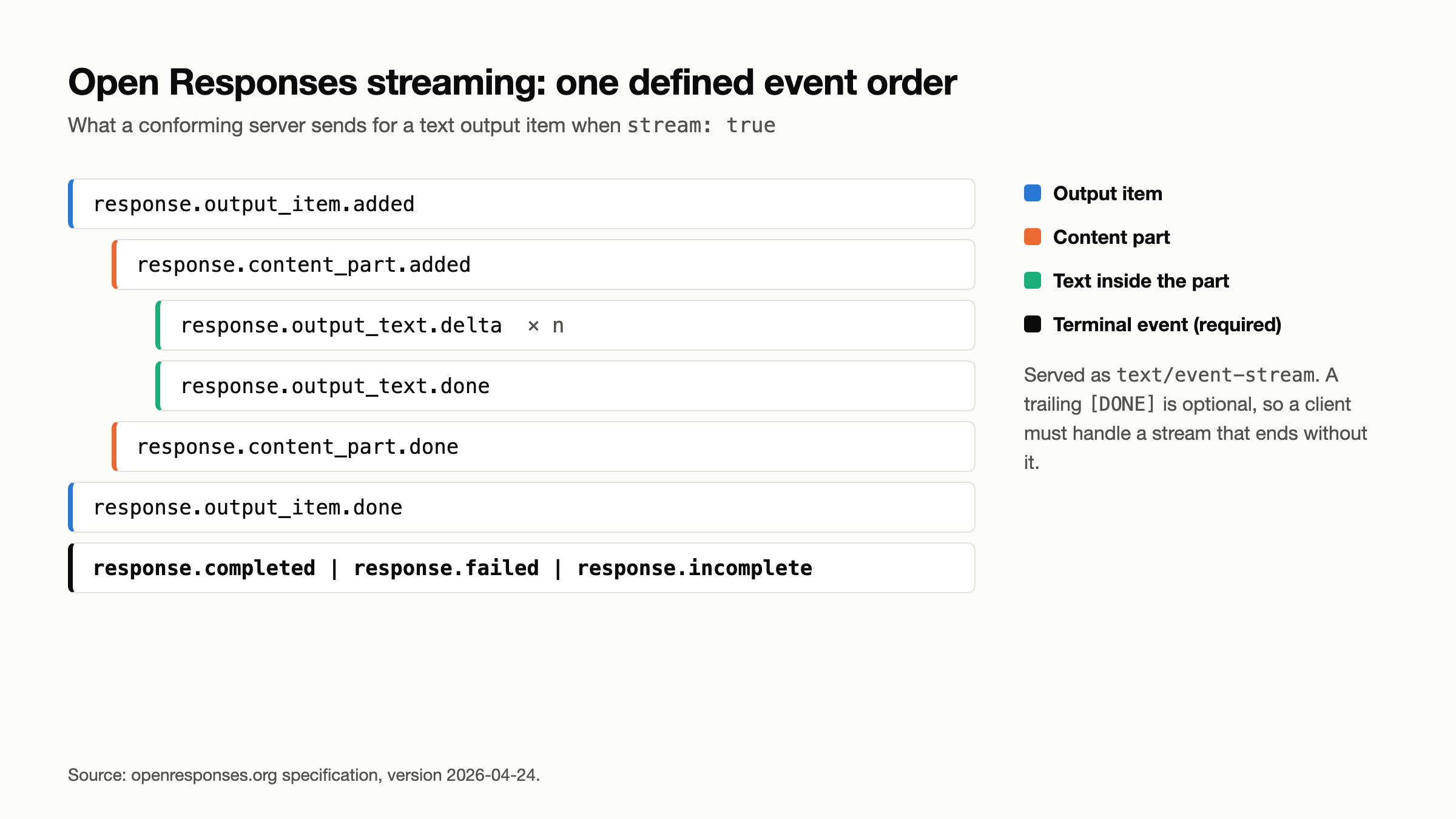
This matters most for client code: if two providers emit the same events in the same order, one SSE parser works for both. Our SSE testing guide shows how to inspect these streams event by event.
A stable core with namespaced extensions
Providers can add their own item types, tools and streaming events, but they must prefix them with a provider slug. The spec’s own example is openai:web_search_call. A client that doesn’t recognize a prefixed type can skip it without breaking. This is how the spec stays portable while hosted tools like web search or file search remain provider features.
The rest of the contract
A few more rules are worth knowing before you build on the spec:
- Two kinds of tools. Externally hosted tools (functions, MCP servers) run outside the provider; for functions, the model emits a
function_call, you run it, and you send back afunction_call_outputwith the matchingcall_id. Internally hosted tools (OpenAI’s file search, for example) run inside the provider without handing control back. tool_choiceandallowed_tools.tool_choicetakesauto(the default),required,none, or an object naming one function.allowed_toolsrestricts which tools the model may call while still showing all of them, so you don’t invalidate a cached prompt by editing thetoolsarray. Servers must enforce it as a hard limit.previous_response_id. The server must treat the new request asprevious_response.input + previous_response.output + input, in that order, so you don’t resend the transcript.- Reasoning items may carry raw
content, an opaqueencrypted_contentblob, a user-safesummary, or any mix. - Errors carry a
type(server_error,invalid_request,not_found,model_error,too_many_requests), pluscode,paramandmessage; mid-stream, an error is followed byresponse.failed.
The 2026-04-24 revision (changelog) added the WebSocket transport: each turn starts with a response.create message, one connection processes one response at a time, connections are capped at 60 minutes (error code websocket_connection_limit_reached), and store: false continuations live in connection-local memory, failing with previous_response_not_found once that state is gone. The same revision added /responses/compact, an optional phase field on assistant messages (commentary or final_answer), and made logprobs optional.
Open Responses vs Chat Completions
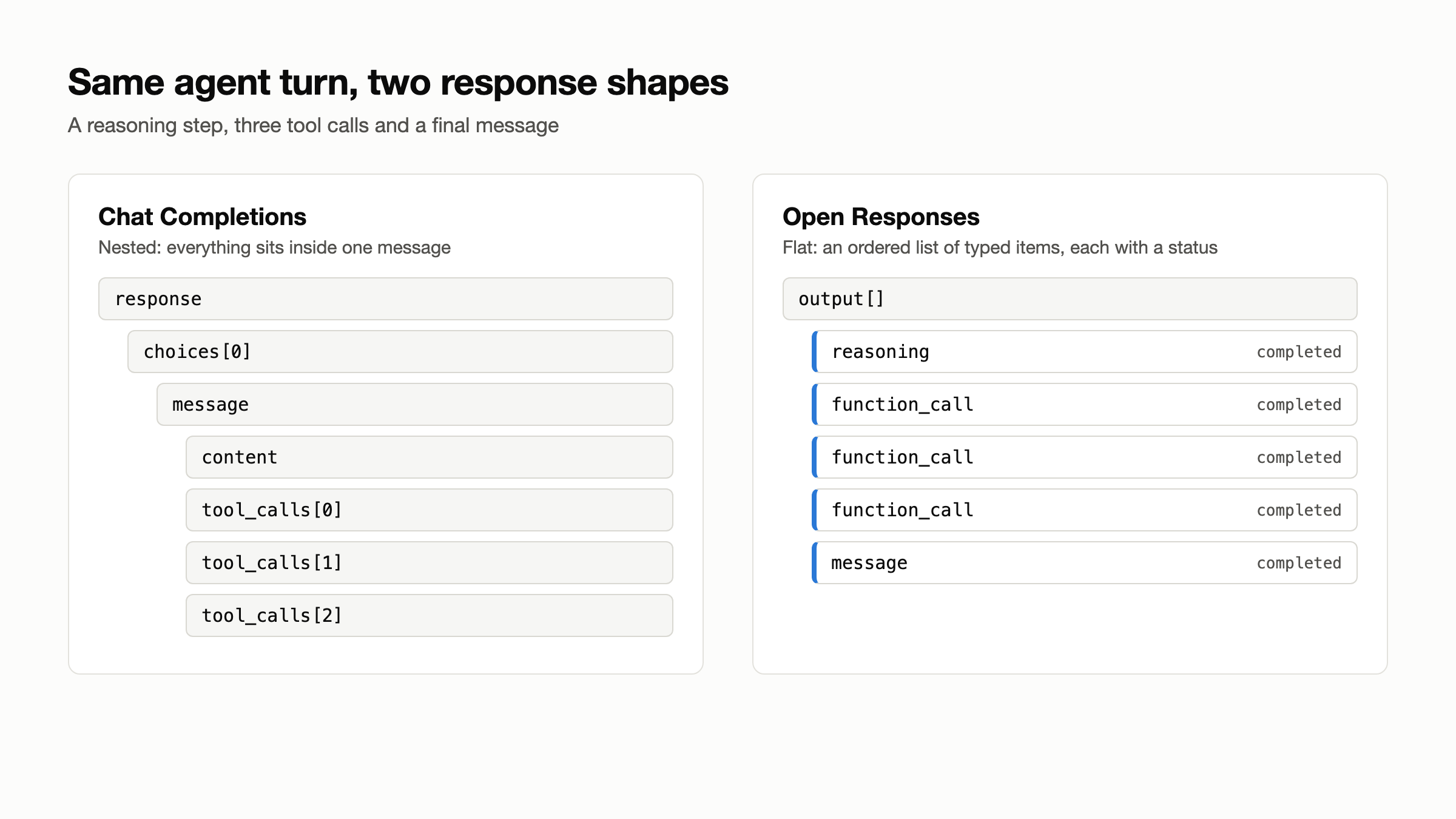
Chat Completions is still the most widely copied LLM interface. The difference is shape: Chat Completions returns choices holding a message, with tool calls tucked inside it, while the Responses model returns a flat list of typed items. A reasoning step, three tool calls and a final message become separate, ordered objects with their own status, which suits agent loops better.
We compared the three dominant formats side by side, with real requests, in Chat Completions vs Anthropic Messages vs Responses API. If you’re choosing between OpenAI’s own surfaces, the Agents API vs Responses API vs Agents SDK breakdown covers where Responses sits.
Who implements it
The supporter list includes AWS Bedrock, Databricks, Hugging Face, LM Studio, Nvidia, Ollama, OpenRouter, Red Hat, Vercel and vLLM, alongside OpenAI. Anthropic and Google aren’t among the named supporters; both still ship their own native formats.
“Supports” covers a wide range, so check the details for the runtime you use:
- Ollama added
POST /v1/responsesin v0.13.3. Its compatibility docs say “only the non-stateful flavor is supported”: streaming, function tools and reasoning summaries work, butprevious_response_id,conversationandtruncationdon’t. You resend history yourself. - LM Studio made its
http://localhost:1234/v1/responsesendpoint compatible in version 0.3.39, includingprevious_response_id, remote image URLs for vision models and logprobs. See our LM Studio guide for setup.
For a sense of scale, API Evangelist took a baseline on September 13: of 120 providers claiming OpenAI compatibility that publish a readable OpenAPI document, 26 declare POST /responses, against 105 that declare POST /chat/completions. The point of the baseline is to measure whether neutral governance moves that number.
What the Agentic AI Foundation move changes
AAIF announced Open Responses on 2026-10-22 at AGNTCon + MCPCon North America in San Jose, together with three other new projects: Agent Skills (from Anthropic), OpenEnv (from Hugging Face) and OpenSandbox (from Alibaba). That brings AAIF to 10 hosted projects in its first year, next to MCP, the Agent2Agent protocol, AGENTS.md, goose, agentgateway and Agent Router. If you’re sorting out how those fit together, our MCP vs A2A explainer is a good start.
What changes:
- Governance. The project is now “Open Responses a Series of LF Projects, LLC,” with a technical charter adopted 2026-10-21. A Technical Steering Committee, initially the project’s maintainers, owns technical decisions, and participation is open to anyone who follows the charter.
- Credibility for other vendors. A spec owned by one company is a product. A spec under a foundation is easier for a competitor to adopt without looking like it’s following a rival.
What doesn’t change:
- OpenAI’s own API. The Responses API on
api.openai.comkeeps its own features and release schedule. Open Responses describes the portable core; OpenAI-specific tools stay behind theopenai:prefix. - The wire format. No new spec version came with the move. The latest release is still
2026-04-24, and dated releases are immutable. - Conformance. Being on the supporter list doesn’t mean an endpoint passes the tests. Nobody publishes a pass/fail index yet, so you check the endpoints you depend on yourself.
Check an endpoint with the acceptance tests
The project ships its own acceptance tests. The compliance page runs 10 tests in the browser against any base URL, model and key: basic text response, streaming, system prompt, tool calling, image input, multi-turn history, assistant phase labels, the compaction endpoint and a negative test for a compact request missing model. Seven more WebSocket tests (sequential turns, store: false continuation, reconnect recovery, cache eviction after a failed continuation) run only from the CLI:
git clone https://github.com/openresponses/openresponses
cd openresponses && bun install
bun run test:compliance --base-url http://localhost:11434/v1 --api-key ollama
Each HTTP request and each WebSocket turn gets a 30-second deadline, and a timeout fails only that test. Expect a non-stateful runtime such as Ollama to fail the continuation tests by design.
Let your coding agent test it with Apidog CLI
The acceptance tests tell you whether a server follows the spec today. They don’t watch the endpoint your app calls every time you deploy, upgrade Ollama or switch a provider. For that, import the spec into an Apidog project and let your coding agent write and run regression tests against it with Apidog CLI.
Install the CLI and the agent skill once:
npm install -g apidog-cli@latest
apidog auth login --with-token <YOUR_TOKEN>
npx -y skills add https://apidog.com   # pick your agent when prompted
Then give Claude Code, Codex or Cursor one prompt:
Download https://www.openresponses.org/openapi/openapi.json and import it into
Apidog project <id>. Create an environment "local-ollama" with base URL
http://localhost:11434/v1. Add test cases for POST /responses: one that expects 200,
status "completed" and an output item of type "message"; one with stream: true that
expects text/event-stream ending in response.completed; one without "model" that
expects a 4xx error with an error.type field. Run them and summarize any failures.
The agent reads the schemas, validates its payloads before writing anything, and runs the cases:
curl -sLO https://www.openresponses.org/openapi/openapi.json
apidog import --project <id> --format openapi --file ./openapi.json
apidog environment create local-ollama --project <id> --base-url http://localhost:11434/v1
apidog cli-schema get test-case-create
apidog cli-schema validate test-case-create --file case.json
apidog test-case create --project <id> --file case.json
apidog run --test-case <caseId> --project <id> -e <envId> -r cli,json
The spec’s servers entry points at https://api.openai.com/v1, so add one environment per provider and run the same cases against each: that’s the portability claim, tested. Put the apidog run ... -r junit line in your pipeline so a runtime upgrade that drops a field fails the build (CI/CD guide); Apidog CLI in Claude Code covers the agent setup in detail.
FAQ
Is Open Responses the same as the OpenAI Responses API? No. Open Responses is a spec derived from it. OpenAI’s Responses API is one implementation with extra OpenAI-only features; Ollama, LM Studio and vLLM are others.
Who owns Open Responses now? Since 2026-10-22 it is an Agentic AI Foundation project under the Linux Foundation, run as an LF Projects series with a Technical Steering Committee. It is licensed under Apache 2.0.
Does Anthropic support Open Responses? Anthropic isn’t among the named supporters. It contributed Agent Skills to AAIF the same day, but Claude’s native interface is still the Messages API.
Where is the spec file? At https://www.openresponses.org/openapi/openapi.json, with dated releases in the GitHub repository.
Next step
Pick the one endpoint your product calls most, run the browser acceptance tests against it, and import the spec into Apidog so your agent can keep those checks running on every deploy. Download Apidog to get started.