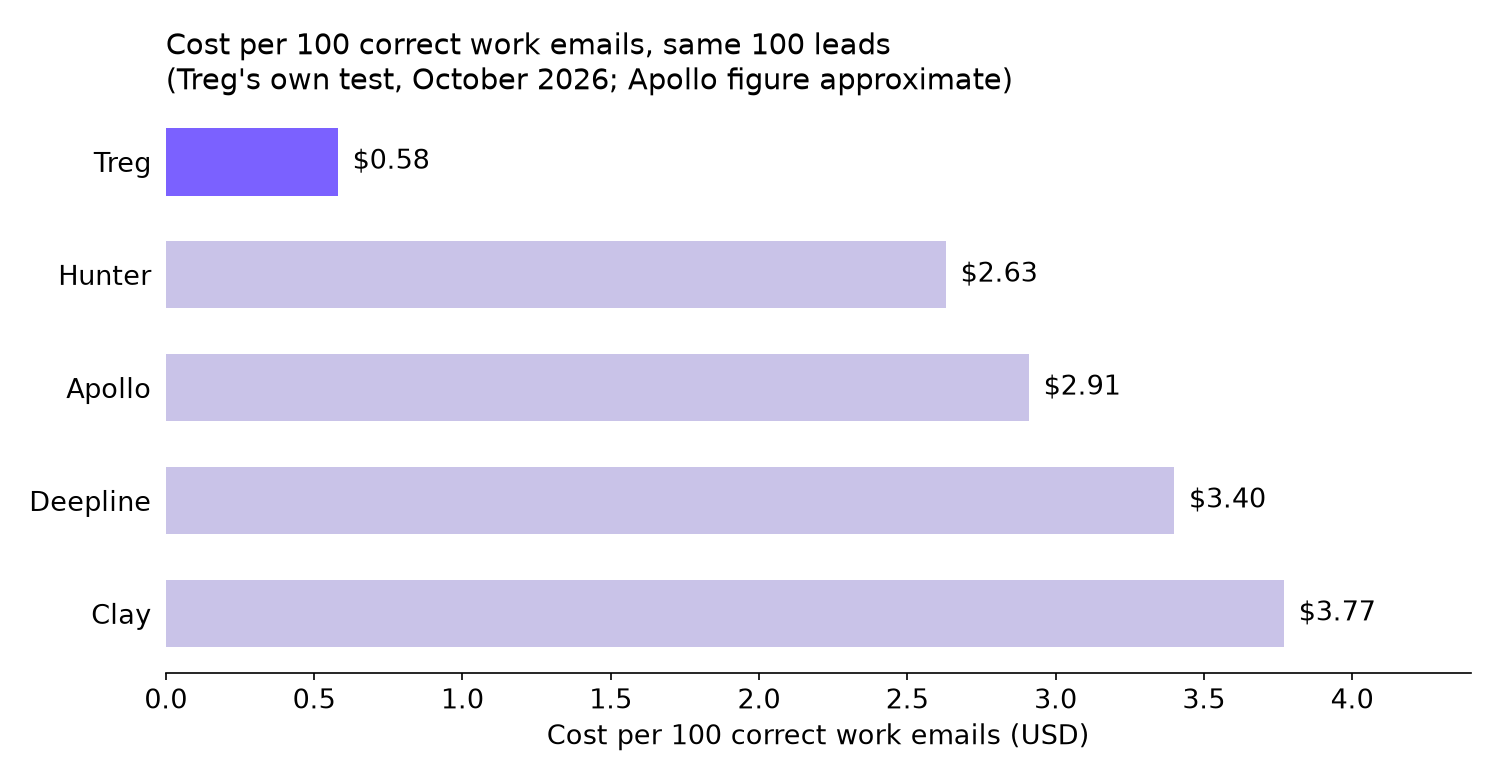
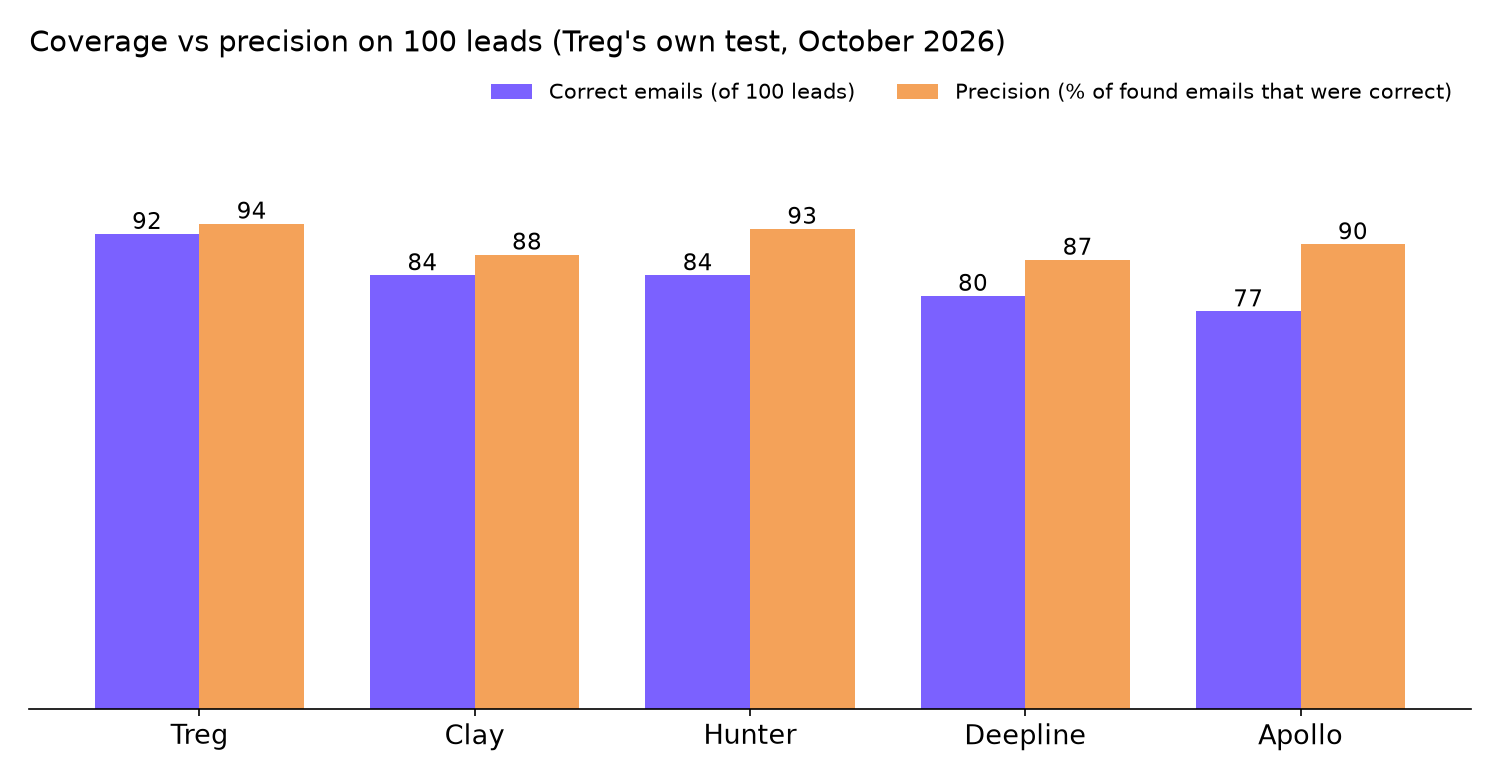
The best Clay alternatives in 2026 depend on how you pay. In Treg’s own October 2026 test of 100 leads, Treg found 92 correct work emails for $0.58 per 100 correct results, against Clay’s 84 at $3.77. Hunter came closest on precision (93%). Apollo and Deepline suit teams that want a full sales workflow, not just email lookups.
Below: the full table, today’s prices (checked November 3, 2026), where each tool wins and loses, and how to rerun the test on your own leads.
Clay alternatives at a glance: the 100-lead head-to-head
Treg ran the same 100 leads (a person’s name plus a company domain) through five work-email tools and checked each result against the address the company publishes. It’s Treg’s own benchmark, published on its people-search page, and nobody independent has reproduced it yet. Treg itself notes that “a gap of a few rows is a tie,” so read small differences as noise.
| Treg | Clay | Apollo | Deepline | Hunter | |
|---|---|---|---|---|---|
| Correct work emails (of 100) | 92 | 84 | 77 | 80 | 84 |
| Precision (correct / found) | 94% | 88% | 90% | 87% | 93% |
| Cost for the 100 leads | $0.53 | ~$3.35 | ~$2.24 | $2.74 | $2.21 |
| Cost per 100 correct emails | $0.58 | $3.77 | ~$2.91 | $3.40 | $2.63 |
Costs are list prices on the test day. Two columns matter most:
- Cost per 100 correct emails. Treg’s $0.58 is about 85% below Clay’s $3.77, and it found 8 more correct emails on the same list.
- Precision. Hunter’s 93% sits one point behind Treg’s 94%. If a wrong address costs you more than a missing one (bounces hurt sender reputation), precision is the column to watch.
Why people look for Clay alternatives
Clay is a spreadsheet-style enrichment workbench: you load rows, chain data providers and AI steps across columns, and push the results to your CRM. Teams start looking elsewhere for three common reasons:
- Plan price versus volume. Clay’s cheapest paid plan, Launch, is $185 a month billed monthly or $167 a month billed annually, per Clay’s pricing page on November 3, 2026. Treg’s comparison page lists Clay at $149 a month, so that figure is already out of date.
- Two meters. Clay now prices plans in actions and data credits. Launch includes 15,000 actions and 2,500 data credits a month, so you track two balances.
- Agents, not spreadsheets. More GTM work now runs from a coding agent like Claude Code. Those teams want an API and a token, not a table UI.
Clay’s Free plan (500 actions, 100 data credits, 200 rows per table) is enough to keep it as a baseline while you test.
Treg: open-source, pay per answer
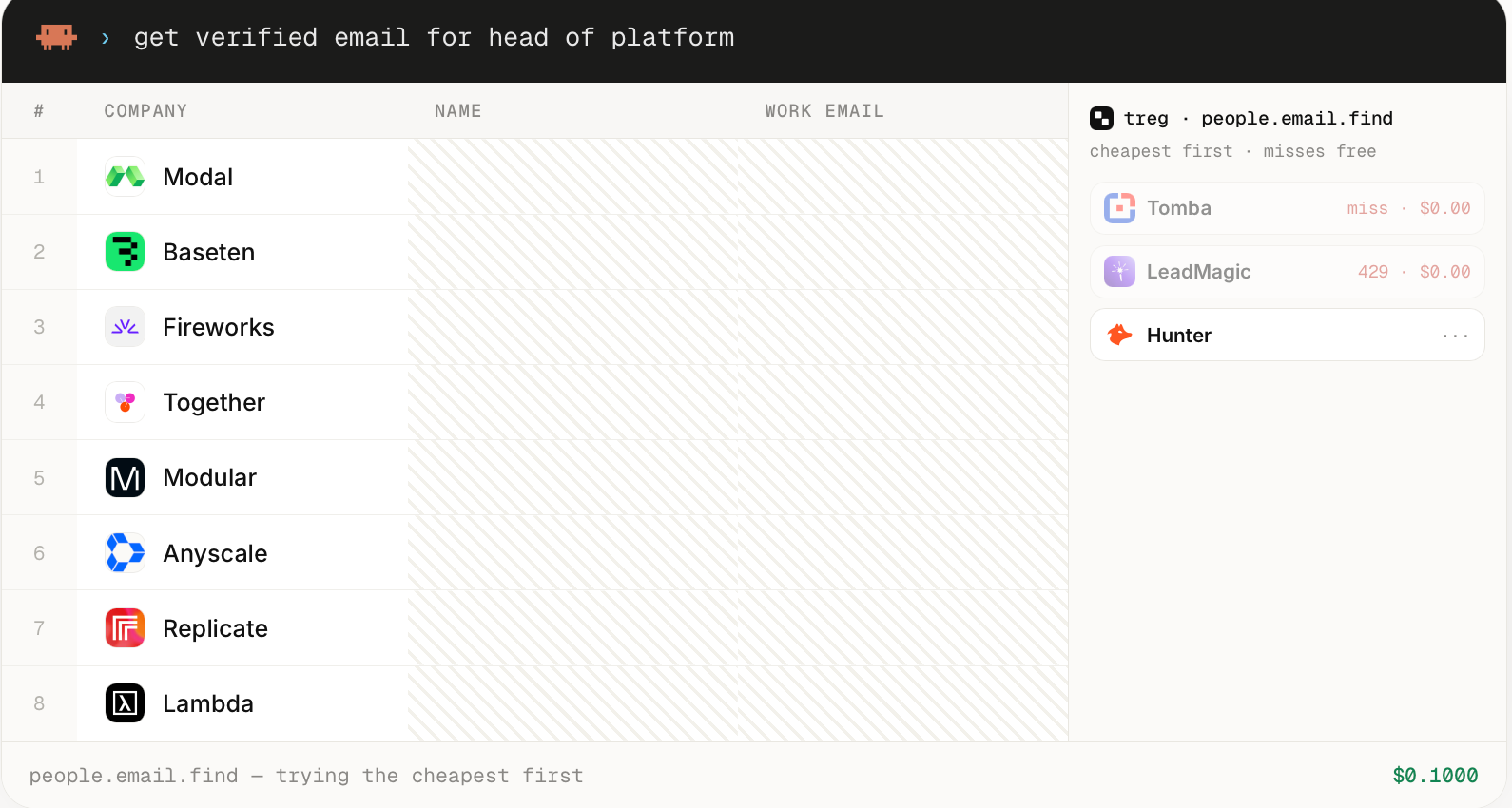
Treg describes itself in its GitHub README as “OpenRouter, but for agent tools instead of models.” One token gives your agent a catalog of 123 data providers, including Apollo, Hunter, Tomba, People Data Labs, LeadMagic, Icypeas, Exa and Crustdata, with 1B+ contacts and 4,100+ tools behind it.
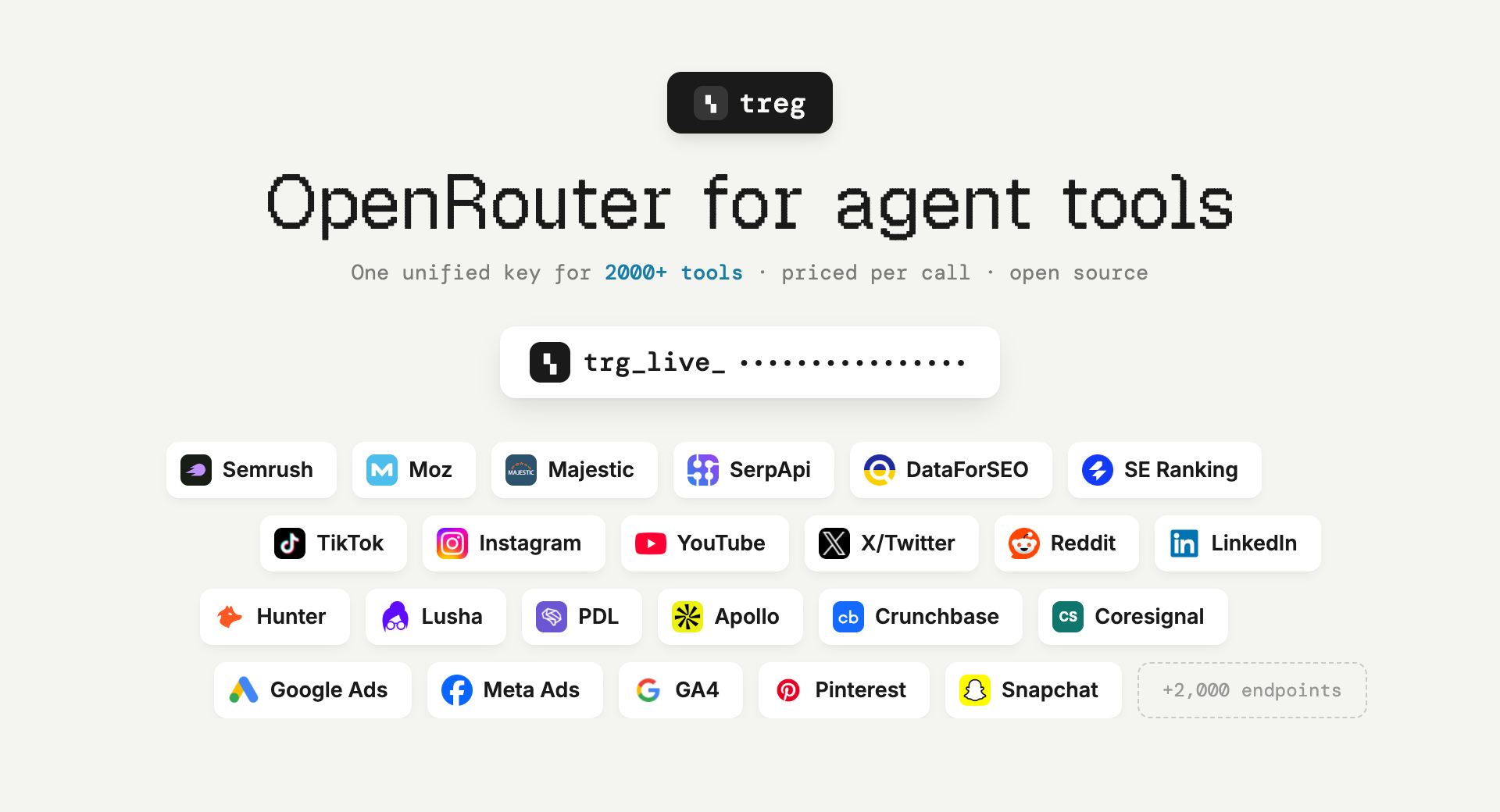
That’s the honest framing: Treg is a router in front of the same providers other tools sell. It doesn’t own a contact database. Its edge in the test comes from trying more than one finder per lead and only charging for hits.
Pricing model
- No subscription. You prepay a balance.
- Calls bill at the provider’s own rate with 0% markup. The cheapest email find starts at $0.0005.
- Misses are free: a finder that returns nothing bills $0.00.
- New verified accounts get $1.00 of free credit, once.
Treg publishes a real receipt from September 23, 2026: 27 people in, 21 emails found (18 by Hunter, 3 by Kitt), 20 verified deliverable, 6 misses billed at $0.00. Total cost was $0.58, or $0.029 per usable result.
License. The repo ships under Apache 2.0 with additional terms. You can use it freely, including commercially inside your company, but you can’t redistribute it as a competing hosted registry without permission.
Where it wins: lowest cost per correct email in the test, no monthly floor, built for agents (CLI, HTTP proxy and a Claude Code plugin).
Where it loses: it’s a young project with no CRM, sequencing or dialer. Every benchmark on its page is its own.
Apollo: database plus sales engagement
Apollo pairs its own contact database with email sequencing, a dialer and CRM sync. It’s the tool reps live in all day, not just a lookup API.

Pricing model. Apollo lists Free, Basic, Professional and Custom plans. Credits are pooled across the team, granted each billing cycle, and don’t roll over. Apollo’s pricing page showed no dollar figures when we checked on November 3, 2026; Treg’s page lists Apollo at $59 a month, so confirm the current price in your Apollo account before you budget.
Where it wins: one place to find, sequence and call. The Free plan has no time limit.
Where it loses: in Treg’s test it found the fewest correct emails (77), though its 90% precision was solid.
Hunter: the precise email finder
Hunter does one job well: find and verify work emails from a name and a domain. Its API is plain REST, which makes it easy to wire into scripts and agents.
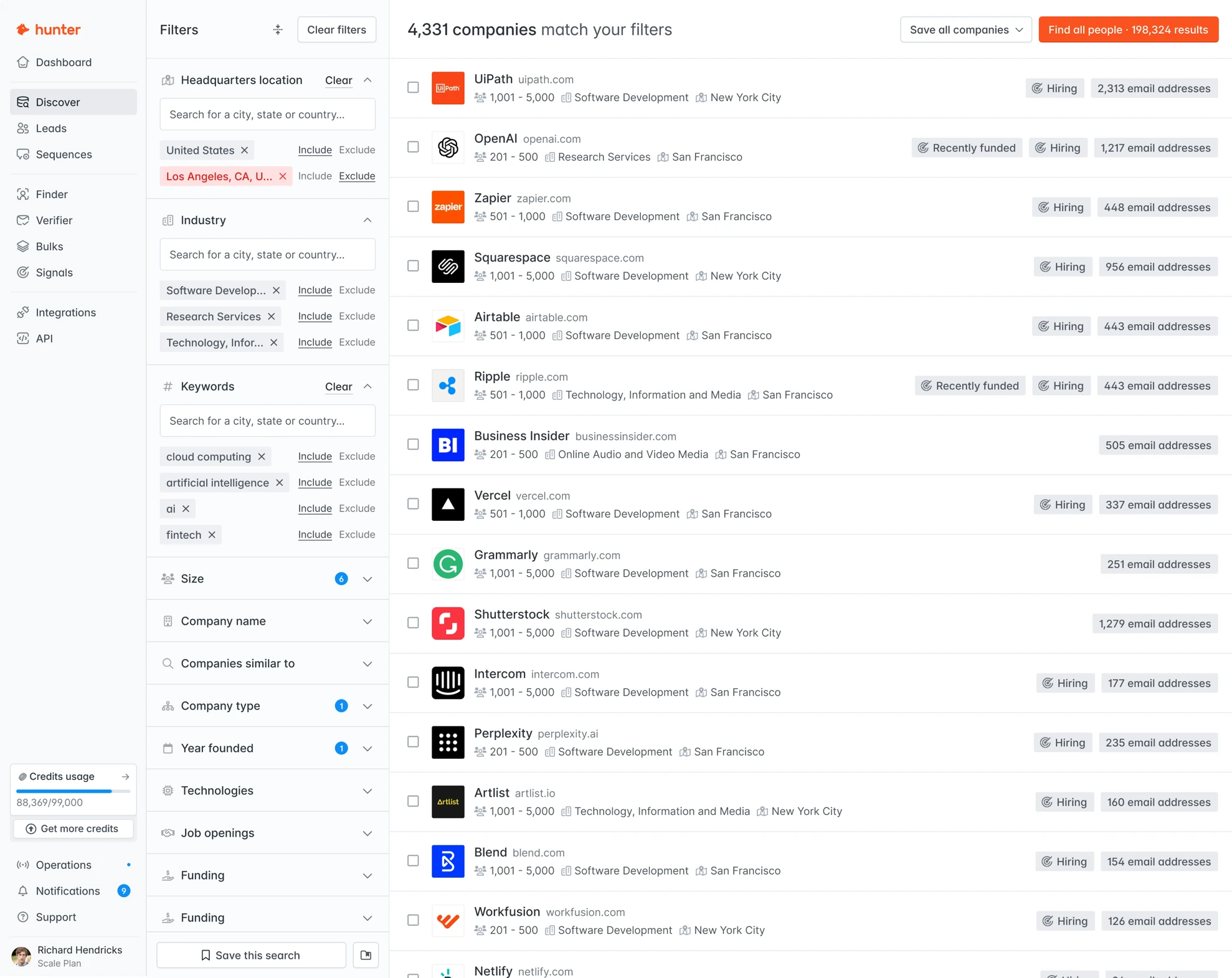
Pricing model (checked November 3, 2026):
| Plan | Monthly billing | Annual billing (per month) | Credits per month |
|---|---|---|---|
| Free | $0 | $0 | 50 |
| Starter | $49 | $34 | 2,000 |
| Growth | $149 | $104 | 10,000 |
| Scale | $299 | $209 | 25,000 |
Credits reset monthly and don’t roll over.
Where it wins: 93% precision in the test, a clear API, and a free tier you can test against today.
Where it loses: it’s an email tool, not an enrichment workbench, so firmographics and multi-step flows live elsewhere.
Deepline: GTM workflows through your own agent
Deepline describes itself as a way to find leads and run GTM workflows with the agent you already use, through one API that connects GTM data providers. It’s the closest in spirit to Treg, with more workflow features on top.
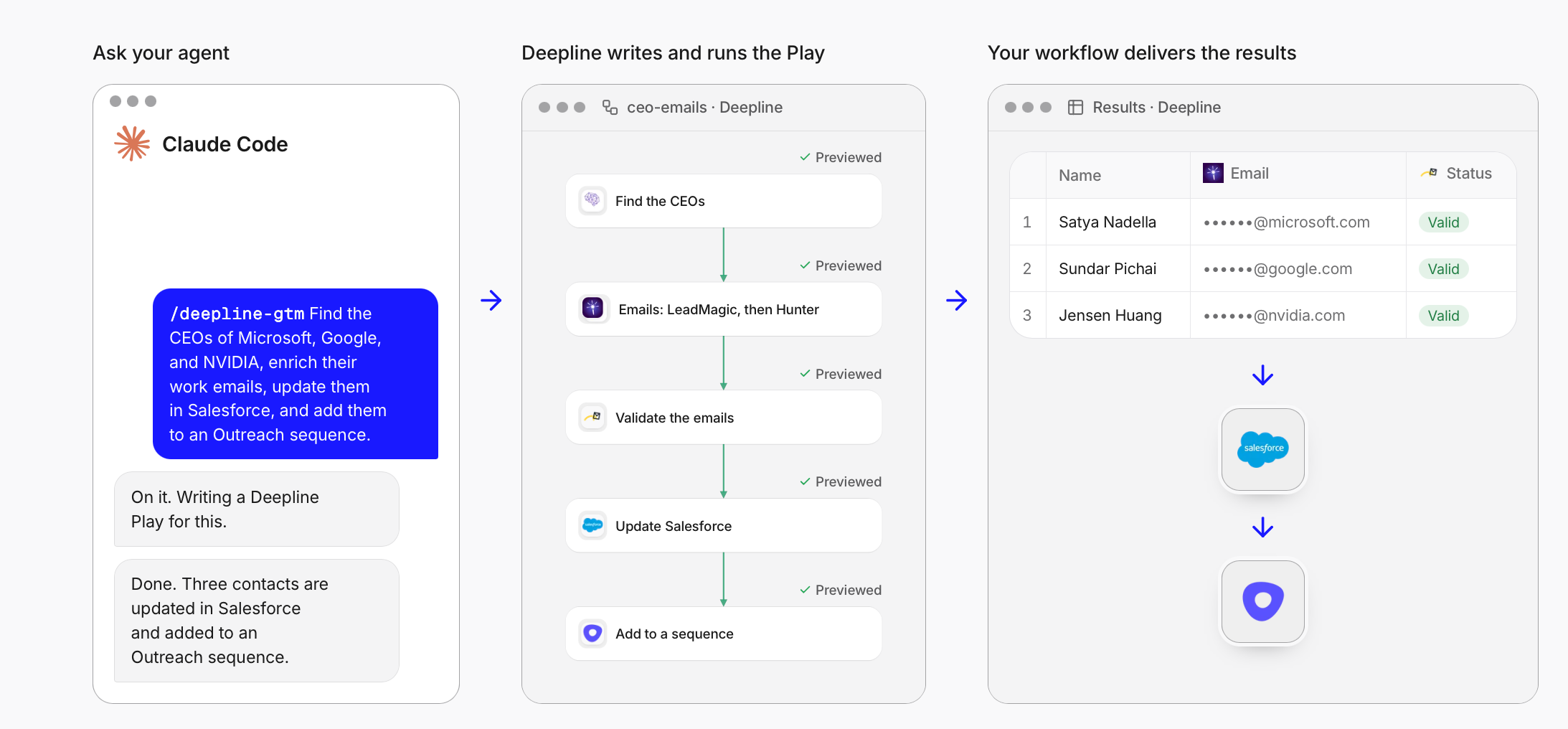
Pricing model (checked November 3, 2026):
- Pay as you go: $0 a month plus usage, no card required, 15 scheduled Plays and live monitors combined.
- Growth: $395 a month plus usage, with $200 of monthly usage credits included.
- Credits: 10 credits equal $1.
- Bring your own keys: you pay providers directly with no markup; Pay as you go includes 50,000 provider-key calls a month, then $0.005 per call.
Where it wins: scheduled Plays, live monitors and CRM sync for teams that want automation, not just lookups.
Where it loses: it was last on precision (87%) in Treg’s test, and the Growth plan is a big step up from $0.
Which Clay alternative should you pick?
Match the tool to how you work:
- You run enrichment from a coding agent and pay per result: start with Treg. Its $1 credit covers a real test.
- You need the highest precision from one well-known API: Hunter, starting on its Free plan.
- Your reps want database, sequences and dialer in one app: Apollo.
- You want scheduled GTM workflows driven by your agent: Deepline on Pay as you go.
- You live in spreadsheets and chain many AI steps per row: stay on Clay, and use the others as cheaper finders inside it.
Don’t switch on someone else’s benchmark. Run your own 10 leads first.
Test Clay alternatives on your own leads with Apidog CLI
Every tool above is an HTTP API, so test them like any API. Let your coding agent do it with Apidog CLI: it defines the endpoints, writes the test case, and runs it against a CSV of leads where you already know the right answer.
Set up once:
npm install -g apidog-cli@latest
apidog auth login --with-token <YOUR_APIDOG_TOKEN>
apidog skill install
Put 10 leads you can verify in leads.csv (columns first_name, last_name, domain, expected_email). Then give your agent one prompt:
In Apidog project <projectId>, create two endpoints: GET https://treg.to/call/<emailFinderToolId>
with header X-Treg-Token, and GET https://api.hunter.io/v2/email-finder with X-API-KEY.
Create one test case per endpoint that reads first_name, last_name and domain from
the iteration data, asserts status 200, and asserts the returned email equals
expected_email. Log the X-Treg-Cost-Micro response header on every Treg call.
Run both against leads.csv in the <envId> environment and give me correct count,
precision and total cost per tool.
Your agent should find the Treg tool ID with treg catalog search "find work email". It then works through the Apidog commands, validating every payload before it writes:
apidog cli-schema get endpoint-create
apidog cli-schema validate endpoint-create --file treg-endpoint.json
apidog endpoint create --project <projectId> --file treg-endpoint.json
apidog cli-schema get test-case-create
apidog cli-schema validate test-case-create --file treg-case.json
apidog test-case create --project <projectId> --file treg-case.json
apidog run --test-case <caseId> --project <projectId> -e <envId> -d leads.csv -r cli,json
The -d flag runs one iteration per CSV row, and -r cli,json gives you a terminal summary plus a JSON report your agent can total up. Add --upload-report if you want to review the run in the Apidog app. Keep the API keys in an Apidog environment, not in the CSV. If you’re new to the setup, the Claude Code walkthrough and the apidog run reference cover each step.
For more on agents that call APIs on your behalf, see how GPT-6 Astra handles computer-use API testing and how teams build an agentic software factory.
FAQ
What is the cheapest Clay alternative in 2026? In Treg’s own October 2026 test, Treg cost $0.58 per 100 correct work emails, against $2.63 for Hunter and $3.77 for Clay. Treg has no subscription and misses bill $0.00. Rerun the test on your own leads before you rely on that ranking.
Is Treg’s 100-lead benchmark independent? No. Treg ran and published it, and no third party has reproduced it as of November 3, 2026. Treg also says a gap of a few rows is a tie.
Does Treg have its own contact database? No. Treg routes your calls to 123 providers, including Apollo, Hunter and People Data Labs, through one token. You pay each provider’s rate with 0% markup.
Is Treg free and open source? The code is open source under Apache 2.0 with additional terms that restrict running it as a competing hosted registry. The hosted API is pay per use, and new verified accounts get $1.00 of free credit once.
Which Clay alternative has the best email precision? Treg (94%) and Hunter (93%) were within one point of each other in Treg’s test, which Treg’s own rules count as a tie. Hunter’s Free plan gives you 50 credits a month to check it yourself.
Can I keep Clay and use these tools too? Yes. Many teams keep Clay as the workbench and call a cheaper finder like Hunter or Treg for the email step. Test the combination on a small list first.