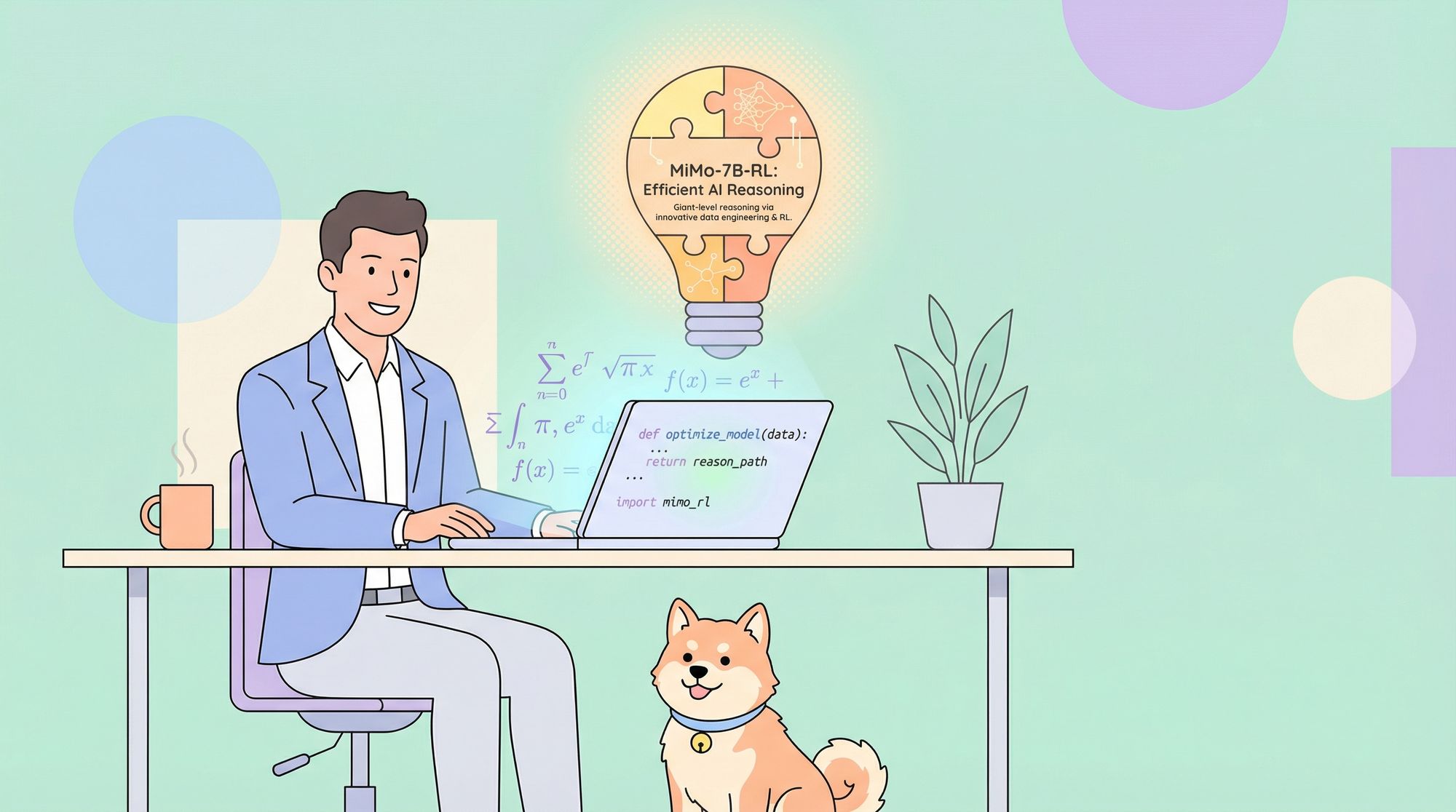
The belief that only massive language models can deliver state-of-the-art reasoning in mathematics and coding is being challenged. Xiaomi’s LLM-Core Team has introduced MiMo-7B-RL, a 7-billion-parameter model tailored for mathematical and coding tasks. Remarkably, it achieves performance comparable to much larger models and specialized systems, such as OpenAI's o1-mini, by optimizing its entire training lifecycle.
Developers and API teams looking to harness efficient, powerful AI for technical tasks can now benefit from these advancements—while tools like Apidog streamline documentation and collaboration for your API projects.
What Is MiMo-7B? Key Innovations in Efficient AI Reasoning
MiMo-7B is founded on the principle that core reasoning ability is established during the pre-training phase. While fine-tuning is important, Xiaomi observed that smaller models often lack exposure to complex logical structures, limiting their abilities.
How Xiaomi Boosted Reasoning in MiMo-7B:
- Enhanced Data Extraction: Improved parsing to capture technical structures in code and documents.
- Dense Reasoning Patterns: Multi-dimensional filtering focused on logical problem-solving examples.
- Synthetic Data Generation: Created large datasets simulating step-by-step reasoning.
- Three-Stage Data Mixing: Trained on ~25 trillion tokens for robust foundational knowledge.
- Multiple-Token Prediction (MTP): The model learns to predict several tokens ahead, improving its grasp of complex dependencies and potentially accelerating inference using speculative decoding.
Advanced Reinforcement Learning for Math & Code Mastery
After initial fine-tuning (MiMo-7B-SFT), Xiaomi employed a reinforcement learning (RL) phase targeting mathematics and coding:
- High-Quality RL Dataset: 130,000+ rigorously vetted math and code problems, all verifiable by rule-based checks (like unit tests).
- Objective Reward System: Only rule-based accuracy was rewarded, preventing reward hacking.
- Partial Credit Rewards: Introduced a "test difficulty driven code reward"—models get partial rewards for passing easier test cases, enabling more nuanced learning signals.
- Adaptive Data Sampling: As the model improved, training shifted toward harder problems, making learning more effective.
- Seamless Rollout Engine: Innovative RL infrastructure that integrates continuous generation, asynchronous reward calculation, and early termination. This keeps GPUs busy and training fast (2.29x speedup).
The MiMo-7B-RL Model Lineup
Xiaomi’s approach is transparent, with several model checkpoints available:
| Model | Description |
|---|---|
| MiMo-7B-Base | Strong foundational reasoning |
| MiMo-7B-RL-Zero | RL applied directly to base |
| MiMo-7B-SFT | Base fine-tuned with supervised data |
| MiMo-7B-RL | RL on SFT model for best reasoning performance |
Benchmark Results: How Does MiMo-7B-RL Compare?
MiMo-7B-RL delivers top-tier results on industry benchmarks—often beating much larger models and specialized solutions.
Comparative Performance (Pass@1, Temperature=0.6):
| Benchmark | GPT-4o | Claude-3.5 | o1-mini | MiMo-7B-RL |
|---|---|---|---|---|
| MATH-500 | 74.6 | 78.3 | 90.0 | 95.8 |
| AIME 2024 | 9.3 | 16.0 | 63.6 | 68.2 |
| AIME 2025 | 11.6 | 7.4 | 50.7 | 55.4 |
| LiveCodeBench v5 | 32.9 | 38.9 | 53.8 | 57.8 |
| LiveCodeBench v6 | 30.9 | 37.2 | 46.8 | 49.3 |
MiMo-7B-RL excels on challenging math and coding tasks, sometimes outperforming larger, more expensive models.
Internal Progression: MiMo-7B Series
| Benchmark | Base | RL-Zero | SFT | RL |
|---|---|---|---|---|
| MATH-500 | 37.4 | 93.6 | 93.0 | 95.8 |
| AIME 2024 | 32.9 | 56.4 | 58.7 | 68.2 |
| LiveCodeBench v5 | 32.9 | 49.1 | 52.3 | 57.8 |
Each stage—base, SFT, RL—adds significant capability. Notably, supervised fine-tuning (SFT) before RL leads to better final results than RL alone.
How to Run MiMo-7B-RL: Developer Guide
MiMo-7B-RL and its variants are open-sourced on Hugging Face (XiaomiMiMo organization page). The model (approx. 7.83B parameters, BF16) can be run using:
1. Recommended: Xiaomi’s vLLM Fork (with MTP Support)
# Ensure Xiaomi's vLLM fork is installed
from vllm import LLM, SamplingParams

model_path = "/path/to/XiaomiMiMo/MiMo-7B-RL"
llm = LLM(
    model=model_path,
    trust_remote_code=True,
    num_speculative_tokens=1,  # Enables MTP
    disable_log_stats=False
)
sampling_params = SamplingParams(temperature=0.6)

conversation = [
    {"role": "system", "content": ""},
    {"role": "user", "content": "Write a python function to compute the nth Fibonacci number."},
]

outputs = llm.chat(conversation, sampling_params=sampling_params, use_tqdm=False)
for output in outputs:
    print(f"Prompt: {output.prompt!r}")
    print("-" * 20)
    print(f"Generated text: {output.outputs[0].text!r}")
2. Standard vLLM (without MTP)
If using the standard vLLM, register the MiMo architecture first:
import register_mimo_in_vllm
from vllm import LLM, SamplingParams

model_path = "/path/to/XiaomiMiMo/MiMo-7B-RL"
llm = LLM(
    model=model_path,
    trust_remote_code=True,
    disable_log_stats=False
)
sampling_params = SamplingParams(temperature=0.6)

conversation = [
    {"role": "system", "content": ""},
    {"role": "user", "content": "Write a python function to compute the nth Fibonacci number."},
]
outputs = llm.chat(conversation, sampling_params=sampling_params, use_tqdm=False)
for output in outputs:
    print(f"Prompt: {output.prompt!r}\n{'-'*20}\nGenerated text: {output.outputs[0].text!r}")
3. Hugging Face Transformers
from transformers import AutoModelForCausalLM, AutoTokenizer

model_path = "/path/to/XiaomiMiMo/MiMo-7B-RL"
model = AutoModelForCausalLM.from_pretrained(
    model_path,
    trust_remote_code=True,
    device_map="auto"
)
tokenizer = AutoTokenizer.from_pretrained(model_path)

prompt = "Write a python function to compute the nth Fibonacci number."
inputs = tokenizer([prompt], return_tensors='pt').to(model.device)

output_sequences = model.generate(
    **inputs,
    max_new_tokens=256,
    temperature=0.6,
    do_sample=True
)

generated_text = tokenizer.decode(output_sequences[0], skip_special_tokens=True)
print(generated_text)
Tip: For best benchmark replication, use Xiaomi’s vLLM fork and an empty system prompt.
Why Efficient AI Matters for API Developers
With models like MiMo-7B-RL, API and backend teams can now deploy high-performing, resource-efficient AI for code generation, automated reasoning, and advanced testing. This unlocks new automation and productivity gains—especially when combined with tools like Apidog for collaborative API development, documentation, and testing.
- API Testing: Generate beautiful API documentation and automate workflow checks.
- Team Collaboration: Boost developer productivity with integrated tooling.
- Cost Savings: Replace Postman at a more affordable price.
MiMo-7B-RL fits comfortably in this class — for the wider field, see our roundup of the best small local LLMs that run on 8GB of RAM or VRAM.
Microsoft's research pushes efficiency in a different direction entirely:BitNet b1.58's 1.58-bit weight representationtrades numerical precision at the architecture level rather than distilling knowledge from a larger teacher model.
Conclusion: Xiaomi’s MiMo-7B-RL Sets a New Standard for Efficient AI
MiMo-7B-RL proves that with the right data engineering and reinforcement learning strategies, small models can match—and sometimes surpass—the reasoning of giants. For technical teams and API developers, this opens opportunities for smarter, leaner, and more accessible AI-powered solutions.
Curious how leading developer teams streamline their API workflows? Try Apidog now for beautifully documented APIs and seamless team productivity.