
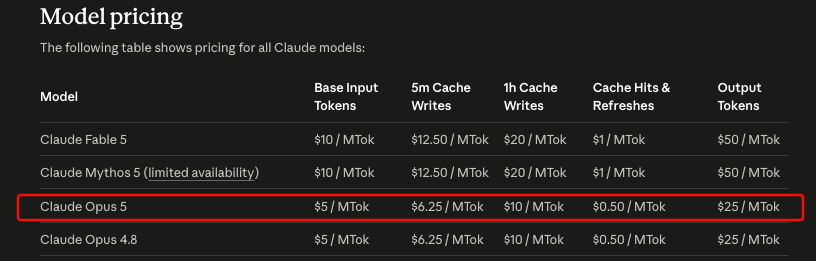
Claude Opus 5 launched on July 24, 2026 at $5 per million input tokens and $25 per million output tokens. That is the same rate Anthropic charged for Opus 4.8, and exactly half of what Fable 5 costs. The launch coverage all ran with that headline, and it is accurate as far as it goes.
What the coverage skipped is the part that decides your invoice: cache writes, cache hits, batch rates, fast mode, the regional multiplier, and the behavior changes that quietly move token counts. This guide gives you the full price table, then works the cost math on real request shapes so you can size a budget before you ship. To check the numbers against your own traffic, send the requests from Apidog and read the usage block on every response.
The full Claude Opus 5 price table
Every rate below comes from Anthropic’s pricing documentation and applies to the model ID claude-opus-5.
| Token category | Price per million tokens |
|---|---|
| Input (standard) | $5.00 |
| Output (standard) | $25.00 |
| Prompt cache write, 5 minute TTL | $6.25 |
| Prompt cache write, 1 hour TTL | $10.00 |
| Cache hits and refreshes | $0.50 |
| Batch API input | $2.50 |
| Batch API output | $12.50 |
| Fast mode input | $10.00 |
| Fast mode output | $50.00 |
A few things to hold onto:
- Cache hits cost one tenth of standard input. This is the biggest lever in the table.
- The 5 minute cache write carries a 1.25x premium over standard input; the 1 hour write carries 2x.
- Batch is a flat 50% off both input and output.
- Fast mode is exactly 2x standard pricing for 2.5x output speed. It is a research preview, first-party API only (not Bedrock, Google Cloud, or Microsoft Foundry), and it does not combine with the Batch API.
- There is no long-context premium. The 1M token context window is the default and the maximum, and tokens past any threshold bill at the same $5. Some competing models charge more once you cross a context tier. Opus 5 does not.
That last point puts a hard ceiling on a single request. The most expensive possible Messages API call is 1M input tokens plus the 128k output maximum: $5.00 + $3.20, or $8.20. On the Batch API, where max output rises to 300k with the output-300k-2026-03-24 beta header, the output side caps at $3.75.
The anchor: same as 4.8, half of Fable 5
Here is where Opus 5 sits against the models you are most likely comparing it to.
| Model | Input / MTok | Output / MTok |
|---|---|---|
| Claude Opus 5 | $5.00 | $25.00 |
| Claude Opus 4.8 | $5.00 | $25.00 |
| Claude Fable 5 | $10.00 | $50.00 |
| Claude Sonnet 5 (intro, through Aug 31 2026) | $2.00 | $10.00 |
| Claude Sonnet 5 (from Sep 1 2026) | $3.00 | $15.00 |
Two readings of this table matter.
First, upgrading from Opus 4.8 costs nothing per token. The rate is identical, and has been across 4.5, 4.6, 4.7, and 4.8. The model ID swap does not touch your unit economics. What it does change is your token volume, which we get to below. The Opus 4.8 pricing breakdown still holds for anything on the older ID.
Second, Opus 5 is half of Fable 5. Anthropic’s launch numbers claim Opus 5 lands within 0.5% of Fable 5’s peak on CursorBench 3.2 and surpasses it on OSWorld 2.0 at roughly one third the cost per task. Those are vendor-run figures from the Opus 5 launch post, and nobody has independently reproduced them as of July 25, 2026. Treat them as claims, not settled results. The Opus 5 vs Fable 5 comparison works through where the price gap is worth it, and the Fable 5 pricing page has the higher-tier detail.
Worked example 1: a single request
Start with the simplest shape. A summarization call with 8,000 input tokens and 1,200 output tokens.
- Input: 8,000 / 1,000,000 x $5.00 = $0.040
- Output: 1,200 / 1,000,000 x $25.00 = $0.030
- Total: $0.070 per call
At 10,000 calls a month, that is $700. The same workload on Fable 5 costs $0.140 per call, or $1,400 a month. On Sonnet 5 at the introductory rate it costs $0.028 per call, or $280.
Note that output is 43% of the bill on a request with almost seven times more input than output. Output costs five times what input costs, so output volume dominates faster than most people expect. That matters more on Opus 5 than on 4.8, because thinking tokens bill as output and adaptive thinking is now on by default.
Worked example 2: a long agentic session with caching
This is where the real money is, and the real savings. Take a coding agent with a 120,000 token system prompt plus repo context, running a 40 turn session. Each turn adds 1,500 tokens of new conversation and produces 2,500 output tokens.
Without prompt caching, you resend the full context every turn:
| Line item | Tokens | Rate | Cost |
|---|---|---|---|
| Input (120,000 x 40, plus 60,000 new) | 4,860,000 | $5.00 | $24.30 |
| Output (2,500 x 40) | 100,000 | $25.00 | $2.50 |
| Total | $26.80 |
With a 5 minute prompt cache on the 120,000 token prefix:
| Line item | Tokens | Rate | Cost |
|---|---|---|---|
| Cache write, once | 120,000 | $6.25 | $0.75 |
| Cache reads (39 turns) | 4,680,000 | $0.50 | $2.34 |
| New input (1,500 x 40) | 60,000 | $5.00 | $0.30 |
| Output (2,500 x 40) | 100,000 | $25.00 | $2.50 |
| Total | $5.89 |
That is a 78% reduction, and output is now 42% of the bill instead of 9%. Once you cache properly, output is the thing you optimize next.
One caveat on the 5 minute TTL: cache reads refresh it, so a session with turns under five minutes apart stays warm on a single write. If your agent idles longer than that, use the 1 hour write at $10 per million. Here that raises the write from $0.75 to $1.20 and the total to $6.34, still 76% below the uncached run.
Worked example 3: batch processing
For anything that does not need a synchronous response, the Batch API is a flat 50% off. Take 50,000 documents at 1,200 input tokens and 150 output tokens each.
| Path | Input cost | Output cost | Total |
|---|---|---|---|
| Standard | 60 MTok x $5.00 = $300.00 | 7.5 MTok x $25.00 = $187.50 | $487.50 |
| Batch | 60 MTok x $2.50 = $150.00 | 7.5 MTok x $12.50 = $93.75 | $243.75 |
Same tokens, same model, $243.75 saved. The tradeoff is latency, not quality. If your classification, enrichment, or evaluation job tolerates asynchronous delivery, running it on the standard endpoint leaves half the budget on the table.
Worked example 4: what fast mode actually costs
Fast mode doubles the rate to $10 / $50 for roughly 2.5x output speed. Run the example 1 request through it and you get $0.080 input plus $0.060 output, or $0.140 per call, exactly double.
That prices Opus 5 identically to Fable 5’s standard rate: you are paying frontier-tier prices for latency, not capability. Worth it for interactive surfaces where a user watches tokens appear, hard to justify for background work. It does not combine with the Batch API, so the two cost levers are mutually exclusive by design.
The four levers that actually move your bill
These four are specific to Opus 5, and specific about how much they save.
1. The prompt cache minimum dropped to 512 tokens
On Opus 4.8 the cacheable minimum was 1,024 tokens. On Opus 5 it is 512. Prompts previously too short to cache now cache with no code change beyond adding the cache control block.
The break-even math is better than most people assume. A cache write costs 1.25x standard input, a read costs 0.1x. Solving for the point where caching wins:
- 5 minute TTL: breaks even at 1.3 requests. You are ahead from the second call onward.
- 1 hour TTL: breaks even at 2.1 requests. You are ahead from the third call onward.
Concretely, a 700 token system prompt reused across 1,000 calls in a burst costs $3.50 uncached. Cached, it costs $0.0044 for the write plus 999 reads at $0.00035, or $0.354 total. That prompt could not be cached at all on Opus 4.8.
2. Batch at 50%
Covered above, but worth restating as a lever: audit which workloads genuinely need a synchronous response. Evaluation runs, backfills, nightly summarization, and content classification usually do not.
3. Effort low and medium are finally usable
output_config.effort controls how much the model thinks, and thinking tokens bill as output at $25 per million. Opus 5 recalibrated the effort levels, and Anthropic states that low and medium are meaningfully stronger than on prior Opus models. The default is high; xhigh remains the recommended start for coding and agentic work.
Savings scale directly with thinking-token volume. If a task averages 8,000 thinking tokens at xhigh and 1,500 at low, you save 6,500 output tokens, or $0.1625 per task, which is $16,250 across 100,000 tasks. Those figures are illustrative: the real delta depends on your prompts, which is why Anthropic tells you to run a fresh effort sweep against your own evals rather than carrying 4.8 settings across. The effort parameter guide covers that sweep.
One trap: lowering effort cuts thinking tokens, not visible response length. Opus 5’s default responses and written deliverables run longer than Opus 4.8’s, and effort will not fix that. If you want shorter answers, ask for shorter answers.
4. Lower tool-use system prompt overhead
When you send tool definitions, the API injects a system prompt you pay for. On Opus 5 that overhead is 286 tokens for auto or none tool choice, down from 290 on Opus 4.8 and 675 on Opus 4.7.
Be honest about the size of this one. Against 4.8, the four token difference is $20 across a million requests: noise. Against 4.7, the 389 token difference is $0.001945 per request, or $1,945 per million requests. If you are still on 4.7 it is real money; on 4.8 it is a rounding error.
For levers that apply across the whole Claude lineup, our guide on cutting your Claude API bill goes wider.
Two line items people miss
The inference_geo: "us" multiplier is 1.1x. Pin inference to US-only infrastructure for compliance or data residency and every token category gets multiplied by 1.1: input $5.50, output $27.50, cache hits $0.55, batch $2.75 / $13.75. The example 1 workload goes from $700 a month to $770. On a $50,000 bill it is a $5,000 line item, so confirm you need the pin before you set it.
Priority Tier is not supported on Opus 5. Opus 4.8 keeps it. If your capacity planning depends on Priority Tier commitments, that is a real constraint on moving over. The Opus 4.8 to Opus 5 migration guide covers it alongside the breaking API changes.
Behavior changes that show up on your invoice
Per-token rates are half a bill. Token volume is the other half, and three Opus 5 behavior changes push volume up if you do nothing.
- Thinking is on by default. On Opus 4.8, a request with no
thinkingfield ran without thinking. On Opus 5 the same request runs adaptive thinking, and those tokens bill as output. Becausemax_tokenscaps thinking plus response together, some of those workloads will also start truncating. - Opus 5 delegates to subagents more readily. Each subagent is its own set of billed tokens. Cap or scope delegation on cost-sensitive workloads.
- Opus 5 verifies its own work unprompted. If you carried over “double-check your work” instructions, Anthropic’s prompting guide says to remove them. Over-verification is tokens.
None of these change the price per token. All of them change what you pay.
Confirming your real spend with Apidog
The fastest way to stop guessing is to read the usage object on every response. It reports input_tokens, output_tokens, cache_creation_input_tokens, and cache_read_input_tokens separately, which is the exact breakdown you need to check the math above against your own traffic.
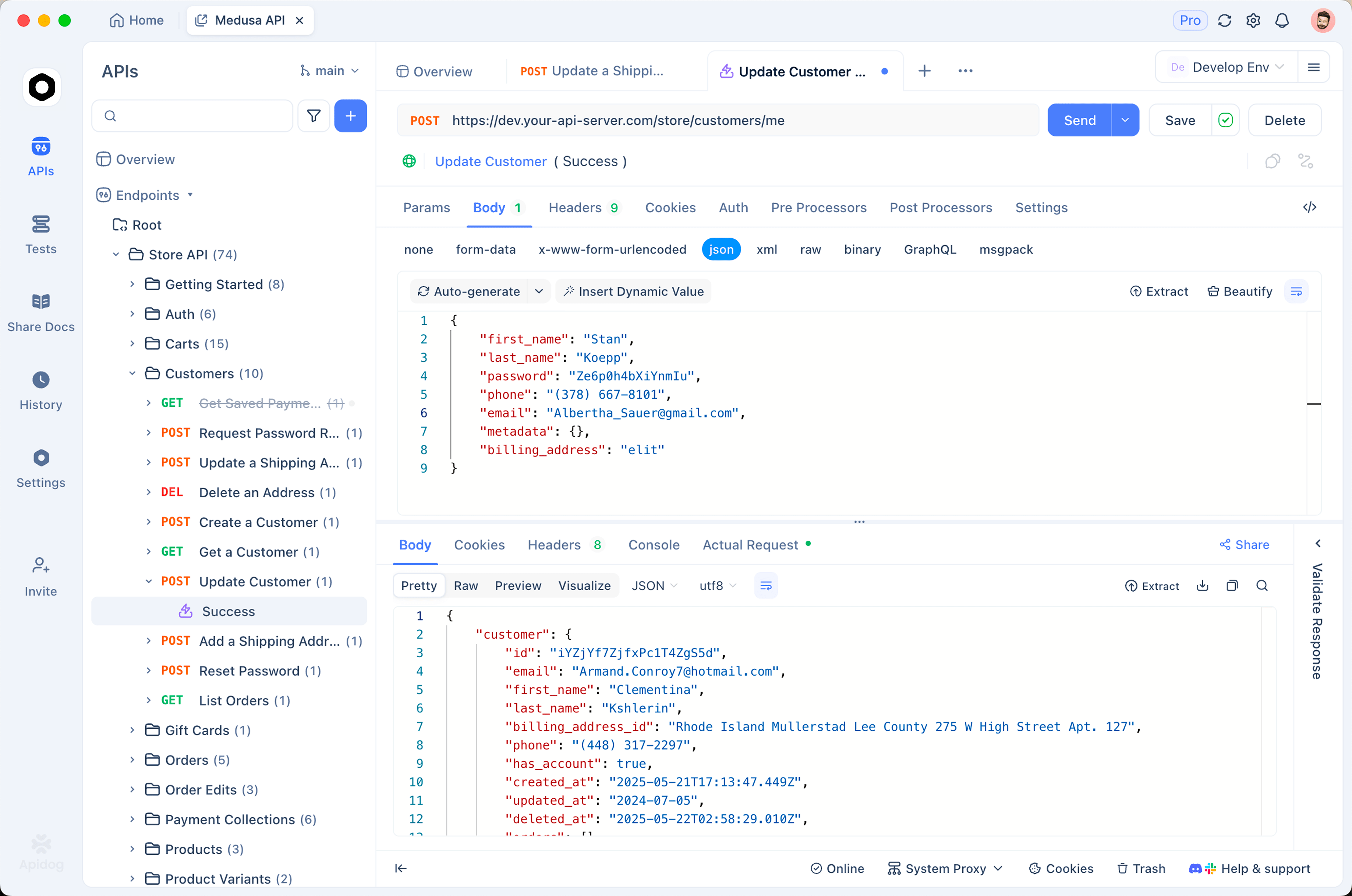
Apidog is an API development and testing platform, so it handles this well. Point a request at the Messages endpoint with "model": "claude-opus-5", then:
- Duplicate the saved request once per effort level and compare thinking-token volume side by side on identical prompts.
- Assert that
usage.cache_read_input_tokensis greater than zero, so a silently broken cache shows up as a failing test instead of a surprise invoice. - Store keys as environment variables rather than in the request body, so a dev key never runs a production-sized batch.
- Watch the SSE stream to see where output tokens go on long generations.
Download Apidog to run these checks alongside the walkthrough in our Opus 5 API guide.
What you are actually buying at $5 / $25
Opus 5 is a strong price-per-capability position, and it is not the top of the Claude stack. Fable 5 remains Anthropic’s most capable widely released model, and Opus 5 still trails Mythos 5 on cybersecurity exploitation and autonomous biology research. Anthropic states both plainly. The honest framing is frontier-class capability at half the frontier price, with a named ceiling above it. Our Mythos-class explainer covers what sits above that line.
For most teams the real question is not Opus 5 versus the ceiling. It is whether the workload needs Opus at all, or whether Sonnet 5 at $2 / $10 (rising to $3 / $15 on September 1, 2026) does the job for 40% of the price. Run both against your own evals before committing a budget. Full specs and availability live in our Claude Opus 5 overview; Anthropic’s models overview has the canonical table.
FAQ
How much does Claude Opus 5 cost? $5 per million input tokens and $25 per million output tokens on the standard API. Cache hits cost $0.50, batch runs at $2.50 / $12.50, and fast mode at $10 / $50.
Is Claude Opus 5 more expensive than Opus 4.8? Per token, no: the rates are identical. Your bill can still rise, because thinking is on by default and default responses run longer. Measure token volume rather than assuming parity.
Is there a long-context surcharge on the 1M window? No. The 1M token context window is both the default and the maximum, and there is no premium tier for long inputs.
What is the cheapest way to run Claude Opus 5? Cache aggressively (the 512 token minimum means almost any reused prefix qualifies), run non-urgent jobs through the Batch API for a flat 50% off, and sweep effort levels for the lowest one that passes your evals. The free and cheapest-path guide has more.
Does the regional pin cost extra? Yes. Setting inference_geo: "us" applies a 1.1x multiplier to every token category, including cache hits and batch.