
GPT-6.2 Astra vs Claude Fable 5.2 comes down to this: both cost $8 per million input tokens and $40 per million output tokens, both offer roughly a million tokens of context and 128K output, and both target long agentic coding work. The differences that decide your pick are cache pricing, long-context billing, API quirks your agent harness must handle, and how each model behaves on your own tasks.
OpenAI released GPT-6.2 Astra on November 17, 2026, eight days after Anthropic shipped Claude Fable 5.2. This guide covers the specs, the cost of a real agent session, the request errors that break a harness built for the other model, and how to test both with Apidog CLI.
GPT-6.2 Astra vs Claude Fable 5.2: the quick verdict
Pick Claude Fable 5.2 if your agent sends long prompts and re-reads a big cached context, because its cache reads cost half as much and its full 1M window bills at the standard rate. Pick GPT-6.2 Astra if your stack already lives on the OpenAI Responses API and you want its hosted tools, such as apply_patch, hosted shell and multi-agent subagents. For anything else, run both on your own tasks before you commit.
Early reviews lean toward Fable on raw capability. Simon Willison wrote on launch day that Astra “isn’t scoring quite as high as Fable 5.2 on various benchmarks” and that some testers find its communication style confusing. Treat that as a signal to test, not a verdict.
How do GPT-6.2 Astra and Claude Fable 5.2 compare on specs and price?
Both models list the same base price, so the comparison lives in the details. Every number below comes from the GPT-6.2 Astra model page and the Claude Fable 5.2 overview, checked on November 18, 2026.
| Spec | GPT-6.2 Astra | Claude Fable 5.2 |
|---|---|---|
| API model ID | gpt-6.2-astra |
claude-fable-5-2 |
| Released | Nov 17, 2026 | Nov 9, 2026 |
| Input / output per 1M tokens | $8 / $40 | $8 / $40 |
| Cached input (cache read) | $0.40 | $0.20 |
| Cache write | $10 (30 min), $20 (12 h) | $10 (5 min), $16 (1 h) |
| Context window | 1,050,000 (922,000 max input) | 1M |
| Max output | 128,000 | 128K |
| Long prompts | Over 272K input: input 2x, output 1.5x | Full 1M at standard price |
| Batch | 50% off | 50% off |
| Knowledge cutoff | May 18, 2026 | Jun 2026 |
| Reasoning control | reasoning.effort (none rejected) |
effort, default high, thinking always on |
Both prices dropped by 20% from the previous generation. GPT-6 Astra and Claude Fable 5 were both $10 / $50, as Willison notes. If you’re still on the older model, the GPT-6 Astra API guide and the Claude Fable 5.2 pricing breakdown cover what changed.
What does a coding agent session actually cost?
A coding agent rarely sends one short prompt. It reloads the repo context, tool definitions and conversation history on every turn, so cache reads and long-prompt rules matter more than the headline price.
Here are two sample workloads priced from the official rate cards, at Standard processing.
| Workload | GPT-6.2 Astra | Claude Fable 5.2 |
|---|---|---|
| Agent session: 150K tokens written to cache, 1.35M cache reads, 150K output (every request under 272K) | $1.50 + $0.54 + $6.00 = $8.04 | $1.50 + $0.27 + $6.00 = $7.77 |
| One long request: 400K input, 8K output, no cache | $6.40 + $0.48 = $6.88 | $3.20 + $0.32 = $3.52 |
The session cost is close because output dominates it: 150K output tokens cost $6.00 on either model. The cache read gap saves 27 cents here and grows with longer sessions.
The single long request is where the bills split. Once an Astra request passes 272K input tokens, OpenAI doubles the input rate to $16 and raises output to $60 for the whole request. Fable 5.2 bills a 400K prompt at the same $8 rate as a 4K prompt.
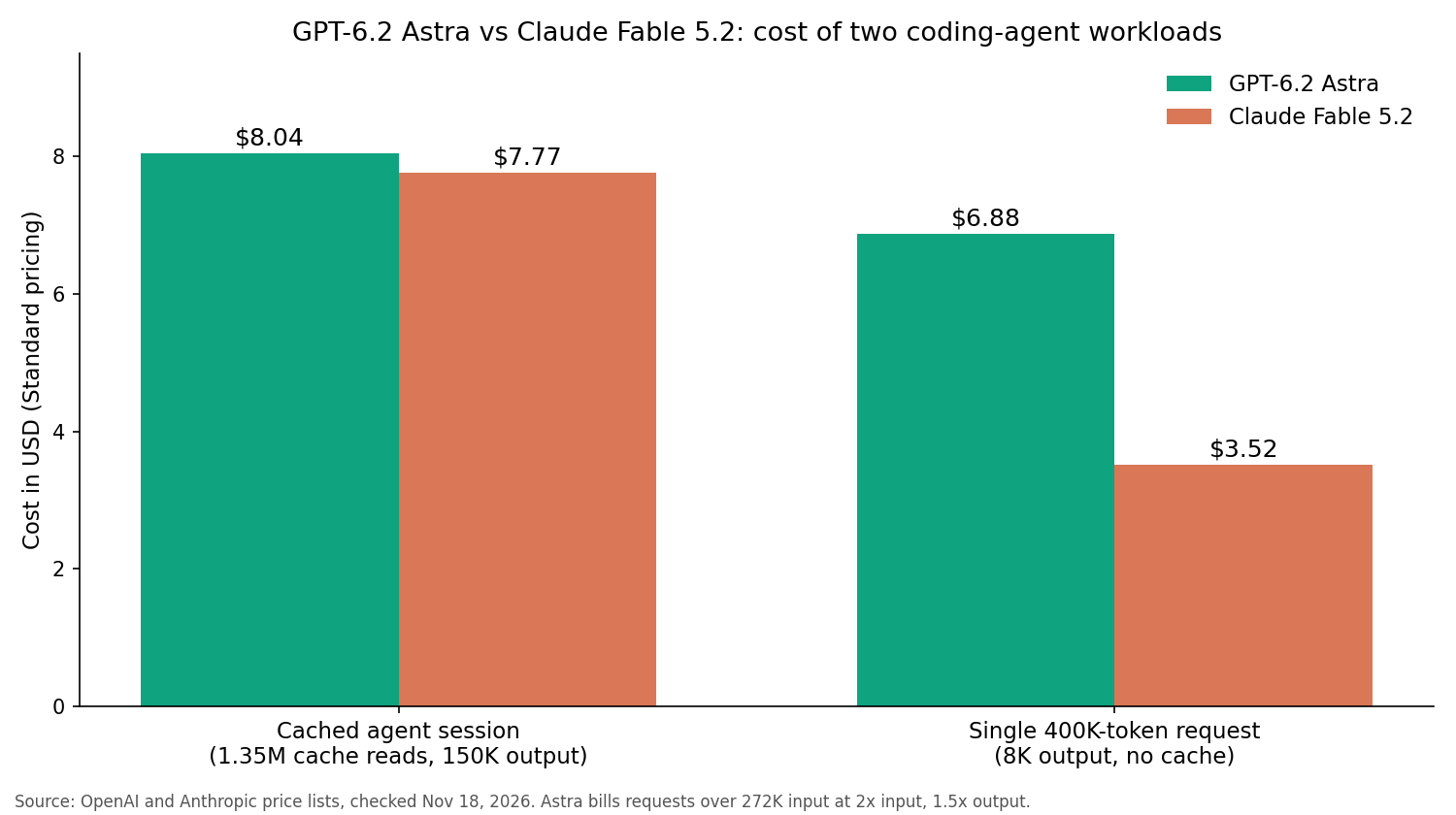
If your agent stuffs a large monorepo or long logs into one request, keep it under 272K on Astra or expect to pay almost twice as much.
Which API quirks will break a harness built for the other model?
Switching models is more than changing the model string. Each API rejects settings the other accepts, and both failures come back as HTTP 400 errors.
Claude Fable 5.2 rejects:
- Forced tool use. Setting
tool_choicetoanyortoolreturns a 400, per Anthropic’s Fable 5.2 notes. - Sampling parameters. Omit
temperature,top_pandtop_k; the values Anthropic lists return a 400. - Turning thinking off. Adaptive thinking is always on, so the effort parameter is your only lever for depth, latency and cost.
GPT-6.2 Astra rejects:
reasoning.effortset tonone(Responses API) orreasoning_effort: "none"(Chat Completions), per OpenAI’s reasoning guide.- Realtime, Assistants and fine-tuning endpoints, which the model page lists as unsupported.
If your harness forces a tool call to get structured output, that works on Astra and fails on Fable; move the structure into the prompt or tool schema. If it sets temperature: 0, strip it for Fable.
Data handling differs too. Anthropic states that Fable 5.2 requires 30-day data retention and isn’t available under zero data retention unless Anthropic expressly authorizes it. Check that against your security policy before you route production code through it.
Where does GPT-6.2 Astra win?
Astra’s strength is the toolbox around it. In the Responses API, OpenAI lists apply_patch, hosted_shell, computer_use, code_interpreter, mcp, skills and tool_search as supported tools. A multi-agent beta lets Astra delegate work to subagents.
That matters if you’d rather not build your own patch applier and shell runner.
Theo Browne’s pre-release feedback, quoted by Willison, says Astra “can pull in a lot of subagents and manage them pretty well” on long tasks, but sometimes stops to ask about internal details a user couldn’t answer. Give it clear stop conditions.
Astra also offers more cost tiers: Batch at 50% off, Fast mode at 2x Standard, and background windows at 30% below Standard for 2-hour completion and 40% below for 8-hour completion. Overnight test generation can run on those for less.
Where does Claude Fable 5.2 win?
Fable wins on long, cache-heavy context. Its cache reads cost $0.20 per million tokens, 2.5% of the input price, and its full 1M window bills at the standard rate with no long-prompt multiplier.
Anthropic positions Fable 5.2 for agent sessions that run for hours. Its effort control runs from low to max; Anthropic suggests starting at high, the default, and stepping up to xhigh only where you’ve measured a gain.
It also has the stronger early reception on hard creative coding. In Willison’s launch test, a Three.js animation prompt run on both new OpenAI models at Ultra effort in Codex CLI, neither matched the result he got from Fable 5.2.
Fable also runs on Amazon Bedrock, Google Cloud and Microsoft Foundry, and its Fast mode gives up to 2.5x higher output speed at $16 / $80 per million tokens. For request examples, see the Claude Fable 5.2 API guide.
How do you test GPT-6.2 Astra and Claude Fable 5.2 on your own API workload?
Benchmarks measure someone else’s tasks. Run the same prompts through both APIs instead:
- Pick 5 to 10 real prompts from your agent’s history, such as a bug fix, a refactor and a test-writing task.
- Write one request per model with identical content, using each API’s own format.
- Assert a 200 status, a non-empty answer and the shape your agent parses.
- Run each request several times and compare tokens, latency and pass rate.
Both calls are plain HTTP. Here’s the Astra request on the Responses API:
curl https://api.openai.com/v1/responses \
  -H "Authorization: Bearer $OPENAI_API_KEY" \
  -H "Content-Type: application/json" \
  -d '{"model": "gpt-6.2-astra", "reasoning": {"effort": "high"},
       "input": "Review this diff and list the bugs."}'
Fable 5.2 goes through Anthropic’s Messages API with claude-fable-5-2 as the model and no temperature field.
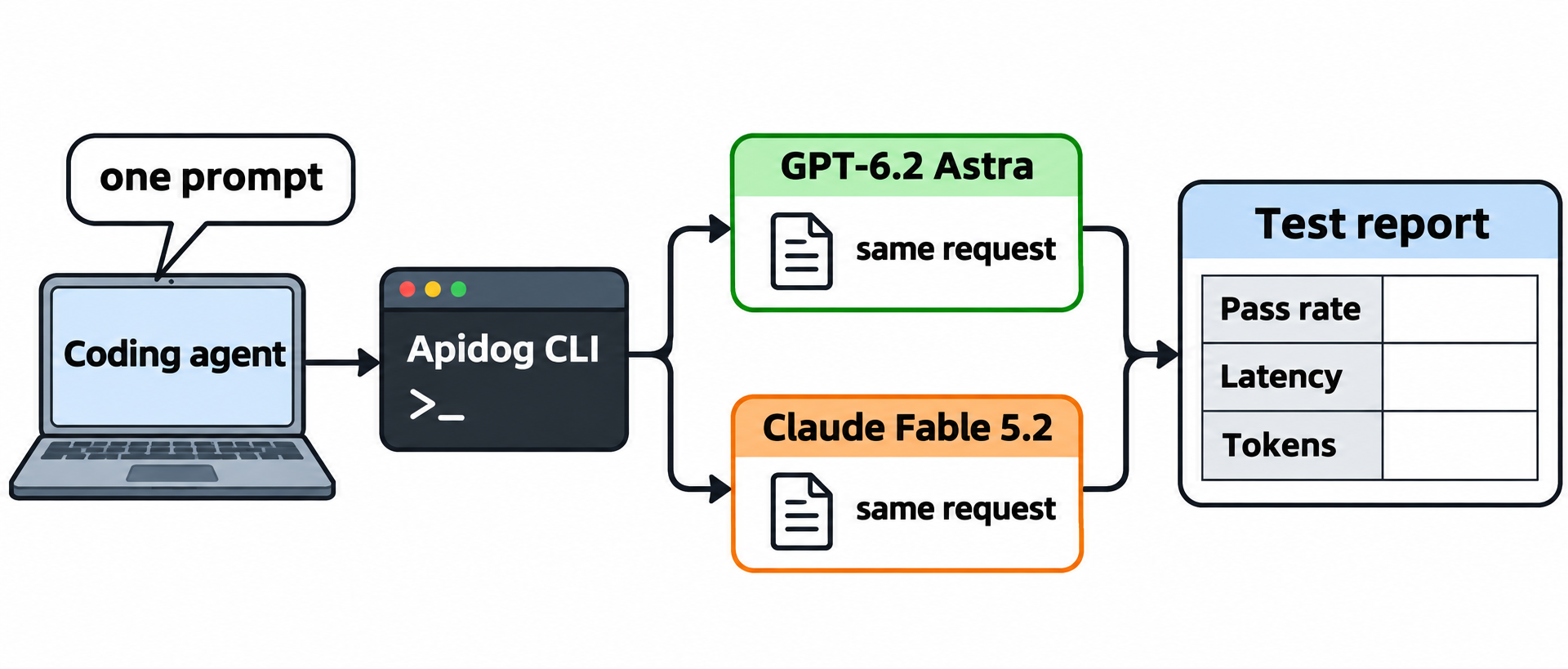
Let your coding agent run the A/B with Apidog CLI
Running request pairs by hand gets old fast. Let Claude Code, Codex or Cursor drive Apidog CLI instead. Setup takes three commands:
npm install -g apidog-cli@latest
apidog login --with-token <YOUR_APIDOG_TOKEN>
npx -y skills add https://apidog.com   # pick your agent when prompted
Then give your agent one prompt:
In Apidog project <PROJECT_ID>, create two test cases: one that sends
our code-review prompt to gpt-6.2-astra through the OpenAI Responses
API, and one that sends the same prompt to claude-fable-5-2 through
the Claude Messages API with no temperature field. Keep both API keys
in private environment variables. Assert a 200 status and a non-empty
answer, record token usage and response time, run each case 5 times
and summarize cost per run. Validate every payload before you write it.
The agent checks the payload schema, writes the cases and runs them. The flags below come from apidog run --help on CLI 2.2.12:
apidog cli-schema get test-case-create
apidog cli-schema validate test-case-create --file astra-case.json
apidog test-case create --project <PROJECT_ID> --file astra-case.json
apidog test-case create --project <PROJECT_ID> --file fable-case.json
apidog run --test-case <ASTRA_CASE_ID> --project <PROJECT_ID> \
  -e <ENV_ID> -n 5 -r cli,json --out-dir ab-results
apidog run --test-case <FABLE_CASE_ID> --project <PROJECT_ID> \
  -e <ENV_ID> -n 5 -r cli,json --out-dir ab-results
-n 5 repeats each case five times, so one slow response doesn’t decide the result. Add --upload-report to view the runs in the Apidog app. This is a workflow template; we haven’t run it against Astra from this machine.
You can turn the quirks section into tests too. Ask the agent for a negative case that sends tool_choice: any to Fable and expects a 400, and one that sends effort: none to Astra and expects a 400. If either provider changes the rule, your suite tells you before your agent does. The Apidog CLI in Claude Code guide and the Apidog CLI in Codex guide cover the agent setup.
Apidog’s Free plan covers up to 4 users, which is enough to run this comparison.
FAQ
Is GPT-6.2 Astra cheaper than Claude Fable 5.2? The base price is identical at $8 input and $40 output per million tokens. Fable is cheaper on cache reads ($0.20 vs $0.40) and on any request over 272K input tokens, where Astra doubles its input rate.
Which model has the bigger context window? Astra lists 1,050,000 tokens of context with a 922,000-token input cap. Fable 5.2 lists 1M tokens. Both cap output at 128K tokens per request.
Can I use forced tool calls with Claude Fable 5.2? No. A tool_choice of any or tool returns a 400 error. Let the model choose tools on its own, and describe the expected structure in the prompt or tool schema.
Can I turn reasoning off on GPT-6.2 Astra? No. The API rejects reasoning.effort set to none with a 400 error. Pick a lower supported effort level for fast, cheap calls instead.
Which model should I run my coding agent on? Start with your workload. Long, cache-heavy prompts favor Fable 5.2, while OpenAI-native stacks that want hosted patch, shell and subagent tools favor Astra. Run both on 5 to 10 real prompts before you switch.