ERNIE 5.5 Flash is free today through one hosted route: OpenRouter’s baidu/ernie-5.5-flash-preview:free endpoint, which charges $0 per input and output token with a 1,024,000-token context. You get 20 requests per minute and 50 requests per day, or 1,000 per day once your account has bought 10 credits. The second $0 route is self-hosting the open ERNIE 5.5 Flash Base weights, which cost nothing to download but need a multi-GPU server.
Every limit below was checked on the official OpenRouter, Hugging Face and Baidu pages on November 12, 2026. Free tiers change fast, so recheck before you build on one.
Is ERNIE 5.5 Flash free?
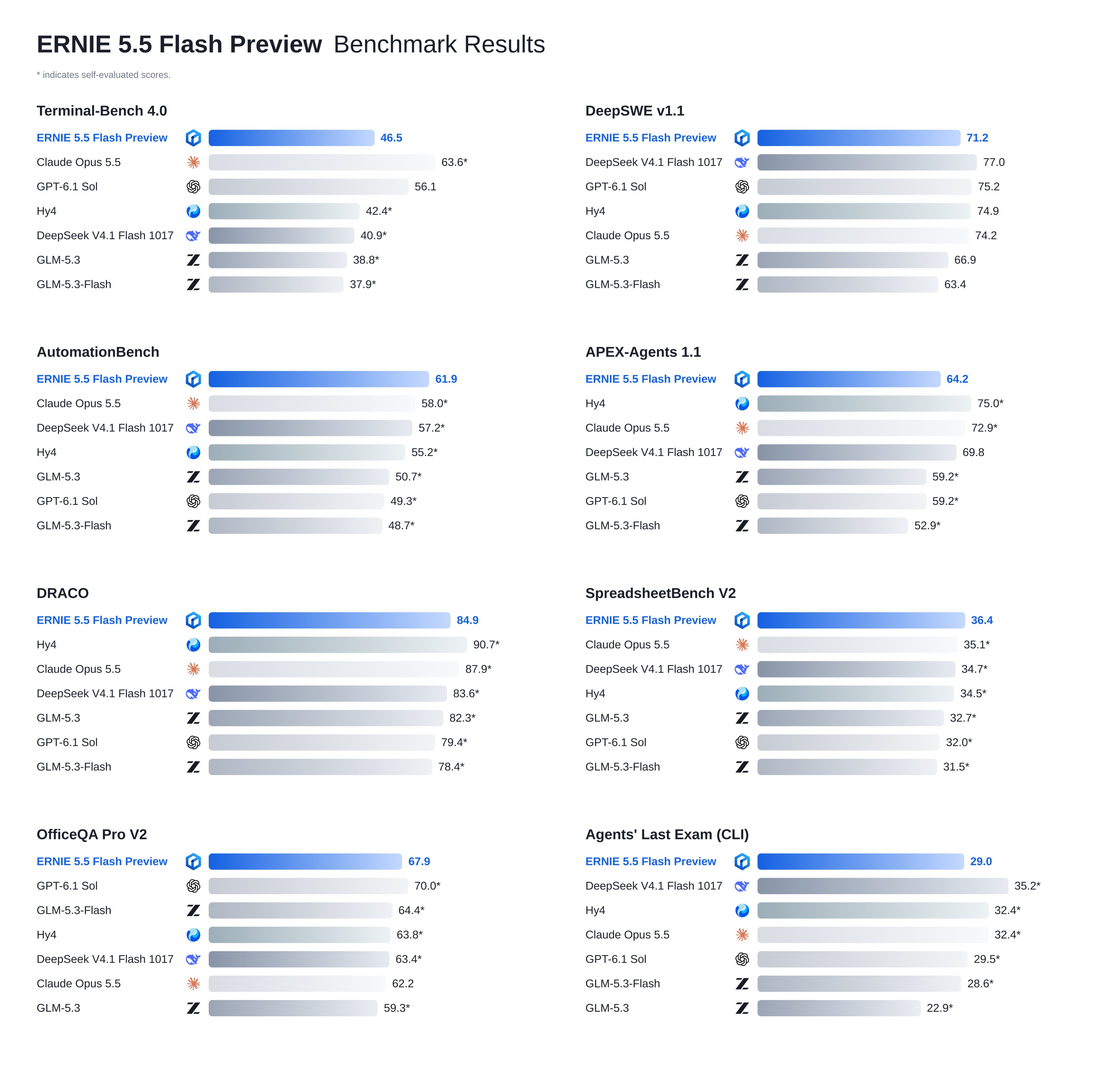
Yes, with limits. ERNIE 5.5 Flash Preview is Baidu’s 280B-parameter mixture-of-experts model with 14B active parameters per token and a 1M-token context. OpenRouter serves it at $0 per token under a free-model rate limit, and Baidu publishes the pretraining-only Base weights on Hugging Face under a licence that’s free for non-commercial use.
There are two artefacts, and it pays to keep them apart:
- ERNIE 5.5 Flash Preview is the post-trained chat and agent model from the November 11 release post. That’s the one you call through an API. Baidu says its weights will be open-sourced under Apache 2.0 “soon”, with no date on the page.
- ERNIE 5.5 Flash Base is the checkpoint at the end of pretraining, published November 5. It’s a base model: it completes text, it doesn’t follow chat instructions.
If you want the model’s background first, read what ERNIE 5.5 Flash is. For the previous generation, see what ERNIE 5.1 is and the ERNIE 5.1 API guide.
Every free ERNIE 5.5 Flash route, compared
Here is what each route costs and what it asks of you, as of November 12, 2026:
| Route | Price | Limits | Card or purchase needed? | Best for |
|---|---|---|---|---|
OpenRouter :free |
$0 per token | 20 req/min; 50 req/day, or 1,000/day after 10 credits bought | No purchase needed for the 50/day tier | Prototypes, evals, coding agents |
| Self-host Base weights | $0 licence for non-commercial use | Your hardware | No, but you pay for GPUs | Fine-tuning, research |
| Self-host Preview weights | Not released yet | n/a | n/a | Wait for the Apache 2.0 drop |
| Baidu Qianfan | Paid | Account quota | Yes, a funded account | Production traffic |
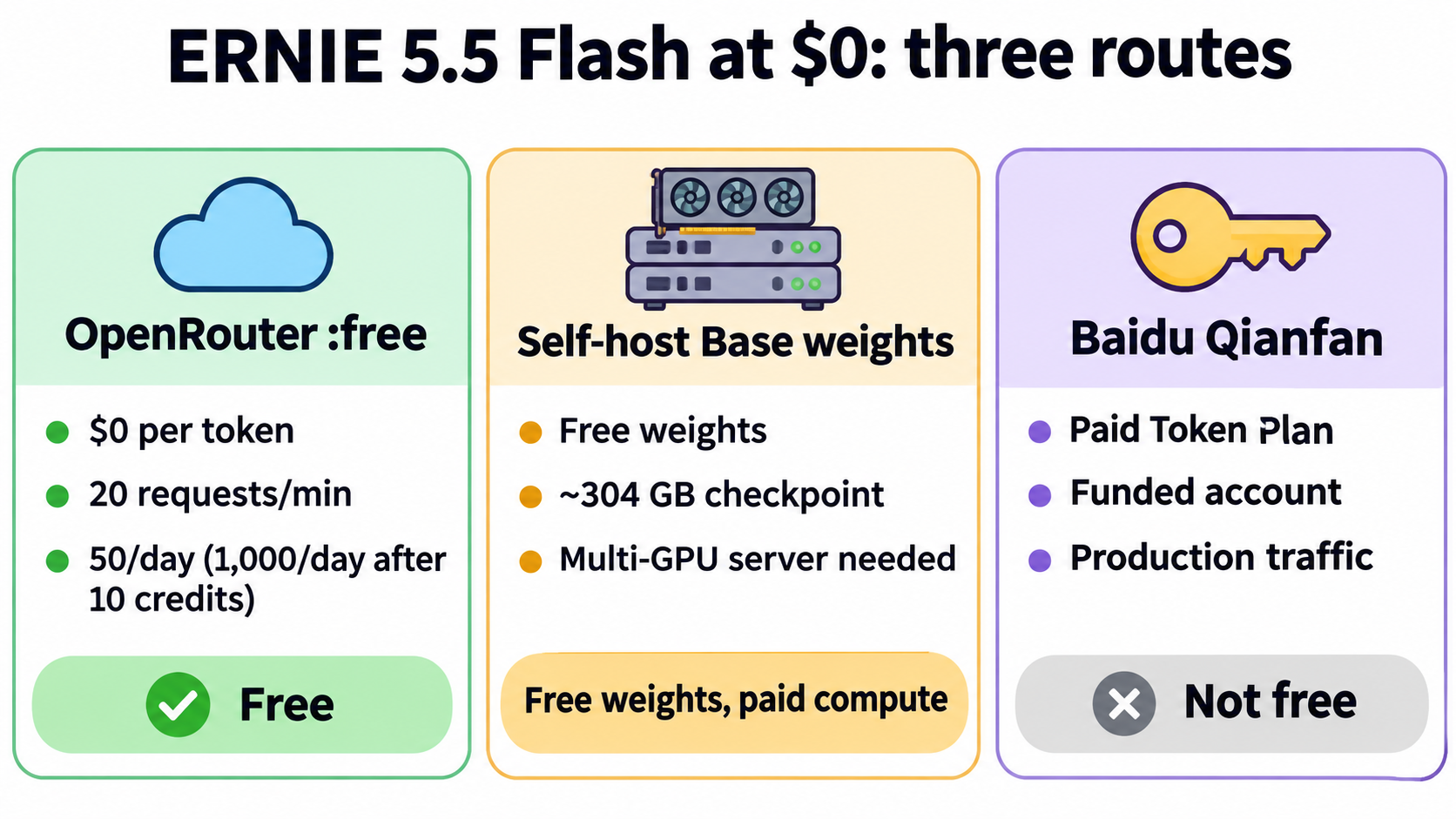
Only the OpenRouter route needs nothing but an account. It lists one provider, Baidu Qianfan, so free requests reach the same backend as paid Qianfan traffic.
How to use ERNIE 5.5 Flash free on OpenRouter
The OpenRouter model page lists the price as “Free” for both input and output and says you are “not charged for prompt or completion tokens”. Getting your first answer takes four steps:
- Create an OpenRouter account and generate an API key from the dashboard.
- Export it:
export OPENROUTER_API_KEY="sk-or-v1-...". - Call the OpenAI-compatible endpoint at
https://openrouter.ai/api/v1/chat/completions. - Set the model to
baidu/ernie-5.5-flash-preview:free, with the:freesuffix. Without it you’re calling a different model ID.
curl https://openrouter.ai/api/v1/chat/completions \
  -H "Content-Type: application/json" \
  -H "Authorization: Bearer $OPENROUTER_API_KEY" \
  -d '{
    "model": "baidu/ernie-5.5-flash-preview:free",
    "messages": [
      {"role": "user", "content": "Write a regex that matches ISO 8601 dates, then explain it."}
    ]
  }'
The same call from Python with the official OpenAI SDK:
import os
from openai import OpenAI

client = OpenAI(
    base_url="https://openrouter.ai/api/v1",
    api_key=os.environ["OPENROUTER_API_KEY"],
)

resp = client.chat.completions.create(
    model="baidu/ernie-5.5-flash-preview:free",
    messages=[{"role": "user", "content": "Summarize the CAP theorem in 3 bullets."}],
    extra_body={"reasoning": {"exclude": True}},
)
print(resp.choices[0].message.content)
The model reasons before it answers. OpenRouter controls that with the reasoning object, and "exclude": true keeps the trace out of your response. The free endpoint also accepts tools, tool_choice and response_format, so you can test function calling and structured output without paying.
Speed is the trade-off. Baidu advertises more than 200 tokens per second; OpenRouter measured a P50 throughput of 79 tokens per second and a P50 latency of 2.56 seconds on the free endpoint on November 12. Stream long answers so your app isn’t silent while the model thinks. The ERNIE 5.5 Flash API guide covers streaming, reasoning tokens and error codes in depth.
How to stay inside the free ERNIE 5.5 Flash limits
OpenRouter’s limits documentation sets one rule for every model ID that ends in :free:
| Credits purchased (all time) | Requests per minute | Requests per day |
|---|---|---|
| Less than 10 | 20 | 50 |
| At least 10 | 20 | 1,000 |
Five habits stretch that quota:
- Count requests, not tokens. The caps are per request. One call with a 400,000-token codebase counts the same as a one-line question, so batch your context into fewer, larger calls.
- Read your remaining quota before a batch job.
GET https://openrouter.ai/api/v1/keyreturns afree_model_daily_requestsobject withused,limitandremainingfor the current UTC day. The per-minute limit isn’t reported there. - Plan around 00:00 UTC. The daily counter is a UTC day, not a rolling 24 hours.
- Back off on 429. When you hit a free-model cap, OpenRouter returns
429withX-RateLimit-*headers. Wait for the reset, then retry with exponential backoff and jitter. - Keep your balance at zero or above. A negative credit balance can return
402even on free models.
Need more than 50 requests a day? Buying 10 credits lifts you to 1,000, but that’s a purchase, so it’s no longer a strict $0 route.
If you want to run ERNIE 5.5 Flash inside a coding agent for free, the OpenCode free setup walks through the config. The same OpenRouter pattern works for other models too; see the free Qwen 3.6 on OpenRouter guide.
Free ERNIE 5.5 Flash weights: self-hosting the Base model
The second $0 route is the ERNIE-5.5-Flash-Base repository on Hugging Face. The weights are ungated and free to download. The repository holds about 304 GB, with FP8 and BF16 weights released.
What the licence allows
The Base model ships under the ERNIE 5.5 Flash Base Model License Agreement v1.0, not Apache 2.0. Its LICENSE file sets three tiers:
- Non-commercial use (research, education, evaluation, personal experiments): free, with no notice.
- Commercial use with related annual revenue at or below US$50 million: no licence charge, but you must display the required attribution and send Baidu a one-time use notice before your first commercial use.
- Commercial use above US$50 million: needs Baidu’s separate written authorization first.
Revenue counts across all related products and affiliated entities, so read the full text before you ship.
What it takes to run
The model card’s serving examples use four-way parallelism, which means a multi-GPU server, not a laptop. The vLLM path installs a pinned vLLM plus Baidu’s plugin:
uv venv --python 3.12 ernie5-venv
source ernie5-venv/bin/activate
uv pip install vllm==0.32.0
uv pip install git+https://github.com/baidu/vLLM-ERNIE.git

vllm serve baidu/ERNIE-5.5-Flash-Base \
  --kv-cache-dtype fp8 \
  --enable-expert-parallel \
  --data-parallel-size 4 \
  --max-model-len 131072 \
  --port 30000 \
  --moe-backend humming
Because it’s a base model, you query /v1/completions with a prompt, not /v1/chat/completions with messages. The card says both vLLM and SGLang accept up to 1,048,576 tokens for long-context inference. The full walkthrough lives in running ERNIE 5.5 Flash locally with vLLM.
The weights are free; the compute isn’t. Without GPUs on hand, OpenRouter is the cheaper way to try the model.
What about the Preview weights?
Baidu’s release post says the Preview weights “will be open-sourced under Apache 2.0 soon”. The OpenRouter page already links a baidu/ERNIE-5.5-Flash-Preview repository, but on November 12 that repository wasn’t publicly available on Hugging Face. Once it lands, Apache 2.0 removes the revenue tiers above.
What isn’t free: Baidu Qianfan
Qianfan is Baidu’s own API for ERNIE 5.5 Flash Preview, and it’s a paid route. Baidu’s launch promotion page offers the model through a discounted paid Token Plan, not a free quota. Baidu’s pages showed no free token allowance for this model on November 12 [VERIFY: whether new Baidu AI Cloud accounts get trial credits that apply to ernie-5.5-flash-preview].
Qianfan makes sense once you outgrow 1,000 requests a day. For prompt-heavy work, compare it with ERNIE 5.5 Flash vs DeepSeek V4.1 Flash before you commit.
Let your coding agent guard the free quota with Apidog CLI
A free endpoint fails in quiet ways: the daily cap runs out mid-job, the model ID loses its :free suffix, or a 429 comes back with no reset header your code expects. Have your coding agent pin those checks down. Apidog CLI lets Claude Code, Codex, Cursor or OpenCode save the request, keep the key in an environment and run a test scenario on demand.
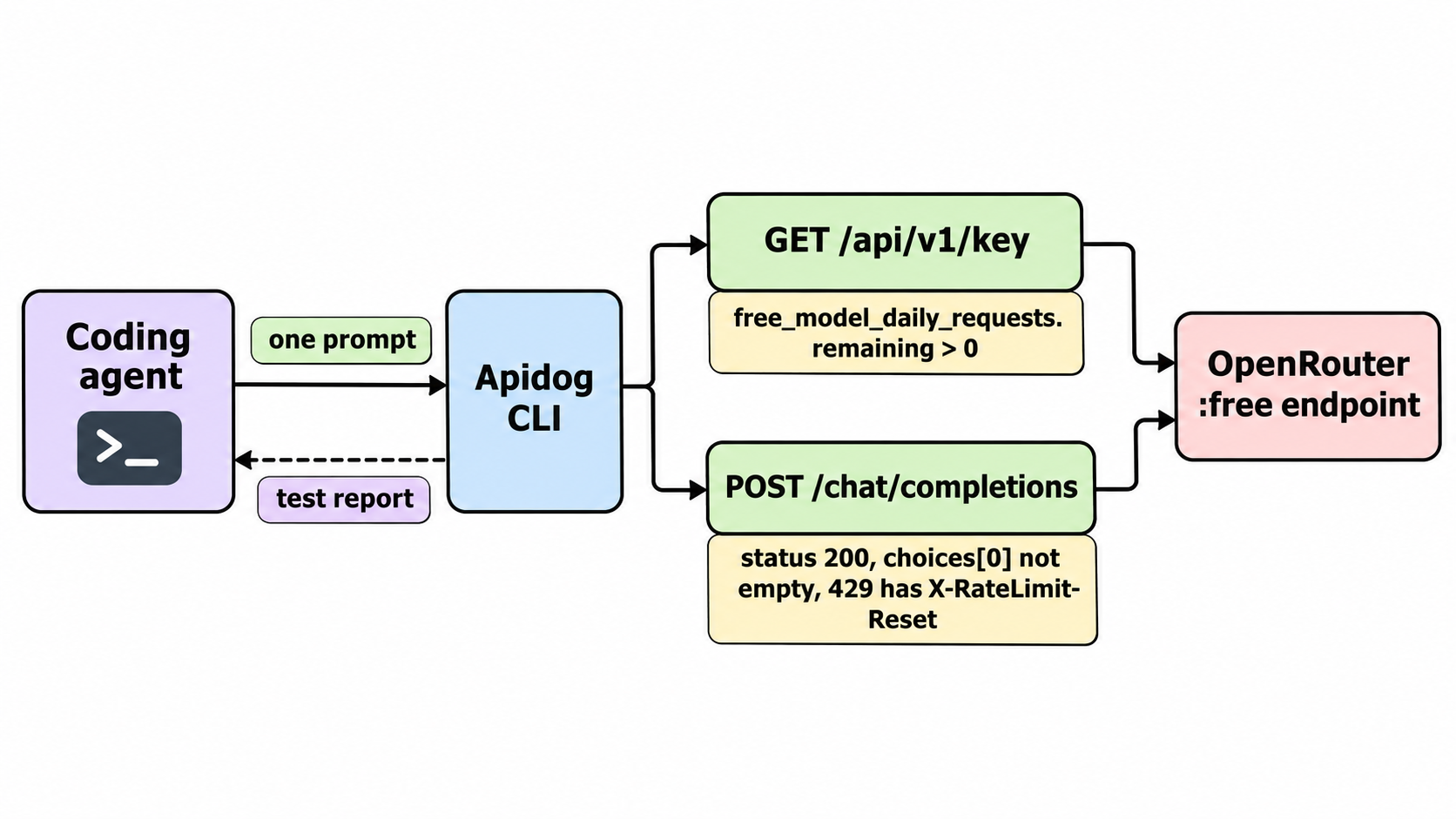
Set it up once:
npm install -g apidog-cli@latest
apidog auth login --with-token <YOUR_APIDOG_TOKEN>
apidog skill install
Then give your agent one prompt:
Write an OpenAPI 3 file with two operations on https://openrouter.ai/api/v1:
GET /key and POST /chat/completions (model baidu/ernie-5.5-flash-preview:free).
Import it into Apidog project <projectId> and create an environment "openrouter-free"
whose apiKey variable is passed at run time. Build a test scenario that:
1) calls GET /key and asserts data.free_model_daily_requests.remaining > 0,
2) sends a short chat prompt and asserts status 200 and a non-empty
   choices[0].message.content,
3) if the status is 429, asserts the X-RateLimit-Reset header exists.
Run it and summarize any failures.
The agent confirms each payload shape with cli-schema and runs commands like these:
apidog import --project <projectId> --format openapi --file ./openrouter-ernie-free.yaml
apidog environment create openrouter-free --project <projectId> --base-url https://openrouter.ai/api/v1
apidog cli-schema get test-scenario-create
apidog test-scenario create --project <projectId> --name "ERNIE free quota guard" --folder-id <folderId> --priority <priority>
apidog test-scenario import-steps <scenarioId> --project <projectId> --source endpoint --ids <keyEndpointId>,<chatEndpointId> --sync manual
apidog run -t <scenarioId> --project <projectId> -e <envId> --env-var "apiKey=$OPENROUTER_API_KEY" -r cli,json
Passing the key with --env-var keeps it out of the saved project. Each run spends one of your free daily requests (the /key read is a status call, not a model call), so run it before a batch job, not on every commit. When you need it in a pipeline, apidog run -r junit slots into the setup from the Apidog CLI CI/CD guide, and Apidog CLI in Claude Code covers the agent side. Apidog’s Free plan covers up to 4 users.
FAQ
Is ERNIE 5.5 Flash completely free? On OpenRouter’s :free endpoint, yes: $0 per input and output token. You’re capped at 20 requests per minute and 50 per day, or 1,000 per day after buying 10 credits.
Do I need a credit card to use ERNIE 5.5 Flash for free? You don’t need to buy credits for the 50-requests-per-day tier on OpenRouter. Self-hosting the Base weights needs no payment to Baidu, but you pay for your own GPUs.
Can I use free ERNIE 5.5 Flash commercially? The OpenRouter route follows OpenRouter’s terms. The Base weights allow commercial use with no licence charge up to US$50 million in related annual revenue, with attribution and a one-time notice to Baidu.
Does the free version keep the 1M-token context? Yes. OpenRouter lists a 1,024,000-token context for baidu/ernie-5.5-flash-preview:free, and the Base model card supports up to 1,048,576 tokens for inference.
When will the ERNIE 5.5 Flash Preview weights be open source? Baidu says “soon” under Apache 2.0, with no date on its release post. Until then, the Base model is the only open checkpoint.