
Anthropic launched Claude Opus 5 on July 24, 2026 with a set of benchmark claims that read like a clean sweep. More than double Opus 4.8 on one eval. Three times the next-best model on another. Past Fable 5 at a third of the cost on a third.
That does not make them wrong. It does mean you should read them the way you would read any vendor’s launch chart: carefully, with attention to what is being measured and what is left out. This guide puts every published Opus 5 benchmark claim in one attributed table, explains what each number can and cannot support, names the ceiling Anthropic puts above its own model, and finishes with an eval plan you can run yourself in Apidog.
For the model itself (claude-opus-5, 1M context, 128k max output, May 2026 knowledge cutoff), start with what Claude Opus 5 is. The primary source below is Anthropic’s Claude Opus 5 launch post.
Every published claim, in one table
Here is the complete set of benchmark statements Anthropic made at launch. The comparison column matters as much as the result column, because several of these are stated relative to another model rather than as a score.
| Benchmark | Anthropic’s claim | Stated as | Compared against |
|---|---|---|---|
| Frontier-Bench v0.1 | Surpasses all other models; more than doubles Opus 4.8’s score, at a lower cost per task | Ratio plus cost claim | Opus 4.8 and the field |
| ARC-AGI 3 | Roughly 3x the next-best model’s score | Ratio | Unnamed next-best model |
| OSWorld 2.0 | Surpasses Fable 5 at one-third the cost | Ordinal plus cost claim | Fable 5 |
| CursorBench 3.2 | Within 0.5% of Fable 5’s peak, at half the price | Gap plus cost claim | Fable 5 |
| Zapier AutomationBench | Pass rate roughly 1.5x the next-best model | Ratio | Unnamed next-best model |
| Organic chemistry | +10.2 points over Opus 4.8 | Absolute delta | Opus 4.8 |
| Protein analysis | +7.7 points over Opus 4.8 | Absolute delta | Opus 4.8 |
| Cybersecurity exploitation | Behind Mythos 5 | Ordinal | Mythos 5 |
| Autonomous biology research | Behind Mythos 5 | Ordinal | Mythos 5 |
Source for all of the above: Anthropic’s launch post and model documentation. No third party has published a reproduction of any of these results at the time of writing.
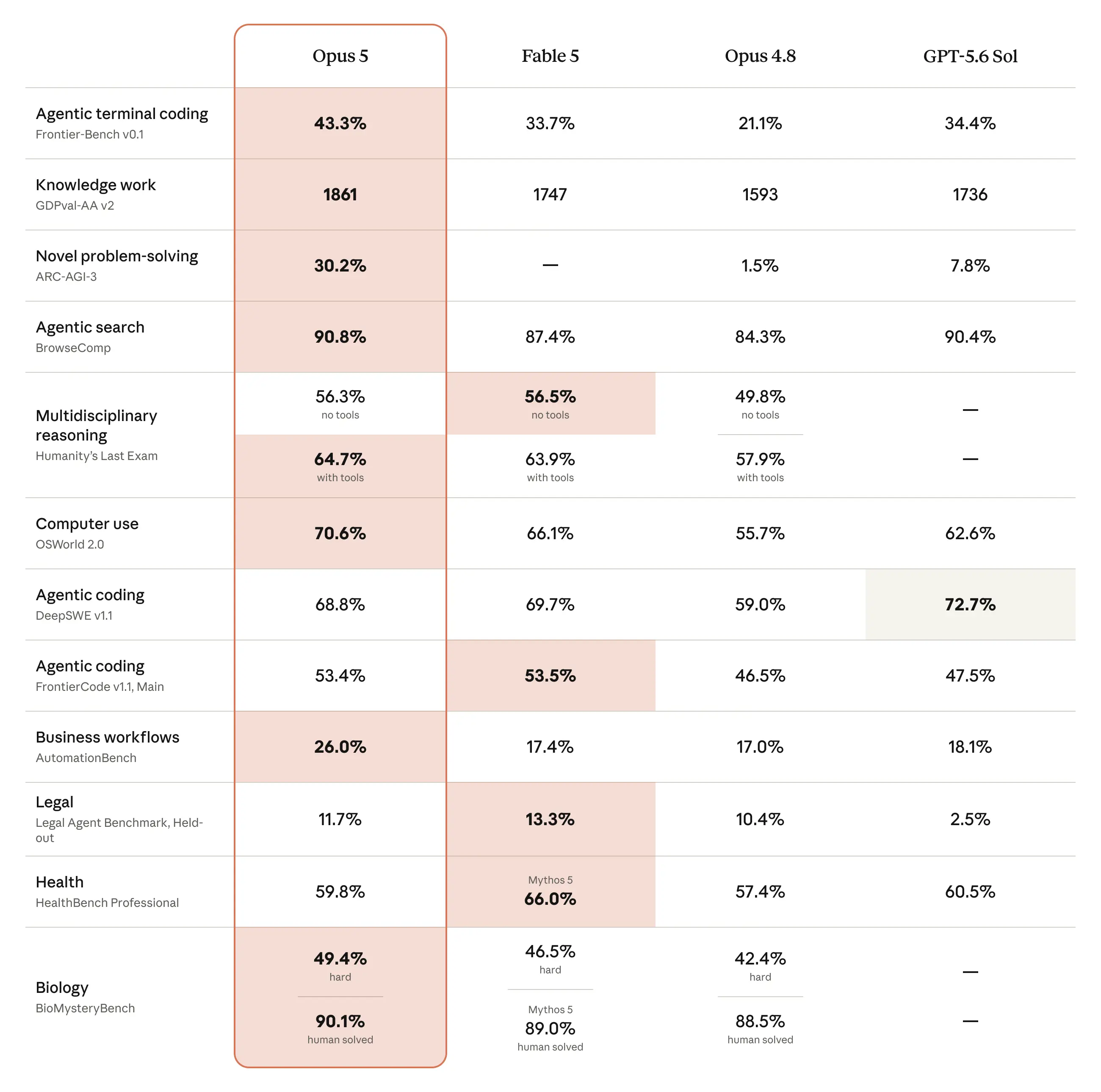
Two things jump out before you read any individual number. Only two of the nine rows give an absolute movement in points. And Anthropic itself supplies the last two rows, where its new flagship loses.
The ratio problem, and why it matters
Four of the claims (Frontier-Bench, ARC-AGI 3, AutomationBench, and to a degree CursorBench) are stated as ratios or gaps rather than scores. That is a real limitation, not a nitpick, and it is worth being specific about why.
A ratio hides the denominator. “Roughly 3x the next-best model” on ARC-AGI 3 means something different depending on where the field sits. If the next-best model scores 8%, then 3x is 24%: real movement on a benchmark nobody is close to solving. If the next-best model scores 25%, then 3x is 75%, a categorically different result. Both are honestly describable as “3x.” You cannot tell which one happened, and Anthropic did not say.
Doubling is easier at the bottom of a scale. “More than doubles Opus 4.8’s score” on Frontier-Bench v0.1 is the same shape of problem. On a hard, new benchmark where the previous flagship scored in the single digits or low teens, doubling is a smaller absolute jump than the phrasing implies. On a benchmark where 4.8 already scored 40%, doubling would be extraordinary. The version string is a hint here: v0.1 is a benchmark with no published track record, no community reproductions, and no established saturation point.
“Next-best model” is unnamed. Two claims compare Opus 5 to an unspecified competitor. That competitor could be Fable 5, Mythos 5, or a model from another lab. The comparison set determines how much the ratio means, and it is not disclosed.
Gaps need units. “Within 0.5% of Fable 5’s peak” on CursorBench 3.2 does not say whether that is 0.5 percentage points or a 0.5% relative difference, and “peak” suggests a best-configuration run rather than a default one. On a coding benchmark, the difference between a default effort setting and a maxed-out one is not trivial. Our Fable 5 benchmarks breakdown covers how that model’s own numbers were framed.
The two science figures are the cleanest claims in the set precisely because they avoid all of this: +10.2 points on organic chemistry and +7.7 points on protein analysis are absolute deltas against a named baseline. You still do not get the starting score, but you know exactly how far the model moved.
The cost-per-task claims are configuration-dependent
Three of Anthropic’s claims bundle capability with cost: lower cost per task on Frontier-Bench, one-third the cost on OSWorld 2.0, half the price on CursorBench 3.2.
The list-price half of that is verifiable and holds up. Opus 5 runs $5 per million input tokens and $25 per million output, identical to Opus 4.8 and exactly half of Fable 5’s $10/$50. That is published on Anthropic’s pricing page and is not a benchmark result at all. The full arithmetic, including cache writes, batch rates, and the fast-mode premium, is in our Opus 5 pricing breakdown.
Cost per task is a different quantity. It depends on how many tokens the run consumed, which depends on the effort level, whether thinking was enabled, how many turns the agentic loop took, and how many subagents got spawned. Anthropic’s own prompting guidance notes that Opus 5 produces longer default responses than Opus 4.8, delegates to subagents more readily, and expands task scope more often. All three push token consumption up in real workloads, so a run tuned for a cost-per-task chart is not automatically the configuration you would ship.
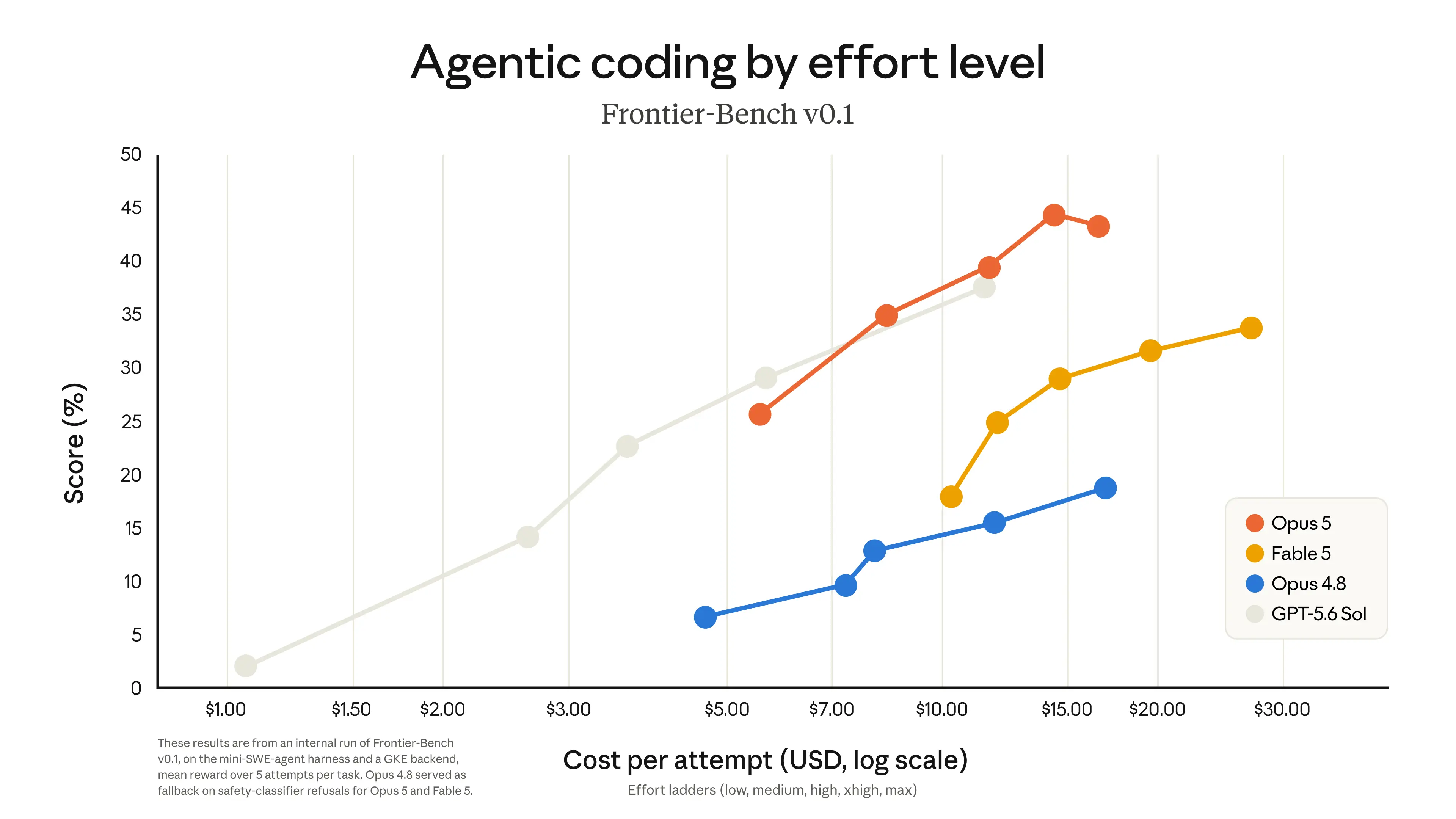
None of this makes the cost story false. Half the list price is half the list price, and our Opus 5 vs Fable 5 comparison works through where that gap actually pays. It means the cost-per-task ratio is an artifact of a specific setup, and yours will differ. Measure it.
The ceiling Anthropic names itself
The most useful line in the launch material is the one that is not a win. Anthropic states plainly that Opus 5 still trails Mythos 5 on cybersecurity exploitation and on autonomous biology research. Fable 5 also keeps the “most capable widely released model” designation.
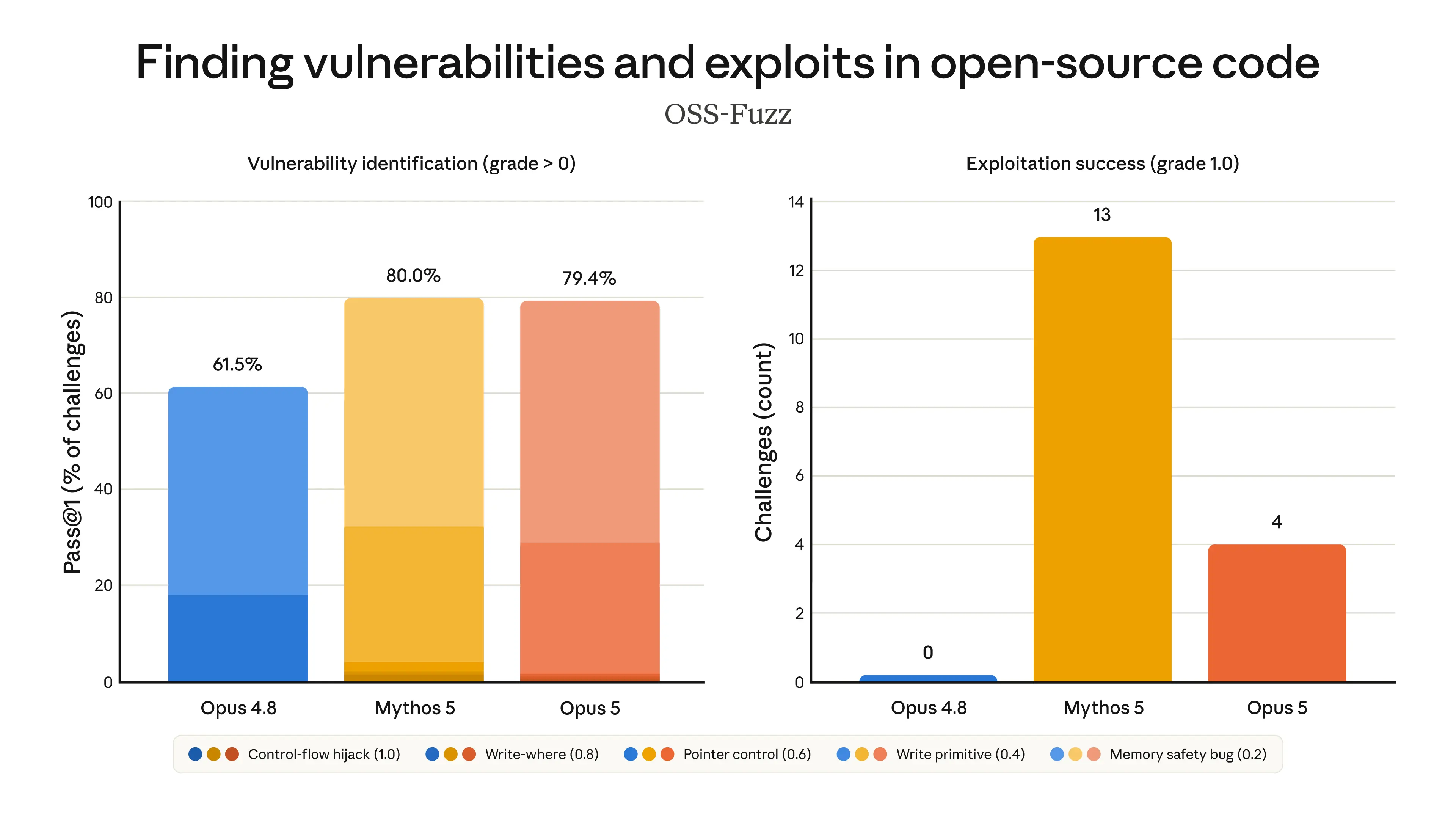
That is worth restating because the press coverage largely dropped it. Opus 5 is not the top of the Claude stack. The honest summary is frontier-class capability at half the frontier price, with a named ceiling above it. For frontier security research or autonomous scientific work, the benchmark answer is still Mythos-class, covered in our Mythos-class model explainer and Fable 5 vs Mythos 5.
There is an operational consequence too. Anthropic shipped a fallbacks: "default" option (behind the server-side-fallback-2026-07-01 beta header) that automatically falls back to Opus 4.8 when Opus 5 refuses a cyber-category request. A model with tighter cyber refusals needs an escape hatch, and the existence of that escape hatch tells you something the chart does not.
What the benchmarks do not cover at all
Benchmarks measure task completion. They do not measure the things that decide whether a model works in your product:
- Behavioral drift on migration. Opus 5 verifies its own work unprompted. If your prompts still carry “double-check your answer” instructions from Opus 4.8, you get over-verification and wasted tokens. Anthropic’s prompting guide for Opus 5 says to remove them.
- Output length. Default responses and written deliverables run longer than on Opus 4.8. Lowering effort cuts thinking tokens, not visible length. You have to ask for conciseness explicitly.
- Failure modes with thinking disabled. With
thinking: {type: "disabled"}, tool calls occasionally appear as plain text that never executes and then poisons later turns in an agentic loop, and internal XML tags sometimes leak into visible output. No benchmark chart shows you that. - Effort recalibration. The effort levels were recalibrated on Opus 5, and Anthropic says to re-sweep rather than carry 4.8 settings over. A benchmark result at one effort level tells you nothing about your throughput at another. See the effort parameter guide.
- The 400 you will hit. Combining
thinking: {type: "disabled"}with effortxhighormaxreturns a 400 error, enforced per request. That is a migration detail, not a capability one, and it is covered in the Opus 4.8 to Opus 5 migration guide.
What to actually test yourself
Vendor benchmarks are a starting hypothesis. Here is a compact eval you can run in an afternoon that will tell you more about Opus 5 for your workload than every number above combined.
1. Build a small task set from your own history. Twenty to fifty real tasks: closed tickets, merged PRs, support threads your model would have handled. Real inputs beat synthetic ones because they carry your actual formatting, ambiguity, and edge cases.
2. Pin the configuration and write it down. Model ID exactly claude-opus-5, plus your output_config.effort level, whether thinking is on, and your max_tokens. An unpinned config makes every later comparison meaningless.
3. Score cost per resolved task, not cost per token. Read the usage block on every response and record input, output, cache-read, and cache-write tokens per task. Then divide total spend by tasks that actually passed your acceptance check. This is the number Anthropic’s chart is claiming, so it is the number to reproduce.
4. Run a real effort sweep. Same task set at low, medium, high, and xhigh. The recalibration means low and medium are meaningfully stronger on Opus 5 than on prior Opus models, and plenty of workloads will find a cheaper level passes just as often. Watch max_tokens at the high end.
5. Test the agentic loop, not the single turn. Most of the launch benchmarks are agentic (OSWorld, CursorBench, AutomationBench). Single-turn spot checks will not reproduce them. Run multi-turn with your real tools attached and count turns, not just outcomes.
6. Compare against your incumbent on the same task set. Whatever you run today, Opus 4.8 or Sonnet 5 or something else, run it through the identical harness. A relative result on your own data is worth more than an absolute score on someone else’s.
7. Log refusals separately. Cyber-adjacent work will hit refusals more often than on 4.8. Count them before you decide whether the fallback header is worth wiring up.
For comparison methodology on a previous launch, our Sonnet 5 benchmarks piece walks through the same exercise, and the Opus 5 API guide has the request shapes.
Running the eval in Apidog
The eval above is a pile of HTTP requests with auth headers, JSON bodies, streaming responses, and a usage block you need to read on every call. That is ordinary API work, which is what Apidog handles.
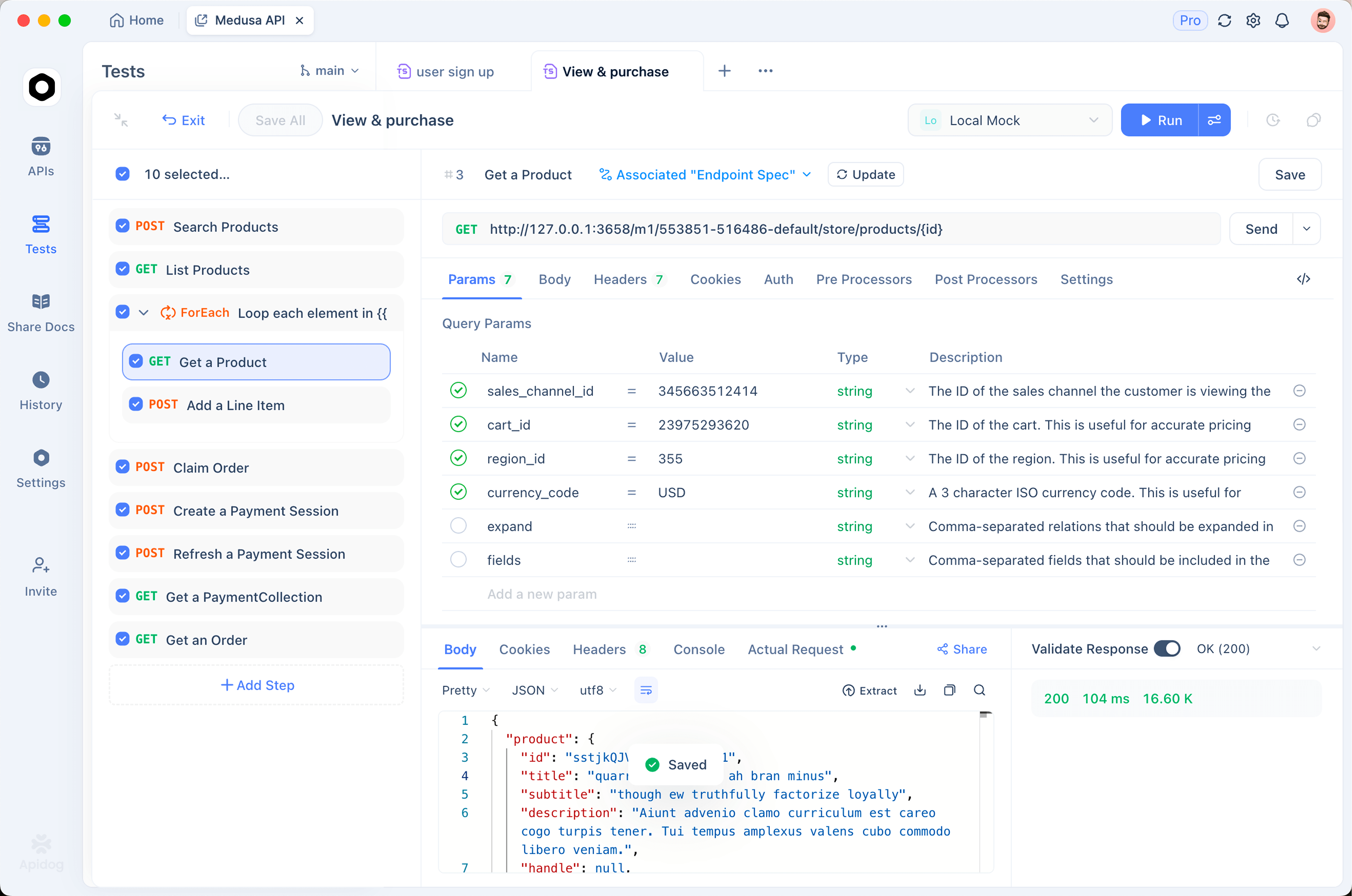
A workable setup:
- Create one request against the Anthropic Messages endpoint and store your API key as an environment variable rather than pasting it into the body.
- Duplicate that request once per effort level so you can fire the same prompt at
lowthroughxhighand diff the responses side by side. - Turn on streaming and inspect the SSE events directly when you need to see how thinking tokens accumulate before the visible answer starts.
- Inspect tool-call payloads in the response to confirm the model is actually emitting structured tool calls rather than describing them in prose, which is the thinking-disabled artifact worth watching for.
- Add an assertion on the
usagefields so cache hits and token totals are captured on every run instead of being eyeballed. - Save the whole thing as a collection so the next model launch is a model-ID swap, not a rebuild.
Here is the base request:
curl https://api.anthropic.com/v1/messages \
  --header "x-api-key: $ANTHROPIC_API_KEY" \
  --header "anthropic-version: 2023-06-01" \
  --header "content-type: application/json" \
  --data '{
    "model": "claude-opus-5",
    "max_tokens": 8192,
    "output_config": {"effort": "medium"},
    "messages": [
      {"role": "user", "content": "Fix the failing test in this diff."}
    ]
  }'
Change one field per run, keep everything else fixed, and log the usage block each time. Download Apidog if you want to follow that pattern with the environments and assertions already wired up.
The honest summary
Opus 5’s benchmark story is genuinely strong: the biggest jump over its predecessor Anthropic has claimed for an Opus release, at unchanged list pricing. It is also entirely vendor-run, unreproduced as of July 25, 2026, and stated largely in ratios that hide their denominators. Both of those things are true at once.
Treat the table at the top of this page as Anthropic’s hypothesis about its own model. Then go get your own number. The gap between a launch chart and a production workload is where every model migration actually gets decided, and the Opus 5 pillar guide covers the rest of what changed.
FAQ
Are the Claude Opus 5 benchmarks independently verified? No. As of July 25, 2026, every published Opus 5 benchmark result comes from Anthropic. No third-party lab or independent evaluator has released a reproduction. Read them as vendor-reported figures.
What is the biggest Opus 5 benchmark claim? Frontier-Bench v0.1, where Anthropic says Opus 5 more than doubles Opus 4.8’s score at a lower cost per task. Anthropic did not publish the underlying scores, only the ratio, and Frontier-Bench v0.1 is a new benchmark without an established track record.
Is Claude Opus 5 the most capable Claude model? No. Fable 5 retains the “most capable widely released” designation, and Anthropic states that Opus 5 still trails Mythos 5 on cybersecurity exploitation and autonomous biology research. Opus 5’s pitch is frontier-class capability at half of Fable 5’s price, not the top of the stack.
How much better is Opus 5 than Opus 4.8 on science tasks? Anthropic reports +10.2 points on organic chemistry and +7.7 points on protein analysis over Opus 4.8. These are the two claims stated as absolute deltas rather than ratios, which makes them the easiest to interpret, though the baseline scores were not published.
Does Opus 5 beat Fable 5? On Anthropic’s numbers it surpasses Fable 5 on OSWorld 2.0 at one-third the cost and lands within 0.5% of Fable 5’s peak on CursorBench 3.2 at half the price. Fable 5 still holds the overall capability designation. See the full comparison.
What should I benchmark myself? Cost per resolved task on twenty to fifty real tasks from your own backlog, run at multiple effort levels, with your actual tools attached and multi-turn loops enabled. Compare against whatever you run today on the identical harness.