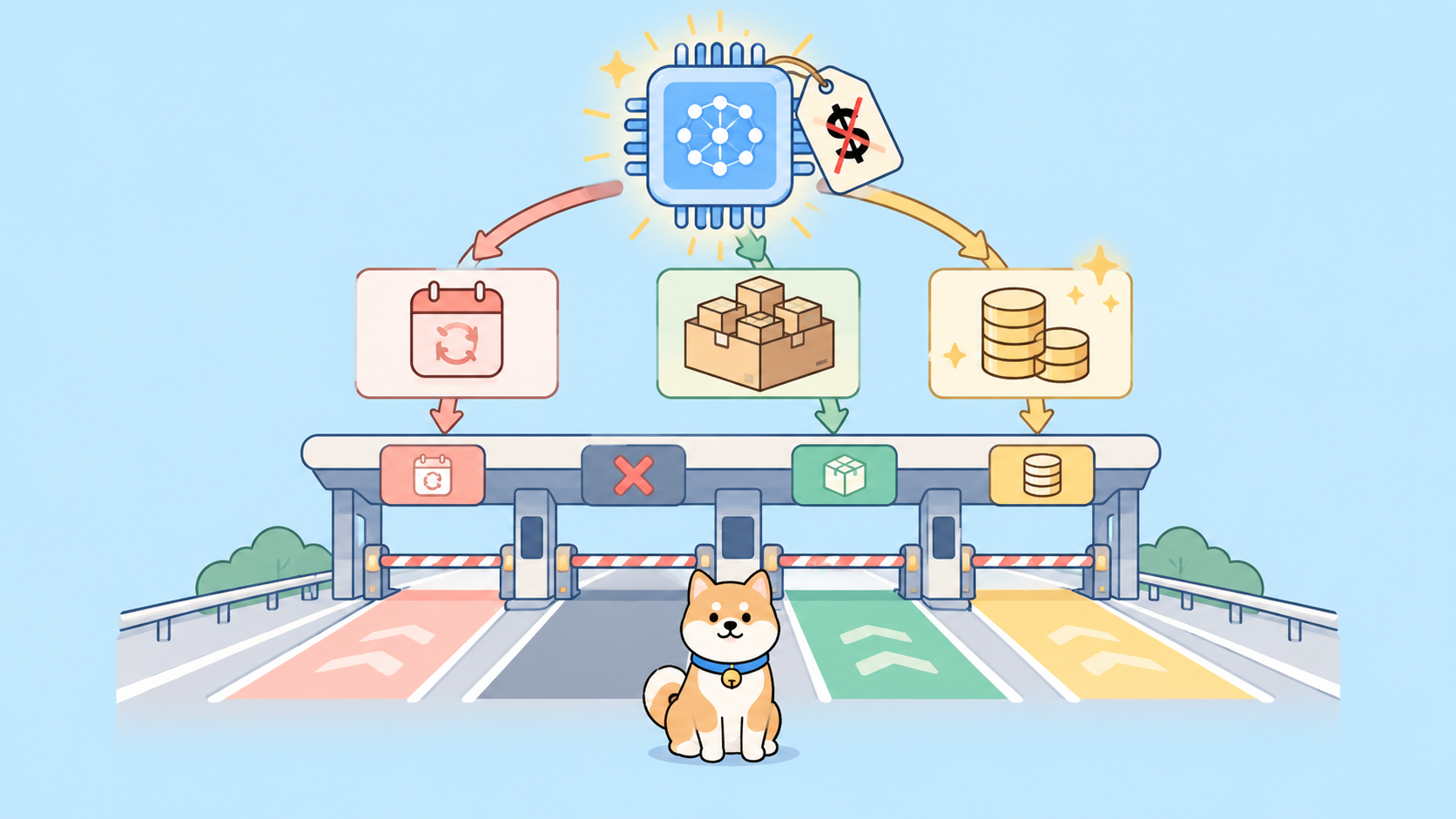
DeepSeek-V4.1-Flash went GA on the API on September 10, 2026, and it arrived with two facts that make “free” a real question instead of a marketing hook. The weights are MIT-licensed on Hugging Face, so the model itself costs nothing. And the official API bills cache-hit input at $0.003 per 1M tokens off-peak, close enough to zero that the line between free and nearly free stops mattering for most side projects.
There is still no permanent free tier on the DeepSeek API. Anyone who tells you otherwise is describing a router promo or the consumer chat app. This guide ranks every honest way to use V4.1-Flash without paying, then shows the math on the paid path so you can decide whether nearly free is close enough. If you want the architecture story first, read what DeepSeek-V4.1-Flash is and come back.
One note first. Several free routes run through third-party endpoints that rate-limit you and sometimes swap models silently. Testing them with Apidog recording responses and asserting on the model field keeps your free quota off your own debugging. That workflow is near the end.
TL;DR
Ranked from “free with no strings” to “nearly free with a card on file”:
- The DeepSeek chat app at chat.deepseek.com. Free, no card. Best for judging output quality by hand.
- The open weights on Hugging Face. Free under MIT, but 552B parameters means the hardware is the cost.
- Third-party routers such as OpenRouter. Free tiers exist for some models some of the time, with rate limits and data-policy trade-offs.
- Bundled trial credits inside coding tools. Only useful when the tool already ships DeepSeek as a backend.
- The official API. Not free, but a hobby project runs for about $1.35 a month off-peak.
Option 1: the DeepSeek chat app
The consumer app at chat.deepseek.com is the zero-friction route. Sign up with an email or phone number, no card, and start prompting.
Two caveats. First, which model the app serves after today’s release is [VERIFY]. The release note covers the API, and the app has previously lagged the API or run a separately tuned build. Second, the app is a chat interface, not an API. You can’t script it, batch prompts or wire it into a product.
So the app answers one question: does V4.1-Flash handle your domain well enough to justify an integration? Paste in the input your users send, images included, since the model is natively multimodal. If the answers hold up, move to one of the routes below.
Option 2: the open weights
DeepSeek published the V4.1-Flash weights and tech report under the MIT license. You can download, run, fine-tune and ship products on them without paying DeepSeek or asking permission.
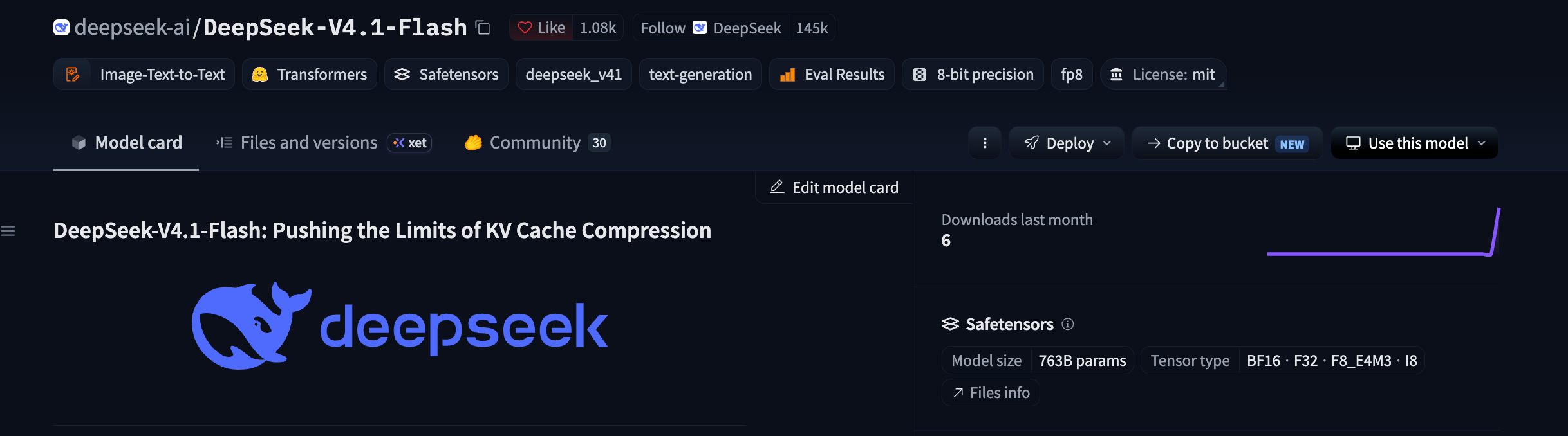
The catch is size. V4.1-Flash is a 552B-parameter mixture-of-experts backbone (763B with the vision encoder). Only 8B parameters are active during prefill and 16B during decode, but the full parameter set still has to live somewhere. At 8-bit that is roughly 552 GB for the backbone alone; at 4-bit, about 280 GB. A single consumer GPU doesn’t get close. The KV cache is the good news: at 890 bytes per token under FP4 caching, a full 1M-token context needs about 0.9 GB.
“Free” here means free to license, not free to run. Read how to run DeepSeek-V4.1-Flash locally for the hardware tiers and which inference engines to check before you download 280 GB. If you already have the hardware, this is the most durable free option on the page: no rate limits, no data policy, no silent model swaps.
Option 3: the official API is not free, but it is close
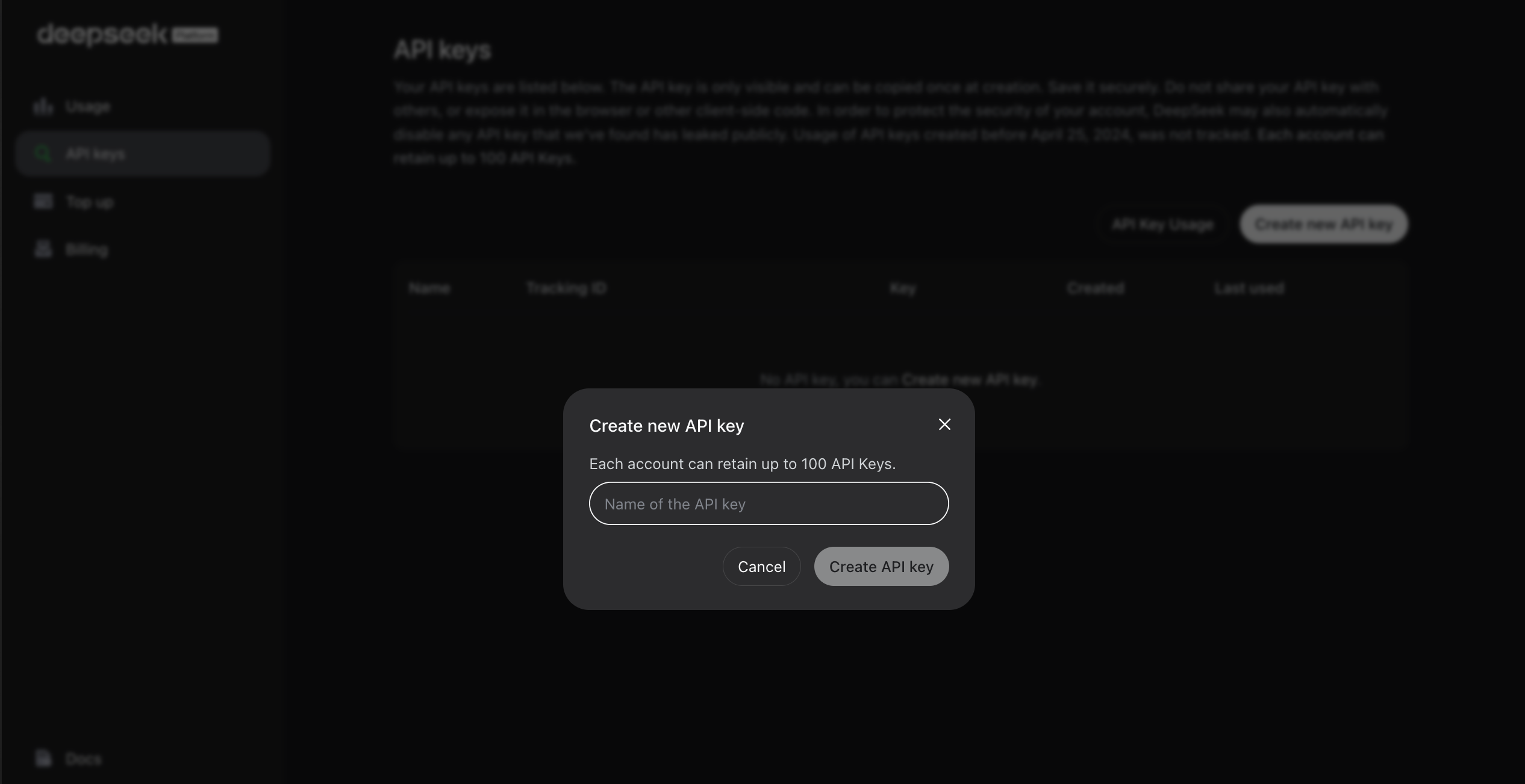
The DeepSeek platform is pay-as-you-go. You top up a balance, create a key, and get billed per token. No permanent free tier.
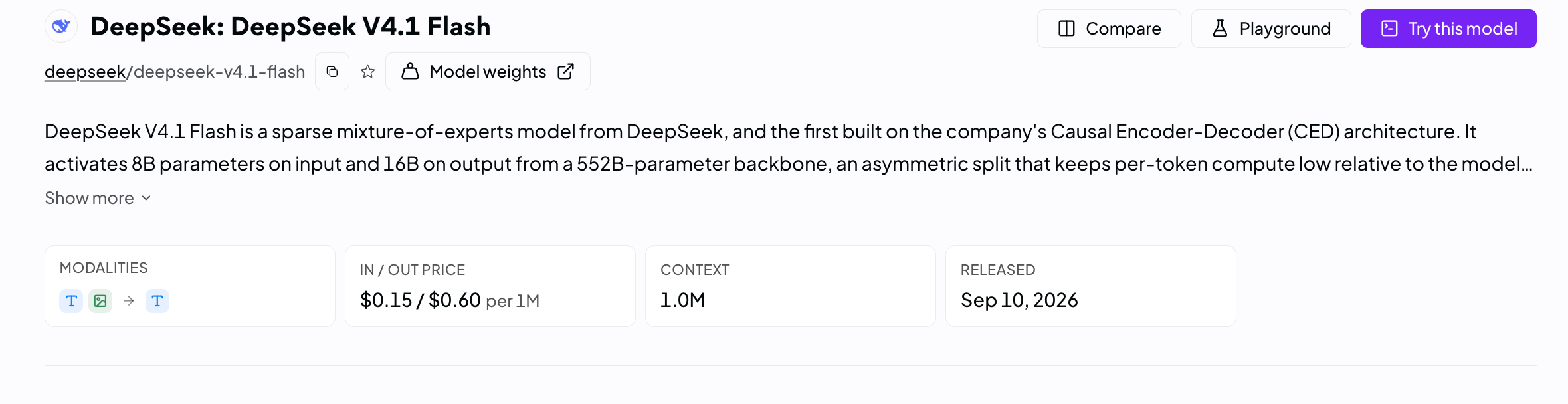
What earns it a place on a “for free” page is the price. Here is the full USD table from the official pricing page, effective September 10, 2026 at 04:00 UTC, per 1M tokens:
| Token type | deepseek-flash off-peak | deepseek-flash peak |
|---|---|---|
| Input, cache hit | $0.003 | $0.006 |
| Input, cache miss | $0.15 | $0.30 |
| Output | $0.60 | $1.20 |
Peak hours are Monday to Friday, 01:00 to 04:00 and 06:00 to 10:00 UTC (09:00 to 12:00 and 14:00 to 18:00 Beijing). Everything else, weekends included, is off-peak at half price. Context caching is automatic, so repeated system prompts hit the cache with no extra code.
Now the math. Suppose a side project sends 5M tokens of fresh (cache-miss) input and generates 1M tokens of output in a month, all off-peak:
- 5M cache-miss input at $0.15 per 1M = $0.75
- 1M output at $0.60 per 1M = $0.60
- Total: $1.35 per month
If part of that input is a repeated system prompt, it drops further. 1M cache-hit tokens off-peak cost $0.003, so a 2,000-token system prompt reused across 10,000 requests (20M cached tokens) adds six cents. The bill rounds to pocket change, and you get the exact model you asked for at a 2,500-request concurrency ceiling. The V4.1-Flash pricing explainer covers how the math shifts with prompt structure.
A minimal call, with the usage block printed so you can see the cache split:
import os
from openai import OpenAI

client = OpenAI(
    api_key=os.environ["DEEPSEEK_API_KEY"],
    base_url="https://api.deepseek.com",
)

response = client.chat.completions.create(
    model="deepseek-flash",
    messages=[
        {"role": "system", "content": "You classify support tickets as billing, bug, or feature request."},
        {"role": "user", "content": "Customer says their August invoice shows two charges for one seat."},
    ],
)

print(response.choices[0].message.content)
print(response.usage)
Options 4 and 5: routers, free tiers and bundled credits
OpenRouter is the usual place to look for a free endpoint to a new open-weight model. Routers aggregate several hosts behind one OpenAI-compatible API, and hosts sometimes run a free tier on a model to pull in traffic. Whether V4.1-Flash is listed there today, and whether any host offers a free tier for it, is [VERIFY]; the model is hours old and listings move fast.
Three warnings apply to every router free tier:
- Rate limits are tight. Per-minute and per-day caps mean a test loop can exhaust a day’s quota in an hour.
- Data policies differ per host. Free traffic is often what a host is permitted to log or train on. Read the policy before sending anything private.
- Free tiers change weekly. Free on Monday can be paid by Friday, or routed to a different host. Don’t build a production dependency on one.
The failure to watch for is silent model substitution: you request V4.1-Flash and an older model answers because the free host fell over. The response’s model field is your first line of defense, and the workflow below asserts on it.
Some coding tools, Cursor and Codex-style agents among them, bundle trial credits you can spend on whichever backends the tool supports. If a tool you already use lists DeepSeek as a selectable model, those credits are a legitimate free route for the length of the trial. Don’t sign up for a tool solely to reach DeepSeek this way; credit amounts and eligible models change too often to document.
Which option fits your situation
| Option | Cost | Model guaranteed? | Rate limits | Best for |
|---|---|---|---|---|
| DeepSeek chat app | Free | Depends on the app build | App usage caps | Hand evaluation, quick checks |
| Open weights (MIT) | Free license, your hardware | Yes, you run it | None | Privacy, fine-tuning, owned GPUs |
| Official API | About $1.35/month at hobby scale | Yes | 2,500 concurrent requests | Anything you ship |
| Router free tier | Free while it lasts | No, hosts swap | Per-minute and per-day caps | Prototypes, comparisons |
| Bundled tool credits | Free during the trial | Depends on the tool | Tool-defined | Coding inside that tool |
If you plan to ship, spend the dollar on the official API. If you are evaluating, start with the chat app. If you have GPUs, the weights beat every other row.
Test free endpoints in Apidog without burning quota
The free routes have two failure modes: you hit the rate limit while debugging your own code, and the router hands you a different model without saying so. Both are cheap to prevent with Apidog, which tests the API layer in front of whichever endpoint you pick.
- Add the endpoint once. Create
POST {{BASE_URL}}/chat/completionswithBearer {{API_KEY}}in the Authorization header. Every option except the chat app speaks the same OpenAI-compatible shape, so one saved request covers all of them. - Create one environment per provider. An
officialenvironment setsBASE_URLtohttps://api.deepseek.comwith your DeepSeek key; arouterenvironment points at the free host. Switching is a dropdown. - Record real responses, then mock them. Send a handful of representative prompts through the free endpoint, save the responses, and serve them from Apidog’s mock server. While you build parsing, retries and UI, your app hits the mock and the free quota stays untouched.
- Assert on the model field. Save the request as a test case asserting that
modelin the response contains the string the host returns for V4.1-Flash. Run it at the start of each session, and a swapped model fails the test before you spend an hour chasing a “regression” in your prompts. - Assert on the usage block. Check that
usage.prompt_tokensandusage.completion_tokensare above zero, and read the cache-hit count on the official API from the same block. After a week you know what a free tier saved you and whether your prompts cache as well as you assumed.
Download Apidog and the loop takes under ten minutes. Once the assertions exist, apidog-cli runs them in CI so a router swap breaks a build instead of a demo.
FAQ
Is DeepSeek-V4.1-Flash free to use? The model is free to license under MIT and free to use inside the DeepSeek chat app. The official API is pay-as-you-go with no permanent free tier. Is DeepSeek free traces how that split has held across the whole model line.
Does the DeepSeek API have a free trial? No standing one. The lowest-cost path is the official API off-peak: 5M cache-miss input tokens plus 1M output tokens cost $1.35.
What is the cheapest way to call V4.1-Flash through the API? Send outside peak hours and structure prompts so shared prefixes hit the cache, since a hit costs 50x less than a miss. What is prompt caching explains how to order a prompt for that.
Can I run V4.1-Flash on a laptop? Not the full model. 552B parameters is about 280 GB at 4-bit for the backbone alone. The local guide linked above covers what is realistic at each hardware tier.
Is a free router version the same model as the official API? Only if the host says so and your tests confirm it. Assert on the model field and compare outputs on a fixed prompt set against the official endpoint. The guides to DeepSeek V4 for free and the V4 API for free run the same check for the previous generation.
Where this leaves you
V4.1-Flash is free in the two ways that matter most: the weights are MIT, and the chat app costs nothing. Everything between those poles is a free tier that will move or an official API priced low enough that “free” stops being worth optimizing for. At $1.35 a month, the cheapest route is usually to pay.
Whichever endpoint you choose, put Apidog in front of it: mock responses while you build, assert on the model field, log usage. Free quota is a resource. Spend it on the model, not on your own bugs.