July’s release follows three clear themes: stronger enterprise security and access management, more dependable API migration and specification sync, and easier-to-maintain testing workflows.
API teams need more than individual features. They need confidence that credentials can be found before they become incidents, that access and organization activity remain traceable, that imported API data keeps its meaning, and that automated tests are easy to reuse and monitor.
This month, Apidog improves those connected workflows across three areas:
- Enterprise security and access (Enterprise plan): Detect credential risks, audit important organization activity, and improve SCIM, SAML, and SSO workflows.
- API migration and specification sync: Preserve more Postman context and make OpenAPI/Swagger imports safer to repeat.
- Testing and workflow reliability: Reuse more test assets, see when scenarios last ran, and save large environment configurations more reliably.
1. 🔐 Enterprise Security and Access
Enterprise API governance depends on three things working together: sensitive information must be discoverable, important activity must be traceable, and the right users must receive the right access. July’s updates strengthen all three parts of that operating model.
Availability: Enterprise plan
Enterprise Secret Scanner Brings Credential Risks Into View
API projects often contain request parameters, headers, environments, variables, scripts, examples, and authentication settings. If an API key, access token, private key, or other credential is stored in plain text, it can create a security risk that is difficult to discover across a large organization.
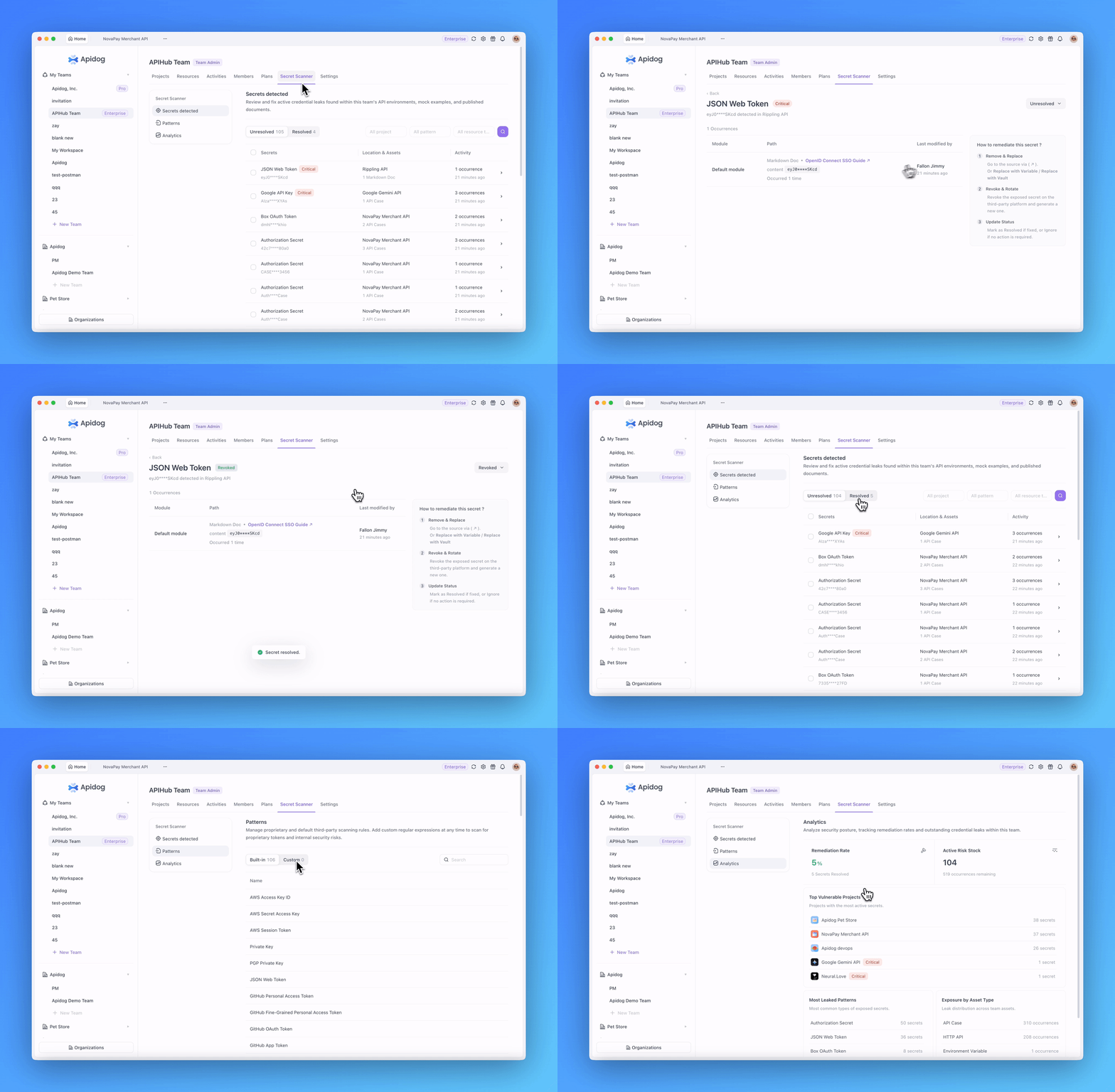
Secret Scanner gives Enterprise teams a structured way to find, review, and manage those risks across the API lifecycle:
- Organization-level visibility: Organization administrators can see which teams have unresolved secret findings and identify the relevant Team Owners or Team Admins who can coordinate remediation.
- Team-level governance: Teams can review findings across their projects and open a detailed view of every occurrence associated with the same secret risk.
- Direct source navigation: Each occurrence can link back to the related request, environment, variable, example, or other source resource, reducing manual investigation.
- Recorded remediation: Findings can be marked as resolved with a reason such as Revoked, False positive, or Won’t fix.
- Custom detection patterns: Team administrators can create, edit, enable, disable, or delete custom patterns for credential formats used inside their organization.
Instead of stopping at detection, teams can locate the source, coordinate ownership, record the outcome, and maintain a clearer remediation history.
Enterprise Audit Logs Improve Organization Traceability
When an organization manages many members, teams, projects, and permissions, administrators need a reliable record of important activity. Without that history, investigating unexpected access changes or understanding who performed a sensitive operation can require time-consuming manual checks.
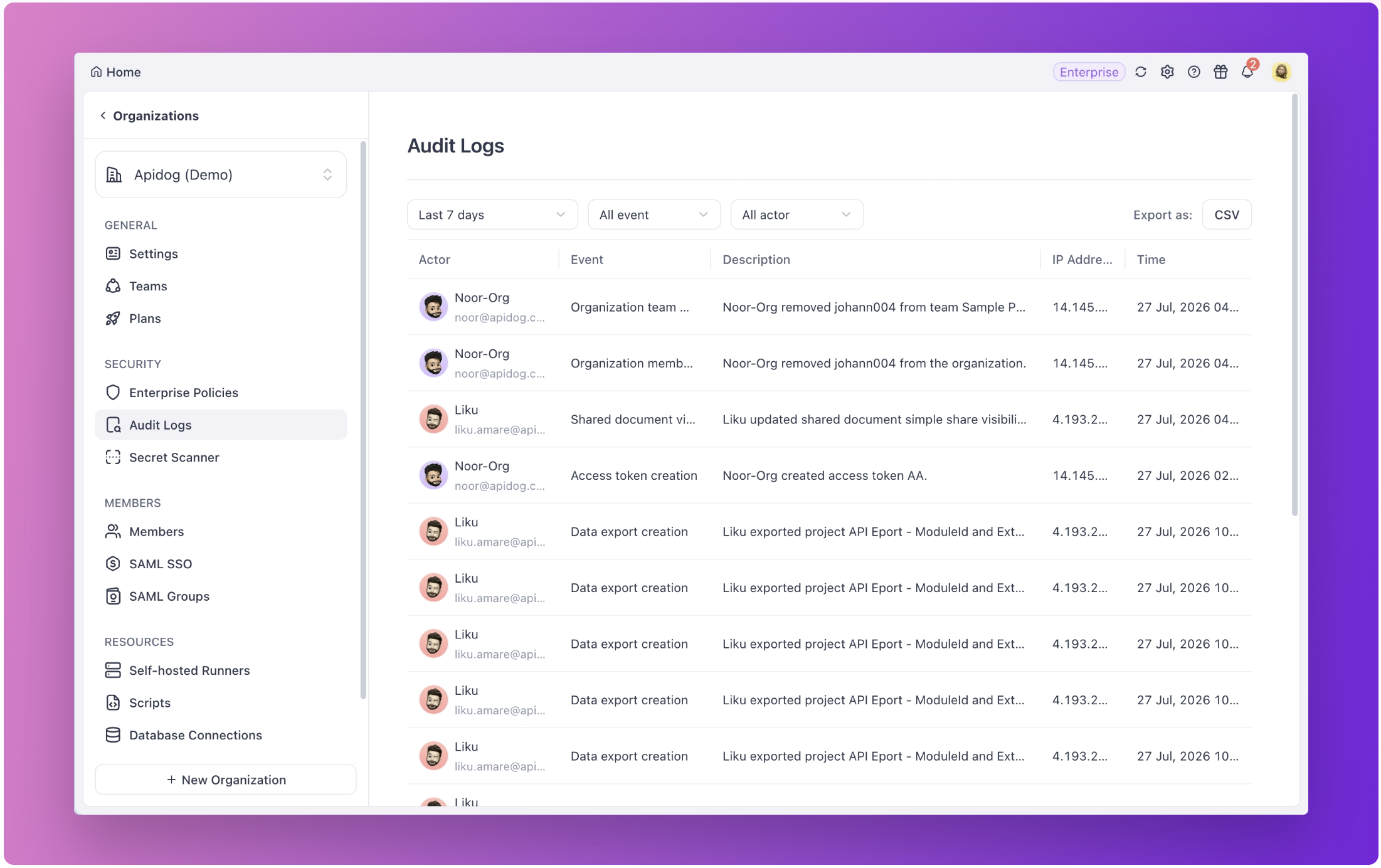
Enterprise Audit Logs give Organization Owners and Admins a centralized view of key events. Each record can include the operator, event type, event description, source IP address, and timestamp. Administrators can filter by time range, event type, and operator to trace changes involving members, teams, permissions, projects, and login events.
This supports security reviews, incident investigation, and internal compliance processes without requiring administrators to reconstruct activity from multiple sources.
More Reliable Enterprise Identity and SSO Workflows
Apidog improved compatibility with SCIM 2.0 across a broader range of identity provider (IdP) integrations. User lifecycle operations and organization-level group management are now more resilient to differences in SCIM fields and endpoint behavior, helping enterprise teams activate, update, and synchronize users and groups more reliably.
For organizations using IdPs such as JumpCloud, Microsoft Entra ID, and Okta, these improvements support a smoother enterprise identity governance workflow beyond provisioning alone. Enhanced SAML Group Mapping handles both single-group strings and multi-group arrays, helping users receive the expected organization and team roles after SSO login without disrupting existing team membership.
The identity governance experience also extends into project access. Following SSO login, Apidog can automatically expand and select the corresponding organization and team, reducing manual navigation across workspaces and helping users enter the right project with the right access more quickly.
2. 📦 API Migration and Specification Sync
Migration quality is determined by what happens after the import. Requests should remain understandable, authentication should remain usable, variables should retain their context, and repeated specification syncs should not remove or overwrite unrelated resources.
More Complete and Reliable Postman Migration
Apidog now preserves and maps more Postman data across both local file imports and Postman API imports:
- Collection-level authentication and endpoint-level OAuth 2.0 settings are imported more accurately.
- OAuth 2.0 Refresh Token URLs are mapped correctly.
- Variable descriptions and secret classifications can be retained.
form-datafile fields preserve the original filename when the actual local file cannot be transferred.- Postman API imports can include Globals, with the option to exclude them during import.
- Unsupported characters in variable names, such as spaces or vertical bars, are replaced with underscores to reduce template-resolution failures.
- Repeated Postman API imports are less likely to use stale browser-cached Collection data.
| Before | Now |
|---|---|
|
|
The result is less post-migration cleanup and a shorter path from imported data to requests that teams can understand, validate, and run.
Safer OpenAPI and Swagger Import Workflows
OpenAPI and Swagger imports often serve as an ongoing synchronization workflow rather than a one-time migration. Import errors, incomplete parsing, or incorrect resource deletion can therefore affect a project repeatedly.
Apidog now provides clearer error details when an OpenAPI or Swagger file cannot be imported. When the problem may be related to the selected specification format, the import flow provides more direct guidance for switching formats and continuing the investigation.
This release also improves several complex synchronization cases:
- Scheduled imports can process definitions returned with non-2xx HTTP responses more correctly.
- OpenAPI 3.1 imports into iteration branches preserve endpoints, Webhooks, folders, descriptions, and deprecated states more reliably.
- Folders without HTTP endpoints are less likely to be removed incorrectly when deleting resources that no longer exist in the source definition.
- Schema circular references are handled more reliably during import.
- Model synchronization across modules and scheduled import sources is less likely to overwrite unrelated models with the same name.
These changes make specification synchronization safer for teams working across multi-module projects, branches, and scheduled import workflows.
3. 🧪 Testing and Workflow Reliability
Automation becomes difficult to maintain when test assets must be duplicated, scenario activity is hard to see, or large configuration updates fail for avoidable reasons. July’s workflow improvements reduce that operational friction.
Reuse More Test Assets in Apidog CLI
When Apidog CLI runs scenario cases, scenario steps can now reference endpoints, test cases, and other scenarios. Existing test assets can be reused more directly in local scripts, CI/CD pipelines, and automated testing workflows instead of being recreated as isolated steps.
This makes scenario composition more modular and helps teams maintain the same reusable test assets across interactive testing and automated execution.
See When Test Scenarios Last Ran
The automated test scenario list now displays the most recent run time in addition to the creation time. Teams can quickly see whether a scenario has been executed recently, identify tests that may need attention, and communicate test activity more clearly to project stakeholders.
Save Large Environment Configurations More Reliably
Large projects can accumulate invalid empty values in environment configuration, increasing request size and occasionally causing save failures. Apidog now removes this unused empty data when saving an environment, making configuration updates more reliable for projects with many modules.
🐞 Bug Fixes and Smaller Improvements
We also shipped a set of fixes and quality-of-life improvements this month, including:
- Fixed an issue where Runner notifications and recent run results could show an average duration of 0 after a test scenario completed.
- Fixed an issue where clicking “Forgot password” did not automatically reuse the previously entered account information.
- Fixed an issue where Organization Owners could lose access to organization settings after the member limit was exceeded.
- Fixed an issue where a Team Owner could rejoin through a project invitation link with an incorrect regular-member role.
- Fixed a timezone offset in the organization member list’s recent activity time.
- Fixed an issue where cloning a project from a published documentation site could include endpoints from unpublished modules.
- Fixed an issue where test suite steps could disappear after saving in a child branch.
- Fixed an issue where Runner could fail to execute test suites in child branches.
- Fixed an issue where multi-module documentation exports could contain endpoints from modules that were not selected.
- Fixed an issue where disabling “Import Authentication” could incorrectly change directory authentication to “No Auth.”
- Improved Secret Scanner recognition for additional credential patterns.
- Fixed an issue where images in Markdown documents could fail to display in the On-Premises desktop client.
- Improved cumulative credit usage data so total increases and total consumption can be displayed more accurately.
🌟 What This Means
July’s release creates a more dependable path across three connected areas of API operations:
Focus | What improves | Why it matters |
|---|---|---|
Enterprise security and access | Secret Scanner, Audit Logs, JumpCloud SCIM and SAML compatibility, and faster SSO workspace navigation. | Organizations can find credential risks, trace important activity, and manage user access with fewer gaps. |
API migration and specification sync | More Postman context is preserved, while OpenAPI and Swagger imports are safer and easier to troubleshoot. | Teams spend less time repairing imported data and face a lower risk of losing or overwriting project resources. |
Testing and workflow reliability | CLI scenarios reuse existing assets, scenario activity is easier to see, and large environment saves are more stable. | Automated workflows become easier to compose, monitor, and maintain. |
Together, these updates help security teams, administrators, API designers, and test engineers work from a clearer and more reliable operational foundation.
💬 Join the Conversation
Connect with fellow API engineers and the Apidog team:
- Join our Discord community for real-time discussions and support.
- Participate in our Slack community for technical conversations.
- Follow us on X (Twitter) for the latest updates.
P.S. For the full details on all updates, check the Apidog Changelog!
Best Regards,
The Apidog Team