Grafana k6 earned its following honestly. It’s an open-source load-testing tool (AGPL-3.0, around 31k GitHub stars) with a Go engine and JavaScript scripting, and it slots into CI as cleanly as any tool in the category. If your job is generating serious load (ramping VUs, soak tests, spike profiles, distributed traffic via Grafana Cloud), k6 is one of the strongest choices available, and this article won’t pretend otherwise.
But a lot of teams didn’t adopt k6 for that job. They adopted it as the scriptable, CI-friendly way to check that their APIs work, and they’ve since discovered the cost: every request is code, every assertion is a hand-written check(), every debugging session is edit-script-rerun-read-terminal, and every readable result needs a Grafana stack or a metered cloud plan. There’s no collection to click through, no docs, no mock server, no place for the teammate who doesn’t write JavaScript.
Here’s the direct answer: if your real workload is API functional testing (does this endpoint return the right response, does this flow still work, does it hold up under everyday load), Apidog is the best k6 alternative. It covers design, debugging, testing, mocking, and documentation in one app, runs test scenarios without a meter, ships a CLI for CI, and includes built-in performance testing up to 100 virtual users. And if your real workload is heavy load generation, keep k6; the rest of this article helps you figure out which team you’re on.
What k6 gets right
Credit first, because k6’s strengths explain its adoption:
- Tests as code. Scripts are JavaScript files that live in git, go through review, and version with the API they exercise.
- Deep load modeling. Scenarios, executors, ramping VUs, thresholds, and custom metrics express arrival rates and soak profiles precisely, as covered in our k6 load testing tutorial.
- A single binary in CI.
k6 run script.jswith threshold-based pass/fail is about as clean as pipeline integration gets. - A real cloud story for scale. Grafana Cloud k6 runs distributed tests from more than 20 geographic locations, up to 1 million concurrent virtual users on Enterprise.
If you read that list and thought “yes, that’s exactly what I use daily,” stop here and keep your setup.
Where the k6 workflow strains
The friction shows up when k6 becomes a team’s general-purpose API testing tool rather than its load generator.
Everything is code, including exploration. k6 has no request client. You can’t paste a URL, tweak a header, and click send; you write a script, run it, and read terminal output. For debugging a failing endpoint, that loop is slow, and it excludes teammates who’d rather not maintain JavaScript to check a response body.
Functional assertions are hand-rolled. k6’s check() gives you booleans, not schemas. Validating that a response matches your API contract means writing and maintaining that logic yourself, for every endpoint, forever. Purpose-built API test tools generate it from a spec.
Readable results cost extra. The OSS CLI prints an end-of-test summary to the terminal. Trend graphs, run history, and shareable dashboards mean either self-hosting a Grafana plus time-series database stack or paying for Grafana Cloud k6, metered in virtual user hours: 500 VUh free per month, then Pro at $0.15 per VUh with a $19 monthly platform fee. Fair pricing for a load platform; a strange bill to pay for smoke tests.
No API lifecycle. k6 has no spec editor, no mock server, no published docs, no shared workspace. It tests APIs; it doesn’t help you design, document, or stub them. Teams end up running k6 next to Postman next to Swagger UI next to a mock library, the fragmentation an API platform exists to end. We hit the same wall from the Python side in our Locust alternative piece.
The answer: Apidog
Apidog is an API development platform used by over 500,000 developers. One spec drives the request client, the automated tests, the mock server, and the documentation.
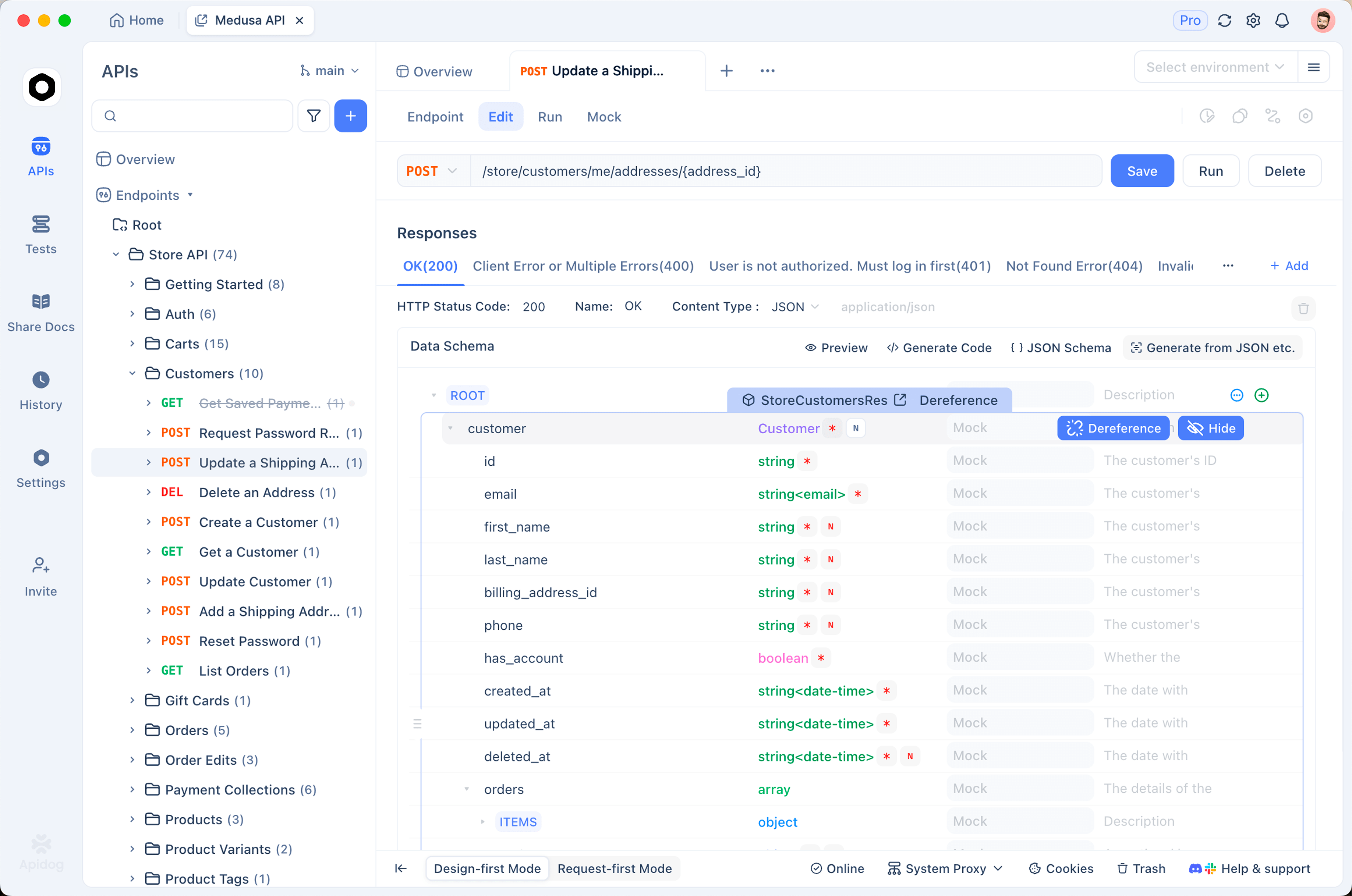
Against k6 specifically, four things change:
- Tests become visual scenarios, not scripts. Chain requests, extract variables between steps, assert on status, body, and headers, and validate responses against schemas automatically. No
check()boilerplate, no JavaScript requirement for teammates who don’t want it, and an unmetered runner on the free plan, which covers up to 4 users. - Debugging gets a client. Send a request, inspect the response, save it as a documented endpoint. The edit-script-rerun loop becomes a click.
- Performance testing is built in, within honest limits. Reuse any scenario as a performance test with up to 100 virtual users, a configurable ramp-up time, and live metrics: total requests, requests per second, average and max/min response time, and failure rate (per the Apidog performance testing docs). Load is generated from the machine running the app. That covers “does this endpoint hold up under everyday concurrency”; it does not replace a dedicated load generator, and we’re not claiming it does.
- CI comes along. The Apidog CLI runs your scenarios in any pipeline, free, with no VUh meter attached.
And because it’s a platform, the same project gives you a smart mock server, published interactive docs, and a visual OpenAPI editor; the things k6 was never meant to provide.
What the switch looks like feature by feature
Functional API tests
This is the migration’s center of gravity. A k6 script that hits five endpoints and checks status codes becomes a five-step visual scenario with no code. Schema validation replaces most hand-written body checks: import or design your spec, and responses are validated automatically. Data-driven testing (each run picking rows from a dataset) is a built-in option rather than a custom loop.
Performance checks
Configure virtual users (up to 100), a ramp-up period, and duration on top of an existing scenario, then watch live charts. For a team whose “load testing” was actually “confirm the API survives 50 concurrent users,” this replaces k6 outright and removes the results-dashboard problem, since reports are stored in the workspace with run history. For ramping arrival-rate models, soak tests, or thousands of VUs, it doesn’t. Our API performance testing tutorial walks through the workflow.
CI and automation
k6 run becomes an Apidog CLI command in the same pipeline slot. Scenarios are pulled from the workspace, so the CI run and the app run stay in sync; no script drift between what developers edit and what the pipeline executes. For the broader pattern, see continuous performance testing tools.
Beyond testing
Everything k6 doesn’t attempt: design endpoints visually or in OpenAPI code, hand frontend teams a schema-aware mock URL before the backend exists, and publish interactive docs on your own domain. Weighing a general API client move too? The best Postman alternative covers that comparison.
k6 vs Apidog at a glance
| Grafana k6 | Apidog | |
|---|---|---|
| Form | CLI + JavaScript scripts | Desktop app + web + CLI |
| Test authoring | Code only | Visual scenarios; scripting available |
| Functional assertions | Hand-written check() calls |
No-code assertions + automatic schema validation |
| Load capability | Excellent: scenarios, executors, soak, spike; cloud to 1M VUs | Up to 100 VUs per run, ramp-up, live metrics |
| Distributed / multi-region load | Yes (Grafana Cloud, 20+ regions) | No |
| Results | Terminal summary; dashboards need Grafana stack or Cloud | Live charts + stored run history, no extra stack |
| CI runs | Free, single binary | Free via Apidog CLI |
| Cloud metering | 500 VUh/month free, then $0.15/VUh + $19/month platform fee | Unmetered runner; free plan covers 4 users |
| API spec editor | No | Visual + code OpenAPI editors |
| Mock server | No | Schema-aware smart mocks, free |
| API docs | No | Published interactive docs, custom domain |
| Non-coder friendly | No | Yes |
The cost math, honestly
k6 OSS is free forever, and if the terminal summary is enough, your load testing costs nothing but engineering time. The bill appears in two other places. First, results infrastructure: either self-hosting Grafana plus a time-series database, or Grafana Cloud k6’s meter, where a modest nightly suite (50 VUs for 30 minutes, roughly 25 VUh a night) eats the 500 free VUh in under three weeks, then runs about $110 a month on Pro. Second, the tools k6 doesn’t include: if your team also pays for an API client, a mock service, and a docs host, k6’s $0 is only one line of the invoice.
Apidog’s free plan covers 4 users with unmetered scenario and performance runs, mocks, and docs; paid plans start at $9 per user per month. For a 5-person team the comparison isn’t “free versus $540 a year,” it’s “$540 a year versus the Grafana stack you maintain plus the client, mock, and docs tools you bought separately.” If heavy load generation is a real requirement, the honest answer is both: Apidog for the API workflow, k6 OSS for the load rig, which still deletes the results-dashboard bill for everyday testing. For the wider field, see our load testing tools roundup.
Migrating from k6
There’s no one-click importer for k6 scripts, because scripts aren’t specs. The path is shorter than it sounds:
- Import your API definition. OpenAPI/Swagger, Postman, or a cURL paste. Endpoints arrive with schemas, docs, and live mocks. No spec? Save requests from the client as you debug and the spec accretes.
- Rebuild each k6 script as a test scenario. The request sequence maps step for step;
check()calls become assertions or disappear into schema validation. - Move datasets. CSV test data attaches to scenarios with random or sequential row matching.
- Recreate everyday load checks as performance tests (VUs, ramp-up, duration) on the same scenarios. Keep genuine load profiles in k6.
- Swap the CI step from
k6 runto the Apidog CLI.
A suite of a dozen scripts typically moves in an afternoon, and the scenarios are then editable by the whole team, not just the script authors.
When k6 still makes sense
Keep k6 when the load itself is the product of your testing: ramping arrival rates, multi-hour soak tests, spike profiles, tests above a few hundred VUs, or distributed generation from multiple regions. Keep it when thresholds on custom metrics gate your deploys, or when tests-as-reviewable-code is a hard team requirement. Apidog’s 100-VU, single-machine performance testing is deliberately not that tool, the same honest line we drew for Artillery and autocannon. Comparing dedicated load tools against each other instead? See the best JMeter alternative and the best Gatling alternative. The switch pays off when you notice most of your k6 scripts assert on response bodies at 1 VU; that’s an API test suite wearing a load tool’s clothes.
Frequently asked questions
Is k6 free?
k6 OSS is free and open source under AGPL-3.0. Grafana Cloud k6, which adds hosted dashboards and distributed load from 20+ regions, meters usage in virtual user hours: 500 VUh free per month, then Pro from $0.15 per VUh with a $19 monthly platform fee. Self-hosting dashboards with the Grafana stack is the free-but-you-run-it middle path; our k6 load testing guide covers the OSS workflow.
Can Apidog replace k6 for load testing?
For everyday concurrency checks, yes: performance tests run up to 100 virtual users with ramp-up and live metrics, reusing your existing scenarios. For large-scale or distributed load (thousands of VUs, multi-region, soak profiles), no; keep k6 or another dedicated generator from our load testing tools roundup for that job.
Can I import k6 scripts into Apidog?
Not directly; k6 scripts are JavaScript programs, not API definitions. Import your OpenAPI spec or Postman collection instead, then rebuild scripts as visual scenarios. Assertions map to no-code checks or automatic schema validation, and CSV datasets attach to scenarios for data-driven runs.
Does Apidog work in CI like k6 does?
Yes. The Apidog CLI runs test scenarios in any pipeline (GitHub Actions, GitLab CI, Jenkins) with pass/fail exit codes, and it’s free with no usage meter. Scenarios live in the shared workspace, so CI always runs what the team last edited.
What does k6 have that Apidog doesn’t?
Deep load modeling: scenarios and executors, ramping arrival rates, thresholds on custom metrics, browser-based performance tests, and cloud-distributed generation up to 1 million VUs. If those are your requirements, k6 is the right tool and this is the wrong migration.
Stop scripting your API checks
If your k6 scripts mostly verify that endpoints behave, move them somewhere built for that: visual scenarios, automatic schema validation, an unmetered runner, built-in performance checks to 100 VUs, and mocks and docs from the same spec. Download Apidog or start in the browser; a team of 4 pays nothing, and your first imported spec comes with tests, mocks, and docs attached.