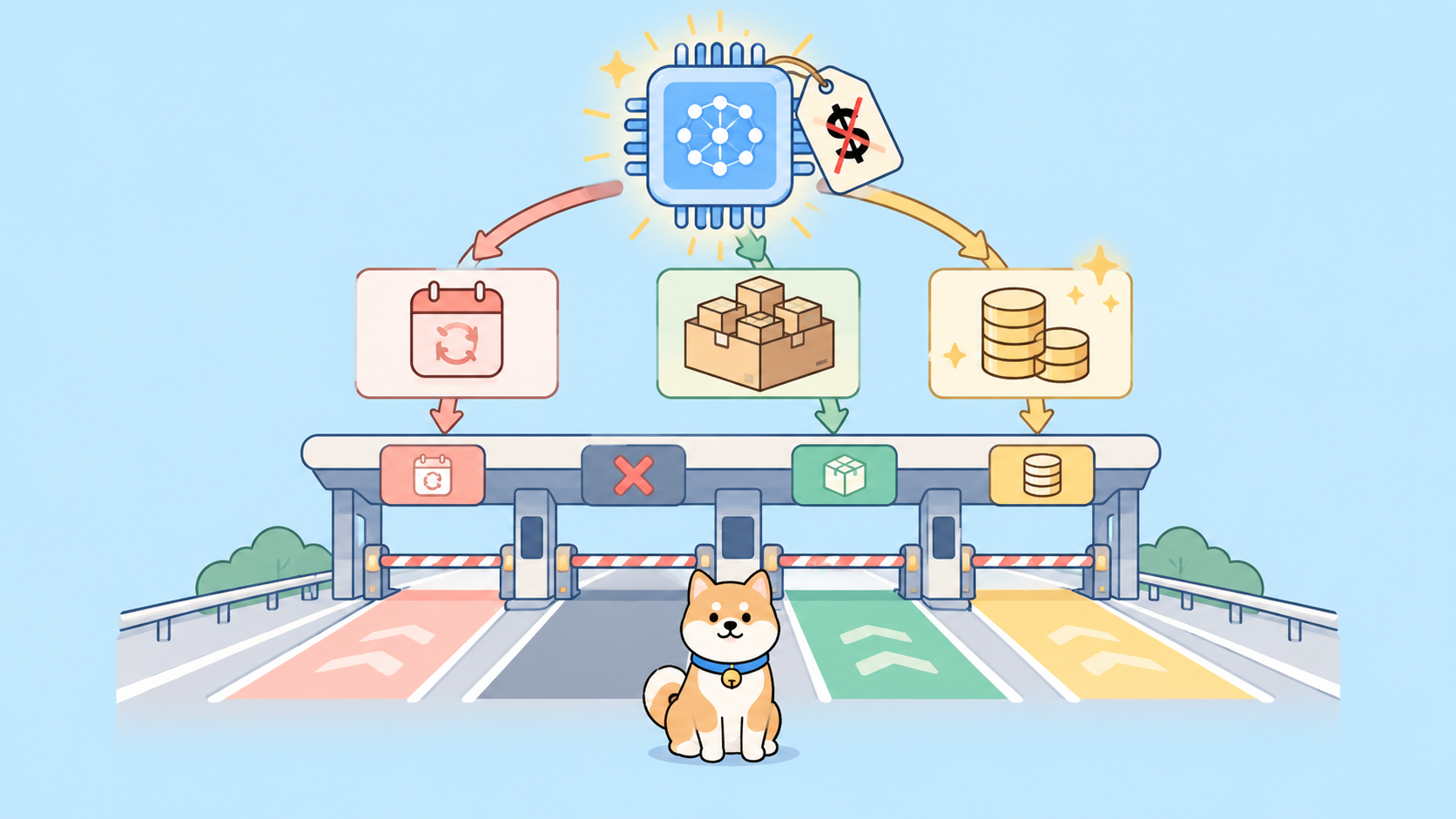
Yes. GPT-6 Luna is genuinely free, and that answer is rare enough on a launch-week frontier-family model that it deserves the first line. OpenAI’s September 22, 2026 launch post states it directly: “Free and Go users can access GPT-6 Luna in the desktop app.” No subscription, no trial balance, no credit card.
The boundary is narrow enough to trip over, so here it is before anything else. Desktop app, yes. Chat, not yet. GPT-6 Sol, no. The free route is one surface and one model, and everything else in the GPT-6 launch sits behind a paid plan or an API key.
What makes this worth a full article rather than a sentence is what is inside the free door. Luna carries a 1 million token context window, larger than Sol’s 872,000, and OpenAI’s own benchmark tables put it inside the range of models costing ten to a hundred times more per task. A free tier pointed at a frontier-family model is a different proposition from a free tier pointed at a stripped-down chatbot. The rest of this guide covers exactly who gets it and where, what the free tier leaves out, and the paid and API paths for anyone who outgrows it.
Exactly who gets GPT-6 Luna for free, and where
One sentence in OpenAI’s launch post does all the work. Sol and Luna are available in ChatGPT Work and Codex for Plus, Pro, Business, Enterprise and Edu users. Free and Go users get Luna in the desktop app. Neither model is in Chat yet.
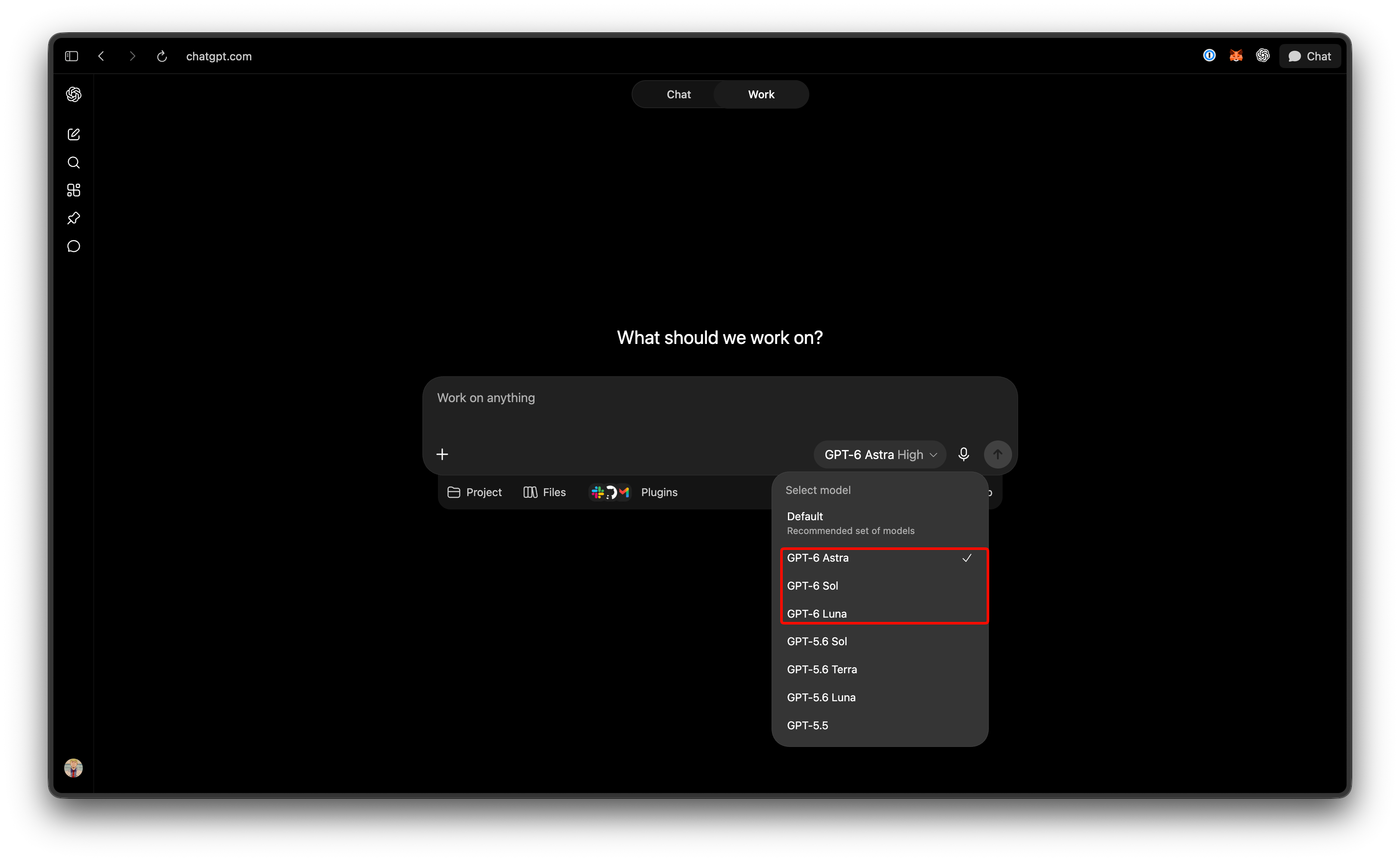
Unpacked into a table:
| Surface | GPT-6 Luna | GPT-6 Sol |
|---|---|---|
| ChatGPT desktop app, Free plan | Yes | No |
| ChatGPT desktop app, Go plan | Yes | No |
| ChatGPT Work (Plus, Pro, Business, Enterprise, Edu) | Yes | Yes |
| Codex (Plus, Pro, Business, Enterprise, Edu) | Yes | Yes |
| Chat | Not yet | Not yet |
API (gpt-6-luna, gpt-6-sol) |
Pay per token | Pay per token |
Two details in that table are easy to misread. First, “desktop app” is a specific surface, not a synonym for ChatGPT. If you open ChatGPT in a browser on the free plan and do not see Luna in the model picker, that is the documented behavior, not a rollout bug. Install the desktop client.
Second, “not yet available in Chat” is OpenAI’s own phrasing, which implies the surface is coming rather than excluded by design. Treat it as a date nobody has announced. Nothing in the launch post commits to when.
OpenAI also did not publish message caps, rate limits or session limits for free-plan Luna access. Assume it is metered the way every free ChatGPT tier has been metered, and do not build a workflow that depends on an unstated allowance holding steady.
What the free tier does not include
The honest version of a free-access article spends as much time on the gaps as on the route.
GPT-6 Sol is not free. Sol sits at $2 per million input tokens and $10 per million output, with an 872,000 token context window and a higher Artificial Analysis Intelligence Index (48 against Luna’s 37). It requires Plus, Pro, Business, Enterprise or Edu. If your task genuinely needs Sol, see what GPT-6 Sol is and what it costs before assuming a free workaround exists. There isn’t one.
Codex is not free. The coding agent surface is on the same paid tier list. Free-plan Luna access is the desktop chat client, not an agent with repository access.
API access is not free. Calling gpt-6-luna programmatically bills per token from the first request. New OpenAI accounts and cloud marketplace promotions sometimes carry starter credits, and those are worth spending on measurement rather than production traffic, but the balance runs down and then stops. There is no free unlimited API tier for Luna, and no proxy, key pool or reseller can legitimately grant one.
GPT-6 Astra is a different tier entirely. At $10 per million input and $50 per million output, Astra is the model OpenAI says “continues to be our best model across the board.” It is not part of the free route in any form.
What you are actually getting for free
Luna is priced like a budget tier. It does not benchmark like one, which is the whole reason this free route is interesting.
On DeepSWE 1.1, Luna at max reasoning scores 66.6%, which OpenAI puts in the same band as Claude Opus 5 and Claude Fable 5 at medium effort, at 93% less cost per task than Opus 5 and 96% less than Fable 5. On OSWorld 2.0 offline, Luna at max beats GPT-5.6 Sol at medium for roughly a tenth of the cost. On AutomationBench 1.0.6, Luna at high effort beats its predecessor by 5.4 percentage points at 58% lower cost per task. On factuality, Luna at higher effort matches GPT-5.6 Sol while costing about a hundredth as much.
Those are vendor-published figures, and cost-per-task comparisons always favor the model the vendor is launching. Read them as a claim to test rather than a settled result. The direction, though, is consistent across four different evaluations: the cheap tier moved into territory that used to require the expensive one.
The 1 million token context window is a model specification, and OpenAI publishes it for the API. How much of it the free desktop tier actually exposes is not documented anywhere in the launch material, so treat a full-repository paste as something to test rather than something to plan around. Luna’s window is larger than Sol’s, which is one of the few places where the cheaper model in the family wins outright. What GPT-6 Luna is has the full specification table.
One caution from third-party measurement: cheap is not fast. Artificial Analysis clocks Luna’s max reasoning variant at 153.9 output tokens per second with a 124 second time to first token [VERIFY]. In a desktop chat window that reads as a long pause before anything appears. It is not a hang.
The paid ChatGPT path
If the desktop app is too narrow a surface, the next rung is a paid ChatGPT plan, which unlocks both models across ChatGPT Work and Codex. Plus, Pro, Business, Enterprise and Edu all qualify. That is a product decision rather than a cost-optimization one, and it does not change what Luna itself costs you per task, because subscription surfaces are metered by allowance rather than billed per token.
The moment you want Luna inside your own software, the calculation changes completely.
The API path, and what it costs
The model ID is gpt-6-luna. Pricing is $0.10 per million input tokens and $0.50 per million output tokens, with a 90% discount on cached input reads.
Put that against the previous generation. OpenAI describes Sol and Luna as 50% cheaper than GPT-5.6 promotional pricing, and that qualifier is OpenAI’s own word, not a hedge added here. The promotional rate for GPT-5.6 Luna was $0.20 / $1.20. The list rate our own launch coverage documented at the time was $1 / $6. Measured against list, GPT-6 Luna’s $0.10 / $0.50 is a 90% cut on input and 92% on output:
| GPT-5.6 Luna list | GPT-5.6 Luna promo | GPT-6 Luna | |
|---|---|---|---|
| Input per 1M | $1.00 | $0.20 | $0.10 |
| Output per 1M | $6.00 | $1.20 | $0.50 |
The headline understates the move, because the headline is measured against a discount. Our GPT-5.6 pricing coverage has the older table, and the September 2026 model price war puts all three launches side by side.
The cheapest way to run Luna at volume
At a tenth of a cent per thousand input tokens, the instinct is to stop optimizing. That instinct is wrong at scale: OpenAI’s own disclosure puts median internal coding-agent spend above $600 per researcher per day, with the 90th percentile at $7,000. Volume finds a way.
Three levers do the work.
Cache everything stable. GPT-6 shipped with a substantial prompt caching release, not just a price: 90% off cached input reads, higher hit rates by default, explicit breakpoints so you choose where a cached prefix ends, a Prompt Caching Dashboard, and a diagnostics tool. The single most useful change is that altering reasoning effort or tool availability no longer invalidates the cache, which removes the old penalty for routing the same prefix through different effort levels. GitHub reports more than 50% fewer prompt tokens needing fresh processing across billions of requests. The GPT-6 caching release covers the mechanics.
Watch output, not input. Output bills at five times input. A verbose response format costs more than a large context window. Constrain the schema, cap max_tokens, and stop paying for prose you parse away.
Route by tier, not by habit. Luna at $0.10 / $0.50, Sol at $2 / $10, Astra at $10 / $50. That is a 100x spread on input. Most pipelines have one step that needs the top tier and a dozen that do not. Choosing between Luna, Sol and Astra works through where the line falls, and Luna at high request volumes has the arithmetic at real QPS.
All three levers are verifiable in a single HTTP response, which is where an API client earns its place. In Apidog, save the gpt-6-luna request with your key held in an environment variable, duplicate it across reasoning effort levels, and read the token counts and cached-read fields back from each response. You get the real cost per call instead of an estimate, and an assertion on those fields catches the day a prompt change quietly breaks your cache prefix.
Which path fits you
| Goal | Path | The catch |
|---|---|---|
| Try Luna at no cost | ChatGPT desktop app, Free or Go plan | Desktop only, not Chat, unstated limits |
| Use Sol or Codex | Plus, Pro, Business, Enterprise or Edu | Sol has no free route |
| Build on Luna | API, gpt-6-luna |
Billed per token from request one |
| Cheapest at volume | Caching plus output discipline plus tier routing | Caching needs a stable prefix |
| Lowest latency | Lower reasoning effort | Max effort has a long time to first token |
FAQ
Is GPT-6 Luna free? Yes, on the ChatGPT desktop app for Free and Go plan users. It is not in Chat yet, and the free plan does not include Codex or API access.
Is GPT-6 Sol free? No. Sol requires Plus, Pro, Business, Enterprise or Edu, in ChatGPT Work or Codex, or an API key.
Can I get free GPT-6 Luna API access? Only through new-account or cloud promotional credits, which have a finite balance. There is no free unlimited API tier.
Why is the free model slow to respond? At max reasoning effort, third-party measurement puts time to first token above two minutes [VERIFY]. Lower effort levels respond faster.
What is the cheapest way to run Luna in production? Cache the stable prefix for 90% off input reads, constrain output because it bills at five times input, and reserve Sol and Astra for the steps that genuinely need them.