Replit DataCat is an open-source, self-hosted observability platform that Replit released on GitHub in November 2026. It collects metrics, logs and distributed traces over OpenTelemetry (OTLP/HTTP) or the Datadog Agent intake API, stores them in PostgreSQL or ClickHouse, and gives you dashboards, an APM trace waterfall and alerting monitors. It’s Apache-2.0 licensed and needs no hosted account.
If you run APIs, Replit DataCat gives you a free way to see every request as a trace on hardware you control. This guide covers what it is, how to run it, which storage to pick, and how to pair it with API tests.
What is Replit DataCat?
Replit DataCat is a single-process observability server: one Node.js process serves the API, the web UI, the agent installer and the downloads. You send it telemetry with OpenTelemetry SDKs, the OpenTelemetry Collector, the Datadog Agent or DataCat’s own Node.js and Python libraries, and you query it in a browser.
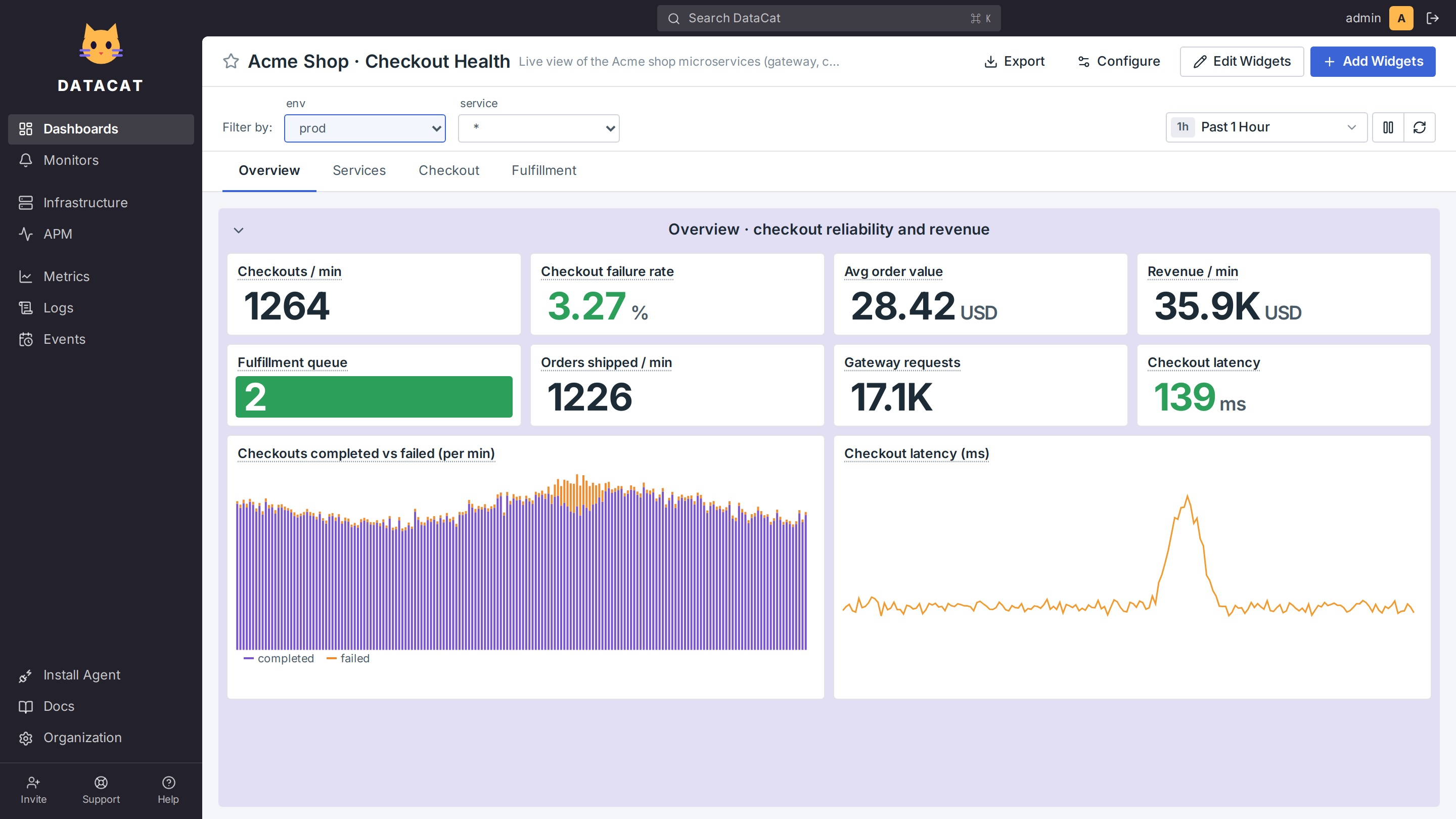
The replit/datacat repository was created on November 17, 2026, is written in TypeScript, and had 557 stars when it trended on GitHub on November 23. The changelog lists 0.1.0 as the first public release, still marked unreleased, so treat it as early software.
Here’s what ships in that first release, per the README:
- Metrics: a metrics explorer with formulas, dashboards and host maps
- Logs: search with facets, live tail and trace correlation
- APM: a service catalog, trace explorer and trace waterfall
- Monitors: metric, log and trace alerts with webhook and Slack notifications
- Access: organizations, local email and password accounts, single-use invites, API and application keys
- Collection: a host agent built on the OpenTelemetry Collector, plus Node.js and Python instrumentation libraries
DataCat says plainly that it is an independent project, not affiliated with Datadog. It names Datadog only to describe protocol compatibility.
How DataCat works: OpenTelemetry in, Postgres or ClickHouse out
DataCat has three layers: senders, one server, and storage.
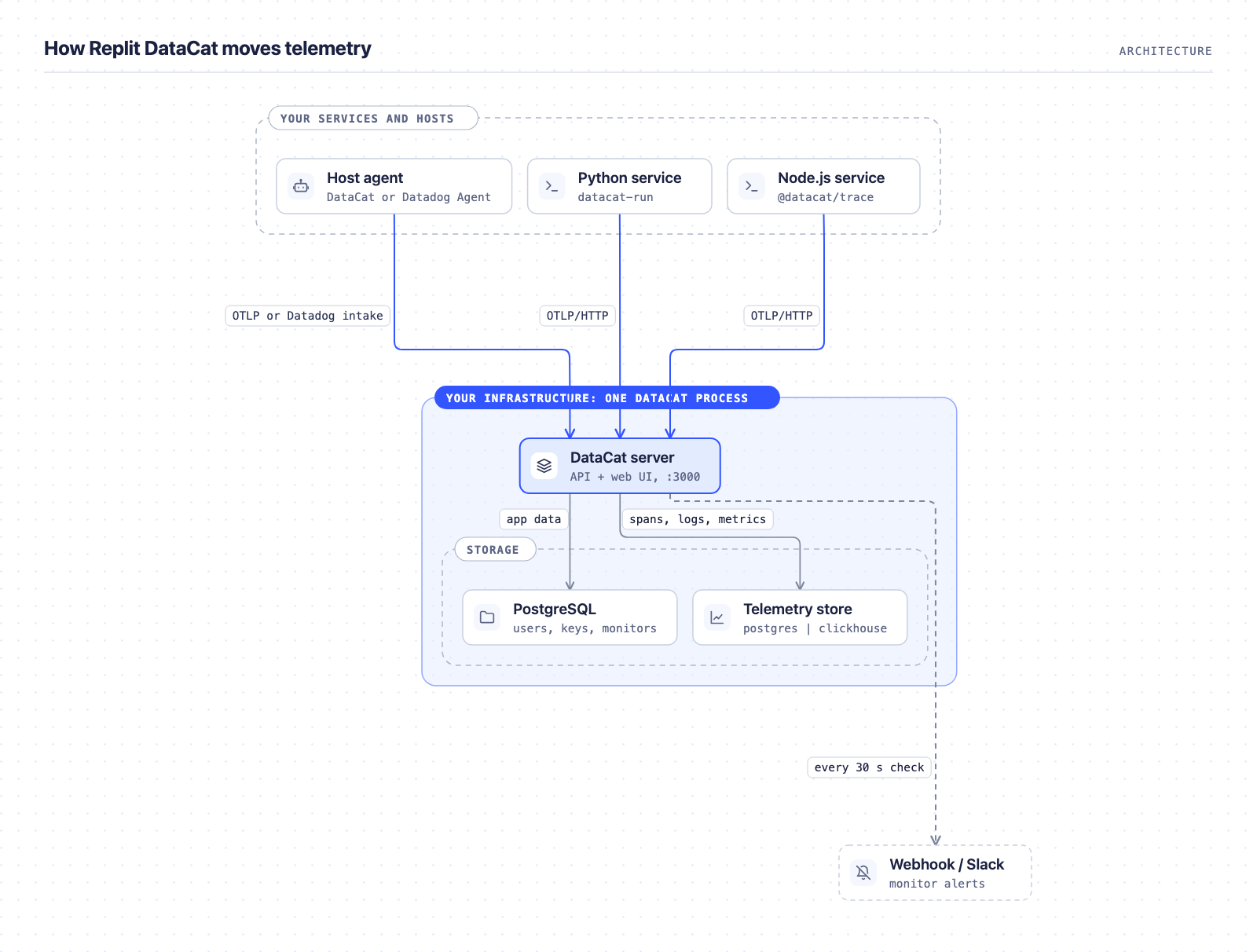
Intake. DataCat accepts OTLP over HTTP at /v1/traces, /v1/metrics and /v1/logs (also under /otlp/v1/*), plus the Datadog public intake API. The README lists Datadog Agent 7.56.2 and 7.85.4 as tested. Versions 7.57 to 7.84 weren’t tested one by one; if an agent sends a trace format DataCat can’t read, it gets a 422 instead of a silent 202.
Agent or agentless. The Node.js library exports to a local agent at http://localhost:4318 by default. Without an agent, you set DATACAT_URL and DATACAT_API_KEY, and signals go to /otlp/v1/{traces,metrics,logs} with a DC-API-KEY header.
Storage. Users, organizations, API keys, monitors and dashboards always live in PostgreSQL. Spans, logs and metrics go to PostgreSQL (the default) or ClickHouse, set by DATACAT_STORAGE.
Redaction. This matters for API teams. DATACAT_REDACTION is on by default and masks card numbers, bearer tokens, JWTs, AWS keys, private keys and secret-named attributes in logs and spans before storage. That’s useful when your spans carry request headers.
How to self-host DataCat with Docker Compose
You need Docker Engine with the Compose plugin, Git and OpenSSL. These are the README’s steps:
- Clone the repo and copy the env file.
- Generate a Postgres password and a session secret.
- Lock down the env file and create the downloads folder.
- Start the stack.
git clone https://github.com/replit/datacat
cd datacat
cp .env.example .env
sed -i "s/^POSTGRES_PASSWORD=.*/POSTGRES_PASSWORD=$(openssl rand -hex 24)/" .env
sed -i "s/^SESSION_SECRET=.*/SESSION_SECRET=$(openssl rand -hex 32)/" .env
chmod 600 .env
mkdir -p downloads
docker compose up -d --build
On macOS, BSD sed needs sed -i '' instead of sed -i.
Open http://localhost:3000, create the admin account and organization, then create an API key under Organization Settings. Setup asks for a setup token, which the server prints in its log:
docker compose logs datacat | grep "setup token"
Set PUBLIC_URL to your HTTPS origin before you invite teammates or install agents on other hosts. Telemetry retention defaults to 15 days (DATACAT_RETENTION_DAYS). If you’d rather skip Docker, the source build needs Node.js 22.15+, pnpm 10.11.0 and PostgreSQL 14+, and the server migrates its own schema on startup.
Instrument an API service
Install the Node.js library from your DataCat instance’s downloads folder, then start your service with it preloaded. The self-hosting guide shows this agentless form:
DATACAT_SERVICE=checkout DATACAT_URL=https://observe.example.com \
  DATACAT_API_KEY="$YOUR_API_KEY" node -r @datacat/trace/init app.js
Initialize it before you import frameworks and loggers. Pino, Winston and Bunyan logs ship with trace IDs attached; console.log doesn’t ship. Python works the same way with Python 3.10+ and the datacat-run wrapper:
DATACAT_SERVICE=checkout DATACAT_URL=https://observe.example.com \
  DATACAT_API_KEY="$YOUR_API_KEY" datacat-run python app.py
Already on OpenTelemetry? Point your existing exporter or OpenTelemetry Collector at DataCat’s OTLP/HTTP endpoints and keep your instrumentation as it is. Then confirm services in APM, records in Logs and metrics in Metrics Explorer.
To alert on a broken API, create a webhook channel under Organization Settings, Notification Channels, write a monitor query, and add @webhook-<name> to the monitor message. The evaluator checks every 30 seconds and sends JSON with the monitor, state, value and tags. Email delivery isn’t implemented yet; Slack and webhooks are.
PostgreSQL vs ClickHouse: which storage to pick
The project measured both backends on 102 million spans. Here’s the comparison from its self-hosting guide:
| PostgreSQL (default) | ClickHouse | |
|---|---|---|
| What you run | PostgreSQL only | PostgreSQL + ClickHouse |
| Best for | Small and medium installs | Large volumes, long time ranges |
| Disk for 102M spans | 63.7 GB | 4.6 GB |
| 7-day aggregations | Seconds to minutes; some pages run out of memory | 9 to 20 times faster |
| Narrow lookups (one service’s errors) | Milliseconds | Hundreds of ms |
| Retention | Hourly deletes of expired rows | Table TTLs that drop whole days |
Start with PostgreSQL if you have a handful of services. Pick ClickHouse when you need weeks of history or high span volume. Decide before you send data: switching storage later starts with empty telemetry and doesn’t move what’s already stored. With Compose, set DATACAT_STORAGE=clickhouse and a CLICKHOUSE_PASSWORD, then run docker compose --profile clickhouse up -d --build.
Where observability stops and API testing starts
DataCat tells you what your API did. It doesn’t tell you what your API should do. A trace shows that POST /orders took 840 ms and returned a 200; it can’t tell you the response body dropped a required field. That’s the gap between API observability and testing, and you need both.
A test run sends known requests with known assertions; DataCat records what each one did inside your services. When a test fails, its trace shows which downstream call broke. If you’re comparing broader API monitoring approaches, this pairing gives you active checks and passive traces from one workflow.
Let your coding agent test the API with Apidog CLI
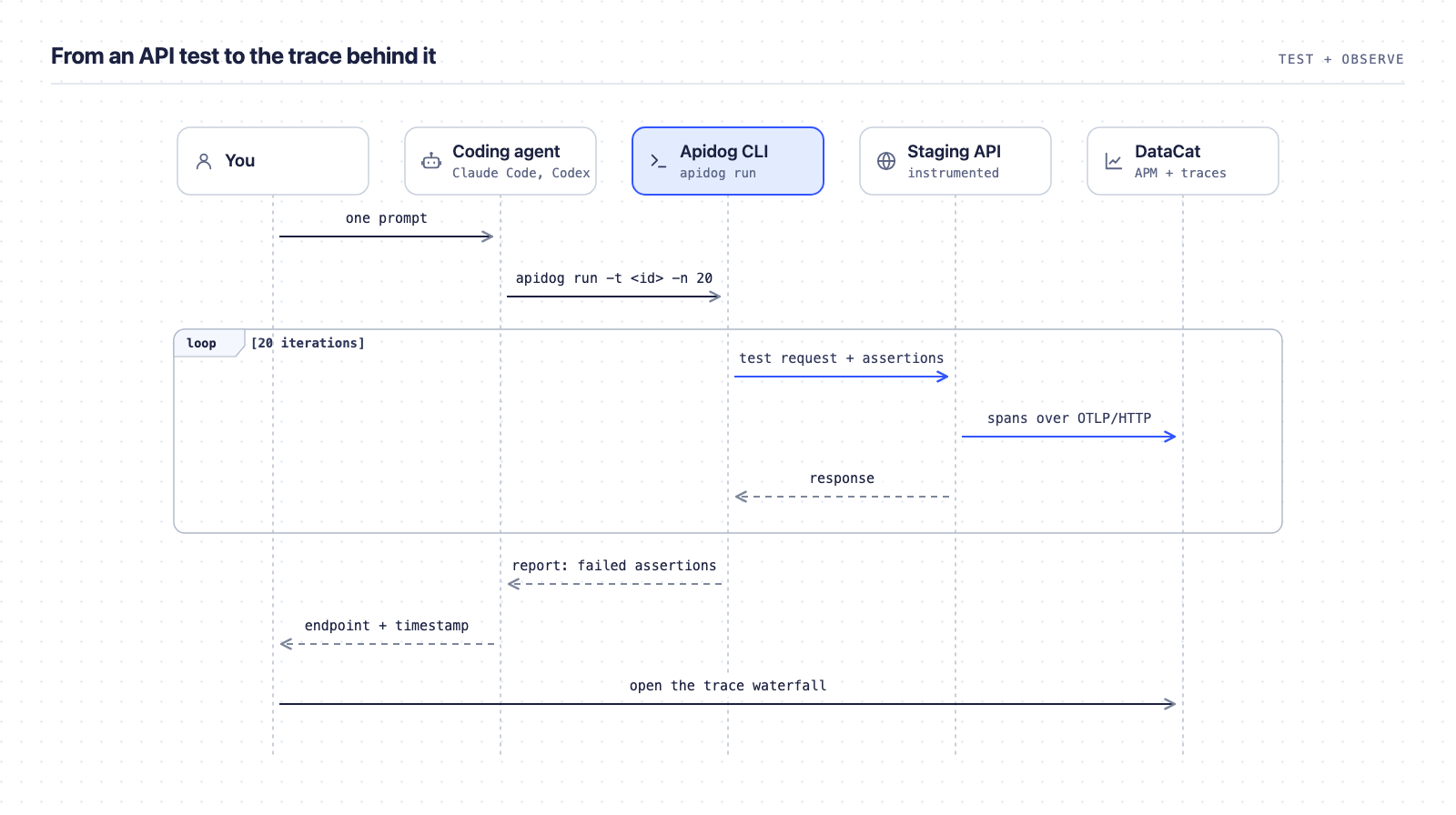
You don’t need to write that test suite by hand. Give your coding agent (Claude Code, Codex, Cursor) the Apidog CLI and one prompt, and it builds the scenario, runs it against staging, and tells you what failed. The traffic lands in DataCat as traces you can open by service and time.
Set it up once:
npm install -g apidog-cli@latest
apidog login --with-token <YOUR_TOKEN>
npx -y skills add https://apidog.com   # pick your agent when prompted
Then give your agent one prompt:
In Apidog project <projectId>, list the endpoints and environments, build a
"Checkout smoke" test scenario from the order endpoints, run it 20 times against
the Staging environment, and summarize any failed assertions with the endpoint
and timestamp so I can find the trace in DataCat.
The agent reads the project, creates the scenario, imports the endpoints as steps and runs it:
apidog endpoint list --project <projectId>
apidog environment list --project <projectId>
apidog test-scenario create --project <projectId> --name "Checkout smoke" --folder-id 0 --priority 1
apidog test-scenario import-steps <scenarioId> --project <projectId> --source endpoint --ids <endpointIds> --sync manual
apidog run -t <scenarioId> --project <projectId> -e <stagingEnvId> -n 20 -r cli,junit
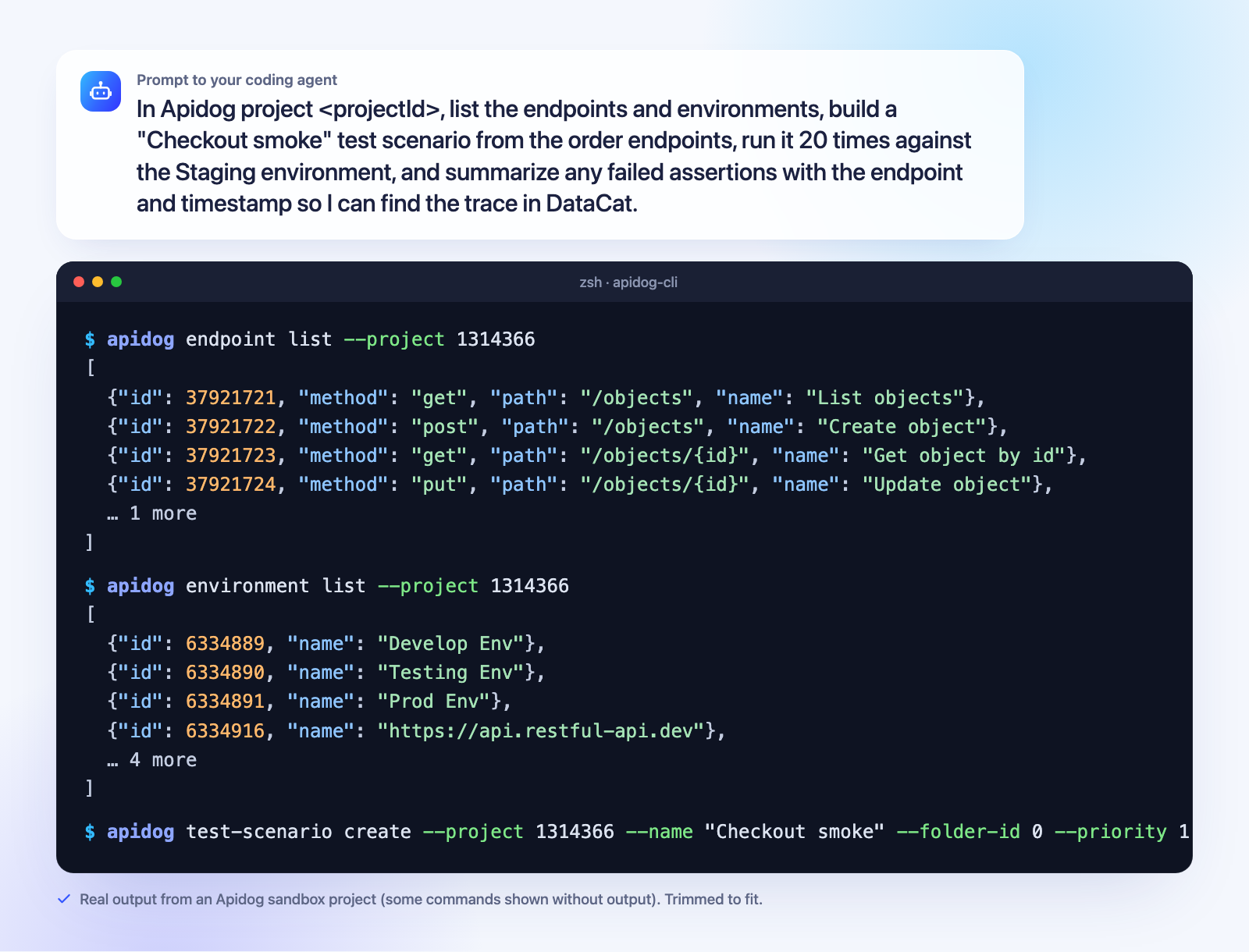
The -n 20 flag repeats the scenario 20 times, so DataCat gets enough spans to show a latency spread, not a single sample. The same apidog run ... -r junit line drops into a deploy pipeline; the Apidog CLI CI/CD guide shows GitHub Actions and GitLab setups, and the Claude Code walkthrough covers the agent side in more depth. Apidog’s Free plan covers up to 4 users.
Limits to know before you adopt it
DataCat is a week-old public release, so check these before you move production traffic:
- Version: the changelog marks 0.1.0 as the first public release and still unreleased.
- Sign-in: local email and password accounts with single-use invite links are what the README documents.
- Notifications: webhook and Slack channels only; email isn’t implemented.
- SDK runtimes: the Node.js library needs Node 22.15+; the Python library needs Python 3.10+.
- Datadog Agent coverage: 7.56.2 and 7.85.4 are tested; versions in between weren’t tested individually.
- Storage switch: changing from PostgreSQL to ClickHouse later doesn’t migrate existing telemetry.
On the plus side, the repo ships benchmark kits under bench/ with raw results in bench/evidence/, so you can rerun the numbers on your own hardware.
Conclusion
Replit DataCat gives you metrics, logs, traces, dashboards and alerts on your own servers, fed by OpenTelemetry or the Datadog Agent, stored in PostgreSQL or ClickHouse, under Apache-2.0. Run it with Docker Compose, instrument one API service, and start on PostgreSQL. Then add the other half: tests that say what your API should return. Let your coding agent build and run them with Apidog CLI, and use DataCat’s traces to see why a failure happened. Download Apidog to start free.
FAQ
Is Replit DataCat free? Yes. DataCat is open source under the Apache License 2.0, and you run it on your own infrastructure. There’s no hosted account. Your cost is the servers, PostgreSQL and, optionally, ClickHouse.
Does DataCat support OpenTelemetry? Yes. It accepts OTLP over HTTP at /v1/traces, /v1/metrics and /v1/logs, so the OpenTelemetry Collector and SDKs can send to it directly. Its own host agent is an OpenTelemetry Collector distribution.
Can I send Datadog Agent data to DataCat? Yes. DataCat accepts the Datadog public intake API. The README lists Datadog Agent 7.56.2 and 7.85.4 as tested for metrics, logs, check runs and traces.
Should I use PostgreSQL or ClickHouse with DataCat? Use PostgreSQL for small and medium installs with fewer moving parts. Use ClickHouse for large volumes and long time ranges: in the project’s test it stored 102 million spans in 4.6 GB against 63.7 GB on PostgreSQL.
Is DataCat a Datadog replacement? It covers similar ground (metrics, logs, APM, monitors) and accepts Datadog Agent traffic, but it’s an independent, early project not affiliated with Datadog.
How do I test APIs that DataCat monitors? Use an API testing tool that runs assertions against your endpoints. With Apidog CLI, your coding agent can build a test scenario and run it with apidog run, and DataCat records each request as a trace.