
Gemini 4 Neon is Google’s new middle model in the Gemini 4 family, released on November 18, 2026, for complex coding, analysis and enterprise workflows that run often. It costs $3 per million input tokens and $15 per million output tokens, shares a 1M-token context window with its output, offers four thinking levels and is available only on the paid Gemini API tier.
If Hydrogen feels too light for your hard steps and Carbon too heavy to run all day, Neon is Google’s answer. Here’s what shipped, where it fits and what’s still unclear.
What is Gemini 4 Neon?
Gemini 4 Neon (gemini-4-neon) is the balance tier of Google’s Gemini 4 family. Google describes it as “frontier-level intelligence with fast end-to-end task completion” for software engineering, knowledge work and science. It sits between Gemini 4 Hydrogen, the fast everyday model, and Gemini 4 Carbon, the model for your hardest long-horizon projects.
The quick facts, from Google’s launch post and the AI Studio model page:
| Spec | Gemini 4 Neon |
|---|---|
| Model ID | gemini-4-neon (stable) |
| Released | November 18, 2026 |
| Input | Text, image, video, audio, PDF |
| Output | Text only |
| Context window | 1,048,576 tokens, shared by input and output |
| Max output | 65,536 per request, up to 1,048,576 with long decode |
| Thinking levels | low, medium, high (default), xhigh |
| Price (standard) | $3.00 input, $15.00 output per 1M tokens |
| Cached input | $0.15 per 1M tokens (implicit caching only) |
| Free API tier | No |
It supports function calling, structured outputs, code execution, computer use, file search, URL context, and grounding with Google Search and Google Maps. It doesn’t generate images or audio, and it isn’t available on the Live API.
Gemini 4 Neon vs Carbon vs Hydrogen
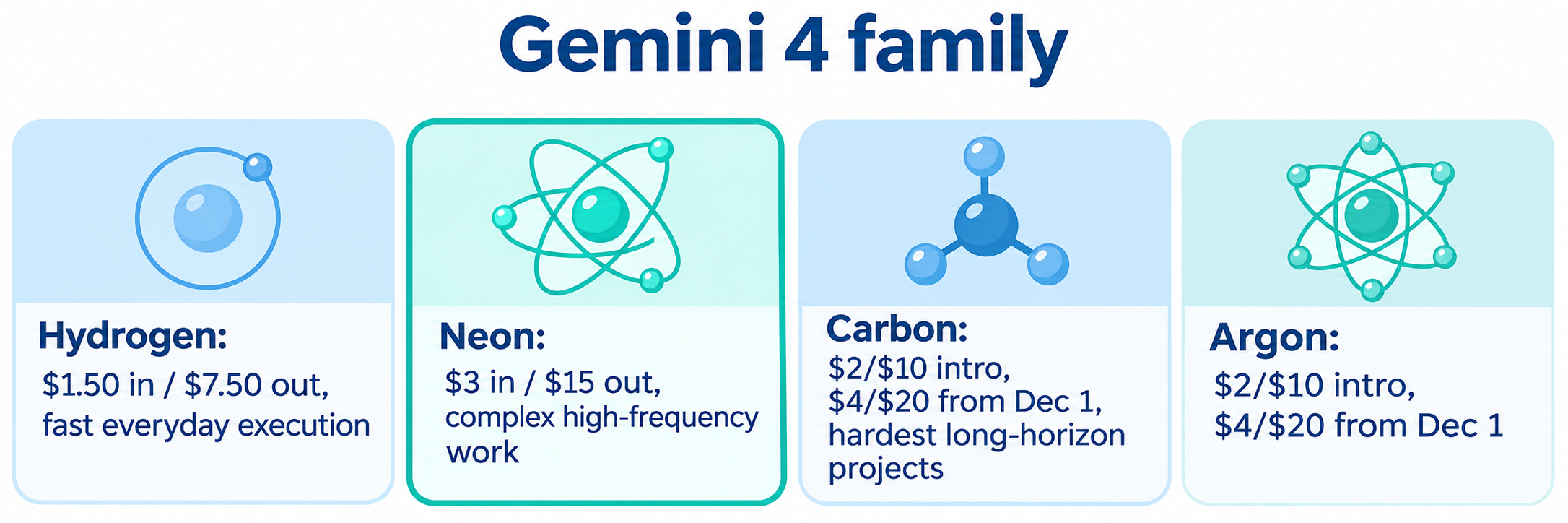
The short version: Hydrogen for volume, Neon for complex work you run often, Carbon for the hardest single problems. Google’s What’s new in Gemini 4 Neon guide puts it this way: use Neon for complex engineering and analytical work, Carbon for your hardest architecture, debugging, science and security problems, and keep Hydrogen as the default for everyday coding and agents.
| Model | Input / output per 1M tokens | Best for |
|---|---|---|
| Gemini 4 Hydrogen | $1.50 / $7.50 | Fast everyday coding and agent steps |
| Gemini 4 Neon | $3.00 / $15.00 | Complex, high-frequency coding and analysis |
| Gemini 4 Carbon | $2 / $10 intro, $4 / $20 from Dec 1 | Hardest long-horizon projects |
| Gemini 4 Argon | $2 / $10 intro, $4 / $20 from Dec 1 | Earlier Gemini 4 frontier model |
The pricing looks odd for a few more days. Until November 30, Carbon’s introductory rate is below Neon’s list price. From December 1, Carbon doubles to $4/$20 (see our Gemini 4 Carbon pricing breakdown), and Neon becomes the cheaper of the two per token.
Per token isn’t the whole story. Google says Neon at high costs 32% less per task than Carbon because it finishes in fewer steps. Artificial Analysis measured roughly 17% lower cost per task. Test your own prompts before trusting either number.
Gemini 4 Neon thinking levels
The thinking level is your main dial for quality, latency and cost. Neon defaults to high, and Google recommends you start there:
low: fewest tokens and lowest latency, for fast chat and high-throughput processing.medium: interactive coding, live UI prototyping and latency-sensitive tool calls.high(default): complex coding, agent execution, tool calling and multimodal knowledge work.xhigh: the hardest multi-step engineering, analytical and scientific problems, at higher latency and token spend.
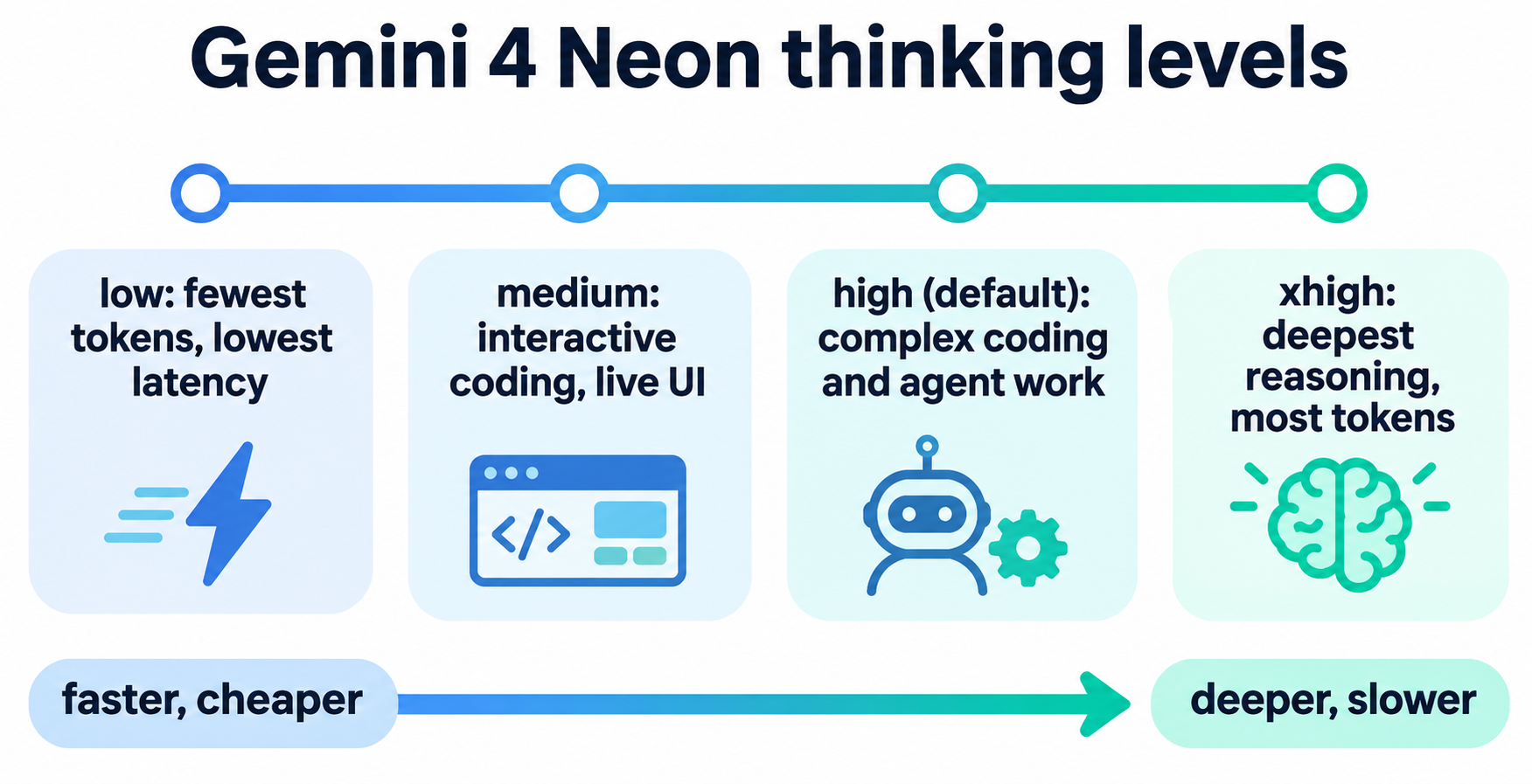
Google’s advice: evaluate at all four levels with a high max_output_tokens, then pick the lowest level that meets your bar. Thinking tokens bill as output at $15 per million.
Two migration gotchas from the Google Cloud developer guide: the MINIMAL level from older Flash models isn’t supported, and the old thinking_budget parameter returns an HTTP 400 instead of mapping silently. Custom temperature, top_k and top_p values are ignored, and frequency_penalty or presence_penalty return a 400.
Gemini 4 Neon benchmarks
All the numbers below come from Google’s launch post, which cites several third-party leaderboards. Independent runs on your own workload matter more, but these show where Google is aiming the model:
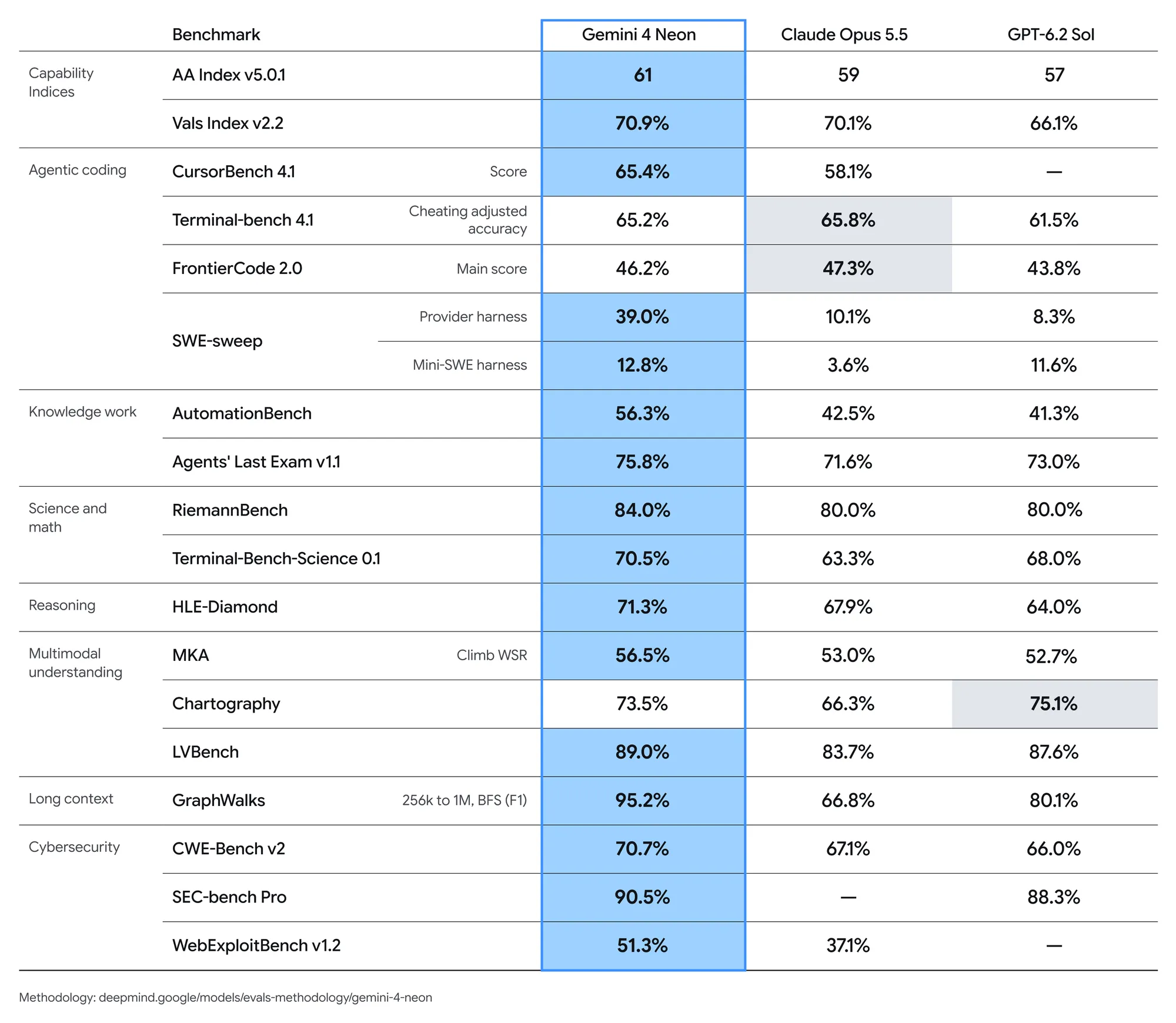
Neon is tuned for agent work. Google says it cuts redundant file reads, handles context compaction in long sessions and posted its lowest fabrication rate yet in internal Antigravity testing.
Where Neon isn’t first: on the Artificial Analysis Intelligence Index, Google itself says Neon lands just behind larger, slower models. Vals AI put Neon 0.4 points behind Claude Fable 5.2 on its index, at less than half the cost per task. For a neutral view, check Artificial Analysis as more independent runs land.
Where you can use Gemini 4 Neon today
Neon rolled out on launch day across five surfaces:
- Gemini API (paid tier) in Google AI Studio and Android Studio, on both
generateContentand the Interactions API. - Gemini Enterprise Agent Platform on Google Cloud, at the
globalendpoint and theusandeumulti-regions. Google says it’s available to verified enterprise customers in select regions. - Google Antigravity for paid Google AI Pro and Ultra subscribers, where it can orchestrate parallel Hydrogen subagents.
- Gemini app for Pro and Ultra subscribers, where it now powers Tasks.
- Gemini for business through the API and the model dropdown.
There’s no free API tier: Google’s pricing page lists every Neon line as “Not available” under Free. Pro and Ultra subscribers can try it in AI Studio. A cyber defense variant goes to trusted defenders through Google’s Fairwind Program over the coming days.
Batch and Flex inference cut the price in half, to $1.50 input and $7.50 output per million tokens, if your jobs can wait.
Neon as an orchestrator
Neon inherits the planner-and-worker pattern Google introduced with Hydrogen. You plan or verify a workflow with gemini-4-neon, then pass previous_interaction_id to gemini-4-hydrogen so the cheaper model runs individual steps. Google’s Cloud guide shows it with the Interactions API:
from google import genai

client = genai.Client()

plan = client.interactions.create(
    model="gemini-4-neon",
    input="Design a 3-step plan to migrate our REST order service to gRPC in Go.",
    store=True,
)

step = client.interactions.create(
    model="gemini-4-hydrogen",
    input="Implement step 1 (.proto service definition) from the plan.",
    previous_interaction_id=plan.id,
)
print(step.output_text)
Neon spends $15 per million output tokens on judgment; Hydrogen spends $7.50 on execution. Our Gemini 4 Hydrogen orchestrator guide covers the Carbon version of this loop.
Limits and open questions
A few things to know before you move production traffic:
- No explicit caching. Only implicit caching applies, on shared prompt prefixes of 4,096 tokens or more. If you built on
cached_contentwith an older model, that call needs rewriting. - Long outputs need continuation. One request returns up to 65,536 tokens. Past that you use long decode, with background execution or a continuation loop; direct REST calls need the
v1beta1path on Google Cloud. - Every token bills. Thinking tokens, plus the internal tool instructions and function declarations Google adds when you use grounding, count toward your bill.
- Region change for some Argon users. If you ran
gemini-4-argonineurope-west2orasia-southeast1, switch toglobal,usoreu. - Rate limits. Check your tier on the Gemini API rate limits page before you plan throughput.
Test Gemini 4 Neon with Apidog CLI and your coding agent
The real question is whether Neon earns its price over Hydrogen on your prompts. Let your coding agent answer it with a repeatable test. This request follows Google’s documented Interactions API format; we haven’t live-run it for this post:
MODEL="${GEMINI_MODEL:-gemini-4-neon}"

curl -s "https://generativelanguage.googleapis.com/v1beta/interactions" \
  -H "x-goog-api-key: $GEMINI_API_KEY" \
  -H "Content-Type: application/json" \
  -d "{\"model\": \"${MODEL}\", \"input\": \"Find the race condition in this retry queue.\", \"generation_config\": {\"thinking_level\": \"high\"}}"
Apidog CLI gives Claude Code, Codex, Cursor or OpenCode a command-line way to create and run API tests. Set it up once:
npm install -g apidog-cli@latest
apidog login --with-token <YOUR_TOKEN>
npx -y skills add https://apidog.com   # pick your agent when prompted
Then give your agent one prompt:
In Apidog project <id>, create an environment for the Gemini API with a MODEL
variable and a GEMINI_API_KEY variable. Add a test case for POST
/v1beta/interactions that sends the same coding prompt at thinking_level high,
asserts HTTP 200 and a non-empty output, and records response time and token
usage. Run it for gemini-4-neon and gemini-4-hydrogen and compare the results.
The agent creates the environment, validates the test case payload against its schema, then runs it once per model:
apidog environment create gemini-api --project <id> --base-url https://generativelanguage.googleapis.com
apidog cli-schema get test-case-create
apidog cli-schema validate test-case-create --file case.json
apidog test-case create --project <id> --file case.json
apidog run --test-case <caseId> --project <id> -e <envId> --env-var "MODEL=gemini-4-neon" -r cli,json
apidog run --test-case <caseId> --project <id> -e <envId> --env-var "MODEL=gemini-4-hydrogen" -r cli,json
Put the same apidog run ... -r junit into CI with the Apidog CLI CI/CD guide, or start from Apidog CLI in Claude Code. Apidog’s Free plan covers up to 4 users.
FAQ
When was Gemini 4 Neon released? November 18, 2026, the same day it rolled out in the Gemini API, AI Studio, Antigravity and the Gemini app.
How much does Gemini 4 Neon cost? $3 per million input tokens, $15 per million output tokens (thinking included) and $0.15 per million cached input tokens. Batch and Flex cost half: $1.50 and $7.50.
Is Gemini 4 Neon free? Not on the API. Google lists no free tier for Neon. Google AI Pro and Ultra subscribers can use it in AI Studio, the Gemini app and Antigravity as part of their plan.
Is Gemini 4 Neon better than Gemini 4 Carbon? For most frequent, complex work, Google says Neon matches or slightly beats Carbon at a 32% lower cost per task. Google still points you to Carbon for its hardest architecture, debugging, science and security problems.
What’s the model ID for Gemini 4 Neon? gemini-4-neon. It’s a stable ID on both the Gemini API and Google Cloud’s Gemini Enterprise Agent Platform.