MACH architecture has nothing to do with the Mach number (a measure of speed) or the Mach kernel that sits under GNU Hurd; it’s an acronym for building enterprise software out of replaceable parts. MACH stands for Microservices, API-first, Cloud-native, and Headless, and it’s promoted by the MACH Alliance, a nonprofit industry body formed in 2020. This guide defines each pillar in plain English, compares MACH to the monolith and SOA approaches it replaces, and shows where it fits, including a look at the API platform you’d use for a microservices estate.
What MACH actually means
MACH is a set of design principles, not a product you can buy. Each letter names one principle, and a system only counts as MACH when it follows all four. The MACH Alliance is strict about that: showing one or two traits doesn’t qualify.
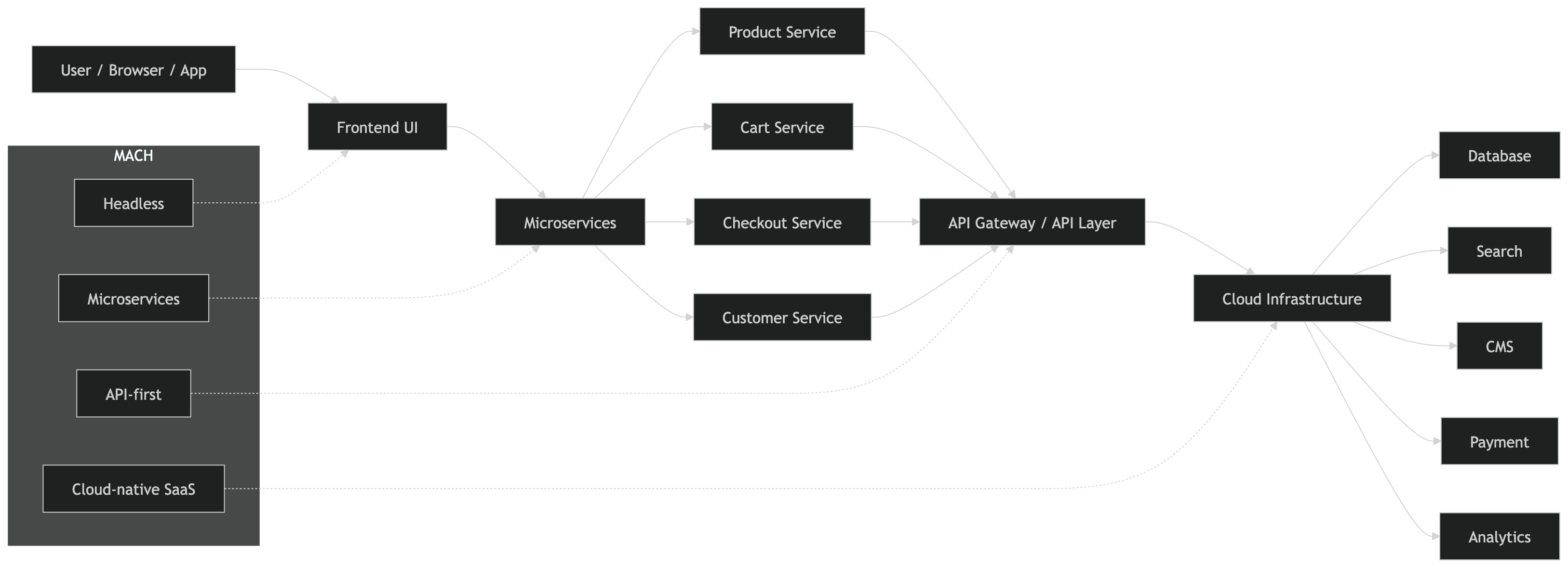
Here’s the acronym at a glance.
| Letter | Principle | What it means |
|---|---|---|
| M | Microservices | Each business capability is its own independently deployable service |
| A | API-first | Every function is exposed through an API, designed before code |
| C | Cloud-native | Built to run as SaaS on cloud infrastructure, elastic and managed |
| H | Headless | The front end is decoupled from the back end and talks over APIs |
The idea is composability. Instead of one large product that does everything, you assemble best-of-breed services that each do one thing, and you swap any of them out without rebuilding the rest. That’s the same goal behind the broader “composable enterprise” movement; MACH is the technical recipe that makes composability possible.
Microservices
A monolith bundles every feature into one codebase and one deployment. Microservices break that apart. Your catalog, cart, search, and payment logic each become a separate service with its own data and its own release cycle. One team can ship the search service on Tuesday without touching the cart service at all.
The trade-off is operational complexity. You now run many services, many databases, and a lot of network calls between them. If you want the long version, see monolith application vs. microservices.
API-first
API-first means the API is the starting point, not an afterthought. You design the contract, the endpoints, the request and response shapes, before anyone writes the implementation. Every capability in a MACH system reaches the outside world through that API, so the contract becomes the actual product surface.
This is the pillar that most affects how teams work day to day, and it’s where tooling matters most. We come back to it below. For the principles, API-first development covers the ground.
Cloud-native
Cloud-native in the MACH sense leans hard toward SaaS. The components are built to run on cloud infrastructure and are usually consumed as managed services. You don’t patch servers or plan capacity for a traffic spike; the service scales elastically and the vendor handles updates. That’s different from “we lifted our old app into a VM in the cloud.” Cloud-native means the software was designed for that environment from the start.
Headless
Headless splits the presentation layer from the business logic. The back end has no built-in front end; it just serves data and operations through APIs. Your website, mobile app, smartwatch, kiosk, or voice assistant each consume the same APIs and render their own experience.
The payoff is reach. One back end can feed many front ends, and you can redesign the storefront without migrating the commerce engine underneath. A headless API becomes the product because it’s the only way in.
MACH vs. monolith vs. SOA
It helps to see where MACH sits against the patterns that came before it.
| Monolith | SOA | MACH | |
|---|---|---|---|
| Unit of deployment | One application | Coarse services on a bus | Fine-grained microservices |
| Integration | In-process calls | Enterprise service bus, often SOAP | Lightweight REST/GraphQL APIs |
| Front end | Coupled, server-rendered | Often coupled | Headless, fully decoupled |
| Hosting | Servers you manage | On-prem or hosted | Cloud-native SaaS |
| Swap a component | Rebuild and redeploy | Hard, bus-coupled | Replace one service |
A monolith is fast to start and simple to reason about, which is why it’s still the right choice for many small teams. SOA tried to decompose systems a decade earlier but often centralized everything on a heavy service bus, which became its own bottleneck. MACH keeps the decomposition idea and drops the bus, connecting services with plain APIs and pushing hosting to the cloud.
MACH is essentially the modern, cloud-era answer to the question SOA asked. If you want the wider map of styles, API architecture styles lays them out.
When to adopt MACH (and when not to)
MACH solves real problems, but it isn’t free. Adopt it when the constraints line up.
Good fit:
- You’re hitting the ceiling of a monolithic platform, and release cycles are slow because everything ships together.
- Multiple teams need to work in parallel without stepping on each other.
- You serve content or commerce to several channels (web, mobile, in-store) and want one back end behind all of them.
- You want to swap vendors for one capability without a full replatform.
Think twice when:
- You’re a small team with a simple product. The operational overhead of many services, pipelines, and contracts will slow you down more than a monolith would.
- You don’t have the platform skills yet. MACH assumes comfort with cloud infrastructure, CI/CD, and API design.
- Your traffic and team are stable and modest. The flexibility you’re paying for may never get used.
A common honest path is to start with a well-structured monolith, then peel off services as specific pain points appear. You don’t have to go full MACH on day one.
The tooling ecosystem
MACH is vendor-neutral by design, but a typical estate pulls from a few categories:
- Headless CMS for content, such as Contentstack or Contentful.
- Headless or composable commerce engines like commercetools.
- Search and personalization as separate API services.
- CDN and edge for cloud-native delivery, often paired with a Jamstack-style front end. Netlify’s Jamstack documentation is a useful reference for the decoupled front-end side.
- API gateways and identity to route, secure, and authenticate traffic across services.
The thread tying all of it together is the API. Every box in that list talks to the others over a contract, so the quality of those contracts decides whether the whole system holds up.
Where the API contract becomes the product
This is the “A” in MACH, and it’s the part you control most directly. In a headless, microservices system, nobody touches your service through a UI you built. They touch the API. So the contract is the product, and it needs the same care any product gets: design, mocks, tests, and docs.
Apidog is the API-quality layer for that work. It isn’t a CMS, a commerce engine, or a gateway, and it doesn’t “do” MACH or headless for you. It’s where you handle the contract itself:
- Design-first OpenAPI. You define each microservice’s contract in Apidog before implementation, so consuming teams agree on the shape up front.
- Mock servers. Apidog spins up mocks from the spec, so a front-end team can build against the cart API before the cart service exists. Decoupled teams stop blocking each other.
- Headless test execution. The Apidog CLI runs your API tests with no GUI, straight in CI, which is a fitting rhyme with a headless system: the contract is verified by machines, not clicked through by hand.
- MCP for agents. Through MCP, you can manage and query the API from your AI agent or IDE, so the contract stays reachable from the tools your team already lives in.
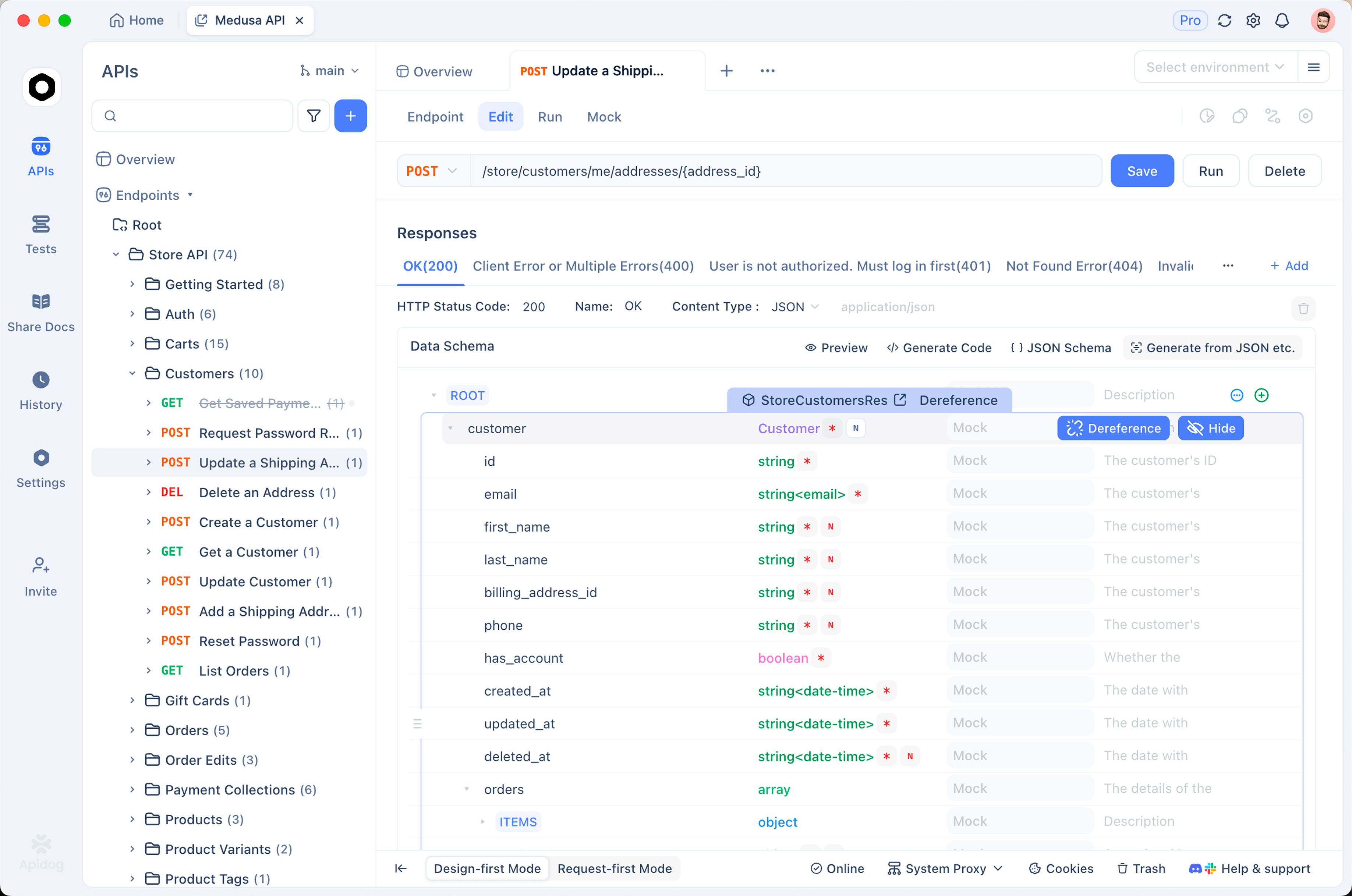
That keeps Apidog honest about its role. It owns the API-first pillar, so your services stay well-described, testable, and mockable across the estate. The same thinking shows up in API as a product, which is exactly the mindset MACH forces on you. Want to try it? Download Apidog and point it at one service’s spec.
Frequently asked questions
Is MACH the same as composable architecture?
They’re closely related but not identical. Composable architecture is the broader business idea: build your stack from interchangeable parts you can recombine. MACH is the specific technical pattern (microservices, API-first, cloud-native, headless) that makes composability achievable. You can think of MACH as the engineering blueprint for a composable enterprise.
Do I need to be a MACH Alliance member to use MACH?
No. The MACH Alliance is a nonprofit that certifies vendors against the four principles, which helps buyers spot genuinely composable products. You can build a MACH system entirely from non-member tools, or even your own services. The principles are open; membership is a vendor certification, not a license to use the pattern.
How is MACH different from a regular microservices setup?
Microservices is one of the four MACH pillars, not the whole thing. A microservices back end with a tightly coupled front end and on-prem hosting isn’t MACH. MACH adds the API-first discipline, the cloud-native SaaS model, and the headless decoupling on top. If you’re choosing infrastructure for services, how to choose an API platform for microservices walks through what to weigh.
Is MACH only for e-commerce?
It started in commerce, where swapping a checkout or search vendor without a replatform has obvious value, but the pattern applies anywhere you serve multiple channels from shared back-end logic. Media, banking, travel, and SaaS products all use MACH-style decoupling.
Bringing it together
MACH is a way to build software out of parts you can replace: microservices for independent deployment, API-first so every capability has a clean contract, cloud-native so it scales as SaaS, and headless so one back end feeds many front ends. It’s powerful when you have the scale and the teams to use it, and overkill when you don’t.
Whichever way you lean, the API contract is the load-bearing piece. When the contract is the product, design it well, mock it early, and test it in CI. Apidog gives you that API-quality layer so your MACH estate stays well-described from the first service to the last.