
Firecrawl Alexandria is a library of 430 data providers and 2,461 capabilities that your AI agent reaches with the same Firecrawl API key it already uses for search and scraping. Its People category holds 12 providers, including Apollo, People Data Labs and FullEnrich. Discovery is free; running a provider tool costs the credits listed on it.
This guide covers what’s in the People category, how the search, find-tools and scrape loop works, what calls cost, and how your coding agent can guard them with an Apidog CLI regression suite.
What is Firecrawl Alexandria?
Firecrawl Alexandria is a catalog of official data providers, custom connectors and Firecrawl’s own indexes that sits behind the Firecrawl API. An agent describes what it needs, gets ranked tools back next to web results, inspects a tool’s inputs and price, then runs it through the scrape endpoint. One key covers the live web and every provider.
Firecrawl launched it on September 22, 2026, in the same announcement as its $75M Series B, led by Smash Capital with Altos Ventures, Nexus Venture Partners, Y Combinator, Freestyle and Offline Ventures. Firecrawl says it pays some providers already, Wikimedia Enterprise among them.
The numbers on the Alexandria page as of November 3, 2026:
| Metric | Value |
|---|---|
| Providers | 430 |
| Capabilities | 2,461 |
| Categories | 20 |
| Indexed sources | 113M+ papers, READMEs, issues and docs |
| People providers | 12 |
Alexandria also includes three Firecrawl-run indexes. The Developer Index searches documentation, repositories, issues and agent skills. The Research Index finds scientific papers and follows citations. The Government & Legal Index covers laws, regulations and ordinances. If you’ve used Firecrawl only to turn pages into markdown, Alexandria reaches data a scraper can’t get from a page.
What the People category holds
The People category puts sales-grade enrichment and public records behind one key. It lists 12 providers:
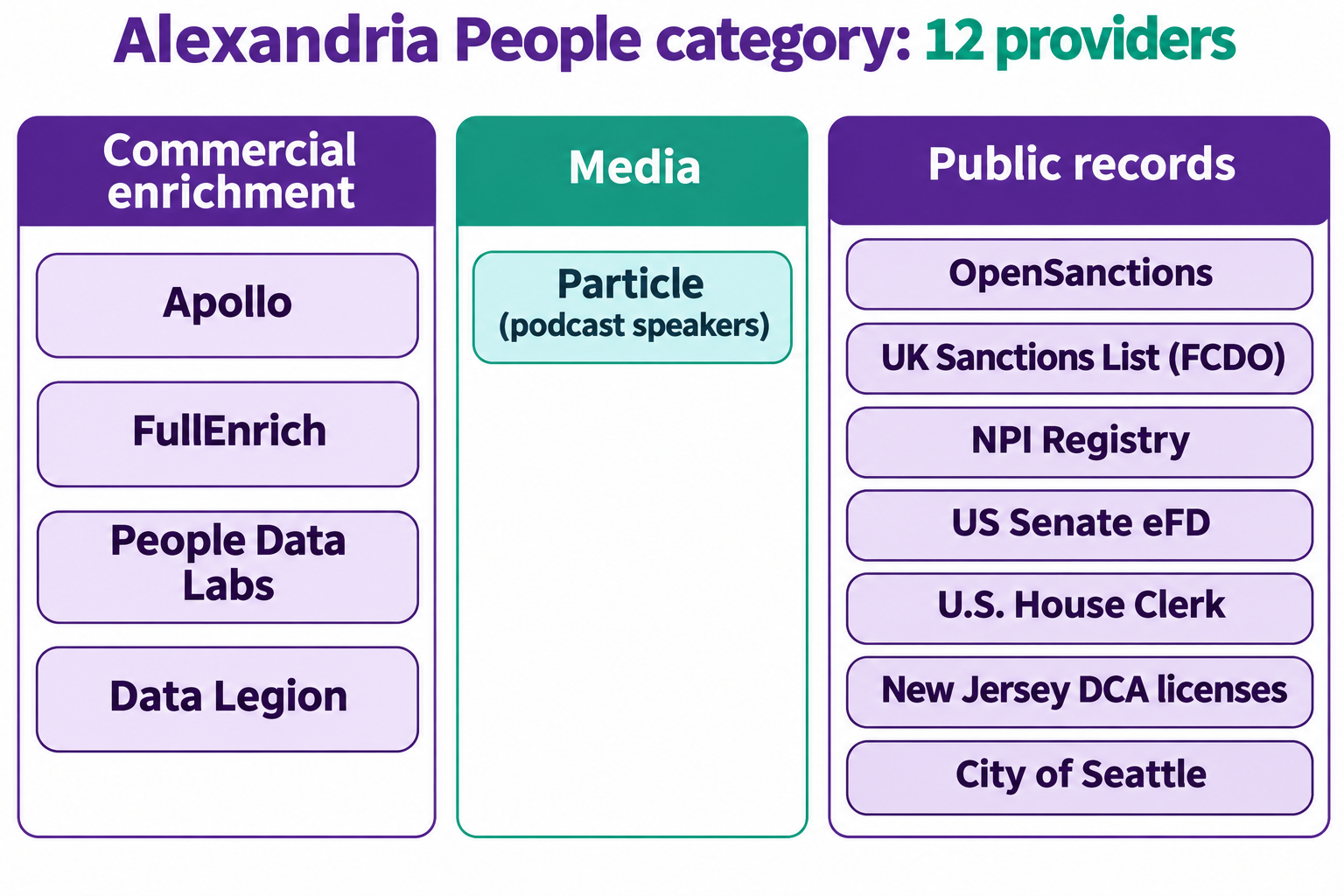
Commercial enrichment (4):
- Apollo: find people by title and company, resolve them to verified work emails, enrich companies from a domain. 10 capabilities.
- People Data Labs: person and company identity resolution, enrichment and search from a profile, email, domain, ticker or name.
- FullEnrich: people and company search, profile lookups, firmographics and verified contact data.
- Data Legion: person and company enrichment.
Media (1):
- Particle: podcast intelligence, including the people who appear on shows.
Public records (7):
- OpenSanctions: sanctions, PEP and persons-of-interest search.
- UK Sanctions List (FCDO): about 6,400 designations across 31 regimes.
- NPI Registry: CMS healthcare provider identities and practice locations.
- US Senate financial disclosures (eFD): each call requires acknowledging statutory use restrictions.
- U.S. House Clerk: roll call votes and the current member roster.
- New Jersey license verification (DCA): licensee search and license records.
- City of Seattle: council roster and district lookup.
Two details matter before you wire these into an agent. People Data Labs carries a quota of 50,000 API calls per year per customer organization, shared across person and company endpoints, counting retries, and resetting January 1 UTC. And Apollo ships with 27 ready-made skills, such as “Search-first prospect list”, which searches free first and pays only to reveal people worth contacting.
How Firecrawl Alexandria works: search, find-tools, scrape
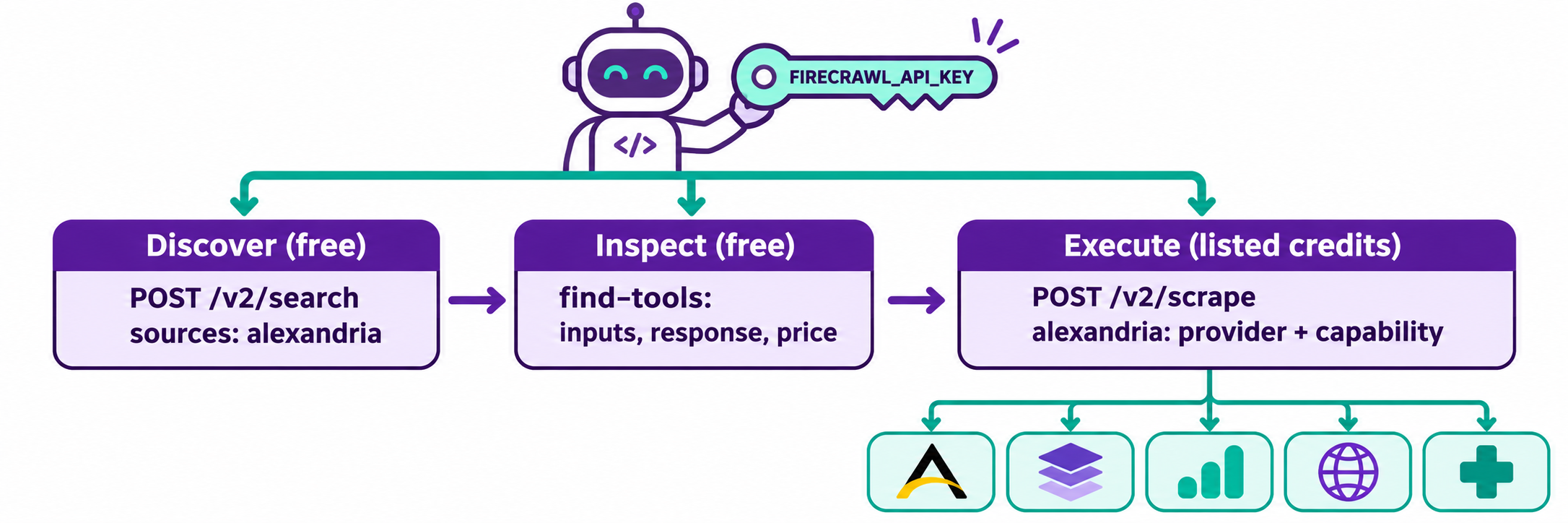
Every Alexandria call follows the same three steps, per the Alexandria docs:
- Discover. Call search with
sources: ["alexandria"]and a plain-language query. You get ranked tools back, each with a provider, capability and description. - Inspect. Call find-tools to read a tool’s inputs, response contract and price.
- Execute. Call scrape with an
alexandriaobject naming the provider, capability and options. No page URL is needed.
Here’s the discovery call over raw HTTP:
curl -s https://api.firecrawl.dev/v2/search \
  -H "Authorization: Bearer $FIRECRAWL_API_KEY" \
  -H "Content-Type: application/json" \
  -d '{"query": "find VP of Sales at a SaaS company", "sources": ["alexandria"], "limit": 5}'
Use ["web", "alexandria"] when you also want pages, but note that web results are paid; tools-only discovery is free.
And here’s execution, using Apollo’s people/search capability:
curl -s https://api.firecrawl.dev/v2/scrape \
  -H "Authorization: Bearer $FIRECRAWL_API_KEY" \
  -H "Content-Type: application/json" \
  -d '{
    "alexandria": {
      "provider": "apollo",
      "capability": "people/search",
      "options": {
        "person_titles": ["VP of Sales"],
        "q_organization_domains_list": ["stripe.com"],
        "page": 1,
        "per_page": 25
      }
    }
  }'
The SDK returns results in alexandria[], with the payload under data; raw HTTP wraps that whole result in one more data field. Check every result for an error before you use it. In Node the same call is firecrawl.scrape({ alexandria: {...} }), and in Python it’s firecrawl.scrape(alexandria={...}).
From a terminal, the Firecrawl CLI does the same loop:
npm install -g firecrawl-cli
firecrawl login
firecrawl search "work email for a VP of Sales" --sources web,alexandria --domain-tools --limit 2
firecrawl find-tools --options '{"providers":["apollo"],"level":"tools","expand":["options","response"]}' --include-costs
firecrawl scrape apollo/people/search --options '{"person_titles":["VP of Sales"],"per_page":10}'
Over MCP, the same loop is firecrawl_search, firecrawl_find_tools and firecrawl_scrape. Our Firecrawl CLI guide and Firecrawl MCP walkthrough cover both setups.
One gate trips first runs: some providers return THIRD_PARTY_DATA_TERMS_REQUIRED with a requiresAction.url, and an org admin has to accept that provider’s terms before the call works.
Firecrawl Alexandria pricing in credits
Alexandria uses the same credit balance as the rest of Firecrawl. The rules from the docs:
- Discovery is free. Search with
sources: ["alexandria"]and find-tools cost nothing. - Execution costs the tool’s listed price. It’s shown on each provider page next to the Run button.
- Government and Research indexes are free with a daily call limit set by your plan; Scale and Enterprise are unlimited.
- Feedback refunds 1 credit. Send it within 20 minutes of your team’s last Alexandria call or it fails with
FEEDBACK_WINDOW_EXPIRED. Refunds cap at 10 credits per website and 100 per team per UTC day.
On November 3, 2026, the provider pages showed two prices: Apollo people/search showed 0 credits, and People Data Labs person/enrich showed 60 credits per call. For Apollo, the paid step is revealing emails, so check those capabilities with find-tools --include-costs before you loop over a list.
What does a credit cost in dollars? Here’s the math from the Firecrawl pricing page, monthly billing:
| Plan | Price | Credits/month | Cost per credit | One PDL enrich (60 credits) |
|---|---|---|---|---|
| Free | $0, no card | 1,000 | $0 | 16 calls fit in the monthly grant |
| Hobby | $19 | 5,000 | $0.0038 | $0.228 |
| Standard | $99 | 100,000 | $0.00099 | $0.0594 |
| Growth | $399 | 500,000 | $0.000798 | $0.0479 |
| Scale | $749 | 1,000,000 | $0.000749 | $0.0449 |
Paid plans add credits in $5 increments (1,000 on Hobby, 2,000 on Standard). Enriching 500 contacts through PDL is 30,000 credits, which puts you on Standard.
PDL’s min_likelihood input (1 to 10, default 2) refuses weak matches, and per the provider page a 404 “is free here and a wrong record is not”. Raise it to save credits and bad rows.
What Alexandria is not
It helps to rule things out:
- Not a scraper. Alexandria tools call official APIs, registries and connectors. Scraping is still Firecrawl’s scrape endpoint, which our web scraping APIs roundup compares with other options.
- Not a CRM. It returns data; storing, deduplicating and syncing contacts is your job or your CRM’s.
- Not an independent benchmark. Firecrawl reports that agents using Alexandria scored 21% higher on answer quality than built-in web tools across 845 tasks, same model and prompts, judged blind by an AI. That’s Firecrawl’s own test, so treat it as a claim to check on your workload.
- Not a compliance tool. The UK sanctions listing itself says a match or an absence isn’t a compliance determination.
Let your coding agent test Alexandria with Apidog CLI
Once a workflow depends on apollo/people/search, you want to know when an input gets renamed or a result starts returning an error. Your agent can catch that with a regression suite in Apidog CLI; you write one prompt.
Set up the CLI and its agent skill once:
npm install -g apidog-cli@latest
apidog auth login --with-token <YOUR_APIDOG_TOKEN>
npx -y skills add https://apidog.com   # pick Claude Code, Codex or Cursor when prompted
Then give your agent this prompt:
Write an OpenAPI 3 file for two Firecrawl calls: POST /v2/search with
sources ["alexandria"], and POST /v2/scrape with an alexandria object for
provider "apollo", capability "people/search", per_page 5. Both send
Authorization: Bearer {{FIRECRAWL_API_KEY}}. Import it into Apidog project
<projectId>, create a "Firecrawl" environment with base URL
https://api.firecrawl.dev, and create a test case per endpoint that asserts
status 200, at least one returned tool on search, and on scrape that
data.alexandria[0].data exists with no error. Run both and summarize failures.
The agent reads each payload schema, validates its JSON, then runs commands like these:
apidog import --project <projectId> --format openapi --file ./firecrawl-alexandria.json
apidog environment create Firecrawl --project <projectId> --base-url https://api.firecrawl.dev
apidog cli-schema get test-case-create
apidog cli-schema validate test-case-create --file ./apollo-search-case.json
apidog test-case create --project <projectId> --file ./apollo-search-case.json
apidog run --test-case <caseId> --project <projectId> -e <envId> \
  --env-var "FIRECRAWL_API_KEY=$FIRECRAWL_API_KEY" -r cli,junit
The choice of calls keeps the suite cheap: tools-only discovery is free, and Apollo search showed 0 credits on November 3. Keep paid capabilities like the 60-credit PDL enrich out of the scheduled run, or run them weekly with a known test input. The same apidog run ... -r junit line drops into a pipeline; the Apidog CLI CI/CD guide has GitHub Actions and GitLab examples, and Apidog CLI in Claude Code covers agent setup. Apidog’s free plan covers up to 4 users.
Wrapping up
Firecrawl Alexandria turns one key into access to 430 providers, with Apollo, People Data Labs and ten more People sources behind the same three calls. Discovery is free, execution has a listed price, and the free plan’s 1,000 credits are enough to test the fit. Check provider terms first, keep min_likelihood high, and let your agent guard the calls with Apidog CLI.
FAQ
Is Firecrawl Alexandria free? Discovery is. Search with sources: ["alexandria"] and find-tools cost no credits, and the Government and Research indexes are free up to a daily limit. Provider tools cost their listed credits, drawn from your plan, which starts with 1,000 free credits a month and no card.
Do I need separate Apollo or People Data Labs accounts? No. Firecrawl says every People provider is callable through the same Firecrawl API key. Some providers do require an org admin to accept their terms first, signalled by a THIRD_PARTY_DATA_TERMS_REQUIRED error.
How much does a People Data Labs lookup cost through Alexandria? The person/enrich capability showed 60 credits per call on November 3, 2026. That’s about $0.23 on Hobby and $0.06 on Standard at monthly prices. PDL also has a 50,000-call yearly quota per organization.
Can Claude Code or Codex use Alexandria? Yes. Install the Firecrawl CLI or connect the Firecrawl MCP server, and the agent gets search, find-tools and scrape.
Is the 21% answer-quality gain independent? No. It’s Firecrawl’s own test: 845 tasks, same model and prompts, blind AI judging. Run your own comparison before you rely on it.