
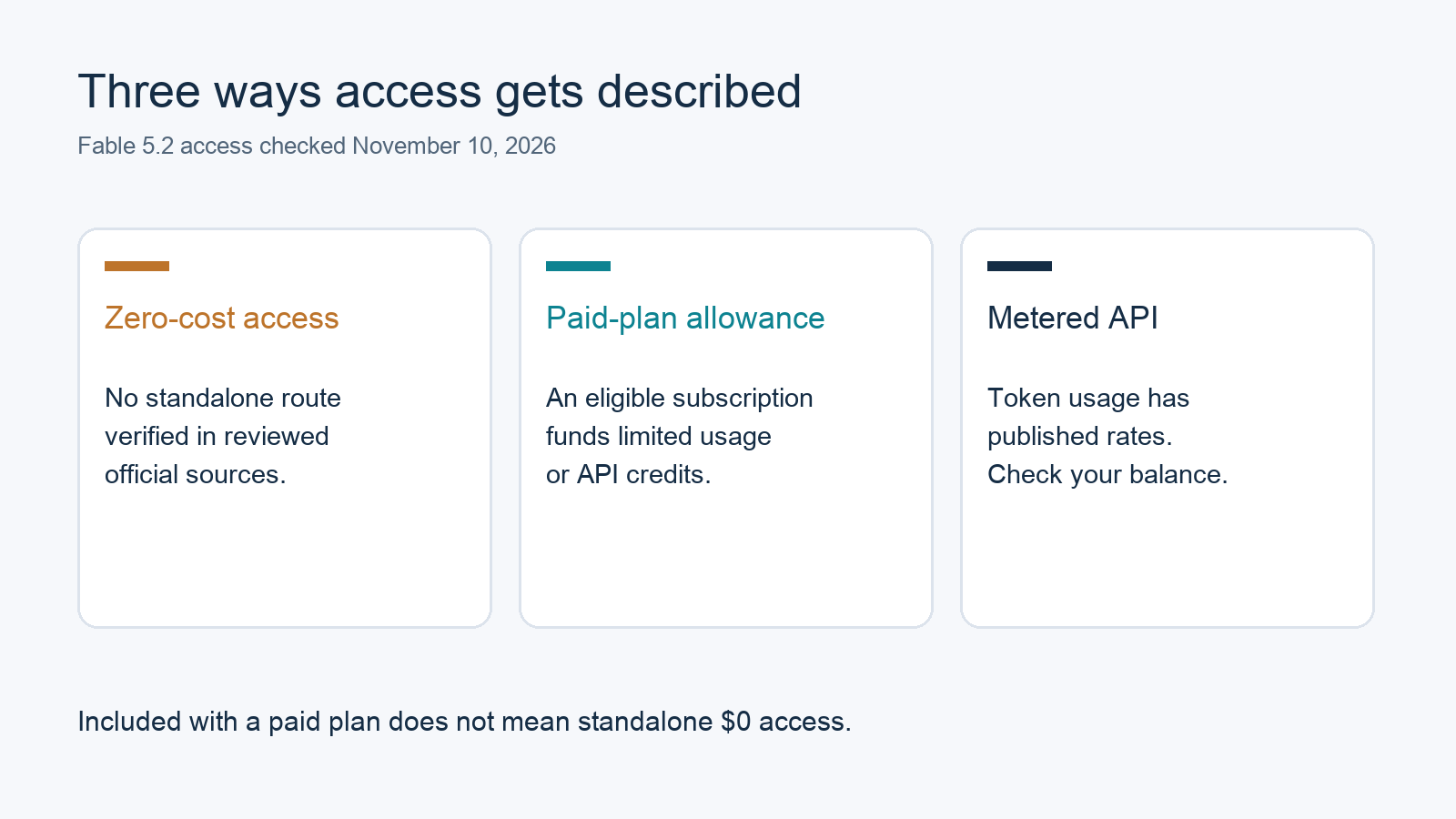
If you want to use Claude Fable 5.2 for free, no standalone $0 route was verified in the official sources checked on November 10, 2026. Anthropic offers launch allowances and API credits for eligible paid subscribers. Those benefits can reduce additional spending, but they still require a paid plan.
The useful question is whether you already qualify for an allowance, which product it covers, and what happens when it runs out. This guide helps you answer those questions before you make a request. If you’re building an integration, Apidog CLI can help your coding agent prepare its tests before you authorize paid calls.
What does “free Claude Fable 5.2” mean?
A genuinely free route lets you use Fable 5.2 without buying a subscription or adding paid credits. Included subscription usage means your existing payment covers an allowance. Promotional API credits are a balance with eligibility rules and an expiry date. These arrangements have different costs, even when a request produces no additional charge.
The Fable 5.2 announcement confirms model availability and a promotion for eligible paid subscribers. It doesn’t establish a public, ongoing free Fable 5.2 quota.
| Access option | Verified position on November 10, 2026 | Requires a paid plan? |
|---|---|---|
| Standalone $0 Fable 5.2 access | No qualifying route verified | Unestablished |
| Launch allowance | Extra usage for eligible paid subscribers | Yes |
| Monthly subscriber API credits | Credits for eligible Max, Ultra, and Team plans | Yes |
| Direct API usage | Metered usage at published token rates | Subscription isn’t the same as API funding |
Don’t carry an older promotion forward. Our Fable 5 free-access guide discusses an earlier model and a June window. That historical offer doesn’t establish your entitlement to Fable 5.2 in November.
Who gets the Fable 5.2 launch allowance?
Anthropic’s announcement describes extra usage for subscribers on eligible paid plans. Plans and seats that include Fable receive one to three resets based on subscription tenure. It also describes Fable inclusion for up to 50% of weekly limits on Pro plans and standard Team seats. That isn’t an unlimited allowance.
Treat these as launch terms, not a permanent feature of every subscription. The announcement describes the offer as applying “this week,” so a search result or saved screenshot can’t establish that it’s still active when you read this.
Before using it, check the offer attached to your account:
- Confirm the subscription and seat you’re signed into.
- Check whether the offer names Fable 5.2 and the product you intend to use.
- Read the remaining allowance and reset conditions.
- Check whether continuing after exhaustion activates separately billed usage.
[VERIFY] The exact promotion expiry, full eligibility conditions, and any payment-card requirements couldn’t be independently confirmed from the linked launch-promotion help page during this review. Don’t rely on the promotion until those details are resolved.
If you already subscribe, an allowance can be useful for evaluating a difficult task. If you don’t, buying a subscription to obtain that allowance is a purchase decision. It doesn’t turn the evaluation into a $0 route.
Can subscriber API credits cover your experiment?
Eligible Max, Ultra, and Team subscribers can claim monthly Claude Platform credits. Anthropic’s subscriber-credit documentation says a separate Claude Platform payment method isn’t required. You still need an active eligible paid subscription, and new subscribers must wait seven days before claiming. Free, Pro, and Enterprise plans aren’t eligible for this program.
The documented monthly amounts are:
| Subscription | Included API credit |
|---|---|
| Max | $100 |
| Ultra | $200 |
| Team Standard seat | $20 per seat |
| Team Premium seat | $100 per seat |
Team credits form a shared pool capped at $500 per month. Seat counts at the start of the billing month determine the allowance. Adding a seat doesn’t immediately increase that month’s credit.
To claim credits, open your plan’s billing settings and link the intended Claude Console organization. The subscriber handles this for Max or Ultra; a Team Primary Owner or Owner handles it for Team. The Console side requires an Owner, Admin, or Billing role.
Choose the organization carefully. Anthropic says you can’t change the linked organization yourself. Confirm ownership and the intended project before accepting the program terms.
Credits cover the Claude API, Managed Agents, the Agent SDK, and the Console playground. They don’t cover Claude Code, extra usage in Claude apps, or calls billed through other cloud platforms. A credit balance in one billing system doesn’t transfer to another because both systems offer Fable 5.2.
What happens when the credits run out?
Included credits are spent before purchased credits. If your organization holds purchased credits, requests can continue using that balance. If it has no credits left, requests stop. Auto-reload can buy more credits when enabled, and organizations invoiced through Anthropic sales are billed for usage beyond included credits under their normal arrangement.
This is the point to inspect before launching an experiment. “No extra charge for the first request” doesn’t guarantee the same outcome for a loop that keeps retrying.
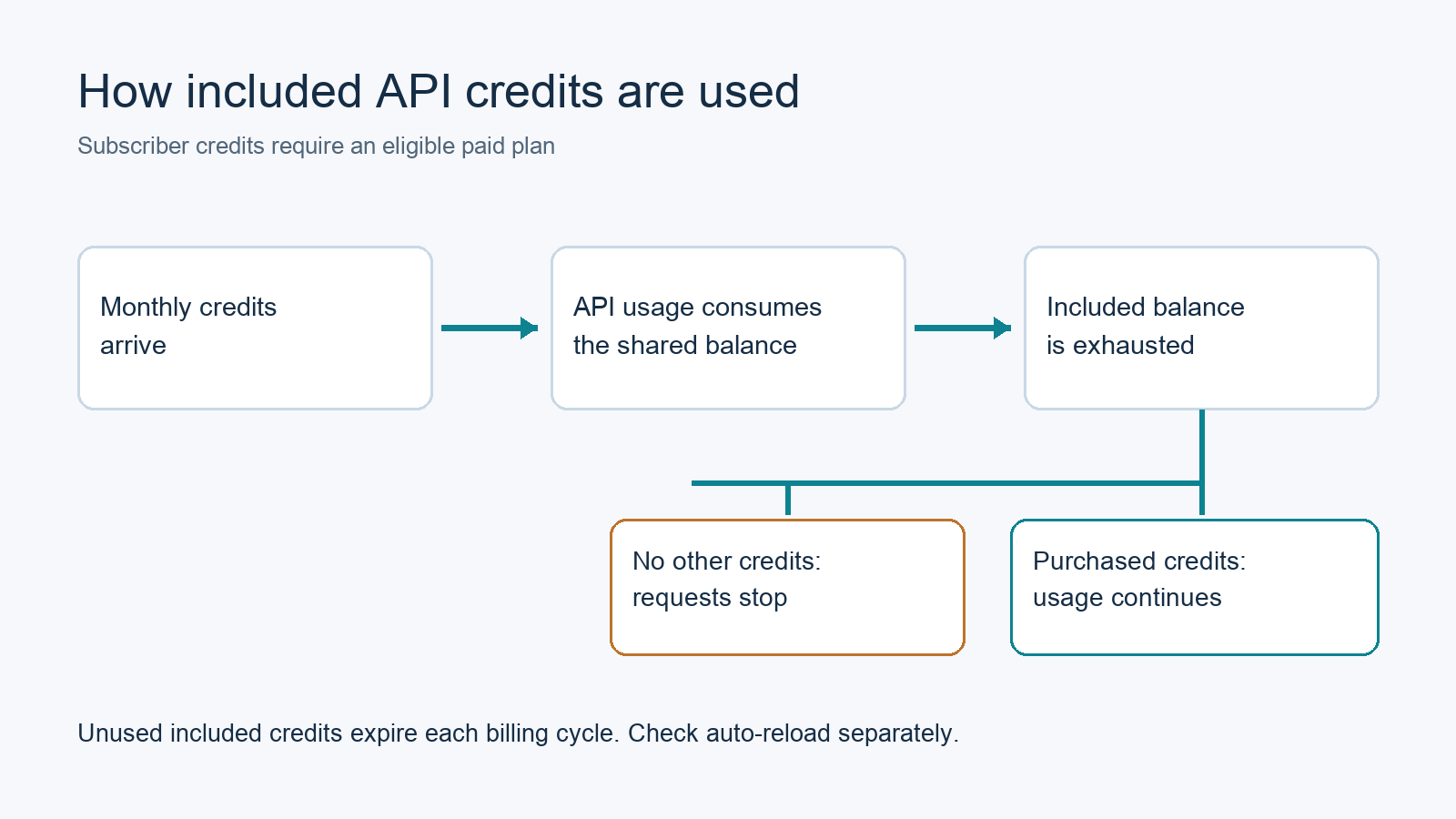
Unused included credits expire at the end of the billing cycle, or monthly for annual plans. They don’t roll over. All API keys and workspaces in the linked organization share the balance, so another application can consume credits you expected to use.
Set a separate workspace spend limit for the experiment. Check the balance and expiry before starting, and review auto-reload separately. Credits don’t remove rate limits or monthly spend caps. A request can hit one of those controls even while the account still has credit.
Is the Fable 5.2 API free?
The official model overview lists claude-fable-5-2 at $8 per million input tokens and $40 per million output tokens. The announcement lists optional fast mode at $16 and $80 respectively. Neither source establishes a standing public $0 API allowance for this model.
For an illustrative standard request, 10,000 input tokens cost $0.08 and 2,000 output tokens cost $0.08. Together that’s $0.16 for those token quantities at the stated standard rates. This is arithmetic, not a measured request or a complete estimate for a tool-using workflow.
A multi-step task can make several requests. Retries and longer outputs change the total. Start with one bounded example and inspect recorded usage before scaling. Keep pricing calculations separate from entitlement checks: a small bill is still a bill, and a credit-funded call still consumes a finite balance.
No model-specific $0 cloud-credit route or guaranteed new-account trial was verified for this guide. Don’t assume a general cloud signup offer covers Fable 5.2. Check the provider’s current eligible-service terms before treating a credit as usable.
Let your agent prepare tests with Apidog CLI
Use Apidog to prepare a repeatable test before authorizing a real model call. Your coding agent can inspect the test-case schema, validate its input, and target a mock environment first. A mock checks your integration’s handling of sample responses; it doesn’t provide Fable inference or prove the model will answer correctly.
Install the CLI and authenticate with your own Apidog token:
npm install -g apidog-cli@latest
apidog login --with-token <YOUR_APIDOG_TOKEN>
The Apidog CLI in Claude Code guide explains the agent workflow. Give your coding agent one prompt:
Prepare an Apidog test case for our Fable 5.2 integration in
project <PROJECT_ID>. Read the current CLI schema and use an
existing valid test-case category. Validate the creation payload.
Test sample success and exhausted-credit responses against our
mock environment. Never send the Anthropic API key to the mock.
Run one iteration and summarize failures. Don't call the live
provider until I approve a separate bounded run.
The command sequence uses the installed CLI’s schema and test-case commands:
apidog cli-schema get test-case-create
apidog cli-schema validate test-case-create --file case.json
apidog test-case create --project <PROJECT_ID> --file case.json
apidog run --test-case <CASE_ID> --project <PROJECT_ID> -e <MOCK_ENV_ID> -n 1 -r cli,json
Replace the placeholders with your own resource IDs. The agent must generate case.json from the schema; it isn’t a predefined fixture. These command flags were checked against CLI 2.2.12. No live Anthropic request was executed for this article.
Apidog doesn’t grant model access or change Anthropic’s billing rules. Its role here is to catch integration mistakes before you spend your model allowance.
FAQ
Can I use Claude Fable 5.2 without paying anything?
No standalone $0 route was verified in the official sources reviewed on November 10, 2026. The confirmed launch allowances and subscriber credits require eligible paid plans. Check any new offer for model eligibility, quota, expiry, and payment requirements before relying on it.
Does Pro include the monthly API-credit benefit?
No. The documented subscriber API-credit program covers eligible Max, Ultra, and Team plans. Pro’s mention in the Fable launch announcement concerns a separate usage promotion. Don’t treat an app allowance as an API-credit balance.
Do I need a card to claim subscriber API credits?
Anthropic says a payment method isn’t required on Claude Platform for eligible subscribers to claim these credits. That doesn’t remove the paid subscription prerequisite. The launch promotion’s separate payment requirements remain unverified here.
Can I spend those API credits in Claude Code?
No. The documented subscriber credits exclude Claude Code and app extra usage. They cover specified Claude Platform products, including the API and Agent SDK. Check the billing path your integration uses rather than assuming every Claude-branded tool draws from the same balance.
Does testing through Apidog make Fable 5.2 free?
No. A mock test can help you prepare without invoking the model, but real provider requests remain subject to Anthropic’s access and billing terms. Use the Apidog CLI workflow to validate your integration, then approve paid evaluation separately.