
For Claude Fable 5.2 vs Opus 5.5, start with Opus 5.5 for everyday coding and knowledge work. Try Fable 5.2 when difficult reasoning, ambiguous migrations, or long agent projects exceed your Opus baseline. Compare effort settings and cost per accepted result before switching your entire workload.
That recommendation follows Anthropic’s Fable 5.2 announcement, checked on November 10, 2026. This is a source-based comparison; we haven’t run an independent head-to-head benchmark. Our earlier Opus 5 vs Fable 5 comparison covers the older generation. The rates, defaults, and evidence below apply to these newer versions.
Claude Fable 5.2 vs Opus 5.5 at a glance
| Decision point | Claude Fable 5.2 | Claude Opus 5.5 |
|---|---|---|
| Starting role | Demanding reasoning and long agent work | Default for most workloads |
| Claude API model ID | claude-fable-5-2 |
claude-opus-5-5 |
| Standard input, per million tokens | $8 | $4 |
| Standard output, per million tokens | $40 | $20 |
| API default effort | High | Medium |
| Context window | 1M tokens | 1M tokens |
| Maximum output | 128K tokens | 128K tokens |
| Comparative latency label | Moderate | Moderate |
Source: the current Claude models overview. Both models accept text and images, produce text, support tools, and use always-on adaptive thinking. A larger context window therefore doesn’t distinguish them. Their ability to finish your particular task does.
Fable’s standard token rates are twice Opus’s. That makes Opus the sensible starting point when both models meet your acceptance criteria at similar token volume. It doesn’t establish which has the lower bill when reasoning depth, retries, and tool calls differ.
Which coding tasks justify switching to Fable 5.2?
Use Opus for bounded changes with clear checks. Test Fable when the agent must discover the problem, coordinate several dependent changes, or recover from a failing approach. These are workload recommendations inferred from Anthropic’s positioning and results, rather than measured guarantees for your repository.
| Your task | Starting choice | Evidence that would justify escalation |
|---|---|---|
| Add a documented endpoint | Opus 5.5 | Repeated contract or integration failures |
| Update tests after a small refactor | Opus 5.5 | Agent can’t identify the changed invariant |
| Debug an intermittent cross-service failure | Opus, then Fable | Opus repeats fixes without testing competing causes |
| Migrate a service with unclear dependencies | Compare both | Fable completes more accepted changes within budget |
| Coordinate a long technical project | Trial Fable | Better planning survives execution and review |
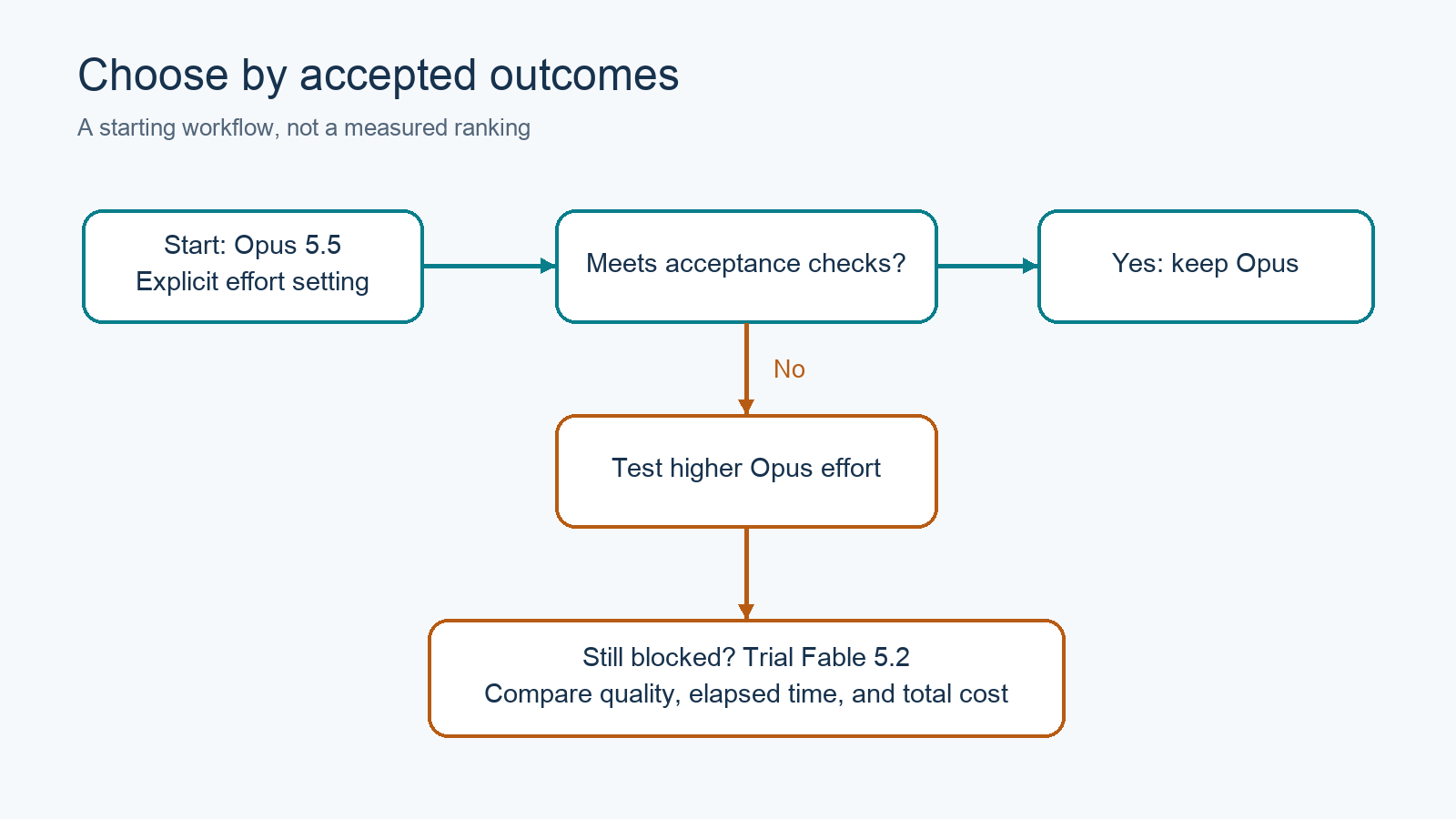
Selective escalation: keep routine tasks on your baseline and send difficult work to the model that clears your checks.
Consider a payment webhook that intermittently processes an event twice. If the required fix is already specified, Opus has a bounded coding task. If the agent must reconstruct concurrency across retries, storage, and downstream services, the investigation is a stronger candidate for a Fable trial.
Give either model the same incident evidence and constraints. A more expensive model cannot compensate for missing logs, inaccessible dependencies, or an acceptance test that rewards the wrong behavior.
What do Anthropic’s benchmarks show?
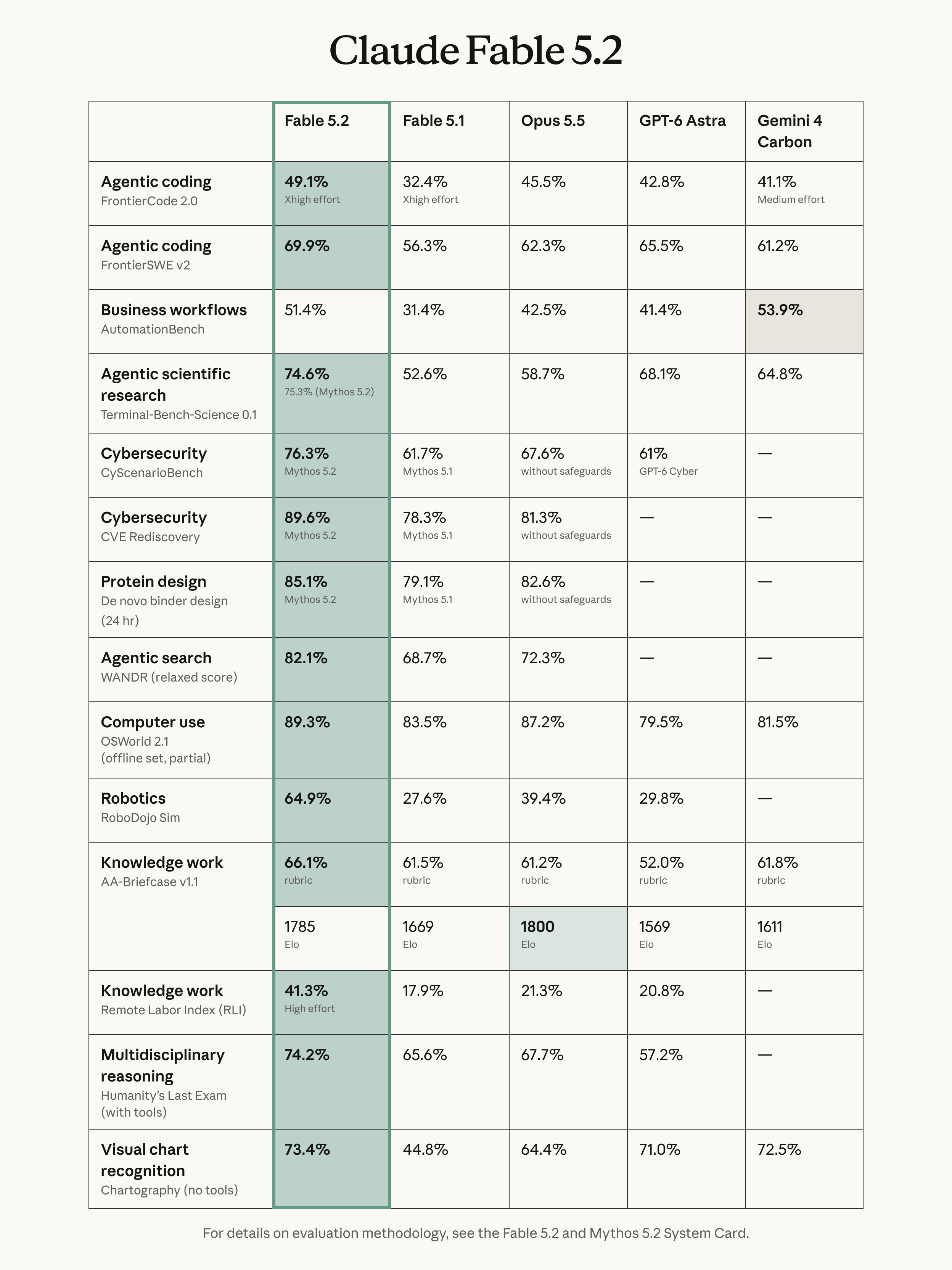
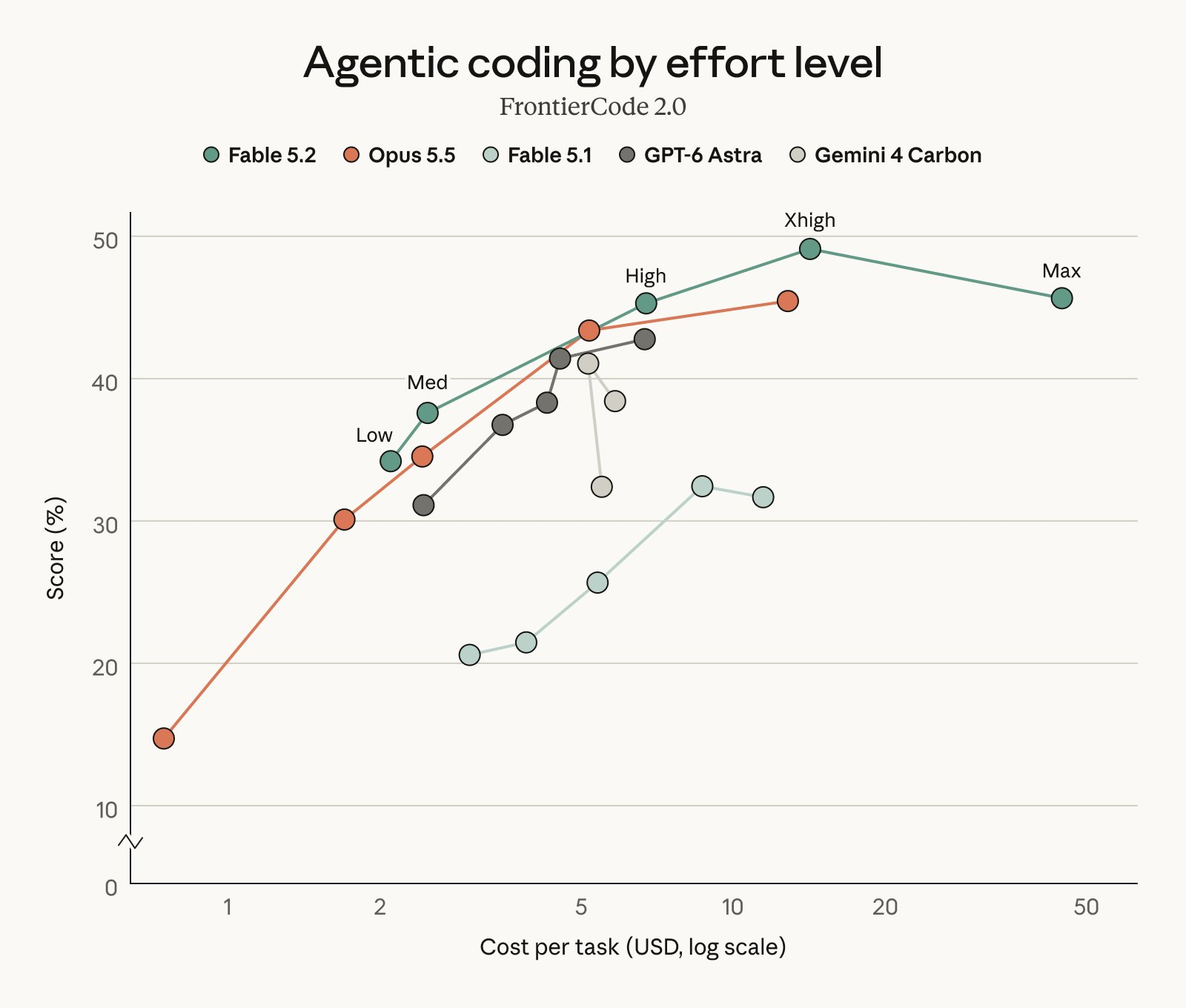
Anthropic reports higher Fable 5.2 scores on several coding and reasoning evaluations. The strongest practical signal is its effort-versus-cost result: Fable at High nearly matches Opus at Max on FrontierCode 2.0 at roughly half the cost per task in Anthropic’s early testing.
| Vendor-reported evaluation | Fable 5.2 | Opus 5.5 |
|---|---|---|
| FrontierCode 2.0, agentic coding | 49.1% at Xhigh | 45.5% |
| FrontierSWE v2, agentic coding | 69.9% | 62.3% |
| WANDR, agentic search, relaxed score | 82.1% | 72.3% |
| OSWorld 2.1, partial offline set | 89.3% | 87.2% |
These figures come from the announcement, which says scores use the highest available effort unless otherwise specified. They describe Anthropic’s evaluation conditions, not default settings or an expected pass rate on your tickets.
The cost comparison is narrower still. Fable at High scores 45.3%, compared with Opus’s 45.5% best score. That supports testing the cheaper configuration for that evaluation. It doesn’t mean every Fable workflow costs half as much as Opus.
Avoid turning a benchmark percentage into a productivity forecast. A coding score doesn’t measure your review queue, deployment risk, or time spent repairing an incorrect migration. Also keep Mythos-only cybersecurity and biology results out of Fable’s scorecard: the announcement identifies a shared underlying model but different safeguards and access.
Effort settings change the comparison
Set effort explicitly when comparing models. The API defaults are High for Fable 5.2 and Medium for Opus 5.5. Anthropic’s announcement separately describes Medium as the default in Claude apps and Claude Code. Record the product and setting rather than assuming one default applies everywhere.
The effort documentation defines low, medium, high, xhigh, and max for both models. Effort influences response text, tool arguments, and thinking. It is a behavioral signal, not a hard spending cap.
Start with your working Opus configuration. If it falls short, compare a higher Opus effort with Fable at Medium or High. Reserve Xhigh and Max trials for tasks where the additional reasoning has a plausible benefit and you can tolerate the spend.
An equal-effort comparison answers one question: how do these models behave under the same named setting? A cost-matched comparison answers another: which configuration produces the strongest acceptable result for your budget? Neither replaces the other.
Latency: measure the whole task
Both models carry a Moderate comparative-latency label in Anthropic’s overview. There isn’t a universal winner from that label. Measure time to a reviewed result, including tools and retries, rather than treating output speed as the speed of your complete development workflow.
Anthropic says Fable 5.2 generates output up to 30% faster than Fable 5.1. That comparison is against its predecessor, not Opus 5.5. Its optional fast mode offers up to 2.5 times token-generation speed, again a vendor claim rather than a measured reduction in your task duration.
A task dominated by compilation or a slow database won’t accelerate in proportion to faster token generation. Conversely, an agent that avoids two failed approaches can finish sooner while generating tokens more slowly. Track these separately before paying a speed premium.
Compare cost per accepted result
Use total workflow spend divided by accepted results as your decision metric. Token prices determine the rate, but token volume, caching, failed attempts, tools, and review determine what you buy. The following arithmetic is illustrative, not a measurement of either model’s behavior.
Assume one request consumes 100,000 uncached input tokens and 10,000 output tokens, with standard global routing and no additional tool charges:
| Configuration | Input cost | Output cost | Total |
|---|---|---|---|
| Opus 5.5 standard | $0.40 | $0.20 | $0.60 |
| Fable 5.2 standard | $0.80 | $0.40 | $1.20 |
| Opus 5.5 fast | $0.80 | $0.40 | $1.20 |
| Fable 5.2 fast | $1.60 | $0.80 | $2.40 |
Rates were checked against Anthropic’s pricing documentation on November 10, 2026. Subscription allowances are separate from these API rates. Cloud providers, caching, residency options, and other features can change the bill.
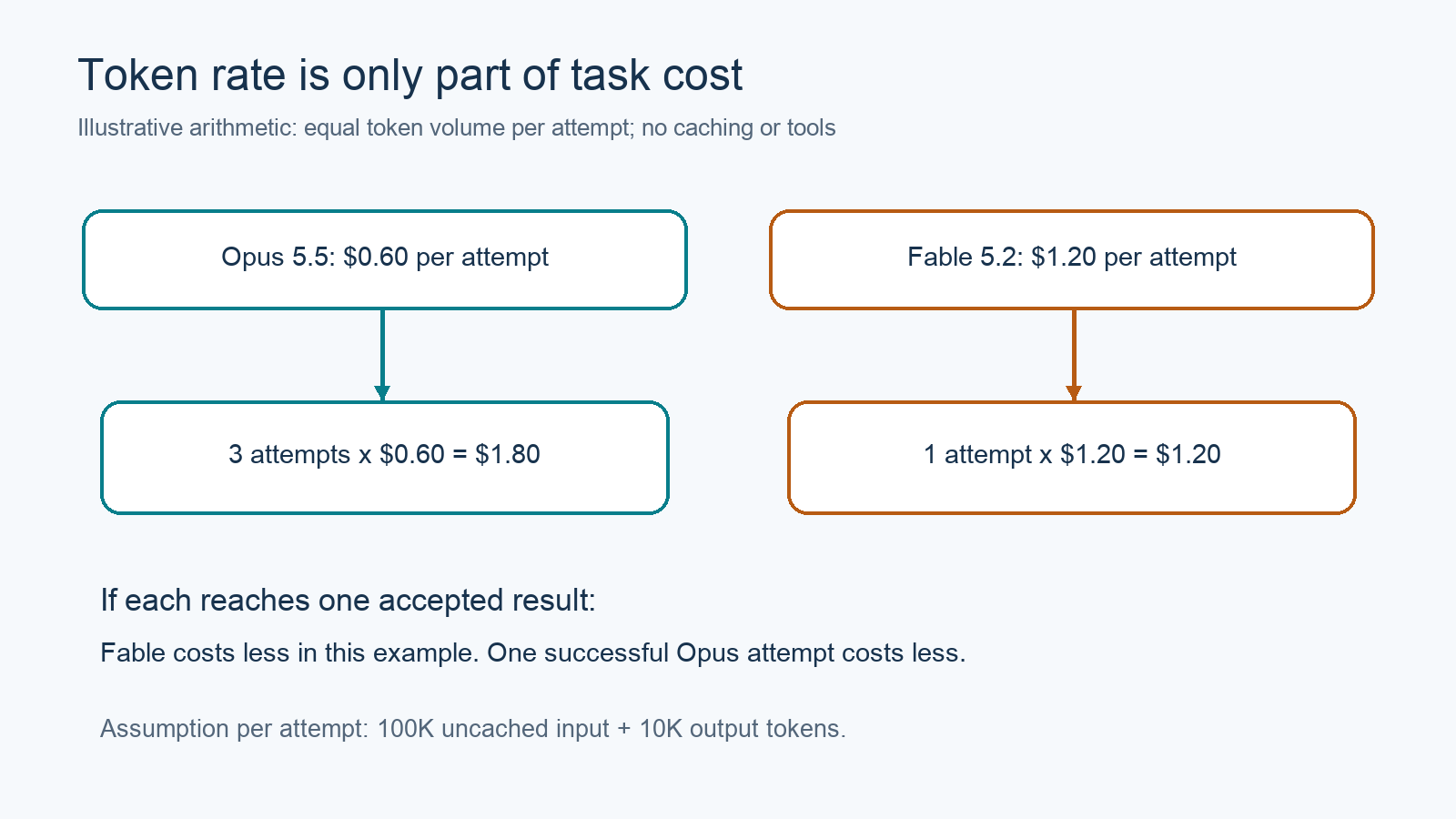
Compare all attempts needed for a successful result, including retries and review.
In this simplified example, three identical-volume Opus attempts cost $1.80; one Fable attempt costs $1.20. That makes Fable cheaper only if it reaches the accepted result in that one attempt. One successful Opus attempt remains cheaper. Real retries often consume different volumes, so use recorded usage rather than multiplying a guessed average.
Keep engineering review time beside API spend. A patch that passes tests but requires substantial correction hasn’t cleared the same bar as a review-ready patch.
Let your coding agent check the API with Apidog CLI
Use Apidog CLI to have your coding agent create and run repeatable API checks. These checks can reveal request or response regressions when you switch models. They don’t establish whether an agent’s repository changes are correct; keep repository tests and human review alongside them.
Set up the CLI, then let your agent read the official installation guide:
npm install -g apidog-cli@latest
apidog login --with-token <YOUR_APIDOG_TOKEN>
Give Claude Code or your preferred agent this prompt:
Read https://apidog.com/apidog-cli-installation-guide.md.
In project <PROJECT_ID>, create a test case for our Claude Messages
request. Compare claude-opus-5-5 and claude-fable-5-2 using the same
prompt and explicit medium effort. Keep API credentials in private
variables. Assert the expected status and response structure, record
usage and elapsed time, and summarize failures. Don't claim these
checks measure coding quality. Validate every write payload first.
The agent checks the schema, chooses a valid test-case category, builds case.json, then runs commands such as these. The flags were checked against installed CLI 2.2.12 help:
apidog test-case category --project <PROJECT_ID>
apidog cli-schema get test-case-create
apidog cli-schema validate test-case-create --file case.json
apidog test-case create --project <PROJECT_ID> --file case.json
apidog run --test-case <CASE_ID> --project <PROJECT_ID> \
  -e <ENVIRONMENT_ID> -r cli,json
Replace placeholders with your project resources. This is a workflow template, not an executed model comparison. Follow the Apidog CLI in Claude Code guide or the Codex integration guide for the agent setup.
FAQ
Is Fable 5.2 better than Opus 5.5 for all coding?
No. Anthropic recommends Opus 5.5 for most coding and knowledge tasks. Fable is worth testing when difficult work exceeds that baseline. Its higher vendor benchmark scores don’t guarantee a better result on every task.
Does Fable 5.2 cost twice as much?
Its standard input and output token rates are twice Opus 5.5’s. The total task cost can differ because configurations consume different tokens and require different numbers of attempts.
Should you always use maximum effort?
No. Compare settings against your acceptance checks and budget. Higher effort allows more token spending; it doesn’t guarantee a useful improvement for a bounded task.
Is Fable 5.2 faster than Opus 5.5?
The sources reviewed here don’t establish a universal head-to-head latency winner. Both have a Moderate latency label. Measure your actual workflow and treat fast mode as a separate configuration.
Can Apidog decide which model writes better code?
Apidog CLI can help your agent run API checks and collect response evidence. Code quality still needs repository tests and review. Use those accepted outcomes to decide which model and effort setting earn their cost.