Claude Fable 5.2 vs Mythos 5.2 is primarily a choice about safeguards and access. Anthropic says both use the same underlying model. Fable is broadly available with additional cybersecurity and biology safeguards; Mythos supports approved work through verification programs. Choose by the work you’re authorized to do, then confirm your account’s eligibility.
Anthropic’s announcement establishes that distinction. It doesn’t describe Mythos as a separate, universally smarter coding model. For developers connecting models to tools, the practical question is whether a workflow needs capabilities restricted by Fable’s safeguards. You can then use an agent and Apidog CLI in Claude Code to validate the surrounding API integration.
Claude Fable 5.2 vs Mythos 5.2 at a glance
Fable 5.2 and Mythos 5.2 share their underlying model, so the comparison starts with permitted tasks and eligibility. Fable adds safeguards for sensitive cyber and biology requests. Mythos provides access for verified work in those areas, subject to program rules. General coding work doesn’t automatically require Mythos.
| Decision point | Fable 5.2 | Mythos 5.2 |
|---|---|---|
| Underlying model | Shared with Mythos | Shared with Fable |
| Main distinction | Additional cyber and biology safeguards | Access for verified cyber and life sciences work |
| Availability | Broad platform availability; account entitlements still matter | Verification-program access |
| Typical fit | Difficult coding, analysis, engineering | Approved security work or biomedical research |
| Access decision | Check your platform and plan | Check program approval, tier, and account configuration |
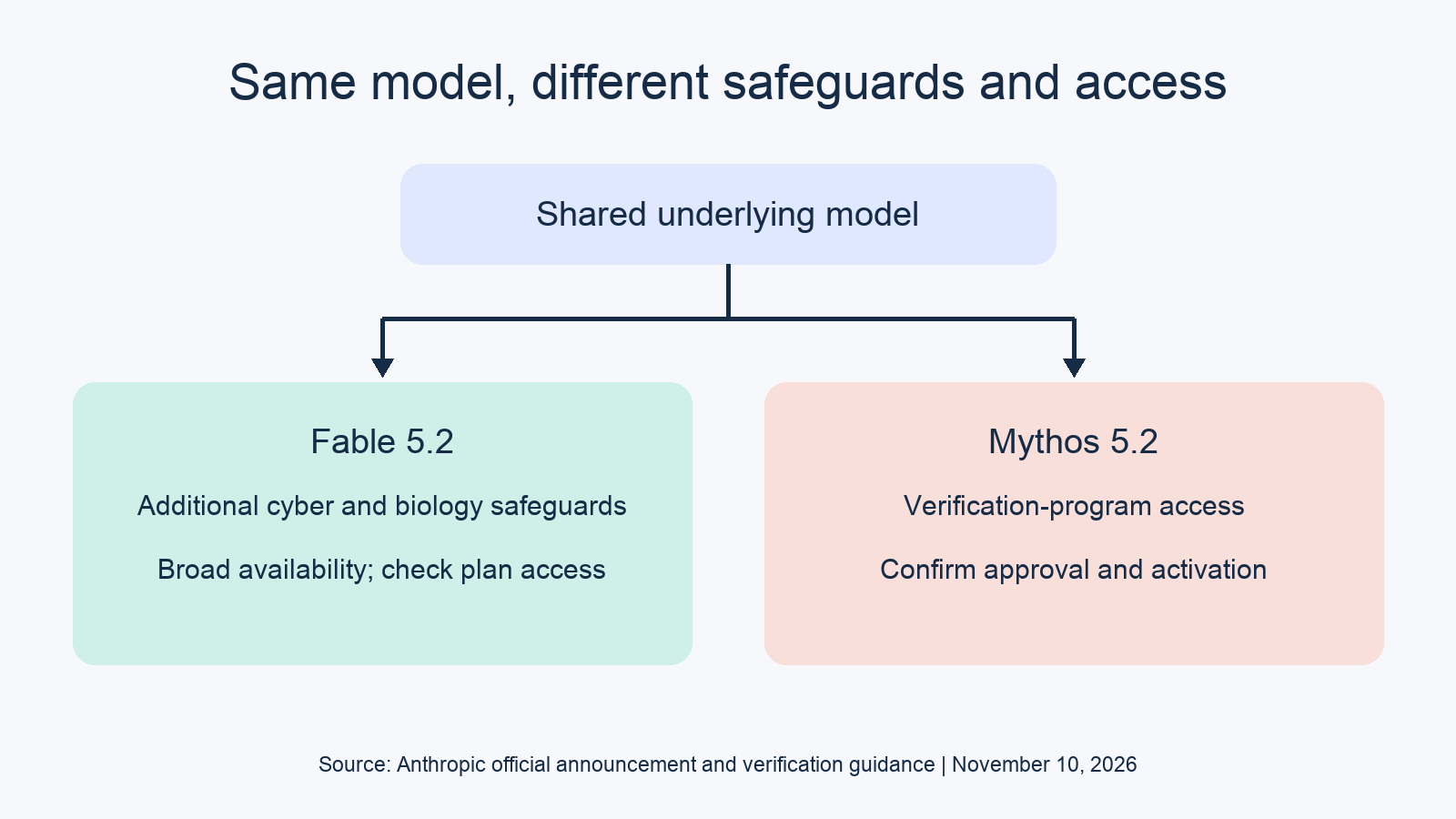
Treat this as an access comparison. A different label doesn’t establish a different reasoning engine. It also doesn’t mean every prompt produces identical answers: safeguards can change which requests proceed and how a service handles restricted requests.
What capabilities do Fable and Mythos share?
Both models draw on the same underlying capabilities in coding, reasoning, and vision. Anthropic positions them for ambitious technical work, including ambiguous software projects and research. That shared foundation makes task requirements more useful than a blanket claim that one model is better for every developer.
Consider a service migration. You need repository understanding, dependency analysis, code changes, and test repair. Those requirements alone don’t establish a need for Mythos. Fable is a candidate when the work is difficult enough to justify escalating from your existing model.
Anthropic recommends starting most coding and knowledge tasks with Opus 5.5, then switching according to complexity. For this comparison, the implication is straightforward: choose a suitable capability level before deciding whether your work requires verification-program access.
Keep task quality separate from integration quality. A model can propose a correct patch while your application mishandles an error, drops a tool result, or uses the wrong credential. Those failures need reproducible tests regardless of which model you select.
How do Fable 5.2 safeguards change its behavior?
Fable’s additional safeguards restrict high-risk cyber activities and much research biology. Anthropic lists penetration testing, exploit generation, and binary-based vulnerability work among the restricted categories. Its announcement also describes fallback responses for blocked cyber and biology queries. A blocked request therefore needs investigation before you judge the model’s underlying ability.
For the fallbacks described at launch, Anthropic names Opus 4.8 for cybersecurity and Opus 5 for biology. Don’t assume every response in a sensitive workflow represents unrestricted Fable execution. Record the task, observed response, and any service-provided fallback information before interpreting results.
Everyday secure development is a separate category. The Cyber Verification Program guidance says generally available models can review code, patch known issues, and triage alerts. It says verification may be needed when safeguards interrupt work such as authorized penetration tests or exploit validation.
That distinction matters when you’re choosing a model for a development team. Reviewing an authentication patch doesn’t carry the same access requirements as building an offensive testing workflow. Describe the actual task before deciding which route fits.
Approval also doesn’t remove every safeguard. Anthropic says allowed security work can still encounter refusals or classifier blocks. Keep a blocked case as evidence for review; changing the model label isn’t a substitute for confirming permission and scope.
Who can access Claude Mythos 5.2?
Cybersecurity users apply through the Cyber Verification Program; life sciences researchers apply through the Life Sciences Verification Program. Cyber access has multiple tiers with different eligibility and allowed work. Approval belongs to the relevant account and organization, so purchasing a subscription alone doesn’t establish that your workflow has Mythos access.
Cyber verification depends on your work
The current cyber guidance includes three tiers:
- Defense Access: organizations and individuals, including independent researchers and open-source maintainers, can apply.
- Red Team Access: organizations can apply for authorized offensive security work.
- Specialized Access: organizations can apply for higher-risk testing of critical systems, with additional review.
Individuals aren’t categorically excluded from Mythos’s cyber route. They can apply for Defense Access under the published criteria. That is more precise than treating all Mythos use as restricted to large enterprises.
The program is available through eligible paid Claude plans, Console accounts with billing, and supported linked platforms. It isn’t available on Claude Free. Read the current program page for your route rather than inferring eligibility from another team’s approval.
Approval and activation are separate
For Enterprise and API use, administrators may need to assign access to the proper role or workspace. Claude and Console accounts are separate organizations, and approval doesn’t transfer across your other organizations.
Before troubleshooting your request body, check that the credential belongs to the approved organization and configured workspace. A working key proves authentication; it doesn’t prove verification-program entitlement.
External customer work also needs care. The cyber guidance distinguishes internal use from customer services or products and requires separate external-use approval. An internally approved team shouldn’t assume it can expose the same capabilities through a customer-facing application.
Life sciences has its own application
Use the official Life Sciences Verification Program for biomedical research access. The beta is for verified organizations on Team, Enterprise, or the Claude Platform API; personal Free, Pro, Max, and Ultra plans aren’t eligible. Your organization’s administrator registers interest, which doesn’t guarantee access. Don’t transfer cyber tiers or approval expectations to biology.
Which model fits your developer use case?
Use Fable as the candidate for difficult general engineering tasks that fit its safeguards. Investigate Mythos when approved cyber or biomedical work requires the verification route. Keep authorization, account eligibility, and task quality as separate checks so an access problem doesn’t become a misleading performance conclusion.
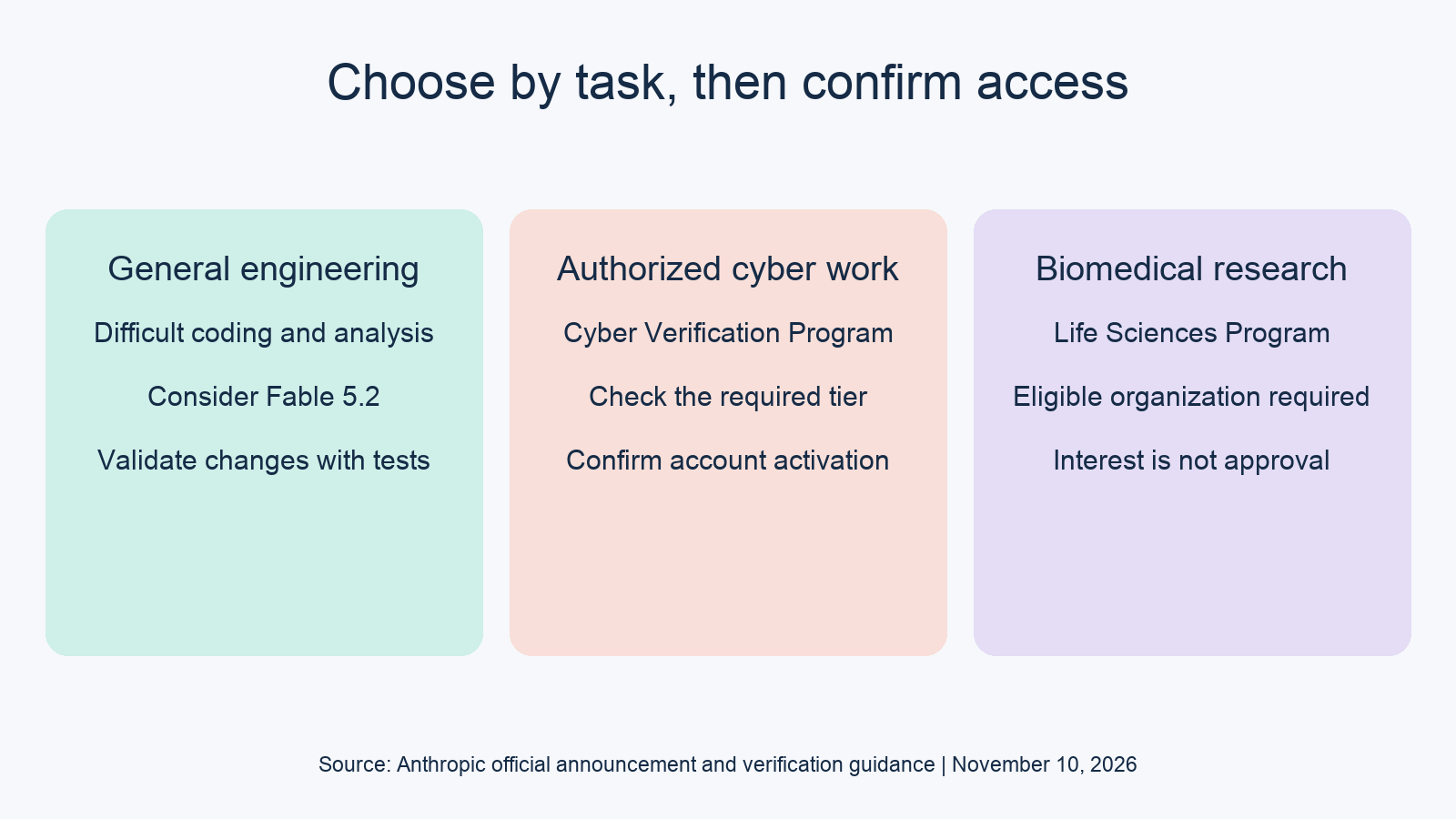
| Your task | Selection approach |
|---|---|
| Refactor a service or investigate ambiguous bugs | Consider Fable; verify the patch with your tests |
| Review code or patch a known security issue | Start with generally available models; inspect any safeguard interruption |
| Run authorized penetration testing | Check the appropriate cyber tier and approval |
| Build a security service for customers | Confirm external-use approval as well as internal access |
| Conduct biomedical research restricted by Fable | Apply through the life sciences program |
These are selection recommendations, not measured outcomes. Keep a human responsible for approving code changes, research conclusions, and security scope.
How should you interpret benchmark differences?
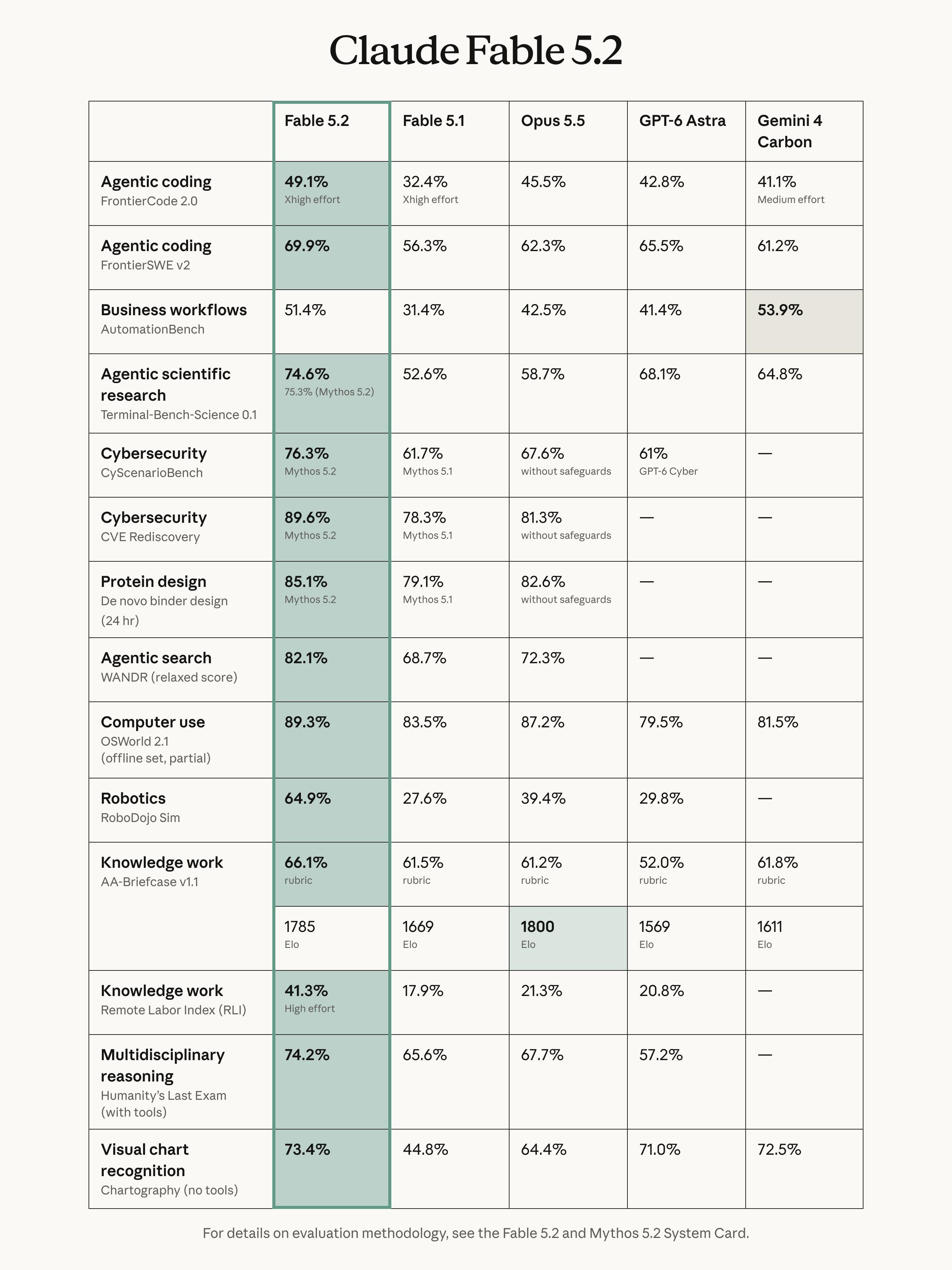
Read each benchmark’s model label, safeguard setting, effort level, and methodology before comparing numbers. Anthropic’s launch table includes Fable results for general tasks and Mythos results for sensitive domains. Those rows don’t form a controlled test proving Mythos is generally more capable than Fable.
Consult the Fable 5.2 and Mythos 5.2 system card for evaluation methodology. Vendor evaluations can help you choose what to investigate; they don’t establish your team’s success rate.
For your own decision, define an acceptable outcome before running a task. A migration needs passing tests and reviewable changes. A security finding needs evidence, reproducibility, and a justified severity assessment. Record safeguard interruptions separately from incorrect answers and transport failures.
Let your coding agent check the API contract with Apidog CLI
Use Apidog CLI to let your coding agent validate the integration around your selected model. Test authentication, response handling, and error paths in a project you control. Keep this contract check separate from claims about model intelligence or verification eligibility.
Start with the Apidog CLI installation guide, then configure your own token:
npm install -g apidog-cli@latest
apidog login --with-token <YOUR_APIDOG_TOKEN>
Give your agent this prompt:
In my Apidog project, create a test case for our Claude integration.
Use the model available to our approved account. Check successful
response structure and invalid-credential handling. Keep provider
credentials in the environment. Read and validate the CLI schema,
create the case, run it, and summarize failures. Do not attempt
to bypass model safeguards or obtain verification access.
The agent can inspect the schema and validate its prepared payload before writing:
apidog cli-schema get test-case-create
apidog cli-schema validate test-case-create --file case.json
apidog test-case create --project <PROJECT_ID> --file case.json
apidog run --test-case <CASE_ID> --project <PROJECT_ID> -e <ENV_ID> -r cli,json
These commands and flags were checked against installed CLI 2.2.12 help. The payload must use your project’s real endpoint and category identifiers. This is an illustrative workflow, not a live Anthropic test performed for this article.
For a Codex-based workflow, follow Apidog CLI in Codex. Once the case is useful, the CLI CI/CD guide explains how to carry repeatable checks into your pipeline.
Frequently asked questions
Is Mythos 5.2 smarter than Fable 5.2?
Anthropic says they share the same underlying model. Their principal distinction is safeguards and access. Sensitive-domain benchmark results don’t establish a universal intelligence advantage for Mythos.
Can an individual apply for Mythos access?
Yes. The cyber guidance allows individuals to apply for Defense Access. Red Team and Specialized Access are organization-only tiers. Application and approval remain separate steps.
Does buying a paid Claude plan guarantee Mythos access?
No. An eligible paid plan can support an application, but program approval and account activation requirements still apply. Check the specific organization, role, workspace, or linked platform you’ll use.
Does Fable support security-related development?
Generally available models support everyday secure development, according to the cyber guidance. Fable’s additional safeguards can restrict more sensitive work. Classify your task precisely and review any block before drawing conclusions.
Do both models require the same data-retention setup?
Check your account’s terms. The announcement describes 30-day safety-monitoring retention for other customers and exceptions for eligible zero-retention customers. Cyber-program requirements also apply. Confirm the arrangement with your administrator before sending sensitive material.