
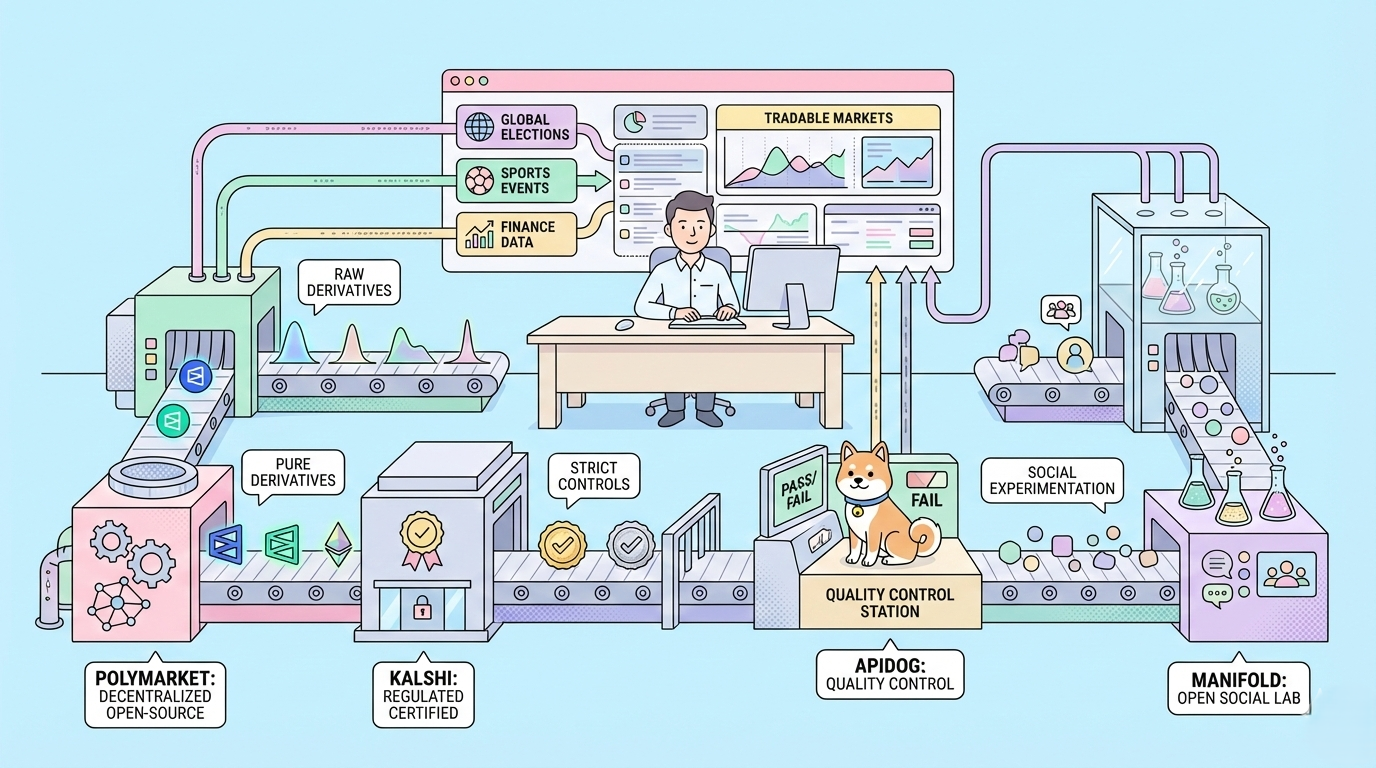
Prediction Market APIs empower developers to access crowd-sourced forecasts on events ranging from elections to sports outcomes. These Prediction Market APIs aggregate trader sentiments into probabilistic insights, enabling applications in finance, risk management, and decision-making tools.
As blockchain and AI advance, Prediction Market APIs deliver faster, more accurate data streams. Developers integrate Prediction Market APIs to build bots, dashboards, and automated strategies. Moreover, platforms now support seamless interactions through robust endpoints.
Transitioning from basics, developers must understand how Prediction Market APIs operate within decentralized ecosystems.
Core Features of Modern Prediction Market APIs
Prediction Market APIs typically include endpoints for market listings, order placement, and real-time updates. For instance, RESTful Prediction Market APIs handle GET requests for market data, while WebSockets in Prediction Market APIs push live price changes. Authentication in Prediction Market APIs often uses API keys or wallet signatures, protecting sensitive trading operations. Additionally, rate limits in Prediction Market APIs prevent abuse, with tiers scaling for enterprise users.
However, not all Prediction Market APIs offer the same depth. Some Prediction Market APIs focus on blockchain integration, whereas others prioritize regulatory compliance. Therefore, selecting the right Prediction Market APIs depends on your project's needs.
Top 10 Prediction Market APIs Dominating 2026
Developers evaluate Prediction Market APIs based on reliability, documentation, and scalability. The following list highlights the top Prediction Market APIs, each excelling in specific areas.
1. Polymarket Prediction Market API
Polymarket leads as a decentralized Prediction Market API on Polygon. This Prediction Market API provides endpoints like /markets for listings and /prices for real-time quotes. Developers use its CLOB Prediction Market API for order books and trading. Authentication relies on EIP-712 signatures, ensuring secure interactions. Moreover, WebSockets in this Prediction Market API deliver updates on orders and markets.
Key Feature:
- Decentralized order book via CLOB for efficient off-chain matching and on-chain settlement
- Gamma API for comprehensive market metadata, discovery, and event filtering
- SDK support in Python, TypeScript, and Rust for building trading bots and dashboards
- Multi-chain bridging and withdrawals for flexible USDC handling across ecosystems
SDKs for Python, TypeScript, and Rust accelerate development with this Prediction Market API. Rate limits start at 1,000 calls per hour, upgrading for premium users. Consequently, traders build arbitrage bots using this Prediction Market API's historical data access.

2. Kalshi Prediction Market API
Kalshi offers a regulated Prediction Market API for U.S. users. Its REST Prediction Market API includes /markets for event categories and /orders for placements. Token-based authentication secures this Prediction Market API, with sessions expiring every 30 minutes. Furthermore, FIX protocol support in this Prediction Market API caters to institutional traders.
Key Feature:
- CFTC-regulated infrastructure for compliant event contract trading in the US
- WebSocket streams for real-time order, fill, and market data updates
- RSA-PSS signed authentication with tiered rate limits and FIX protocol support
- Sandbox environment for risk-free testing of trading and portfolio strategies
Python and TypeScript SDKs simplify async operations in this Prediction Market API. Rate limits adjust by account type, encouraging efficient coding. As a result, developers create portfolio trackers leveraging this Prediction Market API's sandbox environment.
3. Manifold Markets Prediction Market API
Manifold Markets provides a flexible Prediction Market API using play money for testing. Endpoints such as /markets filter listings, while /bet handles authenticated placements. API keys authenticate this Prediction Market API, with a 500 requests per minute limit. Additionally, public endpoints in this Prediction Market API require no login for data fetches.
Key Feature:
- Play money system for zero-risk prototyping and community-driven market creation
- High-rate public read access to market data without authentication barriers
- Support for limit orders combined with automated market maker mechanics
- User-generated questions across unlimited topics for broad forecasting coverage
Partial SDKs support prototyping with this Prediction Market API. Its focus on social predictions makes this Prediction Market API ideal for community apps. Thus, users develop custom interfaces exploring diverse questions via this Prediction Market API.
4. PredictIt Prediction Market API
PredictIt specializes in political Prediction Market APIs. The read-only Prediction Market API endpoint /marketdata/all returns current prices without authentication. Third-party wrappers like Python's predictit enhance this Prediction Market API's usability. However, rate limits cap at one request per minute.
Key Feature:
- No-authentication required JSON access to real-time contract prices
- Focused datasets on US political events with historical CSV exports
- Lightweight endpoint structure for simple polling and election analytics
- Integration-friendly for third-party wrappers and aggregation tools
This Prediction Market API suits data analysis, offering CSV historical downloads. Developers monitor U.S. elections through this Prediction Market API's focused datasets. Therefore, it complements broader Prediction Market APIs in niche applications.
5. Metaculus Prediction Market API
Metaculus emphasizes forecasting in its Prediction Market API. Swagger specs detail endpoints for question metadata and distributions. Authentication targets research partners in this Prediction Market API. Moreover, it provides resolution and accuracy data.
Key Feature:
- Rich probabilistic distributions and community calibration metrics
- Access to resolved question data for accuracy benchmarking and modeling
- Support for binary, numeric, date, and multiple-choice forecast types
- API wrapper compatibility for AI forecasting bots and research integrations
This Prediction Market API excels in non-trading scenarios, like AI risk assessments. Developers integrate it for probabilistic models. Consequently, it bridges Prediction Market APIs with academic tools.
6. Smarkets Prediction Market API
Smarkets delivers a betting-oriented Prediction Market API. Endpoints cover odds and events, with OAuth authentication securing access. WebSockets in this Prediction Market API ensure real-time odds updates. Additionally, SDKs for multiple languages support this Prediction Market API.
Key Feature:
- Low-latency WebSocket streaming for live odds and event updates
- Broad coverage across sports, politics, and entertainment markets
- OAuth-based secure access with scalable rate limits
- Multi-language SDKs for high-volume retail and institutional integrations
Rate limits scale with usage in this Prediction Market API. Traders use it for sports and politics. Thus, it enhances Prediction Market APIs in high-volume environments.
7. Numerai Prediction Market API
Numerai focuses on stock predictions via its Prediction Market API. GraphQL endpoints query datasets and submissions. API keys authenticate this Prediction Market API, with limits based on stakes. Furthermore, it integrates machine learning models.
Key Feature:
- Crypto-rewarded ML model submissions against aggregated hedge fund signals
- GraphQL queries for datasets, submissions, and performance metrics
- Stake-based rate limiting tied to tournament participation
- Direct integration for building and staking algorithmic trading models
This Prediction Market API rewards accurate forecasts with crypto. Developers build algorithms using its signals. As such, it innovates within Prediction Market APIs for finance.
8. Augur Prediction Market API
Augur, a veteran in decentralized Prediction Market APIs, uses Ethereum. Endpoints fetch markets and outcomes, with wallet signatures for authentication. This Prediction Market API supports dispute resolutions. Moreover, its oracle system ensures fair settlements.
Key Feature:
- Permissionless on-chain market creation with decentralized oracle resolution
- Trust-minimized settlement through community dispute mechanisms
- Wallet signature authentication for secure, censorship-resistant access
- Reliable handling of diverse events in a fully decentralized environment
SDKs aid integration with this Prediction Market API. It handles diverse events reliably. Therefore, it remains a staple among Prediction Market APIs.
9. Gnosis Prediction Market API
Gnosis offers conditional tokens in its Prediction Market API. REST endpoints manage outcomes and liquidity. Authentication uses API keys for this Prediction Market API. Additionally, it integrates with DeFi protocols.
Key Feature:
- Conditional token standard for multi-outcome markets and complex hedges
- DeFi composability with automated liquidity and cross-protocol integrations
- REST endpoints for outcome management and position tracking
- Chain-agnostic framework for custom market deployment and settlement
This Prediction Market API enables complex hedges. Developers create custom markets easily. Hence, it advances Prediction Market APIs in blockchain finance.
10. Drift Prediction Market API
Drift provides Solana-based Prediction Market APIs for fast trades. Endpoints include perpetuals and spot markets, with serum integration. Wallet authentication secures this Prediction Market API. Furthermore, low-latency appeals to high-frequency users.
Key Feature:
- Ultra-low latency execution on Solana for perpetuals and event markets
- Serum DEX integration for high-frequency spot and derivatives trading
- Wallet-based authentication with tokenized real-world event support
- Optimized infrastructure for crypto-focused high-speed settlements
SDKs streamline development for this Prediction Market API. It focuses on crypto events. Consequently, it competes strongly in emerging Prediction Market APIs.
Integrating Prediction Market APIs with Apidog
Apidog excels at managing Prediction Market APIs. Users mock endpoints and generate docs automatically. For instance, import OpenAPI specs from these Prediction Market APIs into Apidog. This facilitates testing Polymarket or Kalshi Prediction Market APIs without live calls.
Moreover, Apidog's collaboration features share Prediction Market API setups. Developers debug authentication issues swiftly. Therefore, Apidog optimizes workflows involving multiple Prediction Market APIs.
Conclusion on Prediction Market APIs
These top Prediction Market APIs drive innovation in 2026. From Polymarket's decentralized approach to Kalshi's regulation, each Prediction Market API offers unique strengths. Developers select based on needs, leveraging tools like Apidog for seamless work. Ultimately, Prediction Market APIs empower informed decisions across industries.