On August 20, 2026, a model called ox-alpha appeared on third-party inference platforms. No vendor, no announcement, no model card. It had a 1-million-token context window and it cost nothing to use.
Within days it was one of the most-used models on those platforms. Within about 48 hours, the community had fingerprinted it as a Zhipu model. On August 26, Z.ai confirmed it: Ox Alpha was GLM-5.3-Flash, and the free week had been a deliberate test.
This is now a standard product-launch step rather than a curiosity. Here is how the pattern works, how people identified it, and what it means if you are the one consuming these models.
The timeline
August 20. ox-alpha shows up on OpenRouter and OpenCode as an anonymous model. 1M context, zero price. Anonymous models are not unusual on these platforms, but the combination of a very large context window and free access is a strong signal that somebody is subsidizing something.
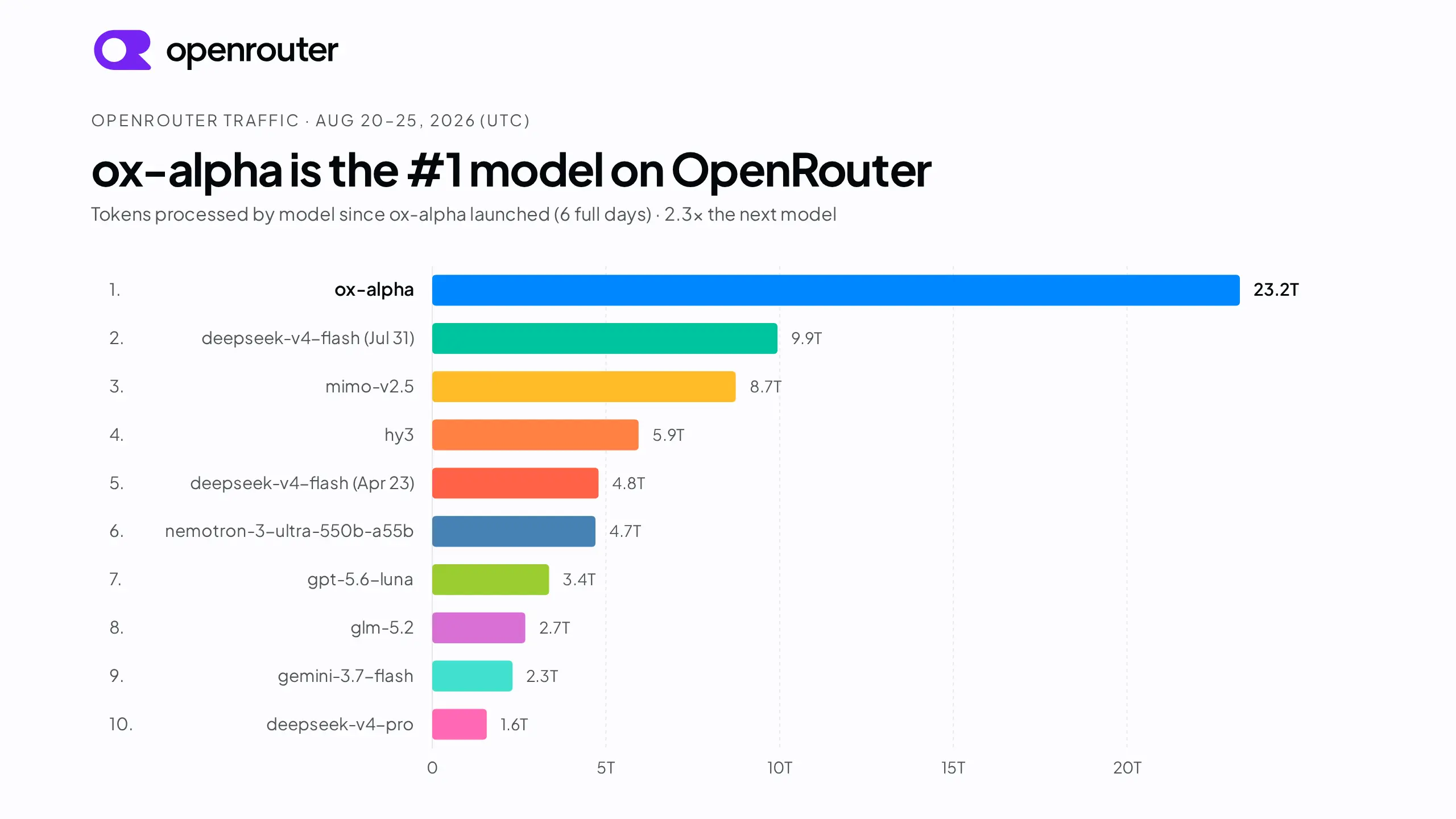
August 20 to 22. Usage climbs quickly. Free access to a capable long-context model is an easy sell, and the developer community routes real work through it. Meanwhile people start probing it to work out whose it is.
Roughly 48 hours in. The consensus lands on Zhipu, based on output characteristics rather than any disclosure.
August 26. Z.ai announces GLM-5.3-Flash and confirms Ox Alpha was it. The company describes the free week as an intentional test.
How you fingerprint an anonymous model
None of this requires special access. It is pattern matching on behavior that model families carry with them.
Tokenizer behavior. Different families split text differently. Feed a model unusual strings, emoji sequences, mixed scripts, long runs of whitespace, code with unusual indentation, and watch where it stumbles or how token counts land. Tokenizers are inherited across a family’s releases and are hard to disguise.
Self-reports under pressure. Models are trained on data that includes descriptions of themselves. Direct questions get evasive or wrong answers, but oblique prompting often surfaces training-data traces: characteristic phrasings, a knowledge cutoff, a house style for refusals.
Refusal and formatting style. How a model declines, how it structures a list, whether it opens with a preamble, whether it uses particular section conventions. These are downstream of post-training and tend to be consistent within a lab.
Multilingual behavior. A model trained heavily on Chinese and English data behaves differently on Chinese prompts than one that treated Chinese as a long-tail language. For a Zhipu model this is a strong tell.
Benchmark shape. Run a quick evaluation battery and compare the profile of strengths and weaknesses against known models. Absolute scores matter less than the shape: which categories are strong relative to which others.
Serving characteristics. Latency patterns, throughput, context limits, and which parameters the endpoint accepts all leak information about the stack behind it.
We watched the same process play out when Pony Alpha turned out to be a DeepSeek or GLM model. The methodology generalizes.
Why vendors do this
A stealth launch buys things a closed beta cannot.
Real traffic at real scale. Internal evaluations and friendly testers produce a narrow slice of what people actually do. A week of open public traffic surfaces the long tail: the weird prompts, the abusive ones, the enormous contexts, the tool-calling loops nobody designed for.
Load testing that is honest. You learn what your serving stack does under genuine concurrency. Z.ai says it ran the Ox Alpha week entirely on domestic Chinese accelerators using an SGLang-based stack, and claims per-token serving cost comparable to mainstream NVIDIA hardware. That is a vendor claim about its own infrastructure with no independent verification, but it is a claim you can only make credibly after serving real traffic.
Unbranded reception. People’s reaction to “a good anonymous model” is different from their reaction to a model with a logo attached. Anonymity strips out brand priors in both directions.
Free marketing on reveal. By announcement day, a population of developers had already used the model and formed positive opinions. That is more persuasive than any benchmark table.
The cost is goodwill risk. Users who built something during a free week discover their dependency now has a price. In this case the reveal came with a 50% launch discount running through September 9, 2026, which softens the landing.
What was actually behind the curtain
GLM-5.3-Flash is a 320B-parameter mixture-of-experts model with 18B active per token, released under the MIT license with weights on Hugging Face. It uses hybrid linear and sparse attention, holds 1,048,576 tokens of context, and is the first natively multimodal model in the GLM-5 series.
Independent measurement from Artificial Analysis puts it at 57 on the Intelligence Index, against 60 for the larger GLM-5.3 and a median of 27 for open-weight models of similar size.
The full picture is in our GLM-5.3-Flash explainer.
One detail explains the free week better than any marketing theory: Z.ai reports the model uses roughly three times less attention compute than GLM-5.3 and a KV cache about 4.4 times smaller. Giving away a model that cheap to serve is a much smaller bet than giving away a frontier flagship. The economics of the stunt were built into the architecture.
What this means for you
Anonymous models on routers are usually somebody’s unreleased flagship. An unbranded model with an unusually large context window and no price is not a hobby project. Someone is paying for that inference.
Free access is temporary by design. If you build during a free window, expect the price to arrive. Ox Alpha went from free to $0.15 per million input tokens in six days, which is cheap but is not zero.
Do not put stealth models in production. No model card, no versioning guarantee, no deprecation notice, no support. The model can change underneath you or vanish. Evaluating one is fine. Depending on one is not.
Your evaluation is worth more than the reveal. By the time the announcement lands, you may already have a week of real data about how the model handles your workload. That beats any benchmark table published by the vendor.
That last point only holds if you actually captured the data. Ad hoc prompting during a free week produces impressions; a saved suite produces evidence. Keeping your evaluation prompts as a collection in Apidog, with the model id and base URL as environment variables, means the next time an interesting anonymous model appears you can point the same suite at it and get a comparison instead of a feeling. When it is revealed and priced, you already know whether it is worth paying for.
What the free week actually revealed
Strip out the marketing and the Ox Alpha episode produced three genuinely useful signals.
The model is cheap to serve, and that is architectural. Roughly three times less attention compute and a KV cache about 4.4 times smaller than GLM-5.3 is not a pricing decision, it is a design one. That makes the low list price more likely to persist than a promotional rate would be. Our pricing breakdown works through what that means in practice.
Open weights followed the hosted launch. The model went up on Hugging Face under the MIT license, so the week of free hosted access was not the only way to use it for free. Anyone with the hardware can run it indefinitely. Running it locally covers what that takes.
Multimodality was the part nobody knew to test. During the anonymous week, most people used Ox Alpha as a text model, because there was no model card telling them it took images. A capability that turned out to be the headline feature went largely unexercised by the very population that was supposedly stress-testing it. That is the structural weakness of an unbranded launch: you get volume, but you get volume aimed at what people assume the model does. Our vision guide covers the pathway that went untested.
The wider pattern
Ox Alpha was not the first and will not be the last. Stealth deployment on third-party routers has become a normal pre-release stage, sitting between internal evaluation and public launch.
For consumers of these models, the practical stance is straightforward. Test them, learn from them, keep records of what you find, and do not build anything load-bearing on a model that has no name. The free week is a research opportunity, not a supply chain.
FAQ
What was ox-alpha? GLM-5.3-Flash, Z.ai’s natively multimodal 320B-A18B open-weights model, deployed anonymously from August 20, 2026 and revealed on August 26.
Is it still free? No. The free period ended at announcement. A 50% launch discount runs through September 9, 2026, after which list pricing of $0.15 input and $0.50 output per million tokens applies.
How did people work out it was Zhipu? Tokenizer behavior, output style, multilingual handling, refusal patterns, and benchmark shape, matched against known GLM releases. No inside information required.
Why give a model away for free? Real traffic at scale, honest load testing, unbranded feedback, and an installed base of positive opinion on launch day.
Should I use anonymous models on OpenRouter? For evaluation, yes. For production, no. They carry no versioning, support, or deprecation guarantees.