A pull request edits openapi.yaml. The CI checks go green. The spec is valid, it lints clean, and two reviewers approve it. Three days later a mobile client starts throwing null-pointer crashes because a response field that used to be there is gone. Nobody removed it on purpose. Someone renamed a property during a refactor, and nothing in the review caught it.
This is the gap a plain validator never sees. A spec can be perfectly well-formed and still break every consumer that depends on it. The only way to know is to compare the new spec against the version it replaces, change by change, and ask one question: would this break a client that worked yesterday? That comparison is an OpenAPI diff, and running it as a merge gate is one of the highest-return checks you can add to an API repo.
What an OpenAPI diff actually compares
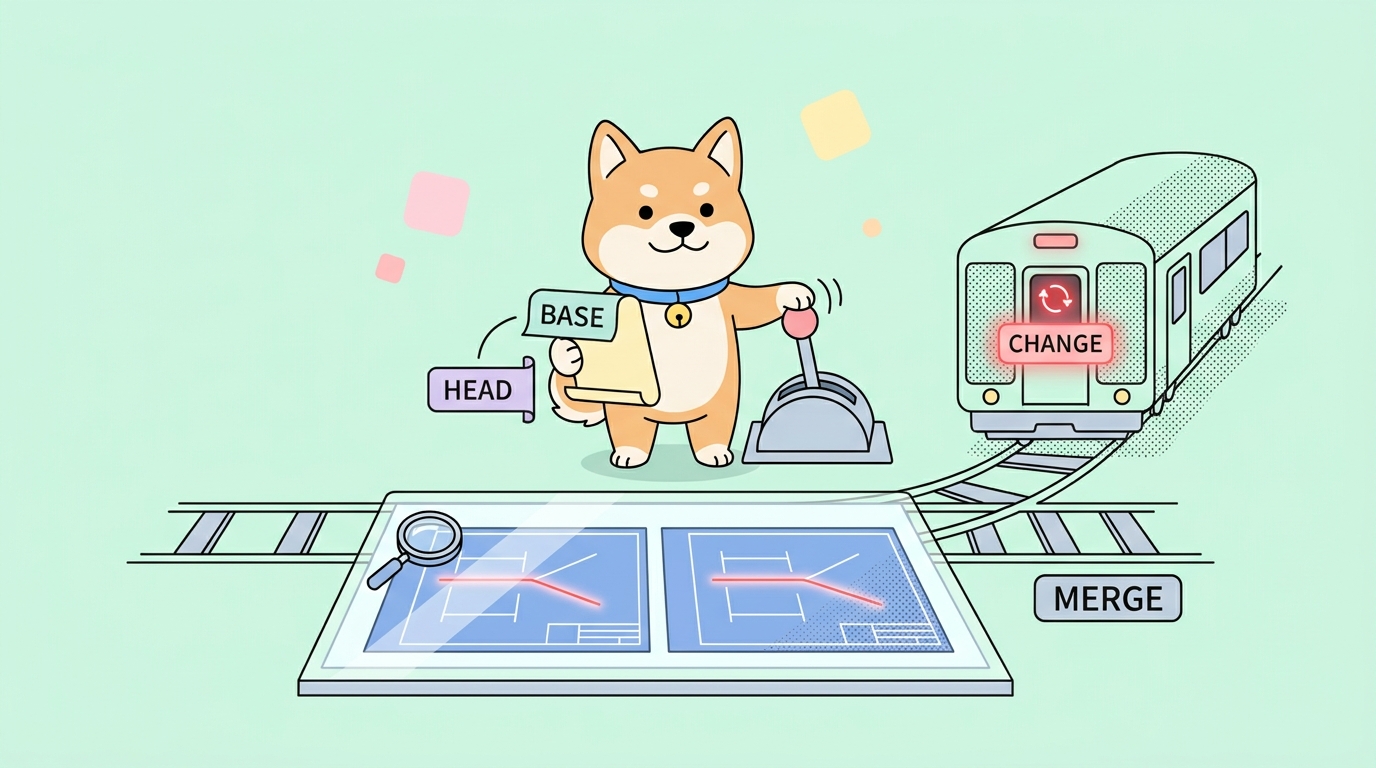
An OpenAPI diff takes two specifications, a base and a head, and reports what changed between them. The base is usually the spec on your target branch (what’s live). The head is the spec your pull request proposes. A good diff tool doesn’t just dump a textual delta the way git diff would. It understands OpenAPI structure, so it can tell the difference between cosmetic edits and contract-breaking ones.
Here’s the distinction that matters. Some changes are additive and safe:
- Adding a new optional request parameter
- Adding a new response field
- Adding a whole new endpoint
- Adding a new enum value to a request body
Existing clients keep working through all of those. They send what they always sent and read what they always read. Other changes are backward-incompatible, and these are the ones that hurt:
- Removing a response field a client reads
- Renaming a property (a remove plus an add, as far as a client is concerned)
- Making a previously optional parameter required
- Narrowing a type, like
stringtointeger - Removing an enum value the client might send
- Deleting an endpoint or an HTTP method
The job of an OpenAPI diff tool is to scan every path, parameter, schema, and response across both documents and sort each change into one of those buckets. That classification is the whole point. A raw line diff buries a removed required field under fifty lines of reformatting. A structural diff surfaces it as a breaking change and tells you which path it lives under.
If you want the underlying mental model for why some changes break and others don’t, the guide on how to version and deprecate APIs at scale covers the compatibility rules in depth. The diff tool is how you enforce those rules mechanically instead of hoping a reviewer remembers them.
oasdiff: the open-source workhorse
oasdiff is the open-source tool most teams reach for. It’s a single Go binary, it’s fast, and it’s built specifically around the breaking-change question. It reads OpenAPI 3.0 and 3.1 documents and gives you a few subcommands depending on what you want out of the comparison.
The three you’ll use most:
diffreports the full set of differences between two specs.breakingreports only the backward-incompatible changes.changelogproduces a human-readable list of every significant change, breaking or not.
For a merge gate, breaking is the one that matters. Point it at your base spec and your head spec:
oasdiff breaking base-openapi.yaml head-openapi.yaml --fail-on ERR
base-openapi.yaml is the spec from the target branch and head-openapi.yaml is the one in the pull request. The breaking subcommand prints only the incompatible changes. The --fail-on ERR flag is what turns this into a gate: it makes the command exit with a non-zero status when it finds a change classified at the ERR level. Non-zero exit is the universal signal CI reads as failure.
That severity model is worth understanding. oasdiff sorts breaking changes into levels, and ERR is the serious one, a change that will break clients. WARN covers changes that might break some clients depending on how they’re written, and INFO is informational. You decide where to draw the line. --fail-on ERR blocks only the definite breaks. --fail-on WARN is stricter and catches the maybes too.
When you want the readable rundown for a changelog or a PR comment rather than a pass/fail, the changelog subcommand is the friendlier output:
oasdiff changelog base-openapi.yaml head-openapi.yaml
oasdiff has a few genuinely useful touches. It does endpoint matching that survives renamed path parameters, so it doesn’t flag {userId} becoming {id} as a delete-plus-add when the path is otherwise identical. It can merge allOf schemas before comparing so inheritance doesn’t produce noise. And it emits more than plain text: HTML, JSON, YAML, and Markdown are all available through the output flags, which makes it easy to feed the result into a CI annotation or a generated changelog. For a tool you can drop into a pipeline in five minutes and trust to be conservative about what it calls breaking, it’s hard to beat.
openapi-diff: the JVM alternative
If your stack already lives on the JVM, OpenAPITools/openapi-diff is a solid second option and worth knowing about. It’s a Java-based tool (Java 8 and up) that compares two OpenAPI 3.x specs and renders the difference as HTML, Markdown, AsciiDoc, JSON, or console text. You can run it from a built jar, through Maven, via Homebrew, or as a Docker image, so it fits a range of build setups without much fuss.
Its comparison goes deep into parameters, responses, endpoints, and HTTP methods, and it draws the same line everyone cares about: changes that kept backward compatibility versus changes that broke it. The CLI is straightforward:
openapi-diff old-openapi.yaml new-openapi.yaml --fail-on-incompatible
The --fail-on-incompatible flag exits non-zero only when a change broke backward compatibility, which is exactly the gate behavior you want. There’s a stricter --fail-on-changed if you’d rather fail on any change at all, and a --state mode that prints just no_changes, compatible, or incompatible when you want a one-word answer to script around.
Where it shines is the rendered output. The HTML and Markdown reports are clean and detailed, which makes openapi-diff a strong pick when you want a diff artifact a human will actually read, not just a CI exit code. The tradeoff is the JVM dependency and a heavier startup than a Go binary. If your team is already a Java shop, that cost is zero and the tool slots right in. If you’re not, oasdiff is the lighter touch. Both answer the breaking-change question well; pick the one that matches the runtime you already maintain.
Wiring the diff into CI as a merge gate
A diff you run by hand catches nothing, because the time you forget to run it is the time the break ships. The gate has to live in the pipeline and fire on every pull request that touches the spec.
The one wrinkle in CI is that you need both versions of the spec present at once: the base from the target branch and the head from the PR. The PR checkout gives you the head. You pull the base straight out of git history without a second checkout:
name: openapi-diff
on:
  pull_request:
    paths:
      - "openapi.yaml"

jobs:
  breaking-changes:
    runs-on: ubuntu-latest
    steps:
      - uses: actions/checkout@v4
        with:
          fetch-depth: 0
      - name: Get base spec
        run: git show origin/${{ github.base_ref }}:openapi.yaml > base-openapi.yaml
      - name: Install oasdiff
        run: |
          curl -fsSL https://raw.githubusercontent.com/oasdiff/oasdiff/main/install.sh | sh
      - name: Diff for breaking changes
        run: oasdiff breaking base-openapi.yaml openapi.yaml --fail-on ERR
A few details carry the weight here. fetch-depth: 0 pulls the full history so git show can reach the base branch. The git show origin/<base>:openapi.yaml line reads the spec as it exists on the target branch and writes it to a file, no extra clone needed. The paths filter means the job only runs when the spec actually changes, so unrelated PRs don’t pay for it. And the final step is the gate: if oasdiff breaking finds an ERR-level change, it exits non-zero, the job goes red, and the PR shows a failing check before anyone clicks merge.
The author sees precisely which change broke compatibility, on which path, while the code is still in review. That’s the entire value. The break gets caught at the cheapest possible moment instead of in a customer’s crash report.
Not every breaking change is a mistake, of course. Sometimes you’re shipping a deliberate major version and the break is intentional. The clean pattern is to gate by default and require an explicit override for the exceptions: a label on the PR, a version bump in info.version, or a separate approved workflow. That way a break is always a decision someone made on purpose, never an accident that slipped through. The API versioning strategy guide walks through when a break earns a new major version versus when it should just be avoided.
The gap a diff can’t close
Here’s the limit of every tool above, and it’s an important one. A diff compares two files. It tells you the new document is backward-compatible with the old document. It says nothing about whether your running service actually matches either one.
That’s a different failure, and it’s the one that bites hardest in production. The spec promises a created_at field; the implementation quietly stopped returning it three sprints ago. The spec says an endpoint returns 200; the live service returns 500 under a condition nobody tested. The diff is clean because both spec versions agree. The contract and the code don’t. A static diff has no way to know, because it never talks to the API.
Closing that gap means testing the live API against the contract, not just diffing the contract against itself. You generate tests from the spec, run them against the running service, and assert that real responses match the documented shapes. That’s contract testing, and it’s the layer that catches drift between what you wrote down and what you actually shipped.
Closing it with Apidog and the Apidog CLI
Apidog is built for this loop, which makes it a natural companion to the diff step rather than a replacement for it. You import or sync your OpenAPI spec into an Apidog project, and Apidog can generate test scenarios directly from the spec, with assertions derived from the schema. The tests check that real responses match the documented types, required fields, and status codes. You build and maintain those scenarios visually instead of hand-writing a parallel set of test scripts that drift out of sync every time the contract moves.
Because Apidog keeps design, mocking, and testing in one workspace, the spec stays the source of truth across all of them. You can download Apidog and import an existing spec to try the loop on your own API. If you’re still deciding how to keep that spec under control across versions in the first place, the walkthrough on version-controlling an OpenAPI spec with Git pairs well with this workflow.
The Apidog CLI is what runs those scenarios headlessly in your pipeline. It’s an npm package:
npm install -g apidog-cli
You run a scenario by ID, point it at the environment you want to validate, and ask for a CI-friendly report:
apidog run \
  --access-token $APIDOG_ACCESS_TOKEN \
  -t <scenarioId> \
  -e <environmentId> \
  -r junit,cli \
  --out-dir ./apidog-reports
The access token authenticates the run and lives in a CI secret, never in a committed file. The -t flag selects the scenario, -e selects the environment, and -r junit,cli emits machine-readable JUnit XML for your CI dashboard alongside readable terminal output for the build log. You don’t guess at the IDs: you copy the exact command, with the real scenario and environment IDs already filled in, from the scenario’s CI/CD tab in Apidog. If you want the full option surface, the complete CLI guide documents every flag, and apidog run --help prints them on demand.
The gate behavior is the same principle as the diff. When an assertion fails, because a live response no longer matches the contract, apidog run exits non-zero. CI reads the exit code, marks the step failed, and blocks the merge. No extra configuration. As long as the run step is in the pipeline, a contract regression stops the line the same way a breaking-change diff does.
The full pre-merge sequence
Put the two halves together and you get a pipeline that catches both kinds of break. The diff catches changes that would break a client by reading the spec. The contract test catches a service that no longer honors the spec by exercising the running API. Run them as separate jobs:
jobs:
  breaking-changes:
    runs-on: ubuntu-latest
    steps:
      - uses: actions/checkout@v4
        with:
          fetch-depth: 0
      - run: git show origin/${{ github.base_ref }}:openapi.yaml > base-openapi.yaml
      - run: curl -fsSL https://raw.githubusercontent.com/oasdiff/oasdiff/main/install.sh | sh
      - run: oasdiff breaking base-openapi.yaml openapi.yaml --fail-on ERR

  contract-conformance:
    runs-on: ubuntu-latest
    steps:
      - uses: actions/checkout@v4
      - uses: actions/setup-node@v4
        with:
          node-version: "20"
      - run: npm install -g apidog-cli
      - name: Run contract tests
        run: |
          apidog run \
            --access-token "$APIDOG_ACCESS_TOKEN" \
            -t 605067 \
            -e 1629989 \
            -r junit,cli \
            --out-dir ./apidog-reports
        env:
          APIDOG_ACCESS_TOKEN: ${{ secrets.APIDOG_ACCESS_TOKEN }}
      - name: Upload report
        if: always()
        uses: actions/upload-artifact@v4
        with:
          name: apidog-report
          path: ./apidog-reports
The two jobs run in parallel. The diff job reads files and needs nothing but git, so it finishes in seconds. The conformance job needs a reachable environment, so it usually runs against a deployed staging build. The if: always() on the upload keeps the report flowing even when the tests fail, which is exactly when you want to read it. If either job goes red, the PR is blocked. For more on running the CLI in real pipelines, the Apidog CLI GitHub Actions guide and the broader CI/CD pipeline walkthrough go deeper on the wiring.