
When a new model launches, two kinds of numbers land at once and rarely agree: the lab’s own figures and independent testers’ results. Kimi K3, which Moonshot AI shipped on July 16, 2026, is a clean case study in reading both without getting fooled. On the independent side it looks smart but not fast; on the vendor side, Moonshot calls it “frontier-level” while admitting in the same post that it still trails the top proprietary systems. This piece pulls those threads apart so you can see what’s proven, what’s claimed, and what nobody has published yet.
TL;DR: how Kimi K3 actually benchmarks
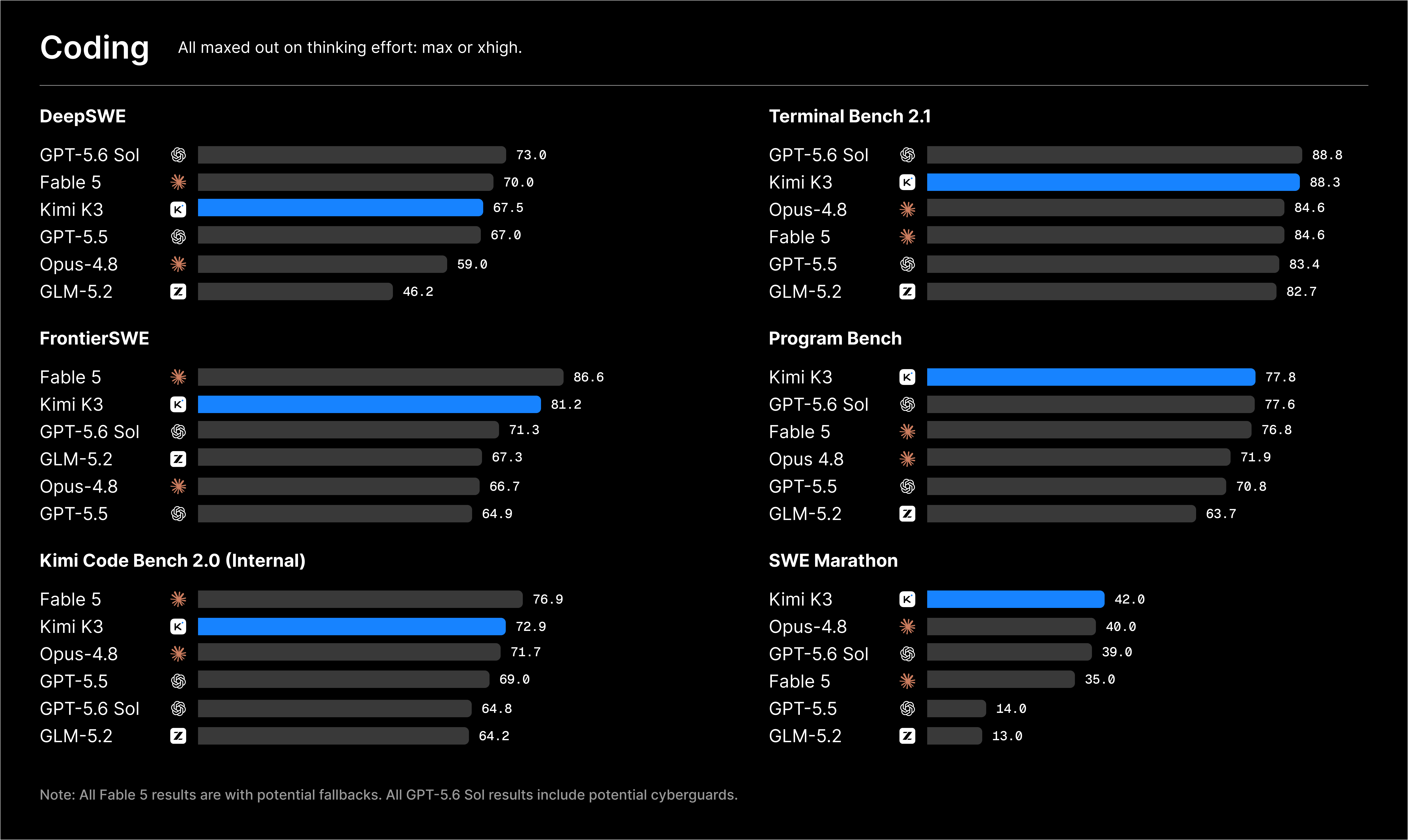
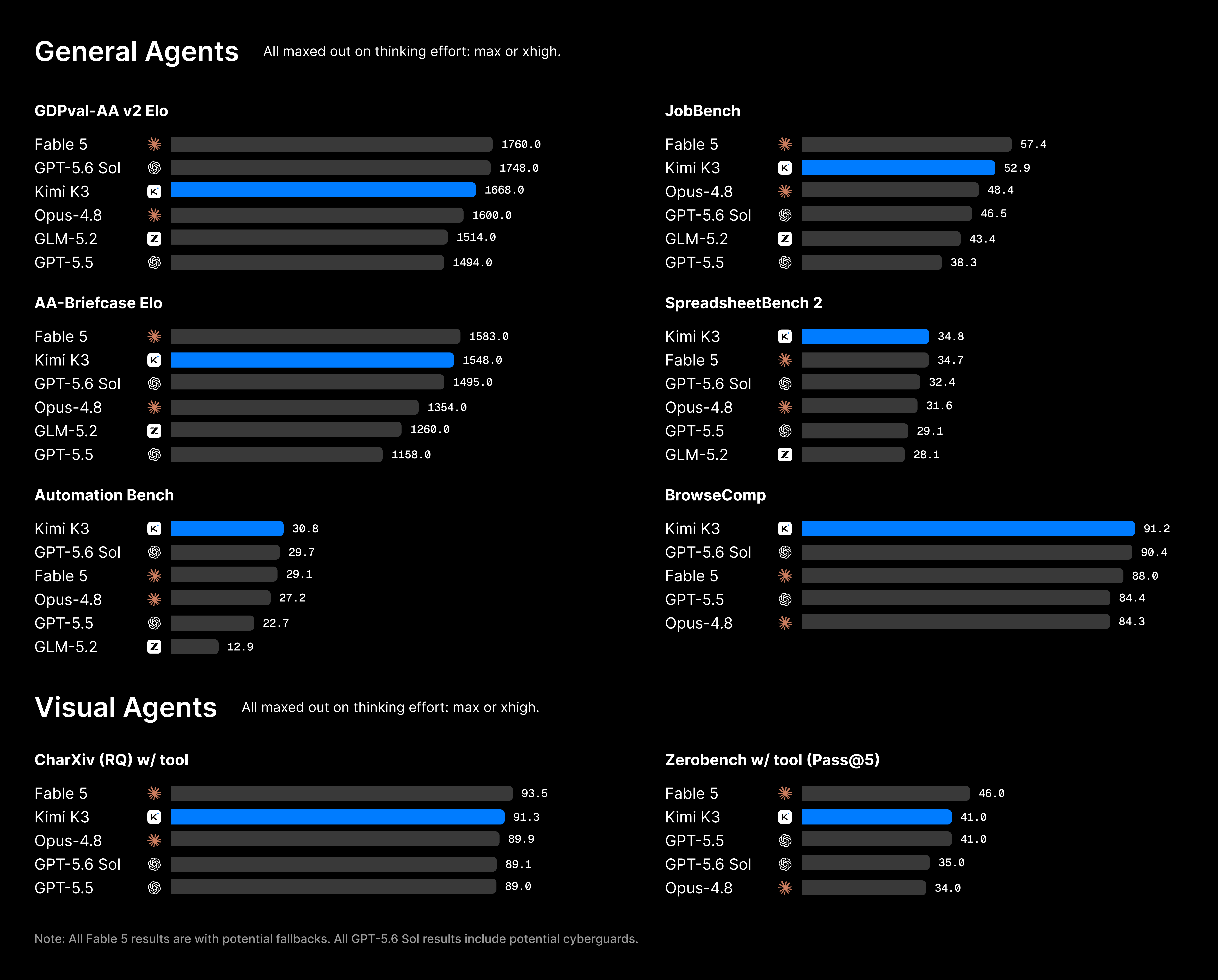
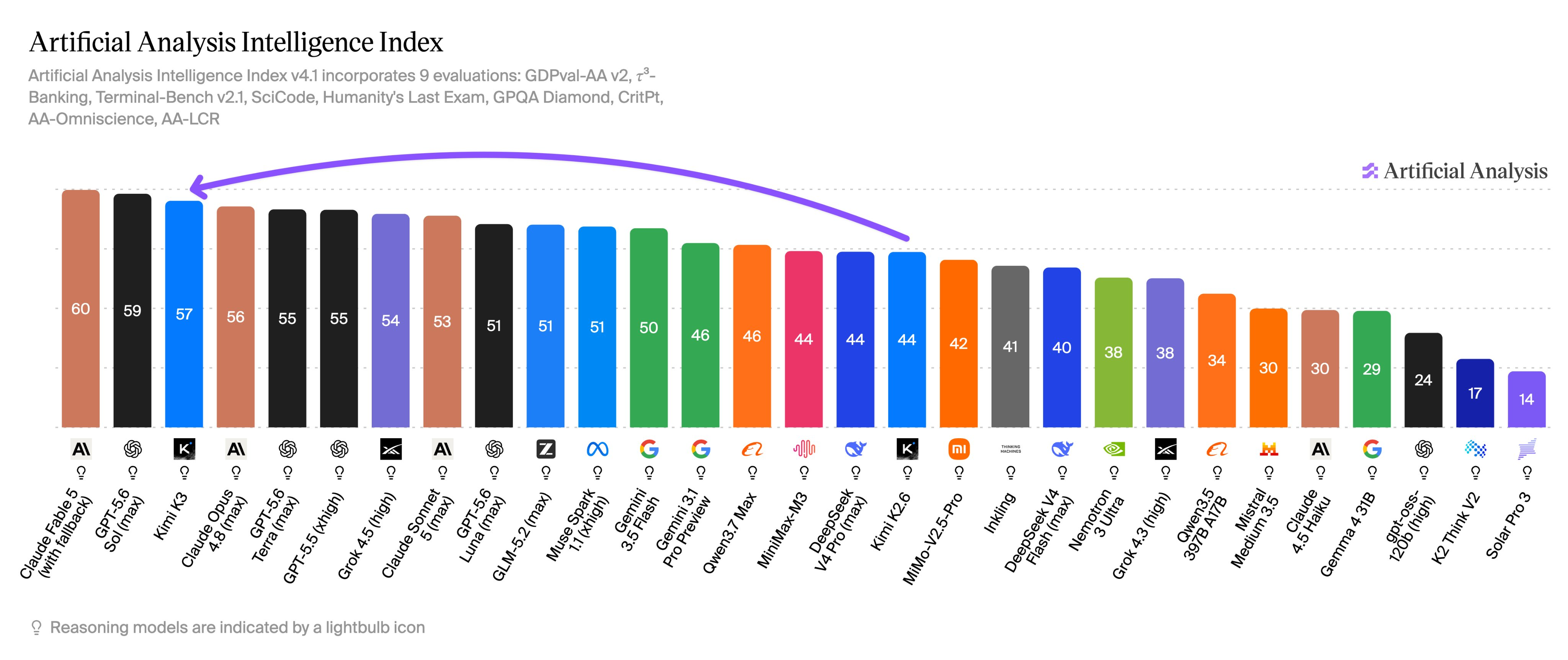
On the independent Artificial Analysis Intelligence Index, Kimi K3 scores 57 and ranks #4 of 189 models, genuine frontier company. But its measured output speed is about 62 tokens per second, below the 72.7 median for its price tier, so it’s a strong reasoner that runs on the slower side. Moonshot’s launch post claims “frontier-level performance across our evaluation suite,” then states plainly that K3 “still trails the most powerful proprietary models, Claude Fable 5 and GPT-5.6 Sol.” Moonshot’s published benchmark table is strong: K3 leads BrowseComp, Automation Bench, and SpreadsheetBench 2, comes second on Terminal-Bench 2.1, and lands third on DeepSWE. Those are vendor-run numbers, not independently reproduced, so treat them as directional; what’s still missing is a neutral rerun of the coding suites and a classic SWE-bench Verified score. The honest summary: verified strong general intelligence, credible but vendor-run task numbers, and a self-declared ceiling below the two proprietary leaders.
kimi-k3 endpoint and measure latency, cost, and output quality on your actual prompts. That number beats any leaderboard for deciding whether K3 belongs in your stack.The three claims, kept separate
Model launches feel confusing because three different kinds of statements get blended into one headline. Pull them apart and the picture sharpens. For the full spec sheet, the what is Kimi K3 pillar covers architecture and pricing; here we stay on the numbers.
Claim 1: the independent anchor (Artificial Analysis)
Artificial Analysis is a third party: it buys API access, runs a fixed evaluation suite, and publishes results without lab input. That’s why its numbers carry the most weight here.
For Kimi K3, the anchor points are:
- Intelligence Index: 57. A composite of reasoning, knowledge, and coding evaluations rolled into one figure.
- Rank: #4 of 189 models. Only three models score higher on general intelligence at the time of writing.
- Output speed: about 62 tokens per second. The tier median is 72.7, so K3 generates slower than the typical peer at its cost level.
- Time to first token: roughly 2 seconds. A short but real wait before generation begins.
Together those numbers tell a specific story: K3 is smart but not fast. It earns a top-four rank, then gives some back in throughput. For an overnight batch job that barely matters. For an interactive coding assistant where a developer waits on every completion, 62 tokens per second is a real tax. Same model, opposite verdicts, depending on what you build.
Claim 2: what Moonshot says about itself
Moonshot’s launch post is a vendor document, written to sell. It describes K3 as showing “frontier-level performance across our evaluation suite, consistently outperforming other tested models.” Notice “our evaluation suite.” Choosing your own benchmark mix isn’t cheating, but it is home-field advantage: every vendor picks the evals where it looks strong, so the claim is directional, not decisive.
A secondary claim from launch coverage says K3 “ranked first in 4 of 8 real-world automation benchmarks, including Automation Bench, SpreadsheetBench 2, and BrowseComp,” while placing second to Claude Fable 5 on most others. It’s a vendor-adjacent, secondary-source figure no independent tester has reproduced, so file it under “interesting, unconfirmed” until a neutral party runs those benchmarks and shows its work.
Claim 3: the ceiling Moonshot admits
The most useful sentence in the launch post undercuts the hype. Moonshot writes that K3’s “overall performance still trails the most powerful proprietary models, Claude Fable 5 and GPT-5.6 Sol.” A vendor volunteering its own ceiling is rare and worth trusting.
This matters for expectations. For your hardest tasks, Moonshot itself says the proprietary options are still ahead on raw capability. The K3 pitch was never “we beat everyone”; it’s “frontier-adjacent quality in an open model at a fraction of the cost.” For the head-to-heads, the Kimi K3 vs GPT-5.6 Sol and Kimi K3 vs Claude Opus 4.8 breakdowns go deeper.
Independent vs vendor numbers, side by side
Here’s the whole benchmark story in one view, sorted by who’s making each claim.
| Claim | Who says it | What it measures | How much to trust it |
|---|---|---|---|
| Intelligence Index 57, rank #4 of 189 | Artificial Analysis (independent) | Composite general intelligence | High. Third party, fixed suite, no lab input. |
| Output ~62 tokens/sec (tier median 72.7) | Artificial Analysis (independent) | Generation throughput | High. Measured, reproducible. |
| Time to first token ~2 seconds | Artificial Analysis (independent) | Responsiveness | High. Measured. |
| “Frontier-level performance across our evaluation suite” | Moonshot (vendor) | Self-selected benchmark mix | Directional. Home-field advantage applies. |
| Wins BrowseComp, Automation Bench, SpreadsheetBench 2; 2nd on Terminal-Bench 2.1; 3rd on DeepSWE | Moonshot (vendor, published table) | Task-level agentic performance | Medium. Real published numbers, but vendor-run and not independently reproduced. |
| Trails Claude Fable 5 and GPT-5.6 Sol overall | Moonshot (vendor, self-admitted) | Ceiling vs proprietary leaders | High. Vendor admitting its own limit. |
| Independently reproduced coding scores + classic SWE-bench Verified | Nobody yet | Coding-specific ability | Not published. Moonshot’s own numbers exist; neutral reruns don’t. |
The pattern is easy to miss: the numbers you can most trust (the independent ones) describe general intelligence and speed, while the task-level numbers are real but vendor-run. That gap is where your own testing pays off.
Here is Moonshot’s published launch table, at the max reasoning setting, so you see the shape of the claim rather than a paraphrase.
| Benchmark | Kimi K3 | Claude Fable 5 | GPT-5.6 Sol | Claude Opus 4.8 |
|---|---|---|---|---|
| Terminal-Bench 2.1 | 88.3 | 84.6 | 88.8 | 84.6 |
| DeepSWE | 67.5 | 70.0 | 73.0 | 59.0 |
| BrowseComp | 91.2 | 88.0 | 90.4 | 84.3 |
| Automation Bench | 30.8 | 29.1 | 29.7 | 27.2 |
| SpreadsheetBench 2 | 34.8 | 34.7 | 32.4 | 31.6 |
Two things pop out. K3 beats both Claude Fable 5 and Claude Opus 4.8 on four of these five, and edges GPT-5.6 Sol on BrowseComp, Automation Bench, and SpreadsheetBench 2. But on DeepSWE, the hardest agentic-coding metric here, K3 lands a clear third behind Sol and Fable 5. That row is why Moonshot’s “still trails the two proprietary leaders overall” line reads as credible: K3 wins on breadth and loses the hardest coding contest.
What’s still missing
A benchmark analysis is only as honest as its list of unknowns. Here’s what Kimi K3 does not yet have publicly.
Independent coding scores. Moonshot published its own Terminal-Bench 2.1 and DeepSWE numbers, but Artificial Analysis folds coding into the composite Index and doesn’t post K3’s standalone SWE-bench Verified figure. Any precise SWE-bench percentage you see for K3 today is citing Moonshot’s own runs or estimating; wait for the neutral figure.
Reproduced automation results. A third party still needs to rerun Moonshot’s Automation Bench, SpreadsheetBench 2, and BrowseComp wins with published methodology. Agentic benchmarks are sensitive to scaffolding, prompt format, and retry logic, so vendor and independent numbers can diverge widely.
Long-context quality at 1M tokens. K3 ships a 1 million token window, but a large window and reliable recall across it are different things. Published long-document scores at full context aren’t broadly available yet, so if your use case leans on the full window, test it yourself.
Moonshot also committed to releasing full open weights shortly after launch, which should bring community benchmarks that confirm or complicate the launch-day story. The absence of a number is not a bad number; it’s just one nobody has published yet.
How to read vendor benchmarks without getting played
You don’t need to distrust every vendor chart, just a short checklist to weigh them.
- Who ran the test? Independent beats self-reported. If the lab ran it, assume the mix favors them.
- Is the exact eval named and versioned? “SWE-bench Verified” is checkable; “our internal coding suite” is not. Named benchmarks let a third party reproduce the result.
- What got left out? A chart of three wins isn’t a chart of all eight. The absent metrics are usually where the model underperforms.
- Does the vendor admit a ceiling? A lab that names the models it trails, as Moonshot does with Fable 5 and Sol, beats one claiming a clean sweep.
- Does it match the independent anchor? When a vendor claim and a neutral source disagree, believe the neutral source.
Run K3’s launch through that filter and it holds up better than most. The independent Index confirms real strength, the vendor volunteers its own limits, and the weak spot is the unverified automation claim, which fails checks 1 and 3. For a longer worked example, the GLM-5.2 benchmarks breakdown uses the same independent-first approach, and the GPT-5.6 vs Claude Fable 5 comparison shows how two frontier models trade wins across suites.
The real test: benchmark K3 for your task
Public leaderboards answer a general question: how smart is this model on average? Your job is specific: how well does it do the one thing you need? A model ranked #4 overall might be first for your exact prompt shape, or trail a cheaper model tuned for your domain. The only way to know is to measure. Here’s a lightweight process for a purchasing decision.
Build a golden set. Collect 20 to 50 real prompts from your workload, with known-good outputs where you have them: real tickets, real code diffs, real support questions. Synthetic prompts lie; production prompts don’t.
Fix your variables. Pin the model ID (kimi-k3), temperature, system prompt, and max tokens. Change one thing at a time or you can’t attribute the difference.
Measure four things per prompt. Output quality (did it solve the task), latency (time to first token plus total generation), cost (input plus output tokens times price), and consistency across several runs. The 62 tokens-per-second figure is a starting estimate; your real latency depends on prompt length and region.
Compare against your incumbent. Run the identical golden set against whatever you use today. A model is only worth switching to if it wins on the axis you care about.
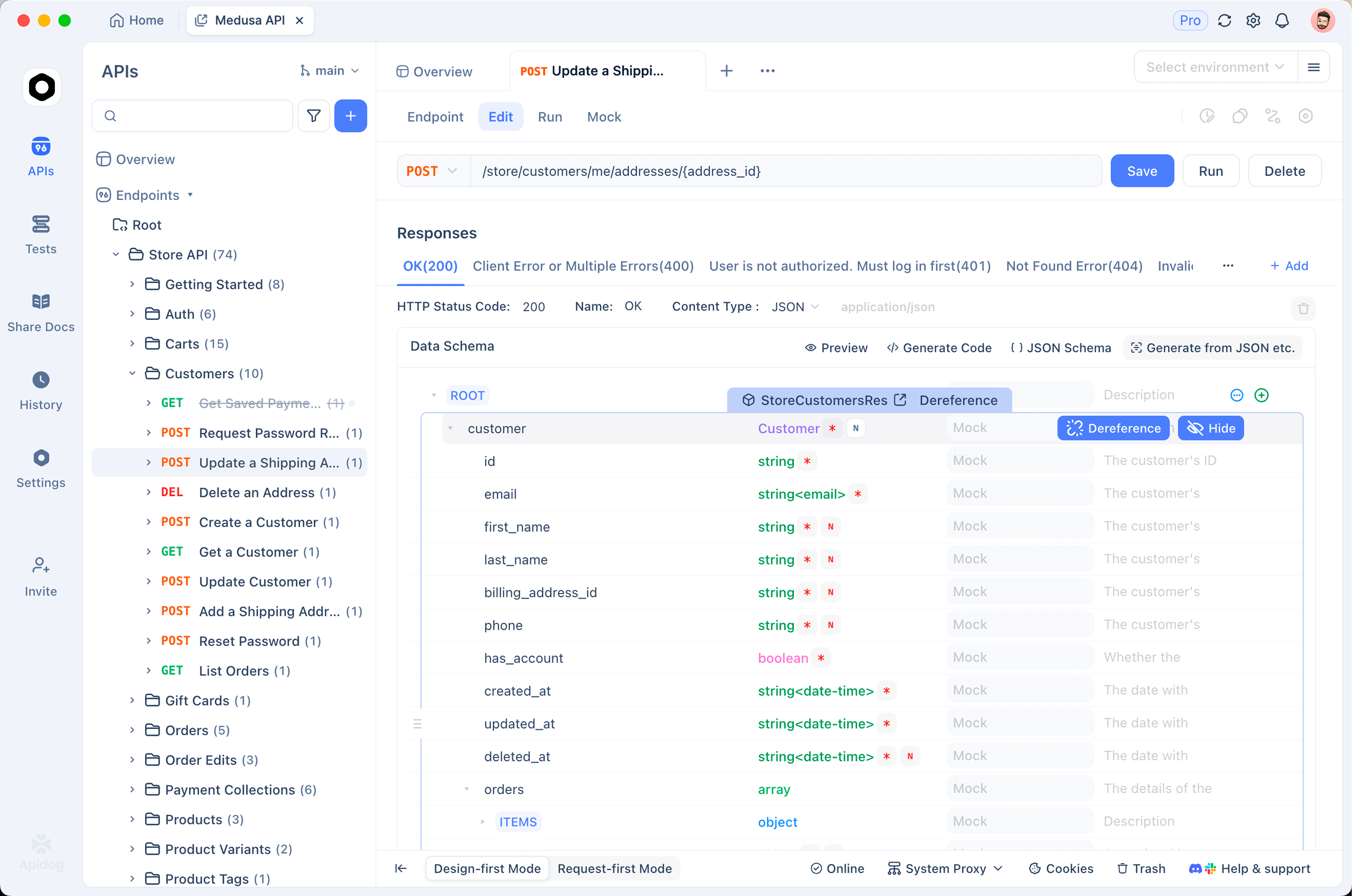
This is where an API client earns its keep. Apidog treats the kimi-k3 endpoint as a first-class request: save your golden-set prompts as a reusable collection, send them with pinned parameters, stream the response to watch token-by-token latency, and read exact token counts back for cost math. Rerun the whole set against a different model by swapping the endpoint. If your work lives in an editor, drive the same requests from inside VS Code. When you’re ready, Download Apidog and point a new request at the Moonshot endpoint.
A few task shapes and what to watch for:
- Coding assistant. Latency dominates. At 62 tokens per second, a long completion has noticeable draw time, so test with your real average completion length. Compare against a faster model even if it scores lower overall.
- Batch data extraction. Nothing waits on the output, so throughput barely matters. K3’s intelligence rank is the whole story; weigh quality and per-token cost.
- Long-document analysis. Test at the context length you actually use. A model reliable at 32K can degrade at 500K, and the 1M window is a ceiling, not a guarantee.
- Agentic automation. This is where the unverified “4 of 8” claim lives, so trust your own runs over the marketing. Build a small agent harness, run your real task loop, and count successes.
You can also pull K3 through an aggregator if you’d rather not manage a direct key: the OpenRouter listing for moonshotai/kimi-k3 exposes the same model behind an OpenAI-compatible route.
Where K3 lands, honestly
Strip away the launch noise and Kimi K3 is a genuinely strong general model with a clear, self-admitted ceiling. The independent read is trustworthy and flattering: a top-four rank out of 189, earned on a suite Moonshot didn’t design. Speed is the honest weak spot, which matters a lot for interactive work and almost not at all for batch work. The vendor claims split cleanly: the admission that it trails Fable 5 and Sol, which you can bank on, and the unverified automation wins, which you should hold loosely until someone independent reproduces them. A launch is the start of the evidence, not the end. Measure the model on your own work and let that number decide. To weigh value against cost, the Kimi K3 pricing breakdown pairs price with these benchmark numbers.
Frequently asked questions
What is Kimi K3’s benchmark score? On the independent Artificial Analysis Intelligence Index, Kimi K3 scores 57 and ranks #4 of 189 models. Moonshot published its own Terminal-Bench 2.1 and DeepSWE scores, but no independent lab has reproduced K3’s standalone coding benchmarks yet, so the Index is the best neutral number available.
Is Kimi K3 faster than other models? No. Its measured output speed is about 62 tokens per second, below the 72.7 median for its price tier, and time to first token is roughly 2 seconds. K3 is a strong reasoner that generates on the slower side, fitting batch and analysis work better than latency-sensitive interactive tools.
Does Kimi K3 beat Claude Fable 5 or GPT-5.6 Sol? Not overall, by Moonshot’s own account: the launch post says K3 “still trails the most powerful proprietary models, Claude Fable 5 and GPT-5.6 Sol.” A secondary claim says K3 leads on a few automation benchmarks, but that’s vendor-adjacent and not independently confirmed. For frontier tasks, the two proprietary models are still ahead.
How should I benchmark Kimi K3 for my own use case? Build a golden set of 20 to 50 real prompts from your workload, pin the model ID and parameters, then measure output quality, latency, cost, and consistency against your current model. Tools like Apidog let you save those prompts as a reusable collection and rerun them against kimi-k3 and any competitor for a fair comparison.