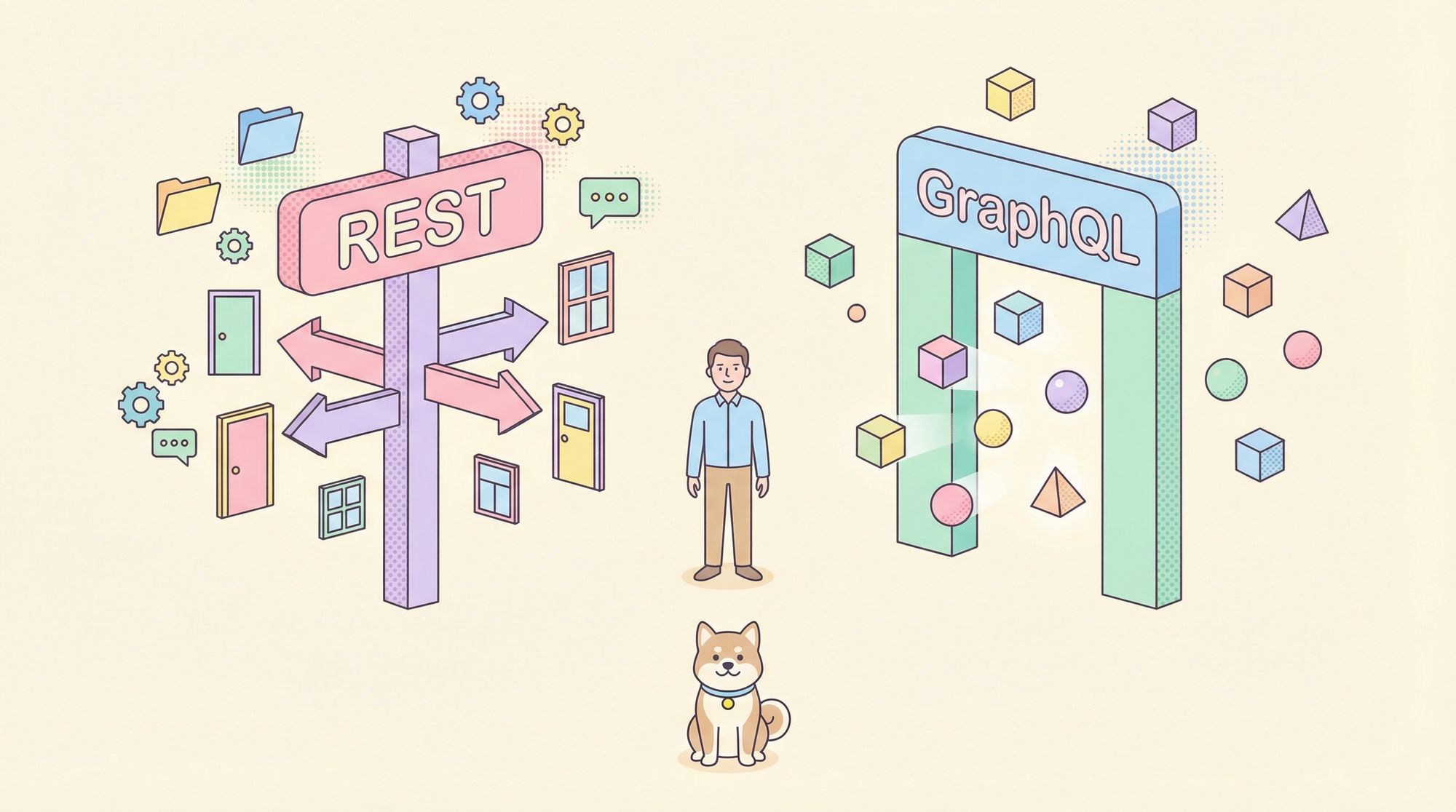
GraphQL and REST have their strengths and unique characteristics, and understanding these differences can help developers choose the best approach for their specific needs. This article delves into the key differences between GraphQL and REST API, providing insights to help you make an informed decision.
What is REST API?
REST (Representational State Transfer) is an architectural style that has been widely adopted since its inception. It relies on a stateless, client-server communication model, and uses standard HTTP methods such as GET, POST, PUT, DELETE, and PATCH to perform CRUD (Create, Read, Update, Delete) operations. REST APIs are organized around resources, which are identified by URIs (Uniform Resource Identifiers).
Key Characteristics of REST:
- Resource-Based: Each resource is identified by a URI, and operations are performed on these resources.
- Statelessness: Each request from a client to a server must contain all the information the server needs to fulfill the request.
- Standard Methods: Uses standard HTTP methods for communication.
- Scalability: The stateless nature makes REST APIs highly scalable.
- Cacheable: Responses can be explicitly marked as cacheable or non-cacheable, improving performance by reducing server load.
- Layered System: The architecture allows for a layered system where intermediaries such as proxies and gateways can operate.
What is GraphQL?
GraphQL, developed by Facebook in 2012 and released publicly in 2015, is a query language for your API. It provides a more flexible and efficient alternative to REST by allowing clients to request exactly the data they need. This eliminates over-fetching and under-fetching of data, common issues in REST APIs.
 David Demir
Key Characteristics of GraphQL:
- Query-Based: Clients specify the structure of the response they require.
- Single Endpoint: All interactions occur through a single endpoint.
- Strongly Typed Schema: The schema defines the types of data and the relationships between them.
- Efficient Data Fetching: Clients can request only the data they need, reducing the amount of transferred data.
- Introspection: Clients can query the schema itself to understand the available types and operations, enabling powerful development tools and documentation generation.
- Real-Time Data: Supports subscriptions to enable real-time data updates.
Apidog fully adheres to REST principles, providing comprehensive capabilities for designing, testing, and documenting RESTful APIs. It supports various HTTP methods, parameter types, and authentication mechanisms.
Key Differences Between GraphQL and REST API
1. Data Fetching
- REST: In REST, the server defines the structure of the responses. Clients might receive more data than needed (over-fetching) or might need multiple requests to gather all required data (under-fetching). For example, a REST endpoint might return an entire user profile when only the user's name and email are needed.
- GraphQL: Clients can specify exactly what data they need. A single request can fetch data from multiple resources, reducing the number of requests and the amount of unnecessary data transferred. For instance, a GraphQL query can request only the user's name and email in a single call, avoiding over-fetching.
2. Endpoints
- REST: Typically involves multiple endpoints for different resources. Each resource has its own URI. For instance,
/users,/posts, and/commentsmight be separate endpoints in a REST API. - GraphQL: Uses a single endpoint for all interactions. Clients send queries to this endpoint to retrieve the necessary data. This simplifies the API design as there is only one entry point for all data requests.
3. Flexibility
- REST: Less flexible in terms of data fetching. The server dictates the structure of responses, and clients must adapt to it. If the required data spans multiple resources, clients may need to make multiple requests and aggregate the data on the client side.
- GraphQL: Highly flexible. Clients define the shape and structure of the response, allowing for more tailored and efficient data retrieval. This flexibility can significantly reduce the complexity of client-side code and improve performance by reducing the number of network requests.
4. Versioning
- REST: Often requires versioning of APIs to handle changes. New versions are introduced to add or modify functionality without breaking existing clients. For example,
/v1/usersand/v2/usersmight represent different versions of the same resource. - GraphQL: Typically does not require versioning. Changes can be managed through the schema, and clients can request the specific fields they need without being affected by other changes. The schema can evolve by adding new fields or types without disrupting existing clients.
5. Error Handling
- REST: Relies on HTTP status codes to indicate the success or failure of a request. Additional error information is often included in the response body. For example, a
404 Not Foundstatus code indicates that the requested resource does not exist. - GraphQL: Uses a dedicated
errorsfield in the response to provide detailed error information. Partial responses are possible, allowing clients to handle partial success/failure scenarios more gracefully. For example, a query might return partial data along with error messages for the fields that failed.
6. Documentation and Tooling
- REST: Documentation is often provided through external tools like Swagger/OpenAPI, which can generate interactive API documentation. Developers must manually maintain the documentation to reflect the current state of the API.
- GraphQL: Documentation is inherently part of the schema. Tools like GraphiQL and GraphQL Playground provide interactive environments for exploring the API and testing queries. The introspection feature allows clients to query the schema itself, generating up-to-date documentation automatically.
7. Performance
- REST: Performance can be impacted by over-fetching and under-fetching, as clients may need to make multiple requests to gather all necessary data. However, the stateless nature of REST can lead to better scalability in distributed systems.
- GraphQL: Can improve performance by allowing clients to request only the data they need. However, complex queries can put a strain on the server, requiring careful optimization and performance monitoring.
When to Use REST?
- Simple CRUD Applications: REST is well-suited for applications with straightforward CRUD operations. If your application primarily involves basic create, read, update, and delete operations on well-defined resources, REST is a simple and effective choice.
- Well-Defined Resources: When resources and their relationships are well-defined and stable, REST's resource-oriented approach works well. If the data model is unlikely to change frequently, REST provides a clear and predictable structure.
- Cacheable Requests: REST’s use of standard HTTP methods and status codes facilitates easy caching. If caching is critical for performance, REST's built-in support for HTTP caching mechanisms can be advantageous.
- Existing Ecosystem and Tools: REST has a mature ecosystem with a wide range of tools, libraries, and best practices. If your team is already familiar with REST or if you're integrating with other systems that use REST, it may be more practical to stick with this approach.
When to Use GraphQL?
- Complex Queries: Ideal for applications that require complex queries and data fetching from multiple sources. If your clients need to retrieve deeply nested or related data, GraphQL's query language allows for efficient data retrieval in a single request.
- Client-Specific Data Needs: When different clients (e.g., mobile vs. web) have varying data requirements, GraphQL's flexibility allows each client to request only the data they need. This can reduce the amount of data transferred and improve performance.
- Rapid Development: Allows for rapid iteration and development without the need for extensive versioning. GraphQL's schema evolution capabilities make it easy to add new fields and types without breaking existing clients.
- Real-Time Applications: Supports subscriptions to enable real-time data updates. If your application requires real-time features, such as live feeds or notifications, GraphQL's subscription model provides a robust solution.
- Unified Data Access: If your application needs to aggregate data from multiple sources (e.g., databases, third-party APIs, microservices), GraphQL's ability to integrate with various backends through a single API endpoint simplifies data access and management.
Challenges and Considerations
Security
- REST: Security considerations include managing authentication and authorization, protecting against common web vulnerabilities (e.g., SQL injection, XSS), and ensuring secure data transmission over HTTPS. REST APIs often use tokens (e.g., JWT) or API keys for authentication.
- GraphQL: Similar security considerations apply, but the flexibility of GraphQL queries can introduce additional challenges. For example, malicious clients can craft complex queries to overwhelm the server (query depth and complexity control). Rate limiting, query whitelisting, and persistent queries can help mitigate these risks.
Learning Curve
- REST: The REST architectural style is relatively straightforward and widely understood. Most developers are familiar with HTTP methods and status codes, making it easier to adopt and implement.
- GraphQL: Requires learning a new query language and understanding the schema-based approach. The initial learning curve can be steeper, but the benefits of flexibility and efficiency can outweigh the complexity in the long run.
Tooling and Ecosystem
- REST: Has a mature ecosystem with a wide range of tools for documentation, testing, and monitoring (e.g., Swagger/OpenAPI, Postman). RESTful principles are well-established, with many frameworks and libraries available for various programming languages.
- GraphQL: The ecosystem is growing rapidly, with tools like Apollo, Relay, and Hasura providing robust solutions for building and managing GraphQL APIs.
More related articles for you.
David Demir Iroro Chadere