Gemini 4 Argon is Google’s new frontier model, announced on September 30, 2026, and it’s available today only to Fairwind Program defenders, a vetted group of cyber defense partners. Google prices it at $2 per million input tokens and $10 per million output tokens during an introductory period, then $4 and $20, and it raises the output limit to 1M tokens per response. There’s no public API, no published model ID, and no release date yet.
This guide is the hub for our Argon coverage: what Google has and hasn’t confirmed, where Argon sits in the Gemini lineup, who gets it next, what it costs, how it benchmarks, and what you can build today. Choosing a model right now? Read our Gemini 4 Argon vs GPT-6 Astra vs Claude Opus 5.5 comparison. If you test model APIs in Apidog, the last section shows how to make the switch to Argon a one-value change.
What Google has confirmed vs what it hasn’t
Most early coverage mixes Google’s statements with third-party guesses. Here’s the split, based on the launch post and Google’s evals methodology.
| Item | Status | What we know |
|---|---|---|
| Announcement | Confirmed | September 30, 2026, by Koray Kavukcuoglu of Google DeepMind |
| Access today | Confirmed | A set of Fairwind Program partners |
| Next in line | Confirmed, undated | Paid API customers and Google AI Ultra subscribers |
| Price | Confirmed | $2/$10 intro, then $4/$20 per 1M tokens; cached input 95% off |
| Output limit | Confirmed | 1M tokens, up from 64K |
| Benchmarks | Confirmed, Google-reported | A 19-row table plus a methodology PDF |
| Model ID | Not published | Strings online are third-party placeholders |
| Input context window | Not published | Google’s long-context eval used prompts up to 1M tokens |
| Knowledge cutoff | Not published | Nothing from Google |
| Intro period length | Not published | No date for the switch to $4/$20 |
| Rate limits, free tier | Not published | Nothing from Google |
| Release date | Not published | “As soon as possible” |
If a site lists a context window, a model string or a speed figure for Argon, treat it as unconfirmed until Google’s own docs show it.
What Gemini 4 Argon is and where it sits
Argon is the only Gemini 4 model announced so far and the new top of Google’s lineup. Google calls it “our new frontier model,” built “to sustain deep reasoning across complex, long-horizon workflows,” and claims frontier performance in software engineering, enterprise knowledge work like legal and finance, and cybersecurity defense. A Google spokesperson told Reuters that Argon is larger than the company’s previous line of “Pro” models.
Until now, the top Gemini API model was gemini-3.1-pro-preview, still in Preview: 1,048,576 input tokens, 65,536 output tokens (the “64K” Argon replaces), and $2 input / $12 output per million for prompts up to 200K. Argon’s intro output price of $10 undercuts it. Google hasn’t said whether Argon gets a separate long-prompt tier like 3.1 Pro, or whether other Gemini 4 models will follow. Reuters described the launch as coming “after months of delays,” a reference to the Gemini 3.5 Pro release that was promised for June and later dropped.
Google already runs Argon internally. It says thousands of employees use it for coding, research and writing, that Argon agents freed over 300 TiB of fleet memory, and that it’s migrating C and C++ code to Rust, up to 800K+ lines for the Fuchsia Zircon kernel, with those rewrites still under audit before production.
Who can use Gemini 4 Argon today, and who’s next
Today: a subset of Fairwind partners. Fairwind is Google’s limited-access cyber defense program with over 650 partners, but only “a set of Fairwind Program partners” get Argon, on its own or inside CodeMender, Google’s code security agent. Accessed directly “as a managed model on Gemini Enterprise,” it supports zero data retention. Partners must commit to phishing-resistant MFA, access limited to internal security, incident response or pen-test teams, and per-employee usage tracking. Governments, critical infrastructure operators and core technology platforms can apply on the Fairwind Program page.
Next: paid API customers and Google AI Ultra subscribers. Google will “gather feedback from early testers as we iterate on guardrails” first, and it’s taking part in the U.S. government’s voluntary pre-release access process. The launch post’s rollout section is titled “Rolling out soon” and gives no date. Our release date and access guide tracks each stage.
Not yet: everyone else. As of October 1, the Gemini API models page, the pricing page, the Gemini app, Antigravity and OpenRouter show no Argon. A Google AI Ultra plan (from $99.99 a month in the US) is a consumer subscription, not an API key, and Google hasn’t said which Ultra tier gets Argon first. There’s no free route; is Gemini 4 Argon free covers what you can use instead.
Gemini 4 Argon pricing
| Token type | Intro (per 1M) | After intro (per 1M) |
|---|---|---|
| Input | $2.00 | $4.00 |
| Cached input (95% off) | $0.10 | $0.20 |
| Output | $10.00 | $20.00 |
| One full 1M-token response, output only | $10.00 | $20.00 |
Google hasn’t said how long the intro period lasts. At standard rates, Argon costs exactly what Claude Opus 5.5 costs; at intro rates it matches GPT-6.1 Sol and Claude Sonnet 5.5. The cached prices are arithmetic from Google’s 95% rule. Worked scenarios are in Gemini 4 Argon pricing.
The 1M output limit
Google says it’s “significantly expanding the model’s output token limit to an industry-leading 1M tokens, up from the previous 64K tokens.” The argument: with room to generate hundreds of thousands of tokens in one trajectory, the model can work through hard problems in one go. For comparison, GPT-6 Astra, Claude Opus 5.5 and Claude Fable 5.1 each cap synchronous output at 128K.
Two caveats. This is an output limit, not a context window; Google hasn’t published the input window. And while Google says Argon’s output limit is 1M tokens, at least one third-party evaluator, Vals AI, lists a 262K max output for the configuration it tested. Plan around the limit your endpoint reports. Our guide to Argon’s 1M output tokens covers timeouts, streaming and cost caps.
Gemini 4 Argon benchmarks: the headline
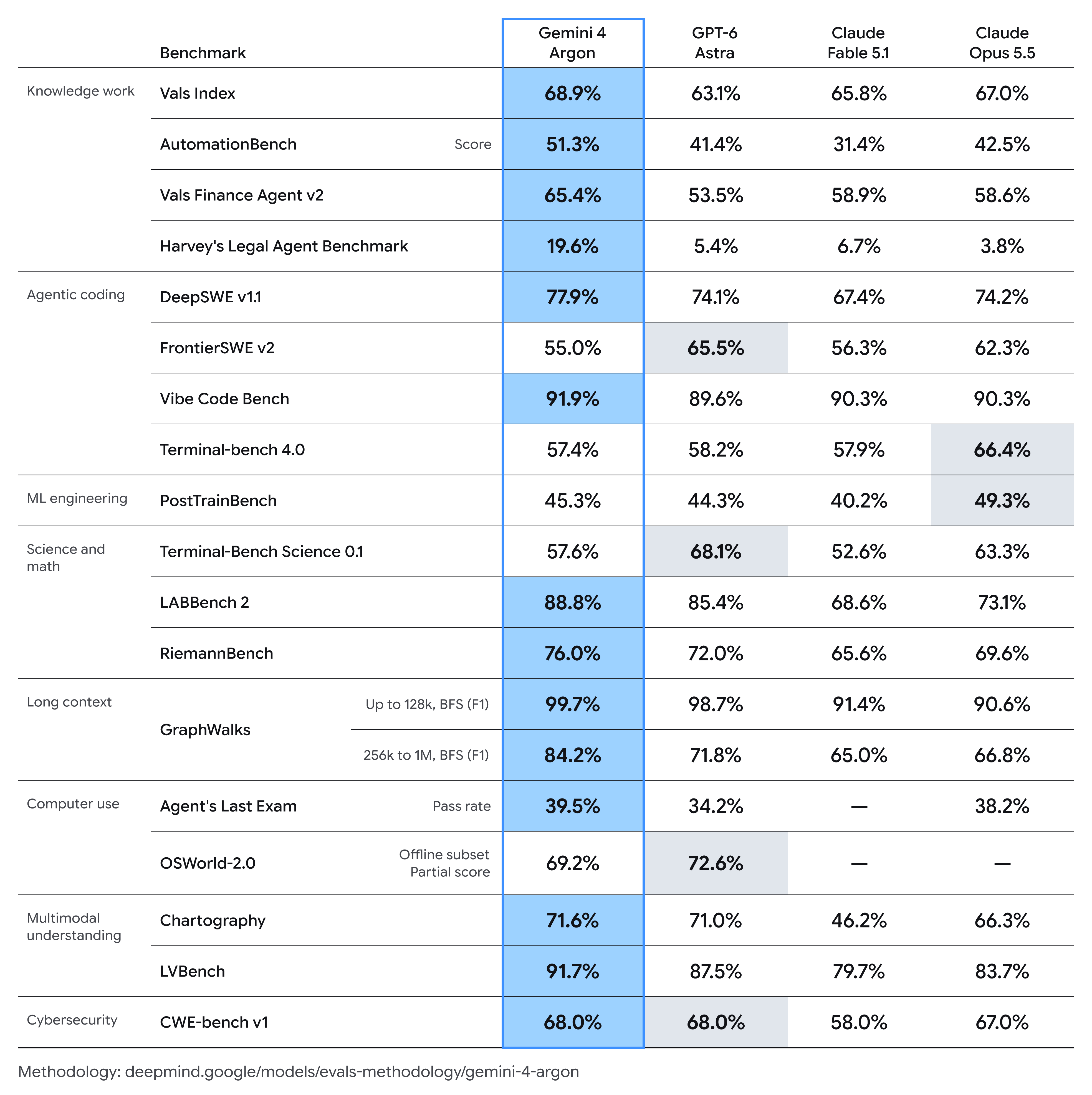
All numbers below come from Google’s table. Argon’s scores are Google-reported, some self-computed and some from leaderboards such as Vals AI; competitor scores are mostly the vendors’ own or public-leaderboard results, and harnesses differ. By our recount, Argon leads 13 of 19 rows outright, ties one and trails on five.
| Benchmark | Gemini 4 Argon | GPT-6 Astra | Claude Fable 5.1 | Claude Opus 5.5 |
|---|---|---|---|---|
| Vals Index | 68.9% | 63.1% | 65.8% | 67.0% |
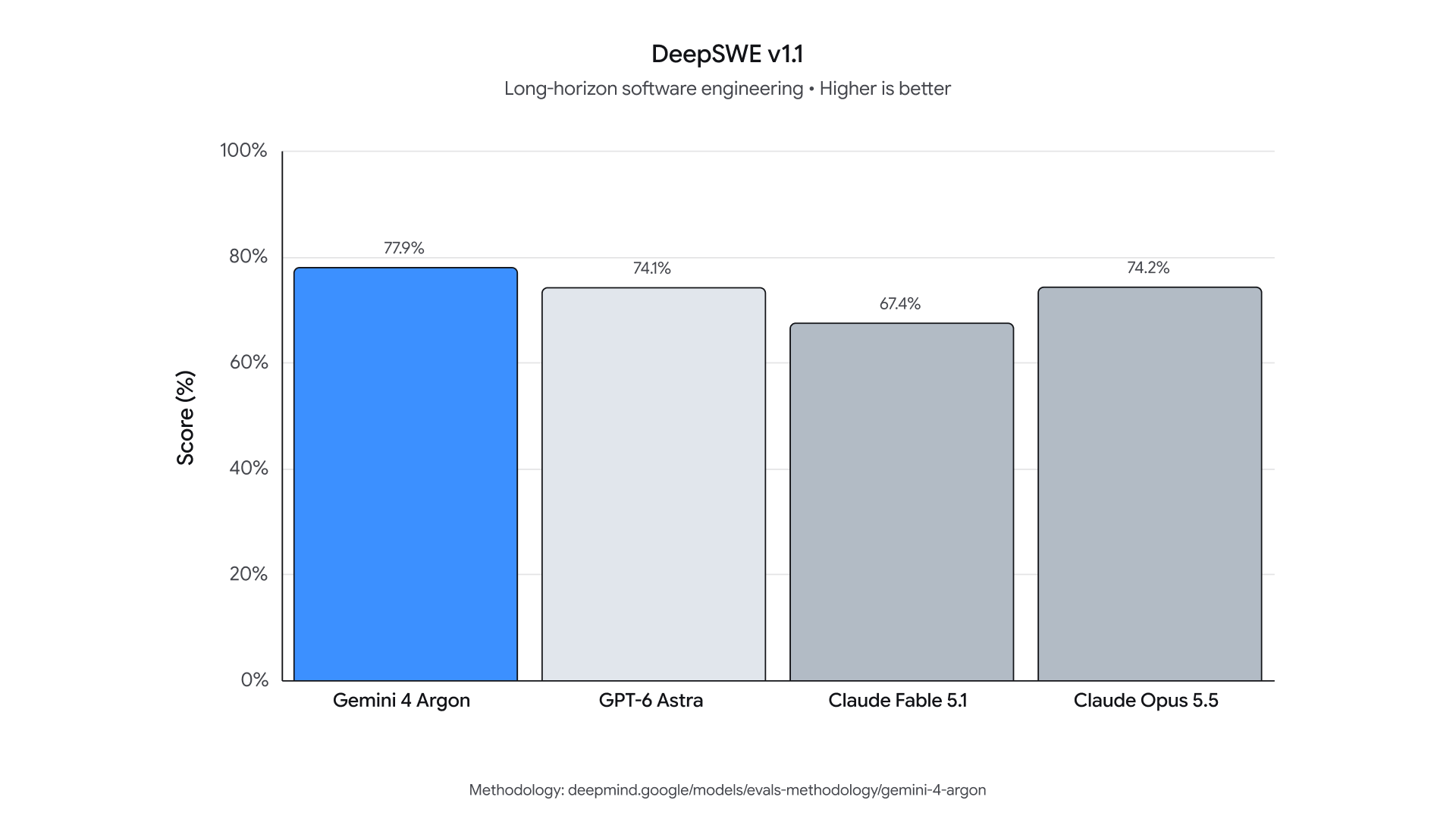
| DeepSWE v1.1 | 77.9% | 74.1% | 67.4% | 74.2% |
| GraphWalks 256K to 1M (F1) | 84.2% | 71.8% | 65.0% | 66.8% |
| FrontierSWE v2 | 55.0% | 65.5% | 56.3% | 62.3% |
| Terminal-bench 4.0 | 57.4% | 58.2% | 57.9% | 66.4% |
| PostTrainBench | 45.3% | 44.3% | 40.2% | 49.3% |
The five rows Argon loses: FrontierSWE v2, Terminal-Bench Science 0.1 and OSWorld-2.0 (to Astra), plus Terminal-bench 4.0 and PostTrainBench (to Opus 5.5).
Third parties put Argon at the frontier without a clear lead. Artificial Analysis scores it 53 on its Intelligence Index, tied with GPT-6 Astra and Claude Fable 5.1 and behind Claude Opus 5.5 at 58 and Claude Sonnet 5.5 at 56 (max settings); Vals ranks it first of 41 models on the Vals Index. All 19 rows and Google’s method notes are in Gemini 4 Argon benchmarks.
Cyber defense in one paragraph
Google says “Argon can autonomously find, validate, and patch critical software vulnerabilities.” For trusted defenders and its internal teams, it adds, “we’ll be releasing Argon without cyber guardrails so they can leverage its full frontier-level cybersecurity defense capabilities.” On DeepMind’s cyber page, Argon scores 85.8% on real-world vulnerability discovery (Gemini 3.8 Flash Cyber: 71.0%), ties Grok 4.7 and GPT-6 Astra at 68% on CWE-bench v1, and posts the chart’s lowest Gray Swan indirect prompt injection attack success rate, 0.7% at k=15. See what Argon’s cyber release means for the APIs you run and its predecessor, Gemini 3.8 Flash Cyber.
What to do now as a developer
Build on a model you can call today and keep the model name in one variable. gemini-3.8-flash is the stand-in: stable, 1,048,576 input and 65,536 output tokens, a free tier, and $0.75/$3.75 per million through December 31, 2026. Google’s Interactions API docs say “all new models, multimodal capabilities, tools, and agentic features will launch on the Interactions API,” so write against it. Google hasn’t published Argon’s model ID, so you’ll swap the variable when it ships.
MODEL="${GEMINI_MODEL:-gemini-3.8-flash}"

curl -s "https://generativelanguage.googleapis.com/v1beta/interactions" \
  -H "x-goog-api-key: $GEMINI_API_KEY" \
  -H "Content-Type: application/json" \
  -d '{
    "model": "'"$MODEL"'",
    "input": "List the breaking changes in this OpenAPI diff.",
    "generation_config": {"thinking_level": "medium"}
  }'
In Apidog, save the same call as a request with GEMINI_API_KEY and GEMINI_MODEL as environment variables, then assert on the token counts in the response’s usage object (total_output_tokens plus total_thought_tokens, since thinking bills as output) so a runaway answer fails the test. Keep the 3.8 Flash response as your baseline. When Argon’s ID shows up in the models list, change GEMINI_MODEL, rerun, and compare.
For request shapes, see the Gemini 4 Argon API guide. To decide whether waiting is worth it at all, read Argon vs Gemini 3.8 Flash.
FAQ
Can I use Gemini 4 Argon in the Gemini API? Not yet. Only a set of Fairwind partners have it; the public models list doesn’t include it.
What is the Gemini 4 Argon model ID? Google hasn’t published one. Strings in circulation, including evaluator slugs, are third-party placeholders, so don’t hard-code them.
When is the Gemini 4 Argon release for developers? Google hasn’t given a date. Paid API customers and Google AI Ultra subscribers come first, “as soon as possible.”
Is Gemini 4 Argon better than GPT-6 Astra and Claude Opus 5.5? It leads most rows in Google’s table, but it ties Astra on Artificial Analysis and trails Opus 5.5 there. For the rivals on their own terms, see what is Claude Opus 5.5 and our GPT-6 Astra API guide.
Does Gemini 4 Argon have a 1M context window? Google hasn’t said. 1M is the output limit; its long-context eval used prompts up to 1M tokens, which isn’t a published spec.
Get ready before Argon opens
Argon is announced, priced and benchmarked, but you can’t call it yet. Build on Gemini 3.8 Flash with our Gemini 3.8 Flash API guide, keep the model in one variable, and put a token assertion on every request. To have the request, environment and baseline ready for the swap, download Apidog and set it up today.