GPT-5.6 went GA on July 9, 2026, and the first question most people ask is the money question: can you use it without paying? The honest answer splits three ways. Free ChatGPT users already have GPT-5.6 Terra, the balanced mid-tier model, at no cost. The flagship needs a paid seat; if Sol is the model you want, our guide on how to access GPT-5.6 Sol covers every plan that unlocks it. And the API has no free tier at all. Every token is metered from your first request.
That answer disappoints anyone hunting for a loophole, but the free-access map is wider than one chat tab. OpenAI shipped all three GPT-5.6 models, Sol, Terra, and Luna, across ChatGPT, Codex, and the API on the same day, and GitHub added them to Copilot within hours. Two of those surfaces have real free tiers, and the cheapest paid path costs less per month than a single coffee if your usage stays light.
This guide maps every legitimate free route, roughly in order of how much GPT-5.6 you get for zero dollars, then shows the math for the moment free runs out. No growth hacks, no gray-market keys.
TL;DR
- Free and Go ChatGPT users get GPT-5.6 Terra at no cost. Usage limits apply, and OpenAI adjusts them over time.
- GPT-5.6 Sol, the flagship, needs ChatGPT Plus or higher. There is no free Sol in ChatGPT.
- GitHub Copilot added Sol, Terra, and Luna on July 9, and Copilot has a free tier; which models your plan exposes varies.
- Codex includes GPT-5.6 at GA, but sustained Codex work requires a ChatGPT plan.
- The API has no free tier. The cheapest real path is gpt-5.6-luna at $1 input / $6 output per 1M tokens, with prompt caching cutting repeated input costs by 90%.
- A month of light Luna usage runs about $3.50, less than most coffees. The worked example is below.
- Apidog makes your first metered calls count: save prompts, compare tiers side by side, and watch token costs before you commit.
The free-access map at a glance
| Where | What you get | What it costs |
|---|---|---|
| ChatGPT Free / Go | GPT-5.6 Terra | $0 |
| ChatGPT Plus and up | Sol, Terra, and Luna with per-model effort control | Paid plan |
| GitHub Copilot Free | GPT-5.6 models; availability varies by plan | $0 within monthly limits |
| Codex | GPT-5.6 at GA, Ultra from Plus upward | Needs a ChatGPT plan |
| OpenAI API | gpt-5.6-sol, gpt-5.6-terra, gpt-5.6-luna | Metered, no free tier |
One thing worth naming up front: “free” means something different on each row. In ChatGPT it means a capped but genuine daily driver. In Copilot it means a monthly allowance. In Codex it means almost nothing. On the API it means nothing at all, which is why the last section covers spending your first dollars intelligently.
Option 1: ChatGPT Free and Go get Terra
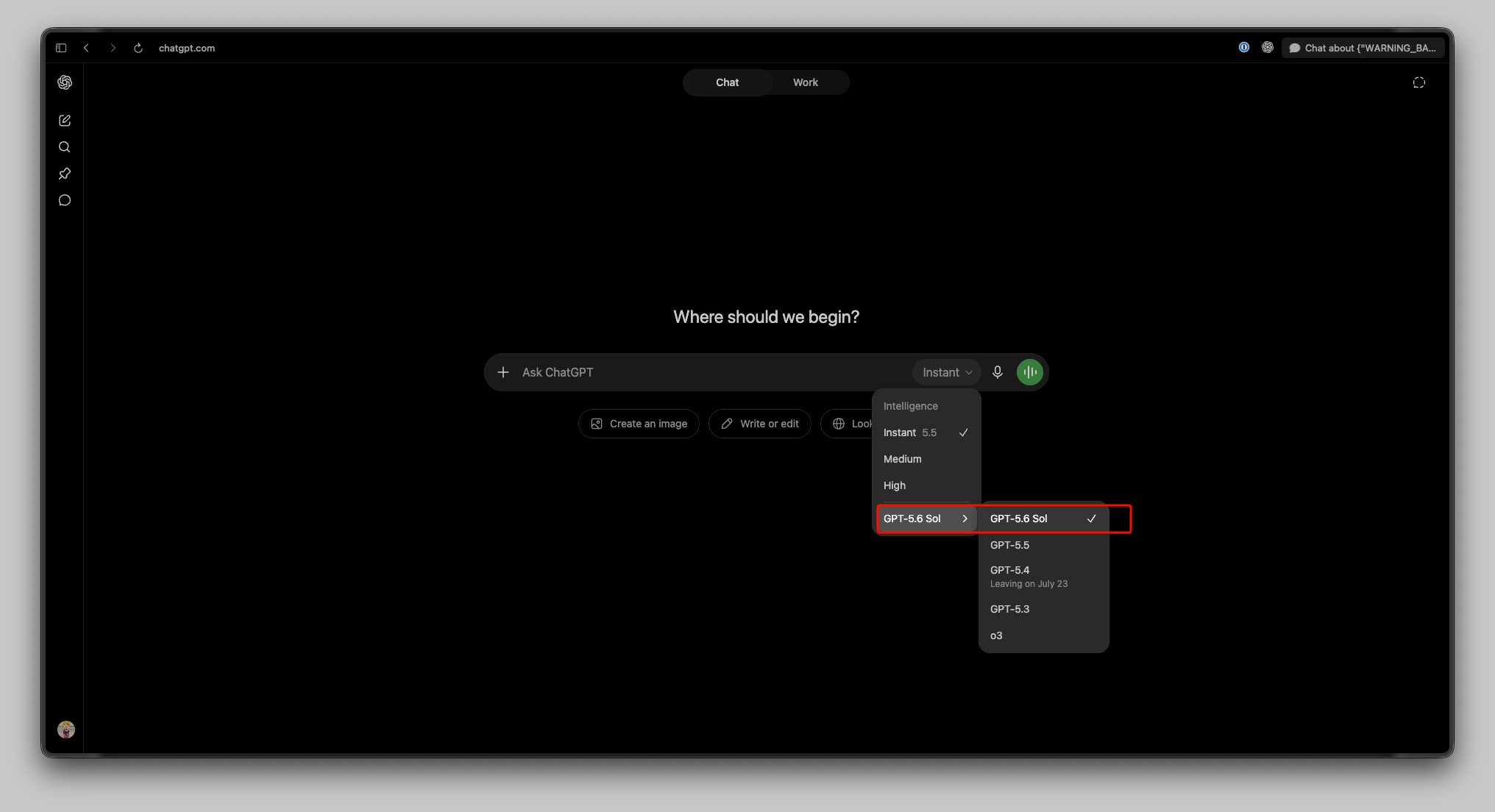
Signing up for ChatGPT costs nothing, and since July 9 the model behind the free tier is GPT-5.6 Terra. OpenAI’s help center page on GPT-5.6 in ChatGPT confirms the plan split: Free and Go users get Terra, while Plus and higher can pick between Sol, Terra, and Luna and set a reasoning effort level per model. Sol Pro and the multi-agent Ultra setting sit further up the ladder on Pro, Business, and Enterprise plans.
Terra is not a consolation prize. OpenAI positions it as competitive with GPT-5.5, the previous flagship generation, at roughly half the cost on the API side. In plain terms, the model free users get today plays in the same class as what subscribers were paying for two weeks ago. It handles everyday writing, code explanations, summarization, translation, and general research questions without strain. Where it trails Sol is deep multi-step reasoning: long agentic tasks, hard debugging sessions, math-heavy problems.
The catch is usage limits. Free tiers cap how much you can send, and OpenAI adjusts those limits over time based on load, so any specific message count you read in a forum thread is a snapshot, not a promise. Expect a ceiling, expect it to move, and don’t build a daily workflow that breaks when you hit it. If you bump against the cap regularly, that is your signal to look at the next two options before reaching for your wallet.
Option 2: GitHub Copilot’s free tier now carries GPT-5.6
On July 9, the same day as GA, GitHub announced that Sol, Terra, and Luna are now available in GitHub Copilot. That matters for free access because Copilot has a free tier: a monthly allowance of code completions and chat messages inside VS Code, JetBrains IDEs, and github.com.
Which GPT-5.6 models appear in your model picker depends on your Copilot plan, and GitHub tunes model availability by plan over time, so open the picker and look rather than trusting any static list, including this one. Even if a free seat exposes Terra rather than Sol, a GPT-5.6-class model wired into your editor with repository context is a more useful flavor of free than a chat window.
If coding help is the reason you want GPT-5.6 in the first place, this is the strongest free seat available right now. Our GitHub Copilot free guide walks through what the free tier includes, where the monthly limits sit, and how to stretch the allowance.
Option 3: Codex, with an asterisk
GPT-5.6 shipped in Codex at GA, including the Ultra setting from Plus upward. Per OpenAI, Ultra lifts Sol’s Terminal-Bench 2.1 score from 88.8% to 91.9% by running four agents in parallel. Impressive, and thoroughly paid.
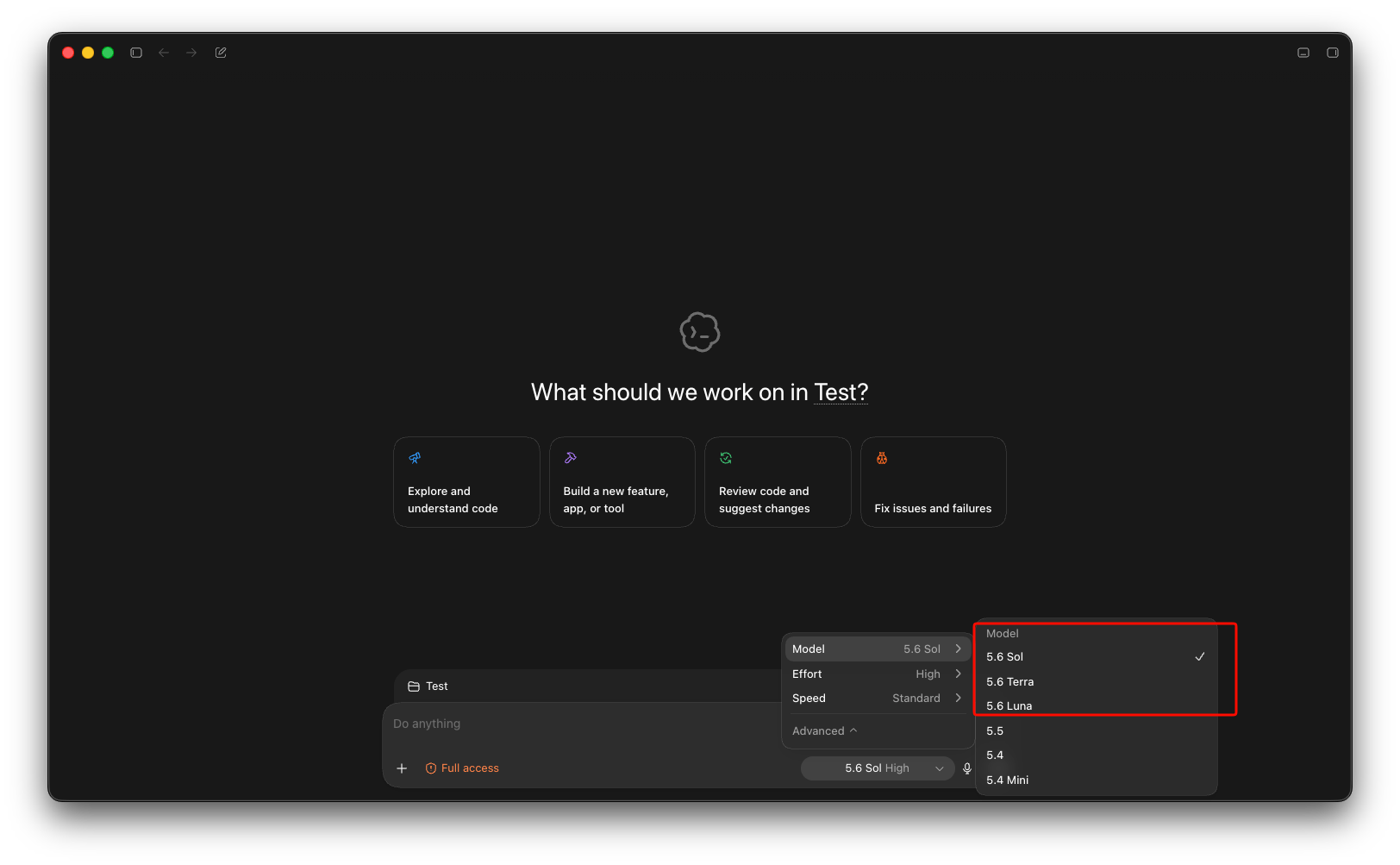
Here’s the asterisk: Codex requires a ChatGPT plan for real use. There is no meaningful free lane. You can poke at it, but sustained agentic work needs Plus at minimum, and the good stuff scales with the plan. If you’re weighing whether a no-spend Codex setup is worth your time, using Codex for free covers what’s realistic and what isn’t. The short version: treat Codex as a reason to consider a paid plan, not as a free path into GPT-5.6.
Option 4: the cheapest real API path when free runs out
The OpenAI API meters every token from the first request. No free tier exists, but there’s no plan gating either; any API account can call all three models self-serve. The cheapest of the three is gpt-5.6-luna at $1 per 1M input tokens and $6 per 1M output tokens. Full tier-by-tier numbers, caching rates included, are in our GPT-5.6 pricing breakdown.
Luna is built for the workloads a budget-conscious developer runs: classification, extraction, routing, first-pass drafting, anything high-volume and latency-sensitive. Two settings keep the bill small:
- Reasoning effort. GPT-5.6 exposes six levels, from none to max. Luna at none or low produces shorter outputs, and output tokens cost six times what input tokens do.
- Explicit prompt caching. GPT-5.6 supports explicit cache breakpoints with a TTL. Cache reads keep the 90% discount, writes bill at 1.25x the normal input rate, and cached content lives for at least 30 minutes.
A minimal Responses API call looks like this:
{
  "model": "gpt-5.6-luna",
  "input": "Summarize this changelog entry in two sentences: ...",
  "reasoning": { "effort": "low" },
  "prompt_cache_options": { "mode": "explicit" }
}
The coffee math
Say you run a small side project: 30 Luna calls a day, each with about 1,500 input tokens (1,000 of them a fixed system prompt) and 400 output tokens. Over a 30-day month, that is 900 requests.
- Input: 900 x 1,500 = 1.35M tokens, or $1.35
- Output: 900 x 400 = 0.36M tokens, or $2.16
- Monthly total: $3.51
Add explicit caching on the fixed system prompt and the 0.9M repeated input tokens bill at $0.10 per 1M instead of $1, dropping the total to roughly $2.80 even after the 1.25x surcharge on cache writes. That is a month of real GPT-5.6 usage for less than one coffee. Free is nice; $3 is close enough.
What to avoid: key resellers and “free API” sites
Search for a GPT-5.6 free API and you’ll find key resellers, Discord servers passing around pooled keys, and proxy sites that mimic OpenAI’s endpoints. Skip all of them.
The economics give the game away. OpenAI sells this model per token with no free tier, and nobody hands out metered compute for nothing unless you are the payment. Every prompt you send through an unofficial proxy passes through someone else’s server, where it can be logged, resold, or fed into something you never agreed to. Pooled keys get revoked without warning, usually mid-project. And resold or stolen keys violate OpenAI’s terms, which can burn the account you’ll eventually want to build on.
Weigh the risk against the reward: the gray market is competing with a $3.51 monthly bill. It isn’t worth it.
Try the API properly before you spend
Because there is no free API tier, your first calls cost real money. Make them experiments instead of guesses.
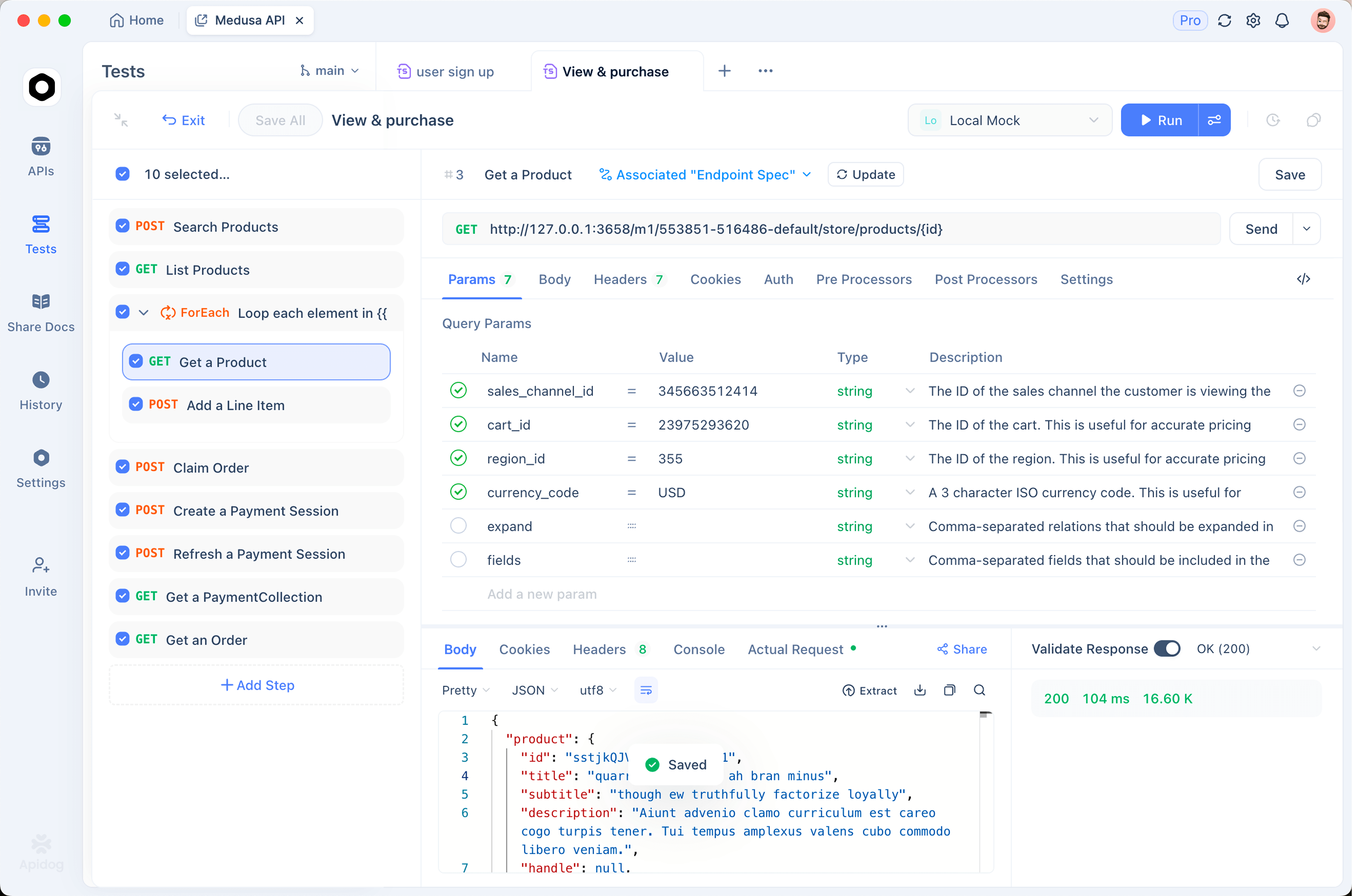
Download Apidog and point it at the Responses API. Store the three model IDs (gpt-5.6-sol, gpt-5.6-terra, gpt-5.6-luna) as environment variables so switching tiers is a dropdown change rather than editing raw JSON. Save your test prompts as named requests you can rerun. Then send the same prompt to Terra and Luna side by side and read the token usage fields in each response: input tokens, output tokens, and what a change in reasoning effort does to both.
Ten minutes of that testing answers the question that will dominate your future bill: is Luna enough for this task, or do you need Terra? The difference is 2.5x on every input token you’ll ever send, so it may be the highest-value ten minutes in this whole article.
FAQ
Is GPT-5.6 free in ChatGPT?
Partly. Free and Go users get GPT-5.6 Terra at no cost, with usage limits that OpenAI adjusts over time. Sol, Luna, and per-model reasoning effort control start at Plus, and Sol Pro sits on Pro plans and above.
Does the GPT-5.6 API have a free tier?
No. Every API token is billed, starting with gpt-5.6-luna at $1 input and $6 output per 1M tokens. This mirrors the previous generation; the realistic no-spend routes in our GPT-5.5 API free guide all ran through official surfaces too, and the same logic applies now.
Can I get GPT-5.6 Sol for free anywhere?
Not reliably. In ChatGPT, Sol starts at Plus. GitHub Copilot added Sol on July 9 and Copilot has a free tier, but which models a free seat exposes varies by plan and shifts over time. If Sol shows up in your Copilot model picker, that is the closest thing to a free Sol seat today.
Is Terra good enough, or am I settling?
OpenAI positions Terra as competitive with GPT-5.5, last generation’s flagship, at roughly half the price. For everyday writing, coding help, and summarization, most people won’t feel a gap. Deep multi-step reasoning and long agentic runs are where Sol pulls ahead.
Where this leaves you
If you want GPT-5.6 today for zero dollars, open ChatGPT and start using Terra; it gives you the previous flagship’s class of capability for nothing. Add Copilot’s free tier if your work lives in an editor. Skip the gray market; the math never favors it.
And when free stops being enough, don’t fear the API. Luna plus explicit caching prices a light month under $4, and a short side-by-side test in a free API client like Apidog tells you which tier your workload needs before the meter starts running. The gap between free and informed-paid is one coffee. Spend it well.