Gemini 4 Neon vs GPT-6.2 Astra vs Claude Fable 5.2, in one line: Fable 5.2 scores highest, Neon costs the least per token, and Astra finishes an independent benchmark task for the least money. Neon lists at $3 / $15 per 1M input/output tokens, while Astra and Fable both list at $8 / $40. All three offer about 1M tokens of context.
Three frontier models shipped in ten days: Claude Fable 5.2 on November 9, 2026, GPT-6.2 Astra on November 17 and Gemini 4 Neon on November 18. Below: price, specs, independent scores, cost per task, and a way to test all three with Apidog CLI.
Gemini 4 Neon vs GPT-6.2 Astra vs Claude Fable 5.2: the quick verdict
Pick by workload, not by leaderboard rank:
- Gemini 4 Neon for complex coding and analysis you run all day. It’s 62.5% cheaper per token than the other two and ranks second on the Vals Index.
- GPT-6.2 Astra if your stack lives on the OpenAI Responses API. It writes far fewer tokens per task, which makes it the cheapest of the three per Artificial Analysis task despite its $8 / $40 price.
- Claude Fable 5.2 for the hardest long-horizon work, where a failed run costs more than the tokens. It leads both independent indexes, at the highest cost per task.
If you came from the October precedent, our Gemini 4 Argon vs GPT-6 Astra vs Claude Opus 5.5 comparison covers the previous generation.
How do the three models compare on price and specs?
Neon is the outlier on price. Figures come from Google’s Gemini 4 Neon launch post and pricing page, the GPT-6.2 Astra model page and Anthropic’s Claude Fable 5.2 overview.
| Spec | Gemini 4 Neon | GPT-6.2 Astra | Claude Fable 5.2 |
|---|---|---|---|
| API model ID | gemini-4-neon |
gpt-6.2-astra |
claude-fable-5-2 |
| Released | Nov 18, 2026 | Nov 17, 2026 | Nov 9, 2026 |
| Input / output per 1M | $3 / $15 | $8 / $40 | $8 / $40 |
| Cached input per 1M | $0.15 (implicit only) | $0.40 | $0.20 |
| Context window | 1,048,576 (shared with output) | 1,050,000 (922,000 max input) | 1M |
| Max output per request | 65,536 | 128,000 | 128K |
| Long prompts | Flat rate across 1M | Over 272K input: input 2x, output 1.5x | Flat rate across 1M |
| Batch discount | 50% (Batch and Flex) | 50% | 50% |
| Reasoning control | thinking_level: low to xhigh, default high |
reasoning.effort, none rejected |
effort, default high |
| Free API tier | No | No | No |
Two details change real bills. Neon’s caching is implicit: you get the $0.15 rate only when Google matches a repeated prompt prefix. And Neon returns at most 65,536 tokens per request, so very long outputs need Google’s long decode or a continuation loop.
For the full rate cards, see our breakdowns of Gemini 4 Neon pricing, GPT-6.2 Astra pricing and Claude Fable 5.2 pricing.
Which model wins on independent benchmarks?
Vendor benchmark tables rarely share tests. Two independent leaderboards rank all three on one suite, and they disagree on second place.
| Metric | Gemini 4 Neon | GPT-6.2 Astra | Claude Fable 5.2 |
|---|---|---|---|
| Artificial Analysis Intelligence Index | 61 (xhigh) | 62 (max) | 65 (max) |
| Vals Index | 70.87%, #2 | 67.66%, #8 | 71.31%, #1 |
| AA cost per index task | $6.44 | $4.00 | $26.54 |
| AA time per index task | 21.5 min | 13.9 min | 41.8 min |
| AA output speed | 110 tok/s | 49 tok/s | 109 tok/s |
| Output tokens across the AA index | 283M | 65.8M | 275M |
Sources: the Artificial Analysis model pages for each model, checked November 19, 2026, and the Vals Index as of November 18, 2026.
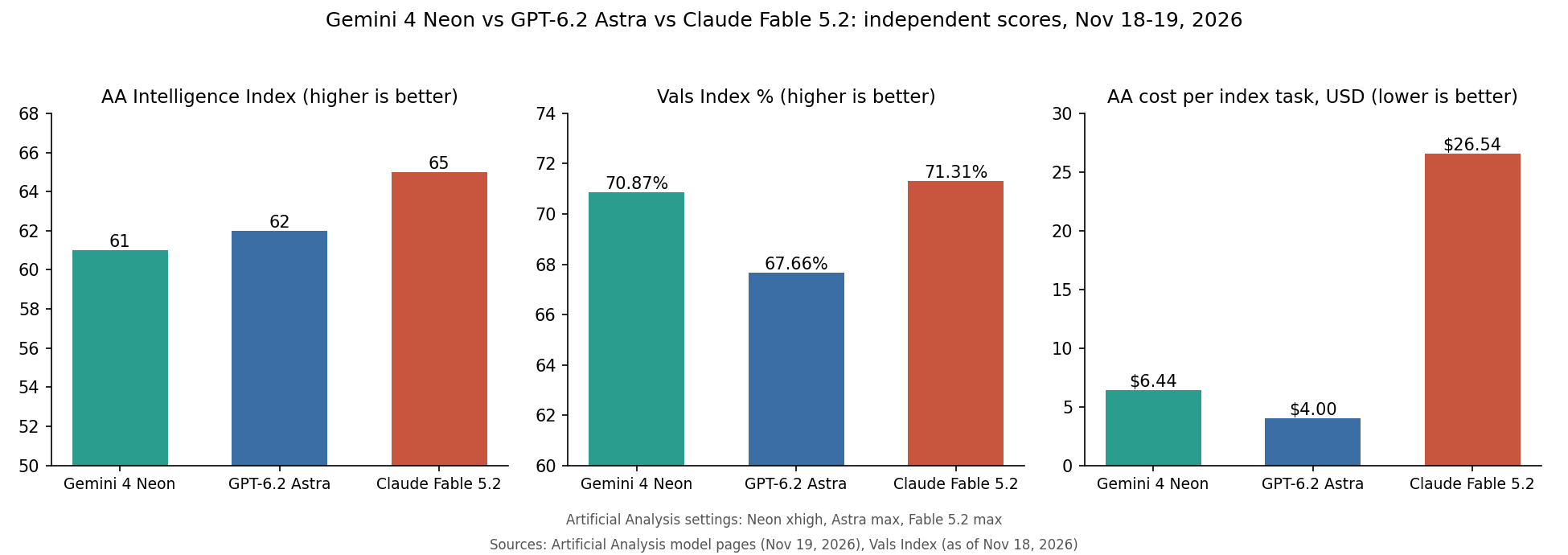
Fable 5.2 leads both boards, and on Vals Neon trails it by only 0.44 points. Artificial Analysis puts Astra one point ahead of Neon; Vals puts Neon more than 3 points ahead of Astra.
Google’s launch post ranked Neon #3 on Artificial Analysis; on November 19 the same page lists it #6 of 96. Launch-day ranks move fast, and a one-point gap is noise. The cost and speed rows tell you more about how each model will feel in your agent.
Why does the most expensive per token cost the least per task?
Price per token is half the bill; the other half is how many tokens a model writes before it answers. On the Artificial Analysis suite, Astra generated 65.8M output tokens. Neon generated 283M and Fable 275M, more than four times as many. Astra’s $40 output rate applied to a much smaller pile, so its cost per task landed at $4.00, below Neon’s $6.44, even though Neon’s output rate is 62.5% lower.
Settings matter. Artificial Analysis ran Neon at xhigh; at high it scores 60 with 123M output tokens instead of 283M, one point for less than half the tokens. Our Gemini 4 Neon thinking levels guide shows the full curve.
Fable’s $26.54 combines a high output rate with high verbosity: the price of the top score.
What does a real agent workload cost on each model?
Two workloads at list rates, assuming identical token counts on each model (they won’t be, so read this as a price comparison, not a forecast).
| Workload | Gemini 4 Neon | GPT-6.2 Astra | Claude Fable 5.2 |
|---|---|---|---|
| Agent session: 150K fresh input, 1.35M cache reads, 150K output | $0.45 + $0.20 + $2.25 = $2.90 | $1.50 + $0.54 + $6.00 = $8.04 | $1.50 + $0.27 + $6.00 = $7.77 |
| One long request: 400K input, 8K output, no cache | $1.20 + $0.12 = $1.32 | $6.40 + $0.48 = $6.88 | $3.20 + $0.32 = $3.52 |
Astra and Fable bill the first 150K as a $10 per 1M cache write; Neon has no write fee. The long request shows Astra’s 272K rule: past that line, OpenAI bills $16 input and $60 output per 1M for the whole request.
If Neon writes 3x more tokens than Astra on your prompts, its $2.90 session can cost more than Astra’s. Measure output tokens before you pick on price.
Which API differences will break your agent harness?
Each API rejects settings the others accept:
- Gemini 4 Neon: the old
thinking_budgetparameter returns HTTP 400, as dofrequency_penaltyandpresence_penalty. Customtemperature,top_kandtop_pvalues are ignored, per Google’s Cloud developer guide. - GPT-6.2 Astra:
reasoning.effortset tononereturns a 400, and the model page lists Realtime, Assistants and fine-tuning as unsupported. - Claude Fable 5.2: forced tool use (
tool_choiceofanyortool) and sampling parameters such astemperaturereturn a 400, and thinking can’t be turned off.
Our GPT-6.2 Astra vs Claude Fable 5.2 guide covers the Astra and Fable quirks in detail, and the Gemini 4 Neon API guide covers Neon’s request format.
Where does each model fit best?
Gemini 4 Neon is built for frequent, complex work. Google says it cuts redundant file reads and can plan while cheaper Gemini 4 Hydrogen subagents run the steps; in Google Antigravity, /swarm runs agents in parallel.
GPT-6.2 Astra brings the OpenAI toolbox: apply_patch, hosted shell, computer use, MCP and a multi-agent beta in the Responses API. It’s the fastest of the three on Artificial Analysis, at 13.9 minutes per task. Simon Willison noted on launch day that it scores a little below Fable 5.2 on several benchmarks.
Claude Fable 5.2 is the pick when quality outweighs cost: long agent sessions, hard refactors, research tasks. Its $0.20 cache reads and flat 1M pricing soften the $40 output rate.
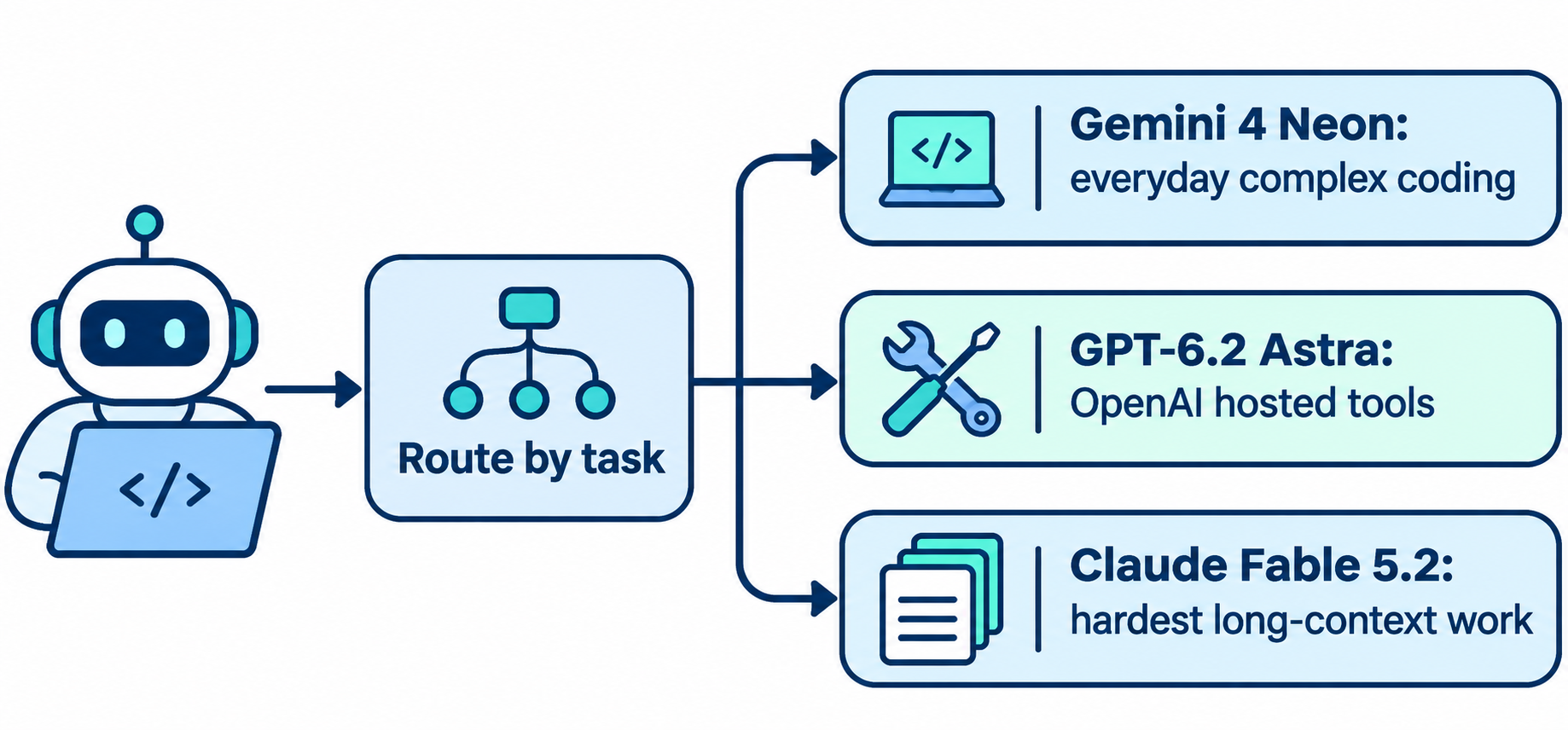
You don’t have to pick one. Send the bulk of agent steps to Neon and the few tasks that fail there to Fable or Astra; your average cost stays near Neon’s.
How do you test all three models on your own workload?
Leaderboards measure someone else’s tasks. Send 5 to 10 real prompts from your agent’s history to all three APIs, and compare pass rate, tokens and latency. Running those requests by hand gets old fast, so let Claude Code, Codex or Cursor drive Apidog CLI. Setup takes three commands:
npm install -g apidog-cli@latest
apidog login --with-token <YOUR_APIDOG_TOKEN>
npx -y skills add https://apidog.com   # pick your agent when prompted
Then give your agent one prompt:
In Apidog project <PROJECT_ID>, create three test cases that send the
same code-review prompt to gemini-4-neon (Gemini Interactions API,
thinking_level high), gpt-6.2-astra (OpenAI Responses API, effort high)
and claude-fable-5-2 (Claude Messages API, no temperature field).
Keep each API key in a private environment variable. Assert a 200
status and a non-empty answer, record token usage and response time,
run each case 5 times and summarize cost per run at list prices.
Validate every payload against its schema before you write it.
The agent checks each payload schema, writes the cases and runs them. These flags come from apidog run --help on CLI 2.2.12:
apidog cli-schema get test-case-create
apidog cli-schema validate test-case-create --file neon-case.json
apidog test-case create --project <PROJECT_ID> --file neon-case.json
apidog test-case create --project <PROJECT_ID> --file astra-case.json
apidog test-case create --project <PROJECT_ID> --file fable-case.json
apidog run --test-case <NEON_CASE_ID> --project <PROJECT_ID> \
  -e <ENV_ID> -n 5 -r cli,json --out-dir abc-results
Repeat the last command with the Astra and Fable case IDs. -n 5 runs each case five times, and --upload-report shows the runs in the Apidog app. This is a workflow template; we haven’t run it against all three APIs from this machine.
Add negative cases for the 400s above, so a provider rule change shows up in your suite first. The Apidog CLI in Claude Code guide covers agent setup, and Apidog’s Free plan covers up to 4 users.
FAQ
Is Gemini 4 Neon better than GPT-6.2 Astra? It depends on the leaderboard: Neon leads on the Vals Index (70.87% vs 67.66%), Astra leads by one point on the Artificial Analysis Intelligence Index (62 vs 61). Neon costs $3 / $15 per 1M tokens against Astra’s $8 / $40.
Which of the three is cheapest? Per token, Gemini 4 Neon at $3 input and $15 output per 1M. Per Artificial Analysis task, GPT-6.2 Astra at $4.00, because it writes far fewer tokens than Neon ($6.44) or Fable 5.2 ($26.54).
Which model scores highest? Claude Fable 5.2 leads both the Artificial Analysis Intelligence Index (65) and the Vals Index (71.31%) as of November 18-19, 2026.
Do any of them have a free API tier? No. Google lists no free tier for Neon, and Astra and Fable 5.2 are paid API models. Google AI Pro and Ultra subscribers can use Neon in the Gemini app and Antigravity. See our Gemini 4 Neon free guide for the $0 options.
Can I use more than one in the same agent? Yes. Route routine steps to Neon and the tasks it fails to Fable 5.2 or Astra. Test each route first: token counts per task differ by more than 4x between models.