
Gemini 4 Neon for cyber is the cyber defense variant of Google’s Gemini 4 Neon, announced on November 18, 2026. It targets the code hardening lifecycle: finding vulnerabilities, checking which ones are exploitable and patching them. It isn’t on the public API. Eligible Fairwind Program members start receiving access over the coming days, and you request access through your Google Cloud account team.
If you don’t qualify, you still have options, and hardening your own APIs doesn’t wait for either.
What is Gemini 4 Neon for cyber?
Gemini 4 Neon for cyber is a version of Gemini 4 Neon that Google releases to vetted defenders through its Fairwind Program. Google’s launch post groups it under “Built for fast, efficient, frontier-level cyber defense” and says it “delivers frontier-level performance across the code hardening lifecycle.”
The base model is the one most teams can already call. Gemini 4 Neon (gemini-4-neon) is Google’s middle Gemini 4 tier: $3 per million input tokens, $15 per million output tokens, $0.15 per million cached input tokens and a 1M-token context window, on the paid Gemini API tier. Our Gemini 4 Neon pricing guide covers the bill in detail.
Three things Google hasn’t published for the cyber variant:
- A model ID. The launch post names no separate API string for Neon for cyber.
- A price. The Fairwind page doesn’t mention pricing.
- Its safeguard settings. For Gemini 4 Argon, Google said it released a build “without cyber guardrails” to trusted defenders (we covered that in our Argon cyber defense post). The Neon launch post says nothing about guardrails for the cyber variant, so don’t assume either way.
Gemini 4 Neon for cyber benchmarks
Google reports five cyber results across the launch post and its Gemini cyber page. Some are attributed to “Neon for cyber” and some to “Neon,” so the table keeps Google’s wording. All are Google-reported.
| Benchmark | Result | What Google says it measures | Comparison Google gives |
|---|---|---|---|
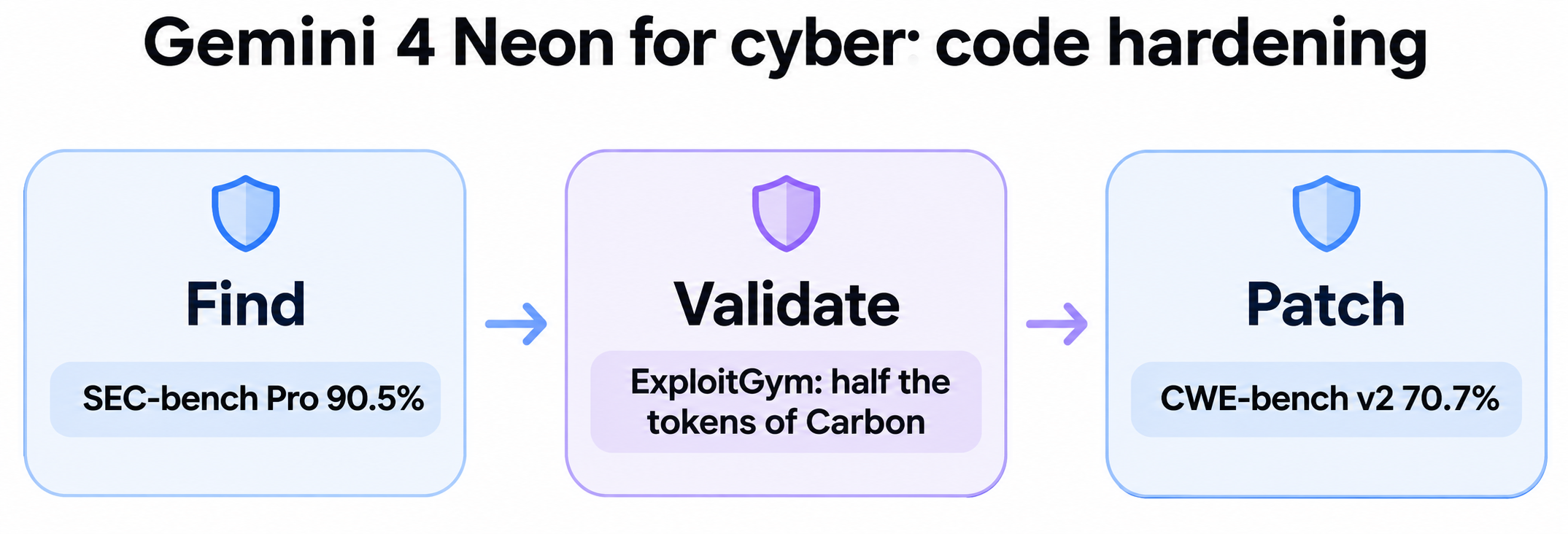
| SEC-bench Pro | 90.5% | Finding code vulnerabilities | State of the art, roughly half the cost per challenge |
| ExploitGym | Not published as a score | Checking which vulnerabilities are exploitable | Frontier-level, half the tokens of Carbon |
| CWE-bench v2 (Collinear) | 70.7% | Patching vulnerabilities at the root cause | 3.4% uplift over Carbon |
| WebExploitBench v1.2 | 51.26% (51.3% on the cyber page) | Penetration testing | State of the art, half the cost of competing large models |
| AutoBaxBench, hard tier | 76% | Generating secure code from the start | More secure code than Carbon on easy, medium and hard |
A few cautions before you quote these. The cost claims (“half the cost,” “half the tokens”) are Google’s and the launch post doesn’t name the comparison models for WebExploitBench. The cyber page lists the CWE-bench v2, SEC-bench Pro and WebExploitBench numbers under the Neon column rather than a separate cyber column. And CWE-bench v2 isn’t the CWE-bench v1 leaderboard Google used for Argon’s 68%, so don’t line the two up as a generation-over-generation gain.
Find, validate, patch: what the cyber variant does
Google frames the cyber variant around three defender jobs, each tied to a benchmark:
- Find code vulnerabilities. SEC-bench Pro at 90.5%, which Google calls state of the art.
- Validate risk through exploitation. “To prioritize which vulnerabilities to remediate, defenders rely on models to check which vulnerabilities are exploitable.” Google reports frontier-level ExploitGym performance at half Carbon’s token spend.
- Patch the root cause. CWE-bench v2 at 70.7%. The benchmark is built around Common Weakness Enumeration categories, the same taxonomy your scanners and bug tracker probably use.
Two more results sit outside the hardening loop. On secure code generation, Google says Neon for cyber beats Carbon at every AutoBaxBench difficulty and hits 76% on the hard tier. On penetration testing, Neon scores 51.26% on WebExploitBench v1.2.
The pitch is cost per job: the cyber claims lean on “half the cost” and “half the tokens” as much as on raw scores.
How to get Fairwind access
The Fairwind Program is Google’s early access program for high-priority defenders. To request access, contact your Google Cloud account team. If you aren’t a Cloud customer, the page points you to Google Cloud’s get-started documentation first.
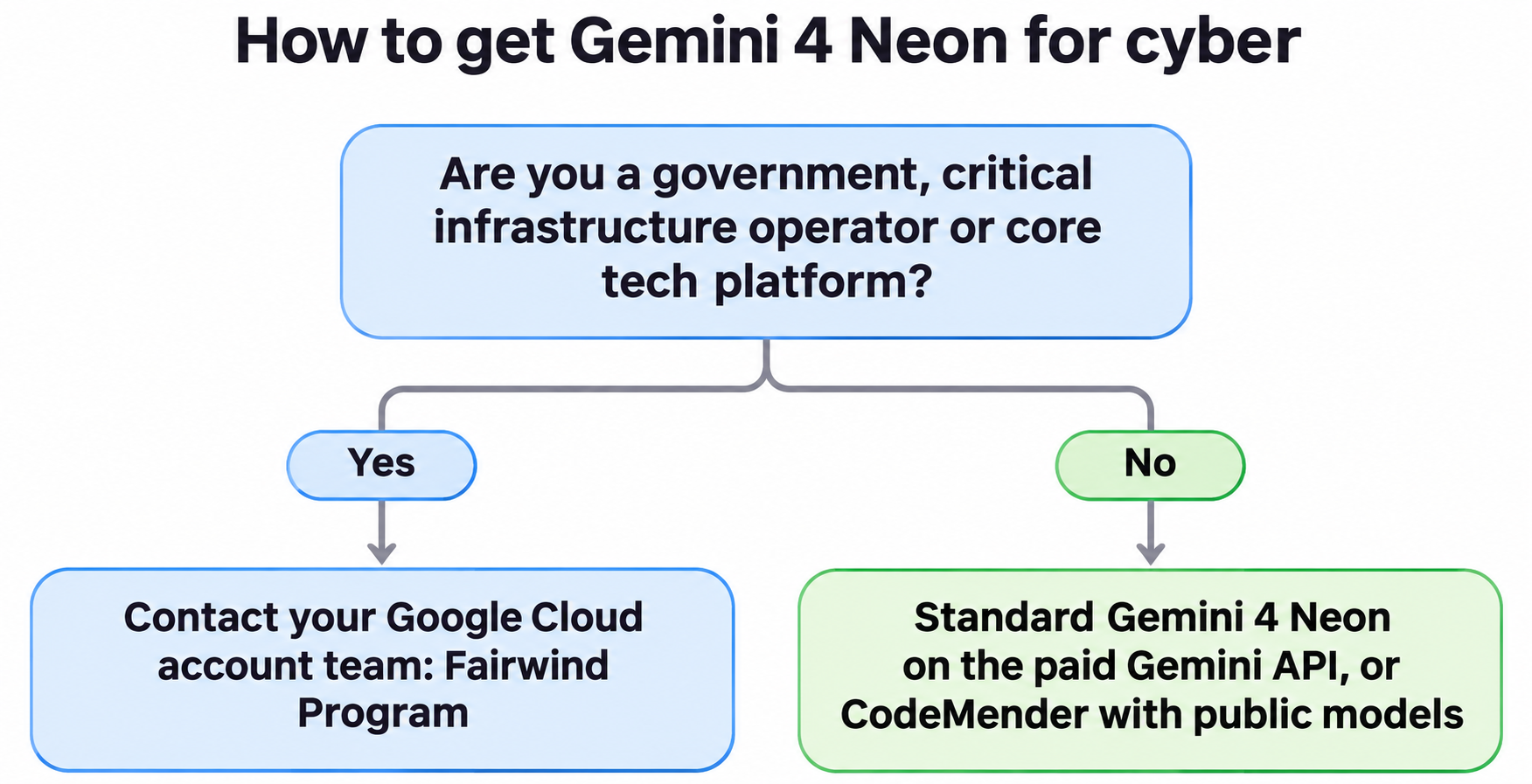
Who Google prioritizes. “We prioritize access for governments and partners most critical to societal resilience.” The page names governments and national cyber authorities, critical infrastructure operators (healthcare, telecom, energy and finance) and core technology platforms. Applicants are vetted on ethical operations and track record. Academic labs focused on defensive benchmarking may also apply.
What partners agree to:
- User-level authentication, phishing-resistant MFA and applicable access controls.
- Access limited to internal cybersecurity, incident response or penetration testing teams.
- Tracking of employee access and use.
- No sharing, redistribution or resale of access to frontier models.
What you can do with it. Permitted work covers “authorized threat simulation, reverse engineering, and malware analysis for defensive and academic research purposes.” Malicious tasks, such as creating malware, aren’t allowed.
How you run it. Fairwind offers “exclusive access to Gemini for cyber models,” standalone or inside CodeMender, Google’s code security agent, so you don’t have to build your own harness. Accessed directly as a managed model on Gemini Enterprise, Gemini for cyber supports zero data retention.
Timing. Google’s wording is “over the next few days” from November 18. As of November 19, the Fairwind page lists Gemini 4 Carbon and Argon in its news feed but doesn’t mention Neon yet.
If you aren’t eligible for Fairwind
Most teams won’t qualify, and that’s by design. You have three routes:
| Route | What you get | Cost |
|---|---|---|
Standard gemini-4-neon |
The same base model on the paid Gemini API, with Google’s real-time cyber safeguards | $3 / $15 per 1M tokens; no free API tier |
| CodeMender with public models | Google’s code security agent, without the Fairwind models | Not published on the Fairwind page |
| Google’s AI threat defense products | Other Google security tools the Fairwind page points to | Varies by product |
Standard Neon isn’t crippled for defensive work. Google says it paired Neon with real-time safeguards against cyber and biosecurity misuse “comparable to our Carbon protections, while declining far less legitimate work in these areas.” It refused 1.98% of tasks on Terminal-Bench 4.0 and 0% on Terminal-Bench-Science. Our Gemini 4 Neon API guide shows the request shapes, and the free access guide explains the $0 ways to try it in Google’s apps. Students are pointed to CodeMender on Google Cloud.
Prompt injection: Neon’s safeguard numbers
If you put Neon behind your own API, the number to watch is prompt injection. Google says that on Gray Swan’s indirect prompt injection benchmark, “with real-time safeguards at its highest thinking level, Neon resisted every attack” in that benchmark, a 0.0% attack success rate that Google says only other Gemini models have matched.
That’s one benchmark, at the highest thinking level, with safeguards on. Treat model output as untrusted input: validate tool-call arguments against a schema, scope the credentials the model can trigger and log every action it takes. Our guide to prompt injection for API teams walks through the tests.
Let your coding agent harden your APIs with Apidog CLI
Neon for cyber reads code; outside probers read your running API. Your cheapest defense is a suite that checks every endpoint rejects what it should, and your coding agent can build it with Apidog CLI.
Set it up once:
npm install -g apidog-cli@latest
apidog login --with-token <YOUR_TOKEN>
npx -y skills add https://apidog.com   # pick your agent when prompted
Then give Claude Code, Codex, Cursor or OpenCode one prompt:
Import ./openapi.yaml into Apidog project <id>. For every endpoint that
requires auth, create test cases that send no token, an expired token and
another user's token, and assert 401 or 403. Add a case that sends a string
where the spec says integer and assert 400 or 422 with no stack trace in the
body. Put them in one test scenario, run it against staging and list every
endpoint that returned 200 when it shouldn't.
The agent imports the spec, reads the payload schema, validates its cases and runs the scenario:
apidog import --project <id> --format openapi --file ./openapi.yaml
apidog endpoint list --project <id>
apidog cli-schema get test-case-create
apidog cli-schema validate test-case-create --file auth-negative.json
apidog test-case create --project <id> --file auth-negative.json
apidog test-scenario create --project <id> --name "Auth and input hardening" --folder-id <folderId> --priority <priority>
apidog test-scenario import-steps <scenarioId> --project <id> --source test-case --endpoint <endpointId> --ids <caseIds> --sync manual
apidog run -t <scenarioId> --project <id> -e <stagingEnvId> -r cli,junit --notification-failed-event <targetId>
Here’s what a healthy API returns to those checks:
| Check | What the agent sends | Expected response |
|---|---|---|
| No credentials | Request with the auth header removed | 401 |
| Expired token | A revoked or expired token | 401 |
| Wrong user | User B’s token on user A’s resource | 403 or 404 |
| Wrong types | A string where the spec says integer | 400 or 422 |
| Burst traffic | The same request with -n 50 iterations |
429, ideally with Retry-After |
Keep the expired and other-user tokens in environment variables, not in the case files. Put the same apidog run ... -r junit into your pipeline with the Apidog CLI CI/CD guide, and look up any flag in the apidog run command reference. For the full list of checks, start from our API security testing checklist.
Apidog is an API design and testing platform, not a vulnerability scanner. It won’t find a memory-safety bug in your parser; that’s the kind of work Neon for cyber is built for. It does catch the route that shipped without auth before someone else does. Apidog’s Free plan covers up to 4 users.
FAQ
What is Gemini 4 Neon for cyber? A cyber defense variant of Gemini 4 Neon that Google is rolling out to trusted defenders through the Fairwind Program. Google positions it for finding, validating and patching vulnerabilities.
How do I get Fairwind Program access? Contact your Google Cloud account team. Google prioritizes governments, national cyber authorities, critical infrastructure operators and core technology platforms, and vets each applicant.
Is Gemini 4 Neon for cyber on the Gemini API? Not publicly. Google hasn’t published a separate model ID. Standard gemini-4-neon is on the paid Gemini API at $3 input and $15 output per million tokens.
How much does Gemini 4 Neon for cyber cost? Google hasn’t published Fairwind pricing. Ask your Cloud account team.
How does Neon for cyber compare to Gemini 4 Carbon on security? Google says it writes more secure code than Carbon on AutoBaxBench, beats Carbon by 3.4% on CWE-bench v2 and matches frontier-level ExploitGym results with half Carbon’s tokens.
Is Apidog a security scanner? No. Apidog designs, mocks and tests APIs. Use Apidog CLI to keep auth, input validation and rate-limit checks running against every endpoint in your spec.