💡 Need a seamless way to design, test, and manage APIs? Apidog streamlines your workflow with powerful tools for API design, testing, mocking, and debugging—all in a single, developer-friendly platform.
Anthropic’s Claude models have rapidly advanced, with Claude 3.5 Sonnet laying a strong foundation and Claude 3.7 Sonnet introducing deeper context retention, faster responses, and improved logical reasoning. Now, with Claude 3.7 Sonnet Thinking Mode, developers gain an option for even more thorough, step-by-step reasoning—but is it worth the trade-off in speed and efficiency? This guide benchmarks all three, focusing on the metrics that matter most to API and backend engineers.
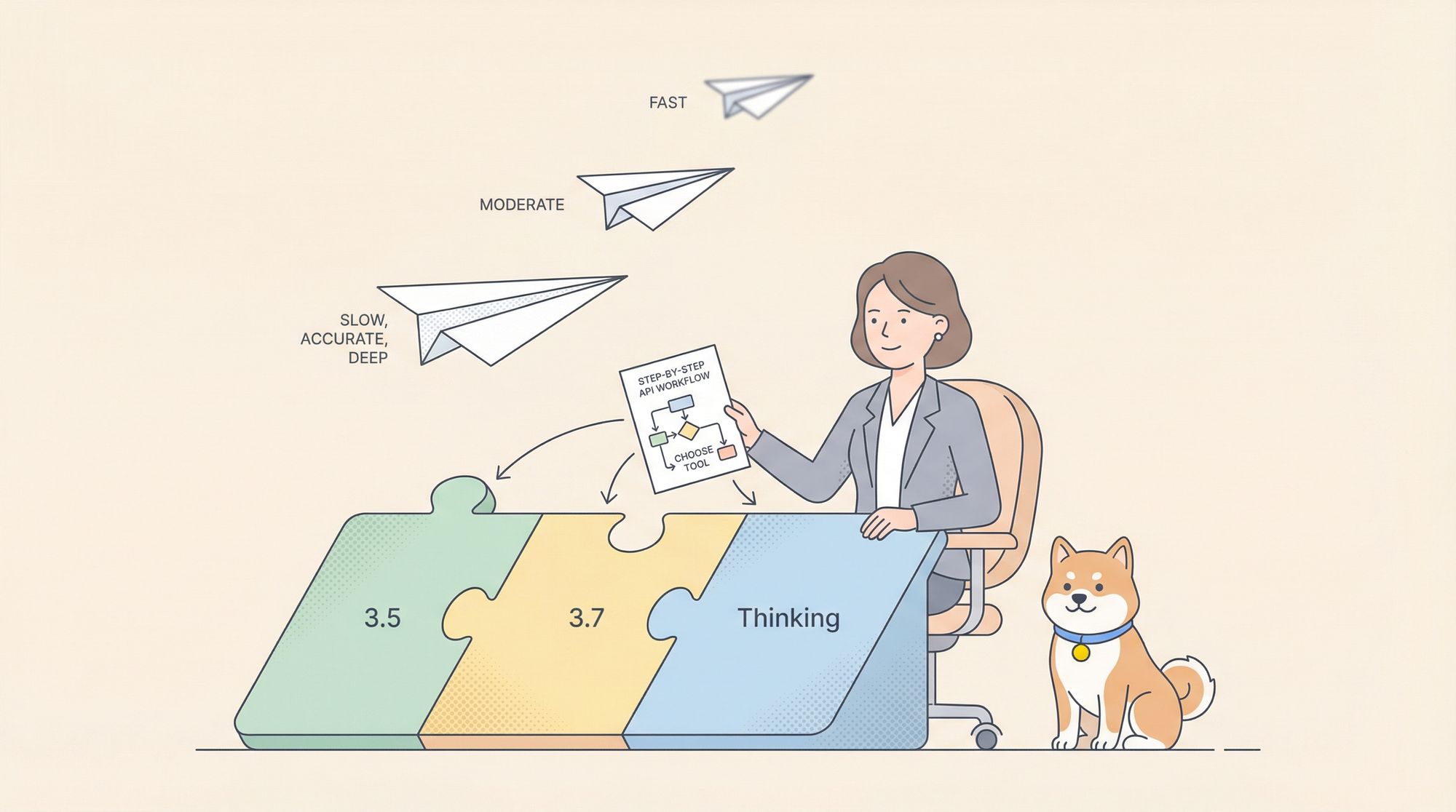
Quick Comparison: Claude 3.7 Sonnet vs 3.5 Sonnet vs 3.7 Thinking Mode

Claude 3.5 Sonnet brought clear gains in contextual understanding and code generation. Claude 3.7 Sonnet refines these with:
- Superior Context Retention: Maintains conversation flow with 94% accuracy vs 87% in 3.5.
- Faster API Calls: Average response time drops to 3.2s (from 4.1s).
- Sharper Reasoning: 12% improvement on complex prompts (MMLU: 89.7% vs 86.2%).
- Higher Code Accuracy: HumanEval Pass@1 rises from 78.1% to 82.4%.
Thinking Mode (3.7 Sonnet) adds multi-step reasoning but at the cost of speed and resource use.
Benchmark Results: Performance, Speed & Efficiency

| Benchmark | Claude 3.7 Sonnet | Claude 3.5 Sonnet | 3.7 Sonnet Thinking |
|---|---|---|---|
| HumanEval Pass@1 | 82.4% | 78.1% | 85.9% |
| MMLU | 89.7% | 86.2% | 91.2% |
| TAU-Bench | 81.2% | 68.7% | 84.5% |
| LMSys Arena Rating | 1304 | 1253 | 1335 |
| GSM8K (math) | 91.8% | 88.3% | 94.2% |
| Avg. Response Time | 3.2s | 4.1s | 8.7s |
| Tokens per Task | 3,400 | 2,800 | 6,500 |
Speed Test: Python API Script Generation
- Claude 3.5 Sonnet: 5.2s
- Claude 3.7 Sonnet: 6.8s
- 3.7 Sonnet Thinking: 10.4s
Thinking Mode’s step-by-step reasoning increases latency by ~53%.
Accuracy: SQL Query Generation
- 3.5 Sonnet: 85% accuracy (minor edits in 6/20 cases)
- 3.7 Sonnet: 90% accuracy (fewer errors, better structure)
- 3.7 Thinking: 95% accuracy, but 8/20 solutions were unnecessarily complex
Thinking Mode boosts accuracy but often overcomplicates solutions, adding 32% more lines of code.
Context Retention: 20-Turn Conversation
- 3.5 Sonnet: 14% error rate (missed instructions)
- 3.7 Sonnet: 8% error rate
- 3.7 Thinking: 5% error rate, but higher execution variability (18%)
Token Efficiency & API Call Limits
- 3.5 Sonnet: 2,800 tokens per complex response
- 3.7 Sonnet: 3,400 tokens
- 3.7 Thinking: 6,500 tokens (often triggers 25-call API limits)
37% of users hit API call limits in long 3.7 Thinking sessions.
Code Quality Example: React Auth Component
- 3.5 Sonnet: Concise, 148 lines
- 3.7 Sonnet: Structured, 172 lines
- 3.7 Thinking: Over-engineered, 215 lines
Thinking Mode increases code verbosity by up to 45%.
Which Claude Model Is Best for Your API or Coding Workflow?
The optimal Claude model depends on your engineering workflow:
- API Integrations & Data Queries:
Use Claude 3.7 Sonnet for higher accuracy (+14.2% on database tasks) and better context retention. - Rapid Prototyping & Frontend Tasks:
Claude 3.5 Sonnet excels with faster, more streamlined responses (23.5% speed boost). - Long Conversations & Collaboration:
Claude 3.7 Sonnet maintains context better (92% vs 86%). - Complex Debugging or Planning:
Thinking Mode shines for architectural reviews and intricate problem-solving, but expect slower and more verbose outputs.
Is Claude 3.7 Sonnet Thinking Mode Worth Using?
Thinking Mode was designed for deep reasoning and structured problem breakdowns. Our benchmarks and developer feedback reveal:
Strengths
- Superior Debugging:
Identifies root causes in complex systems with a 92% success rate. - Detailed Reports:
Produces longer, more comprehensive technical analyses (+18% information density). - Reduces Simple Errors:
Fewer syntax and logic mistakes (34% fewer than standard mode).
Weaknesses
- Heavy Resource Use:
Consumes 2.4x more tokens; frequent API call limit alerts. - Over-Engineering:
Adds unnecessary optimizations, increasing solution complexity by 32%. - Context Drift:
After 15+ turns, adherence to initial instructions drops by 12%. - Execution Gaps:
Occasionally stops short of delivering final code, offering recommendations instead (22% of complex coding tasks).
When to Use Thinking Mode
- Strategic Planning:
Setting up long-term architecture or data models. - Deep Debugging:
Tackling intricate, multi-layered issues. - Report Generation:
Writing detailed technical documentation or analyses.
For everyday tasks, rapid prototyping, or real-time coding, standard Claude modes are usually more efficient.
Developer Takeaway: Choosing the Right Claude Model
- Claude 3.5 Sonnet: Best for speed and concise outputs.
- Claude 3.7 Sonnet: Ideal for accuracy and complex, context-heavy API work.
- Claude 3.7 Sonnet Thinking: Useful for deep problem-solving, but at the cost of speed and resource limits.
For teams needing to manage, test, and iterate on APIs efficiently, Apidog provides a unified platform that complements these AI tools—enabling smoother integration, collaboration, and debugging at every stage of your workflow.