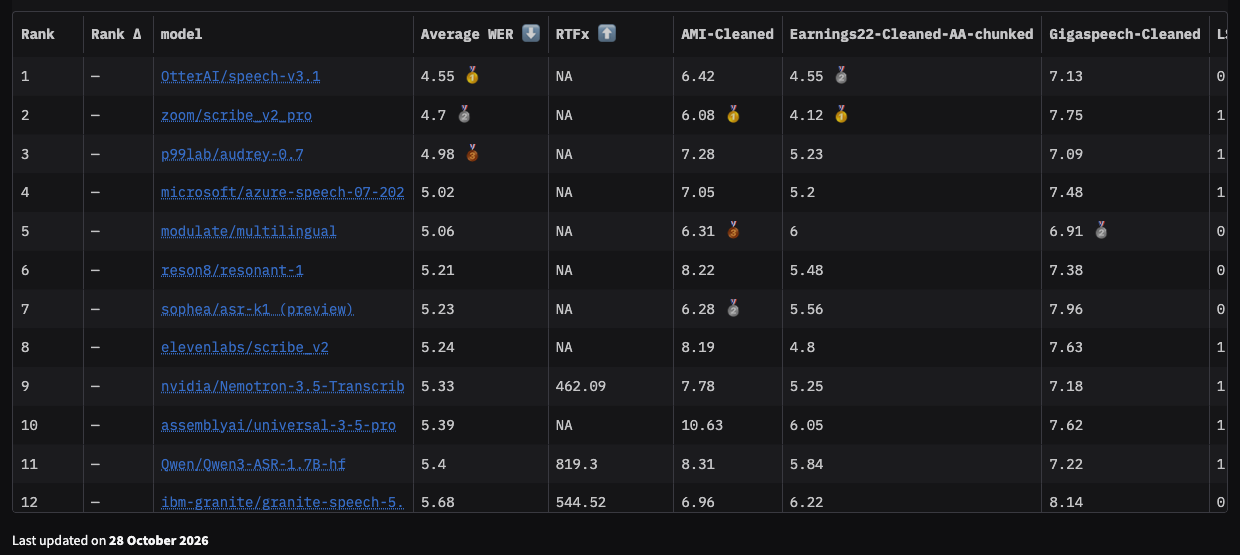
The best open-source speech-to-text model in October 2026 is NVIDIA’s Nemotron 3.5 Transcribe, released on October 28. On the Hugging Face Open ASR Leaderboard updated that same day, it averages 5.33% word error rate and ranks 9th of 61 models. All eight models above it are closed commercial APIs. OpenAI’s whisper-large-v3, still the default in many tutorials, sits 41st at 7.16%.
Below are the nine open-weight speech recognition models worth considering right now, ranked by that leaderboard, with speed, strengths and the job each one fits. Every WER and speed figure comes from the leaderboard as read on October 29, 2026.
If you’re choosing between hosted APIs instead, read our Nemotron 3.5 Transcribe API guide and the Whisper API guide.
How we ranked them
The Open ASR Leaderboard runs every model on the same English test sets: meetings (AMI), earnings calls (Earnings22), podcasts and YouTube (GigaSpeech), audiobooks (LibriSpeech), finance calls (SPGISpeech), noisy speech (URGENT24), conversational audio (Voice Arena Monsoon), parliament speeches (VoxPopuli), and two private sets. The ranking metric is average WER, where lower is better.
We also list RTFx, the leaderboard’s speed measure: seconds of audio transcribed per second of compute. Higher is faster. Closed APIs show “NA” because they can’t be timed on the same hardware.
We counted a model as open-weight when its checkpoint is downloadable and the leaderboard reports an RTFx for it. Check each license before commercial use.
The ranking at a glance
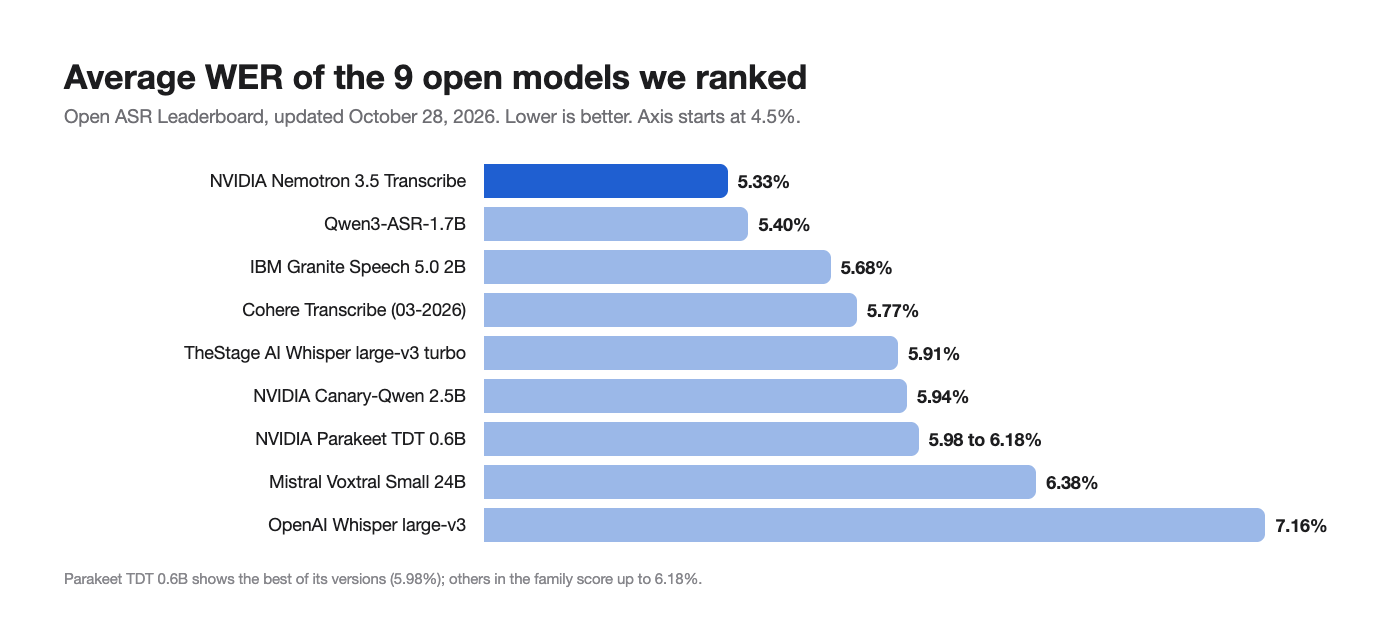
| Rank (open) | Model | Avg WER | RTFx | Overall rank |
|---|---|---|---|---|
| 1 | NVIDIA Nemotron 3.5 Transcribe 30B-A4B | 5.33% | 462 | 9 |
| 2 | Qwen3-ASR-1.7B | 5.40% | 819 | 11 |
| 3 | IBM Granite Speech 5.0 2B | 5.68% | 545 | 12 |
| 4 | Cohere Transcribe (03-2026) | 5.77% | 902 | 14 |
| 5 | TheStage AI Whisper large-v3 turbo | 5.91% | 1,177 | 17 |
| 6 | NVIDIA Canary-Qwen 2.5B | 5.94% | 862 | 21 |
| 7 | NVIDIA Parakeet TDT 0.6B (versions) | 5.98% to 6.18% | not compared | 24 to 31 |
| 8 | Mistral Voxtral Small 24B | 6.38% | not compared | 35 |
| 9 | OpenAI Whisper large-v3 | 7.16% | not compared | 41 |
For context, the best closed APIs on the same board: Otter speech-v3.1 at 4.55%, Zoom Scribe v2 Pro at 4.70%, ElevenLabs Scribe v2 at 5.24%, AssemblyAI Universal-3.5 Pro at 5.39% and OpenAI gpt-transcribe at 5.96%. Nemotron 3.5 Transcribe beats AssemblyAI and OpenAI’s hosted model while being free to download.
1. NVIDIA Nemotron 3.5 Transcribe: best overall
5.33% WER, RTFx 462, OpenMDW-1.1 license
NVIDIA’s new model isn’t a classic ASR network. It’s a speech-augmented language model: a 600M-parameter ASR encoder and a speaker encoder feed a hybrid Mamba-2 and Transformer mixture-of-experts LLM with 34B total and about 4.3B active parameters. That design is why it does more than transcribe.
Why it ranks first:
- 40 languages, with 13 rated “leading”
- One-hour files in a single pass, with a 65,536-token context
- Speaker attribution (up to eight speakers) and word timestamps from one model
- Prompts: verbatim or clean wording, context terms for jargon, translation
- Long-form accuracy: 10.98% mean WER on the leaderboard’s long-form sets, versus 13.37% for Parakeet-TDT-0.6B-v3, per the model card
- Meetings: 15.80% mean cpWER on multi-speaker sets, ahead of the DiCoW plus DiariZen pipeline at 16.83%
Trade-offs: it needs a big GPU (one H100 80 GB in BF16, or an RTX 5090 with NVFP4 weights), it doesn’t stream, and audio question answering is English-only.
Pick it for: meetings, podcasts, earnings calls, multilingual archives and anything where speaker labels or one-hour files matter. Start with the free routes or run it locally.
2. Qwen3-ASR-1.7B: best accuracy per GPU dollar
5.40% WER, RTFx 819
Alibaba’s Qwen3-ASR-1.7B lands only 0.07 points behind Nemotron on the English average while running about 1.8 times faster on the leaderboard’s hardware, from a model one-twentieth the total size. On NVIDIA’s own seven-language multilingual comparison, Nemotron leads more clearly: 4.62% mean WER versus 6.49%.
Pick it for: English-heavy batch transcription on smaller GPUs, where you don’t need built-in speaker attribution. If you already use Qwen’s multimodal models, see our guide to Qwen3.5-Omni.
3. IBM Granite Speech 5.0 2B: best on meeting audio for its size
5.68% WER, RTFx 545
IBM’s Granite Speech 5.0 posts a 6.96% WER on AMI meeting recordings, the best AMI score among the top six open models here and better than Nemotron’s 7.78% there. Its weak spot is SPGISpeech finance calls at 3.36%.
Pick it for: enterprise teams standardizing on IBM’s Granite stack, and meeting transcription on mid-range GPUs.
4. Cohere Transcribe: fast and accurate
5.77% WER, RTFx 902
Cohere Labs’ March 2026 transcription model pairs a top-five open accuracy score with one of the highest speeds here. It’s strongest on LibriSpeech (0.97% clean, 2.05% other) and weaker on VoxPopuli at 5.38%.
Pick it for: high-volume English pipelines where throughput matters as much as accuracy.
5. TheStage AI Whisper large-v3 turbo: fastest in the top tier
5.91% WER, RTFx 1,177
This is an optimized Whisper large-v3 turbo build from TheStage AI, and it’s the fastest model in our list. It scores 1.62% on SPGISpeech, the third-best score on that set across all 61 models. It shows how much life the Whisper family still has once someone tunes it.
Pick it for: teams with existing Whisper code who want a drop-in speed and accuracy upgrade.
6. NVIDIA Canary-Qwen 2.5B: the previous NVIDIA flagship
5.94% WER, RTFx 862
Canary-Qwen was NVIDIA’s earlier speech-plus-LLM model, and Nemotron 3.5 Transcribe replaces it at the top. It’s still fast, and its 1.70% SPGISpeech score is excellent. On NVIDIA’s preference-ASR test, Nemotron scores 7.56% against Canary-Qwen’s 8.16%.
Pick it for: existing NeMo deployments that can’t move to an 80 GB GPU yet.
7. NVIDIA Parakeet TDT 0.6B: smallest serious option
5.98% to 6.18% WER across versions
Parakeet TDT has several 0.6B-parameter versions on the board, all within about 0.2 points of each other. At 600M parameters, it’s the smallest model here that stays near 6% WER, so it runs on modest GPUs. Its weakness is long-form audio, where Nemotron beats it by more than two points.
Pick it for: edge devices, cheap GPUs, and short clips such as voice commands or call snippets.
8. Mistral Voxtral Small 24B: speech plus a strong LLM
6.38% WER
Voxtral Small pairs speech input with a 24B Mistral language model, so like Nemotron it can answer questions about audio, not just transcribe it. It trails the top five on pure WER. Our Voxtral vs. Whisper breakdown covers its earlier release in depth.
Pick it for: voice assistants and audio Q&A where the language model matters more than the last point of WER.
9. OpenAI Whisper large-v3: the baseline
7.16% WER, 41st overall
Whisper large-v3 is still the most widely deployed open model, with the biggest ecosystem of wrappers, fine-tunes and tutorials. On accuracy it now trails every other model in this list. If you run it in production, a switch to any of the top six is the cheapest quality upgrade available.
Pick it for: prototypes that depend on Whisper-specific tooling, or as the baseline to beat.
Which one should you pick?
| Your job | Pick |
|---|---|
| Meetings with several speakers | Nemotron 3.5 Transcribe |
| One-hour podcasts or calls in one pass | Nemotron 3.5 Transcribe |
| Multilingual archives | Nemotron 3.5 Transcribe |
| English batch jobs on smaller GPUs | Qwen3-ASR-1.7B |
| Maximum throughput | TheStage Whisper large-v3 turbo or Cohere Transcribe |
| Edge or low-cost hardware | Parakeet TDT 0.6B |
| Audio Q&A plus transcription | Nemotron 3.5 Transcribe or Voxtral Small |
| Existing Whisper code, minimal change | TheStage Whisper large-v3 turbo |
One caution: leaderboard averages hide domain gaps. Nemotron is best overall, yet Granite beats it on AMI and several models beat it on LibriSpeech. Test the top two or three on 50 to 100 of your own recordings before you commit.
Benchmark candidates with your coding agent and Apidog CLI
The fastest way to run that bake-off is to let your coding agent do it. Serve two or three models behind OpenAI-style /v1/audio/transcriptions endpoints (SGLang-Omni serves Nemotron this way), then have the agent build and run the same checks against each with Apidog CLI.
npm install -g apidog-cli@latest
apidog login --with-token <YOUR_TOKEN>
npx -y skills add https://apidog.com   # pick your agent when prompted
Then give your agent one prompt:
In Apidog project <id>, create one environment per speech server (nemotron, qwen3-asr,
whisper) with its baseUrl. Create test cases that POST each file in samples/ to
{{baseUrl}}/v1/audio/transcriptions, assert status 200 and non-empty text, and save the
transcript to a variable. Run the cases against each environment and give me a table
of failures and response times per server.
The agent reads the schema, validates its payload, writes the cases and runs them per environment:
apidog cli-schema get test-case-create
apidog cli-schema validate test-case-create --file case.json
apidog test-case create --project <id> --file case.json
apidog run --test-case <caseId> --project <id> -e <envId> -r cli,json
Score the saved transcripts against your reference text with any WER script, and keep the winning environment’s run in CI with -r junit. See Apidog CLI in Claude Code and Apidog CLI in a CI/CD pipeline.
FAQ
What’s the most accurate open-source speech-to-text model? NVIDIA Nemotron 3.5 Transcribe, at 5.33% average WER on the October 28, 2026 Open ASR Leaderboard.
Is Whisper still good? It works, but whisper-large-v3 ranks 41st at 7.16%. Tuned Whisper builds like TheStage’s large-v3 turbo score 5.91%.
Which open model is fastest? Of the models here, TheStage AI’s Whisper large-v3 turbo, at an RTFx of 1,177.
Do open models beat paid APIs now? Some. Nemotron 3.5 Transcribe beats AssemblyAI Universal-3.5 Pro (5.39%) and OpenAI gpt-transcribe (5.96%). Otter, Zoom and ElevenLabs still lead overall. For hosted options, see our speech-to-text APIs roundup.
Which supports speaker diarization? Nemotron 3.5 Transcribe does it in the same model, with up to eight speakers. Most others need a separate diarization step.
The verdict
For most teams in late 2026, start with Nemotron 3.5 Transcribe if you have an 80 GB GPU or can pay $0.12 an hour on a hosted API. Choose Qwen3-ASR-1.7B when GPU budget is tight, and Parakeet when hardware is tighter still. Whatever you pick, test it on your own audio, and let your agent keep Apidog checks running so the model you chose keeps performing after every upgrade.