
Apache JMeter has earned its permanence. It’s free, open source, and per the official project page, a 100% pure Java application built to load test functional behavior and measure performance, with protocol coverage running from HTTP and REST through JDBC, LDAP, JMS, FTP, and mail servers. That’s also the problem. Teams adopt JMeter for a load test, then keep using it as their everyday API tool, and everyday API work is what JMeter was never shaped for. Test plans are XML files edited through a Java Swing GUI. The learning curve is a wall: thread groups, samplers, listeners, and controllers before your first request. And the project’s own documentation tells you not to trust the GUI under load; the recommended way to run a real test is headless, jmeter -n -t test.jmx -l test.jtl, with result-tree listeners switched off.
Here’s the direct answer: Apidog is the best JMeter alternative for the API work most teams do all day, because it replaces the XML-and-Swing workflow with one platform covering design, debugging, automated functional testing, mocking, documentation, and CI runs via a CLI, and it includes built-in performance testing that points up to 100 virtual users at the test scenarios you’ve already built. The honest boundary comes with it: for distributed load tests simulating tens of thousands of users, JMeter (or k6, Gatling, Locust) remains the right tool. What follows is where JMeter’s weight stops paying for itself, what Apidog covers instead, and how to move.
What JMeter is, and what using it daily feels like
JMeter’s scope is genuinely wide. The official site lists load testing across HTTP/HTTPS web services (SOAP and REST), FTP, JDBC database connections, LDAP, JMS message queues, mail protocols, TCP, and even native commands and shell scripts, with a test IDE, a command-line mode, multi-threaded execution, and dynamic HTML reports. The current release is 5.6.3 on Java 8 or newer, per the download page. If your job is stress-testing a message queue and a database behind one scenario, few tools reach that far for free.

Daily API work is a different job, and here the design shows its age:
- Everything is a test plan. There’s no lightweight “send this request, read the response” flow. You build a thread group, add an HTTP sampler, attach a listener, and run a plan, even for a single GET.
- Test plans are JMX files, which are XML. Diffs are noisy, code review is painful, and merge conflicts in a 4,000-line XML tree are a special kind of morning.
- The GUI can’t be trusted for the real thing. JMeter’s own performance guidance says to use CLI mode for actual load runs and keep listeners like View Results Tree for debugging only, because they eat the memory the load generator needs. The interface you learn is the one you’re told to stop using.
- It works at the protocol level, not the lifecycle level. JMeter doesn’t execute the JavaScript in HTML pages, and it has no concept of an API spec: no design surface, no generated documentation, no mock server for your frontend team, no schema to validate responses against.
None of this is a flaw in JMeter; it’s a scope statement. JMeter is a load-generation engine with a test IDE bolted on, and the mismatch appears when a load engine gets used as an API workflow. We drew the same boundary from the other side in Postman vs JMeter: the differences that matter.
The answer: Apidog
Apidog is an API development platform that covers the lifecycle JMeter never claimed: design endpoints against a spec, debug requests, chain them into automated test scenarios, serve mocks, publish docs, and run everything in CI. For someone weighing it against JMeter specifically, four things matter.
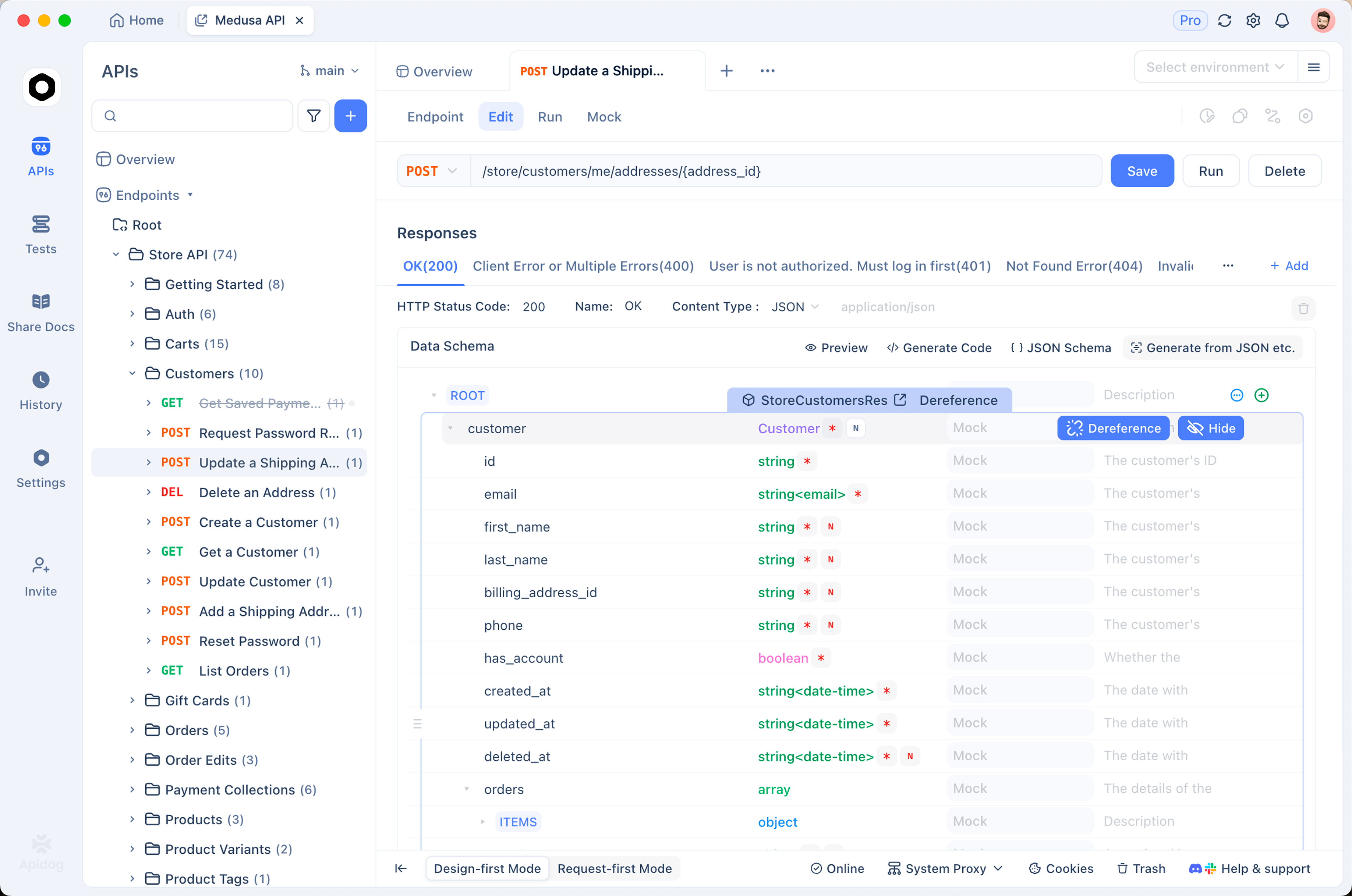
- Requests stop being test plans. Pick a method, fill in the URL, hit send. Saved requests become documented endpoints with schemas, so debugging work compounds into an API definition instead of a JMX tree.
- Functional testing is visual, not XML. Test scenarios chain requests with extracted variables, assertions, data-driven cases, and branching, built in a UI and stored in a shared workspace. What took a thread group, samplers, extractors, and assertion elements in JMeter is a drag-together flow here.
- Performance testing is built in, scoped honestly. Point a performance test at an existing test scenario, set virtual users (up to 100), a ramp-up time, and a duration, and read Total Requests, Avg Throughput, Avg/Max/Min Response Time, and Errors per API off a live dashboard, per Apidog’s performance testing docs. The feature is in beta, one performance test runs per project at a time, and reports aren’t exportable yet. That covers the “will this endpoint survive Monday” check most teams run JMeter for. It does not cover 20,000 distributed users, and it isn’t pretending to.
- CI without the JMX handoff. The Apidog CLI runs the same scenarios headlessly in any pipeline: no Java install on the runner, no plan files to sync.
The same platform then adds the categories JMeter has no answer for: a smart mock server that serves schema-based responses the moment an endpoint is defined, and interactive documentation published from the same spec your tests validate.
What the switch looks like feature by feature
Sending and debugging requests
This is the daily-driver gap. JMeter can send an HTTP request, but only inside a test plan, and inspecting a response means wiring a listener. Apidog is built around this loop: environments, auth helpers, cookies, code generation, and response validation against the endpoint’s schema. The ten-times-a-day task takes seconds, not a plan.
Functional test automation
JMeter assertions (Response Assertion, JSON Assertion, and friends) map to Apidog’s visual assertions and extracted variables. Schema validation replaces a whole class of hand-written checks: if the endpoint has a response schema, Apidog flags drift without an assertion. Data-driven testing carries over too; scenarios accept data sets the way JMeter reads CSV Data Set Configs.
Performance testing
Build the scenario once as a functional flow, then reuse it for load: virtual users, ramp-up, duration, live metrics. For a 50-VU check on a staging API, that’s the whole job with no JMX and no listener discipline. For genuinely large or geographically distributed load, keep a dedicated engine; we walked the same line in the best Locust alternative for API load testing.
CI and reporting
JMeter in CI means Java on the agent, plan files in the repo, and JTL output parsed into something readable. Apidog CLI runs scenarios from a pipeline and reports results directly; docs and mocks update from the same project without a separate publishing step.
JMeter vs Apidog at a glance
| Apache JMeter | Apidog | |
|---|---|---|
| Category | Load-generation engine + test IDE | API development platform |
| Price | Free, open source (Apache 2.0) | Free plan; paid tiers for larger teams |
| Test format | JMX (XML) files | Visual scenarios in a shared workspace |
| Everyday request debugging | Via test plan + listener | First-class request client |
| Protocols | HTTP(S), SOAP/REST, FTP, JDBC, LDAP, JMS, mail, TCP, shell | HTTP(S), REST, GraphQL, WebSocket, SSE, gRPC, SOAP |
| Functional API tests | Assertion elements in plans | Visual assertions, schema validation, data-driven |
| Performance testing | Core strength; CLI + distributed mode for scale | Built in, up to 100 virtual users on test scenarios (beta) |
| Massive distributed load | Yes, controller/worker setup | No; use JMeter, k6, Gatling, or Locust |
| API design / spec | None | Visual + code OpenAPI editors |
| Mock server | None | Schema-aware smart mocks |
| API documentation | None (HTML load reports only) | Published interactive docs |
| CI integration | Java + JMX + JTL parsing | Apidog CLI |
| Learning curve | Steep (thread groups, samplers, listeners) | Familiar request-client model |
The cost math, honestly
JMeter costs nothing, forever, and no per-seat table will change that. The spend is time: the JMX-XML review tax, the “why is the GUI frozen” hour, the CI plumbing that parses JTL files, and the second and third tools you still need, because JMeter generates load but won’t design, mock, or document anything. If your team pairs JMeter with Postman for daily requests and something else for docs, you’re already running a platform assembled from parts. Apidog’s free plan covers small teams across the whole lifecycle, and paid tiers price per user. The comparison that matters isn’t JMeter vs Apidog on price; it’s three disconnected tools vs one platform plus a load engine kept for the workloads that earn it. The same logic applied to commercial suites in the best ReadyAPI alternative for load testing, and to the daily-driver question in the best Postman alternative.
Migrating from JMeter
There’s no one-click JMX import, and pretending otherwise would waste your afternoon. The honest path is shorter than it sounds:
- Inventory the plans. Most JMeter suites contain a handful of real flows wrapped in structural noise. List the endpoints and the assertions that matter.
- Import your spec, not your plans. If the API has an OpenAPI/Swagger file, import it into Apidog and every endpoint arrives with schemas, docs, and a live mock. If not, capture endpoints by debugging them once.
- Rebuild flows as test scenarios. Recreate each thread-group flow as a visual scenario: chain requests, extract variables, add assertions. Schema validation will quietly replace many Response Assertions.
- Recreate the load checks. For each JMeter load test under 100 concurrent users, run a performance test on the matching scenario with the same ramp-up and duration.
- Move CI to the CLI. Replace the
jmeter -nstep with an Apidog CLI run, and delete the JTL parsing. - Keep JMeter for the big runs. Archive the distributed-load plans that genuinely need it. Retiring a tool from daily duty isn’t deleting it.
A suite of a dozen flows typically moves in a day or two, most of it spent deciding which assertions were load-bearing.
When JMeter still makes sense
Be fair to the engine. If you need tens of thousands of simulated users from a controller/worker cluster, load tests against JDBC, JMS, LDAP, or FTP alongside HTTP, or your performance team already maintains a JMeter pipeline with plugins and dashboards, JMeter stays the right call, and it costs nothing. Apidog’s 100-virtual-user ceiling is a real ceiling. The switch pays off when the daily reality is design, debugging, functional regression, mocks, and docs, with performance checks that fit inside that ceiling; that’s most API teams, most days. For picking a dedicated engine, start with the best load testing tools or the code-based options in our k6 guide.
Frequently asked questions
Is Apache JMeter still good in 2026?
For its core job, yes: it’s free, maintained (5.6.3 on Java 8+), and its protocol reach and distributed mode remain hard to beat. The case against it is fit, not quality. As an everyday API tool it forces XML plans and a heavyweight GUI onto tasks a platform handles directly; see Postman vs JMeter for that boundary.
Can Apidog do load testing like JMeter?
Within a defined scope. Apidog runs performance tests on test scenarios with up to 100 virtual users, configurable ramp-up and duration, and live throughput, response time, and error metrics; the feature is in beta and load generates from your machine. Beyond that, use JMeter or a code-based engine; our API performance testing tutorial covers structuring either.
Can I import JMeter JMX files into Apidog?
No. JMX is a JMeter-specific XML format, and Apidog imports API definitions (OpenAPI/Swagger, Postman collections, and others), not load-test plans. The practical route is importing your OpenAPI spec, then rebuilding flows as visual scenarios; assertion counts usually shrink because schema validation absorbs them.
Does JMeter work for API functional testing, not just load?
It can: samplers plus assertion elements will check status codes and response content. But every check lives inside a test plan, results need listeners, and there’s no schema awareness, so teams maintain assertions a spec would have caught. Purpose-built functional tooling with CI via the Apidog CLI covers the same ground with less ceremony.
What are the best JMeter alternatives besides Apidog?
Depends on which JMeter you’re replacing. For the load engine: k6, Gatling, and Locust are the code-based names; we compared the field in the best load testing tools and wrote up the best k6 alternative and the best Gatling alternative as companions to this piece. For the API-workflow half, that’s the platform category this article covers.
Retire the XML, keep the engine
Move the daily work (design, debugging, functional tests, mocks, docs, and sub-100-VU performance checks) into one platform, and let JMeter go back to being the specialist it was built to be. Download Apidog for free, import your OpenAPI spec, and rebuild your first thread-group flow as a visual scenario; you can have a performance test running on it the same afternoon.