Fiddler earned two decades of goodwill as the free Windows debugging proxy that showed you every request your machine made, from any app, decrypted. That Fiddler is now Fiddler Classic, and Telerik’s own page describes its state plainly: Windows-only, non-commercial use only, maintenance mode, with “no commitments for releases, patches or tech support.” The supported successor, Fiddler Everywhere, is cross-platform and active, but it’s a subscription: per the Telerik pricing page, Lite is $7 per user per month billed annually ($10 monthly), Pro is $13 ($19 monthly), and Enterprise is $37, annual only. There’s a 10-day trial and no free tier.
So “free Fiddler” is gone for anyone using it at work, and the honest replacement question splits in two. Fiddler is a system-wide MITM proxy, and Apidog is not one, so this article won’t pretend otherwise. But look at how most developers actually used Fiddler: composing requests against their own API, inspecting responses, faking a backend with AutoResponder rules. That’s API client work wearing a proxy costume, and for that share of the job, Apidog is the purpose-built home: a full request client, a smart mock server in place of AutoResponder rules, documented endpoints, automated tests, free for up to 4 users. For true traffic capture, the right answers are capture tools like mitmproxy, named honestly below.
What happened to Fiddler
Two products share the name now, and neither is the old deal.
Fiddler Classic is still a free download, but read the fine print: non-commercial use only, Windows only, maintenance mode with no promised releases, patches, or support. It predates HTTP/2 and gRPC. If you’re debugging company APIs with it, you’re outside the license; if you’re on a Mac or a Linux box, you were never in the club.
Fiddler Everywhere is the version Telerik wants professionals on: macOS, Linux, and Windows, with HTTP/2, WebSockets, gRPC, and SSE support. It kept the two halves of the old workflow: Compose Requests for building and saving API calls, and a Rules engine (the AutoResponder’s successor) for modifying traffic and mocking responses. The catch is the meter. Traffic-modifying Rules and team collaboration live on Pro at $13 per user per month; Lite at $7 covers capture and inspection; Enterprise controls cost $37. Ten days of trial, then the bill starts.
None of this is a scandal; maintaining a cross-platform decrypting proxy is real work. But it changes the calculation: you’re no longer deciding whether to keep a free tool, you’re deciding which paid tool deserves the seat, and that depends on which Fiddler job you were actually doing.
The two jobs hiding inside Fiddler
Be precise about your own usage before you pick a replacement, because Fiddler bundled two different jobs:
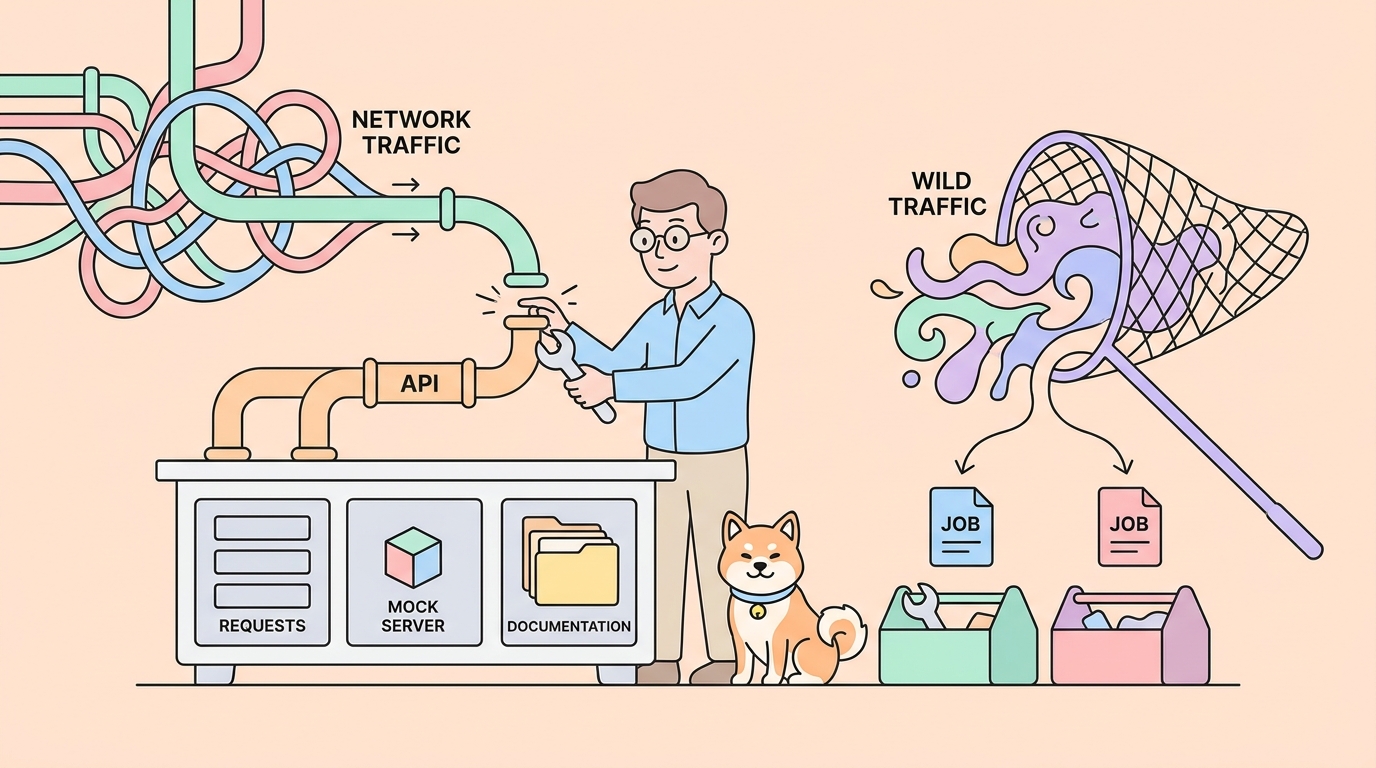
Job 1: traffic capture. You need to see requests you don’t control: a desktop app’s phone-home calls, a mobile app’s undocumented API, a browser session decrypted. This requires a system-wide MITM proxy with certificate installation. Apidog does not do this job, and no API client does.
Job 2: API work. You’re building or consuming an API you do control. You composed requests, inspected responses, wrote AutoResponder rules so the front end could develop against fake responses, and replayed sessions to reproduce bugs. None of that needs a proxy; it needs an API platform. This is where most daily Fiddler hours actually went, which is why the Everywhere subscription stings: you’re paying proxy prices for client work.
If your usage is mostly Job 1, skip to the capture tools section. If it’s mostly Job 2, read on; that’s the job Apidog was built for. (For the broader landscape, see packet capture tools and Apidog.)
The answer: Apidog
Apidog is an API development platform used by over 500,000 developers: design, debugging, testing, mocking, and documentation in one app, driven by one spec. For an ex-Fiddler user, four things matter:
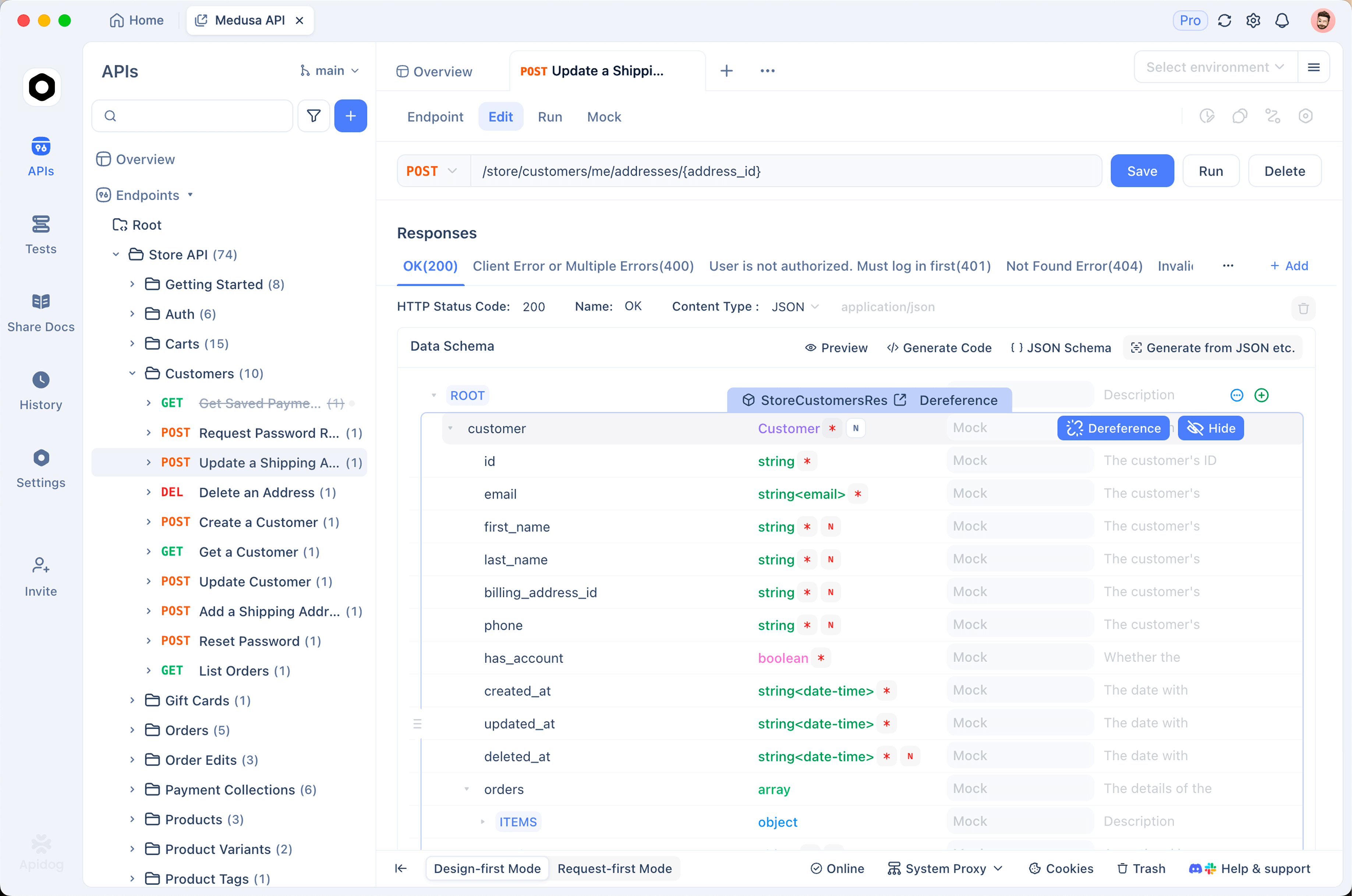
- The Composer, grown up. Fiddler’s Compose Requests builds one-off calls. Apidog’s request client covers HTTP, WebSocket, SSE, gRPC, and GraphQL, with environments, auth helpers, cookies, scripting, and code generation, and every request you save can become a documented endpoint with a schema instead of a line in a session log.
- AutoResponder rules become a mock server. This is the strongest migration story, mapped concretely below. Instead of a local rule list matching URLs and returning canned files, Apidog’s smart mock serves schema-aware fake responses from a real URL your whole team and CI can hit, with zero rules to write for the default case.
- Replay becomes regression testing. Re-issuing a saved session by hand turns into visual test scenarios: chained requests, assertions, schema validation, data-driven runs, executed on a schedule or in CI via the Apidog CLI.
- The price is zero for small teams. The free plan covers up to 4 users with unlimited runs, mocking, and published docs. Paid plans start at $9 per user per month, in the same range as a single Fiddler Everywhere Pro seat.
What the switch looks like feature by feature
Composing and inspecting requests
Day-to-day request work translates directly: build the request, send it, inspect status, headers, body, and timing. Apidog adds what a proxy session never had: folders and environments instead of a capture log, schema validation so a wrong payload fails loudly, and history you can turn into documentation. What you lose is passive capture of other apps’ traffic; that’s Job 1, and it stays with a proxy. If your capture habit was “watch my own front end call my own API,” browser DevTools plus a request client is the lighter path, the same pattern we describe in how to install and use Postman Interceptor.
AutoResponder rules to smart mocks
Here’s the concrete mapping. A typical Fiddler AutoResponder setup for front-end work: match EXACT:https://api.example.com/users/42, return users-42.json from disk; add a rule per endpoint; keep Fiddler running; hope nobody else needs the same fake backend on their machine.
In Apidog: define the GET /users/{id} endpoint with its response schema (or import your OpenAPI file and get every endpoint at once). The smart mock immediately serves realistic generated data at a stable mock URL, no rule written. Need a fixed payload? Attach users-42.json as a response example. Need id 42 to return 200 and id 99 to return 404? Add expectations that match on parameters. That covers every AutoResponder pattern (static file, per-endpoint fake, conditional response) with three upgrades: the mock is shared by URL instead of trapped in one machine’s proxy, it stays in sync with the spec, and it doesn’t route your whole system’s traffic through an interceptor just to fake one API.
Testing, docs, and the spec
This is the category jump rather than a translation. Fiddler sessions die with the window; Apidog endpoints accumulate into an API definition that generates interactive docs on your domain, mocks for consumers, and test scenarios for CI. If your team’s real comparison set is Postman or Insomnia rather than Fiddler, we’ve done those head-to-heads in the best Postman alternative and the best Insomnia alternative.
Fiddler vs Apidog at a glance
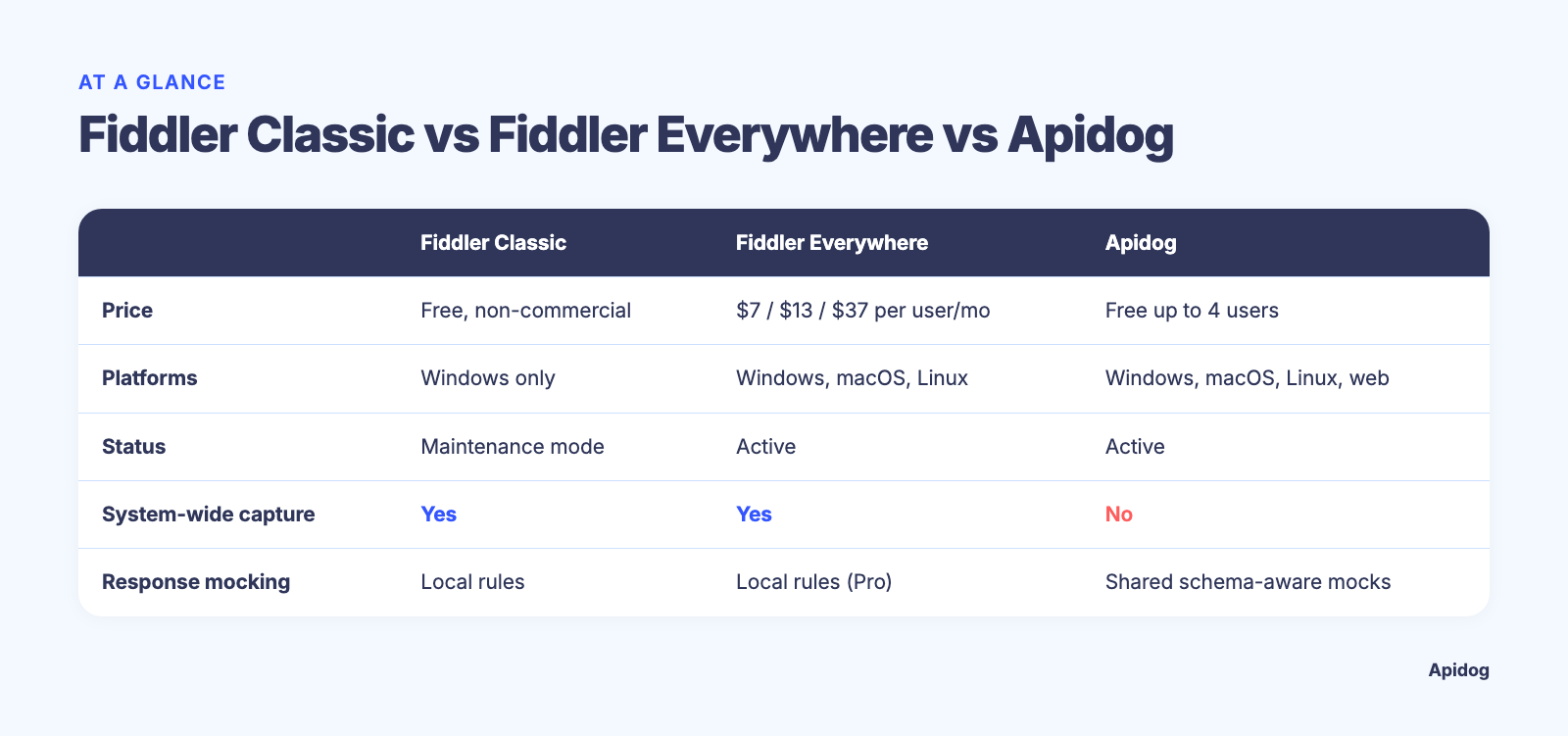
| Fiddler Classic | Fiddler Everywhere | Apidog | |
|---|---|---|---|
| Price | Free, non-commercial only | $7/$13/$37 per user/mo (annual) | Free up to 4 users; paid from $9 |
| Platforms | Windows only | Windows, macOS, Linux | Windows, macOS, Linux, web |
| Status | Maintenance mode | Active | Active |
| System-wide traffic capture | Yes | Yes | No |
| Compose API requests | Basic Composer | Compose Requests | Full client: HTTP, WebSocket, SSE, gRPC, GraphQL |
| Response mocking | AutoResponder rules, local | Rules engine (Pro tier), local | Schema-aware smart mock server, shared URL, free |
| Saved, documented endpoints | No | Sessions and saved requests | Spec-backed endpoints with published docs |
| Automated testing | No | Replay-based | Visual scenarios, assertions, data-driven, CI |
| CLI / CI runs | No | No | Free via Apidog CLI |
| Team collaboration | No | Pro tier | Free plan, 4 users |
The seat math, honestly
A 5-person team that wants traffic rules and collaboration needs Fiddler Everywhere Pro: $13 x 5 x 12 = $780 per year. The same team doing API work in Apidog pays $0 for 4 seats plus $108 for the fifth at $9 per month, or $540 per year with everyone on paid, still under the Fiddler bill. But the fairer framing is fit, not price: those Fiddler seats buy traffic capture that API work doesn’t need, and don’t buy the spec, docs, shared mocks, or CI testing that it does. Pay proxy prices only for the people who genuinely debug foreign traffic.
For real traffic capture, use a capture tool
When the job is MITM interception, pick a proxy; don’t force an API client into the role:
- mitmproxy: free, open source, cross-platform; console, web UI, and Python scripting; the default answer when “free Fiddler replacement” means the proxy part.
- Charles Proxy: paid one-time license; long-standing choice for mobile app debugging with throttling and rewrite rules. It has its own aging-tool questions, which we cover in the best Charles Proxy alternative.
- HTTP Toolkit: open core, one-click interception of specific browsers, terminals, and Docker containers rather than the whole system; the gentlest setup of the group.
- Proxyman: native macOS (with iOS device support); the polished choice for Apple-centric teams.
A capture proxy plus Apidog is a coherent stack: the proxy for the rare foreign-traffic hunt, Apidog for the daily API work. To untangle debugging proxies from the other kind, see API proxy vs API gateway explained.
When Fiddler still makes sense
Fiddler Everywhere is the right tool if system-wide decrypted capture is your daily job and you want a supported commercial product behind it; $13 a month is fair for that. Fiddler Classic remains defensible for hobby debugging on a personal Windows machine, license and all. And FiddlerScript veterans with years of custom rules have switching costs no import button erases. The move to Apidog pays off the moment your Fiddler use is mostly the Composer and AutoResponder: when you’re faking your own backend through a system proxy, a mock server with a URL is simply the better shape.
Frequently asked questions
Is Fiddler still free?
Fiddler Classic is free but restricted: non-commercial use only, Windows only, maintenance mode. Fiddler Everywhere has no free tier, only a 10-day trial, then $7 to $37 per user per month. For commercial API work on a free plan, see the best Postman alternative landscape or start with Apidog’s free 4-user plan.
Can Apidog capture all my system’s HTTP traffic like Fiddler?
No. Apidog is an API development platform, not a system-wide MITM proxy, and we won’t pretend otherwise. For decrypting arbitrary app or mobile traffic, use mitmproxy, Charles, HTTP Toolkit, or Proxyman; our packet capture tools guide compares them and shows where each fits alongside Apidog.
What replaces Fiddler’s AutoResponder in Apidog?
The smart mock server. Define or import an endpoint and Apidog serves schema-based fake responses at a shared mock URL immediately; attach examples for fixed payloads and expectations for conditional cases. Unlike AutoResponder rules, mocks live with the spec and work for teammates and CI without anyone running a proxy, and they run in your pipeline via the Apidog CLI.
How do I move my Fiddler workflow into Apidog?
Import your API’s OpenAPI file so every endpoint arrives with schemas, docs, and live mocks at once, then port AutoResponder rules as response examples and expectations. Fiddler’s SAZ session archives aren’t a collection format, so treat the move as importing your spec, not your capture history.
Is Fiddler Everywhere the same as Fiddler Classic?
No. Everywhere is a rewritten cross-platform subscription product; Classic is the frozen Windows freeware, and Telerik points commercial users to Everywhere. For the neighboring tool’s version of this same fork, see the best Charles Proxy alternative.
Stop paying proxy prices for API work
If Fiddler was your request composer and fake backend, move that work to the tool shaped for it. Import your OpenAPI spec, get documented endpoints with live smart mocks in minutes, and wire the tests into CI. Download Apidog or start in the browser; a team of 4 pays nothing, and the AutoResponder rules you’ve been babysitting become mock URLs you can share.
References
External sources:
- Fiddler Everywhere pricing (Telerik)
- Fiddler Classic product page (Telerik)
- Fiddler Everywhere product page (Telerik)
- mitmproxy
- HTTP Toolkit
Further reading on the Apidog blog: