Charles Proxy has earned its place on developer machines since the mid-2000s: a $50 one-time license, per Charles’s pricing page, buys a debugging proxy for Windows, macOS, and Linux (plus an iOS app) that records every request leaving your machine, decrypts HTTPS with SSL proxying, throttles connections, and fakes or rewrites responses with tools like Rewrite and Map Local. If you’re searching for a Charles Proxy alternative, first ask which of those jobs you actually use it for, because they split into two categories that want two different replacements.
Here’s the direct answer. If you use Charles to capture traffic you don’t control (a third-party app, an SDK, a mobile client with certificate pinning), the alternatives are other capture proxies: mitmproxy, Proxyman, HTTP Toolkit, or Fiddler, compared below. But if you use Charles the way most API developers do, as a workaround for API work (peeking at your own API’s responses, faking a response with Map Local so the frontend can build, replaying a request until the bug shows up), the better alternative isn’t another proxy at all. It’s Apidog, a purpose-built API platform where those same jobs become documented endpoints, a smart mock server, and repeatable tests, free for up to 4 users. This article covers both paths, and is blunt about which tool fits which job.
What Charles is, and what it costs
Charles is a man-in-the-middle (MITM) debugging proxy. You route a device or app’s traffic through it, install its root certificate, and it shows you everything on the wire. The documented tool set is where the day-to-day value lives:
- SSL proxying decrypts HTTPS traffic so you can read request and response bodies.
- Throttling simulates slow or lossy networks to see how an app behaves on bad connections.
- Breakpoints pause a request or response mid-flight so you can edit it by hand.
- Rewrite applies rules that modify headers, bodies, or URLs automatically as traffic passes.
- Map Local serves a file from your disk in place of the real server response; Map Remote redirects requests to a different server.
- Repeat re-sends a captured request, with an advanced mode for iterations and concurrency.
The license is $50 per user as a one-time purchase (volume discounts at 5 and 10 seats, site licenses at $400), with a 30-day free trial. No subscription, which is why people keep it around for a decade. None of that is the problem. The problem is what a proxy can’t do, and how much of your Charles time goes to compensating for it.
The question that picks your alternative
Watch what you actually do in Charles for a week. Two patterns emerge.
Capture work: traffic you observe but don’t own. Reverse-engineering an undocumented API, auditing what an SDK phones home with, debugging an app you can’t rebuild. This is proxy territory, permanently. No API client replaces it.
API work in disguise: traffic you own from both ends. You capture your own backend’s response to see the payload (because it isn’t documented anywhere). You Map Local a JSON file so the mobile team can build against an endpoint that doesn’t exist yet (because there’s no mock server). You breakpoint and edit a response to test an error path (because there’s no test that injects it). Every one of those parentheses is a missing piece of API tooling, and the proxy is the duct tape. Whole teams run Charles all day without ever inspecting third-party traffic; the same dynamic drives Postman’s proxy feature, covered in what the Postman proxy does and how to install and use Postman Interceptor.
If your Charles hours are mostly the second pattern, replacing Charles with another proxy just buys prettier duct tape.
The answer for API work: Apidog
Apidog is an API development platform used by over 500,000 developers: design, debugging, testing, mocking, and documentation in one app driven by one spec. To be clear about scope: Apidog is not a traffic sniffer. It won’t capture another app’s packets, and if that’s your job, skip to the capture tools below (or see our roundup of packet capture tools and where Apidog fits). What Apidog does is make the API-work half of your Charles usage unnecessary, because each workaround becomes a real feature:
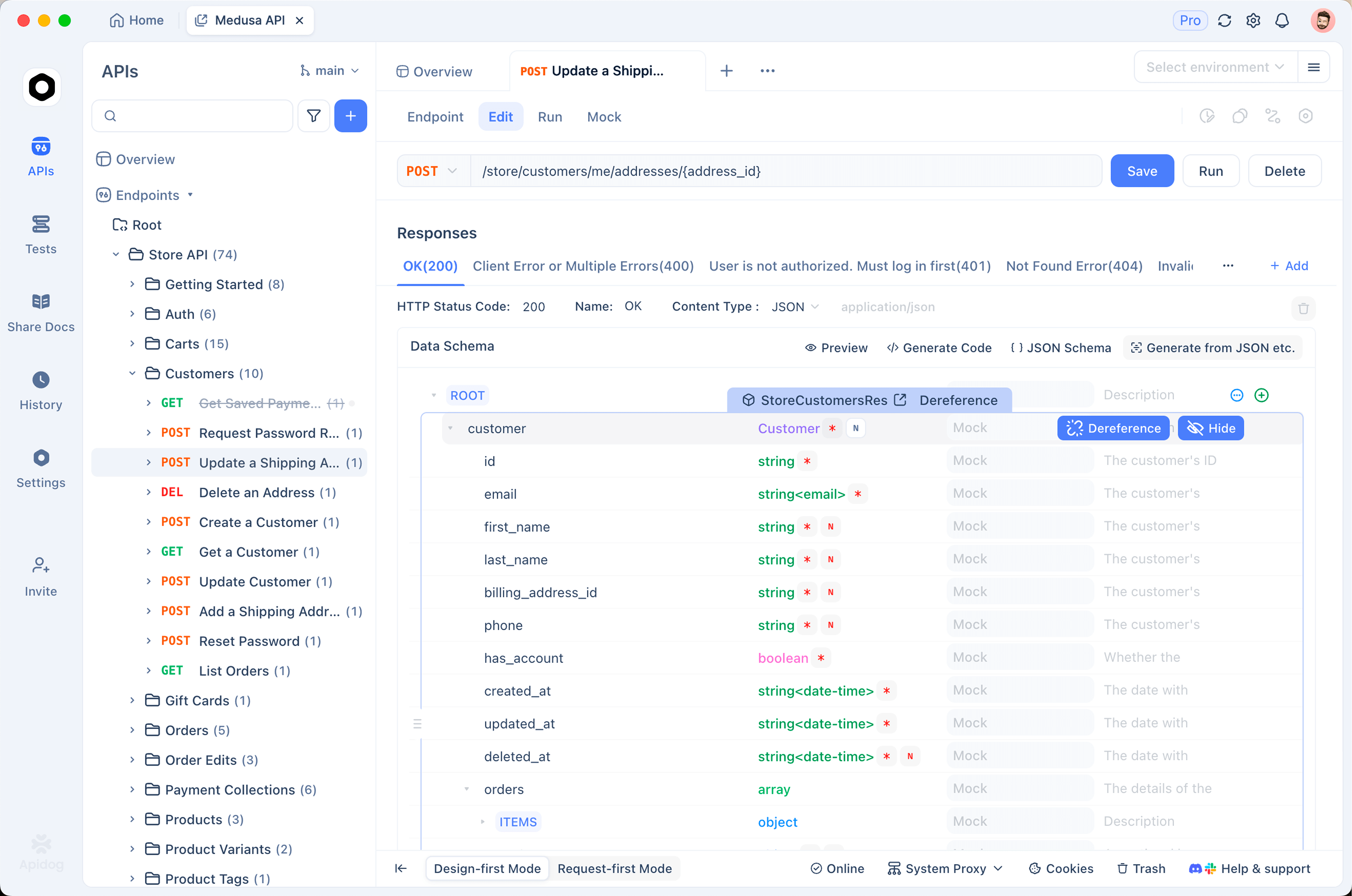
- “Capture my own response to see the payload” becomes a documented endpoint. Send the request in Apidog’s client, save it with a schema, and the payload shape is now visible to the whole team as interactive docs, not trapped in one person’s session window.
- Map Local becomes a smart mock server. Instead of hand-editing a JSON file on your disk and routing a device through your laptop, Apidog serves schema-based mock responses from a URL the moment an endpoint is defined. Anyone on the team hits the mock URL; nobody installs a root certificate.
- Breakpoint-and-edit becomes a test scenario. Editing a response by hand to check an error path works once. An Apidog test scenario that asserts on the error path runs on every commit via the Apidog CLI.
- Repeat becomes the runner. Re-sending requests with variations is what collections, environments, and data-driven test cases are for.
All of that, including unlimited mock and test runs, is on the free plan for up to 4 users; paid plans start at $9 per user per month.
The Map Local to smart mock migration, concretely
This is the switch that changes daily work most. Say your Charles setup maps /api/v2/orders to orders-fake.json on your disk so the iOS team can build the order screen before the backend ships.
- Define the endpoint in Apidog. Create
GET /api/v2/ordersand pasteorders-fake.jsonas the response example, or better, define the response schema (Apidog generates the schema from the JSON in one click). - The mock URL exists immediately. The smart mock reads the schema and serves realistic values (names that look like names, dates that look like dates) with no rules to write. Your one static file becomes varied, plausible data.
- Point the app at the mock base URL. The iOS build uses the mock server URL as its dev API host. No proxy on the device, no certificate install, no “works only when Dana’s laptop is on the office Wi-Fi.”
- When the real backend ships, flip the environment. The endpoint definition stays, becomes the contract you test against, and the docs were published the whole time.
The difference in kind: Map Local is a per-machine trick that dies with your Charles session. The mock is shared infrastructure that outlives it.
For genuine capture jobs: the honest proxy shortlist
When the job is inspecting traffic you don’t own, pick a proxy. One-line fit notes:
- mitmproxy: free, open source (MIT), with console, web, and Python-scripting interfaces. The default answer when “free” and “automatable” matter more than GUI polish.
- Proxyman: the native-app experience on macOS (with iOS, Android, Windows, and Linux versions), freemium. The closest like-for-like Charles upgrade for Apple-centric teams, with its own Map Local and breakpoints.
- HTTP Toolkit: open source with a free core, on Windows, macOS, and Linux. Its one-click interception of a specific browser or terminal beats system-wide proxying for scoped debugging.
- Fiddler: the long-running Windows name; Fiddler Everywhere is its cross-platform, subscription-based successor. If you’re weighing that one, we’ve written up the best Fiddler alternative with the same honest scoping.
A sensible end state for many teams is a pair: Apidog for the API lifecycle, plus mitmproxy (free) for the occasional capture job.
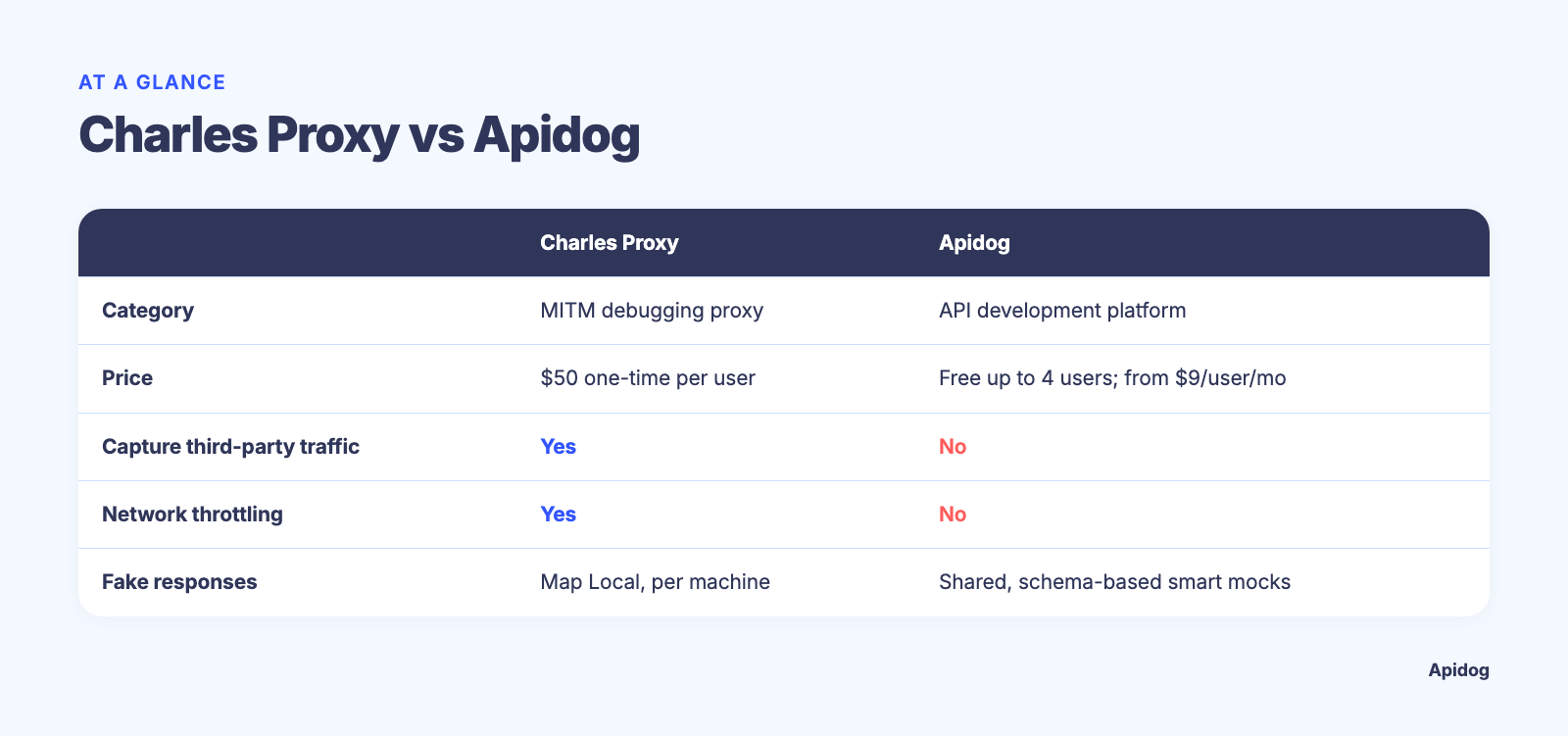
Charles Proxy vs Apidog at a glance
| Charles Proxy | Apidog | |
|---|---|---|
| Category | MITM debugging proxy | API development platform |
| Price | $50 one-time per user | Free up to 4 users; paid from $9/user/month |
| Capture third-party traffic | Yes (its core job) | No |
| SSL proxying / decryption | Yes, via root certificate | Not applicable (you own both ends) |
| Network throttling | Yes | No (keep a proxy for device-level throttling) |
| Fake responses | Map Local / Rewrite, per machine | Smart mock server, shared URL, schema-based |
| Edit requests in flight | Breakpoints, by hand | Scripted pre/post processing, repeatable |
| Replay requests | Repeat / Repeat Advanced | Collections, runner, data-driven cases |
| API documentation | No | Published interactive docs |
| Automated tests / CI | No | Test scenarios + CLI in CI |
| Team sharing | Session files | Cloud workspace, real-time sync |
| Mobile capture | Yes, incl. iOS app | No |
One flag on terminology: “proxy” means something different at every layer of this conversation; if that’s muddying your search, API proxy vs API gateway explained untangles it.
The cost math, honestly
Charles at $50 one-time is close to free amortized over years, and pretending Apidog wins a sticker-price fight against it would insult your calculator. The comparison isn’t the licenses; it’s the workflow around them. The Charles-centric API workflow has hidden line items: payloads documented in screenshots, mock data that exists on one laptop, error paths tested by hand and never again, and a proxy setup each new teammate rebuilds from a wiki page. Apidog’s free plan replaces those with shared docs, a hosted mock, and CI tests at $0 for a team of 4. If you also pay for a separate API client, the consolidation math gets better still; see the best Postman alternative for that comparison.
When Charles still makes sense
Keep Charles (or a peer) when the job is genuinely about the wire: auditing third-party SDK traffic, debugging an app you can’t rebuild, working through certificate-pinning workarounds on mobile, or throttling a whole device to reproduce a bad-network bug. A proxy is the right tool there, and $50 once is a fair price. The switch to Apidog pays off at the first mock a teammate needs, the first payload question answered by docs instead of a capture session, and the first error path that becomes a test instead of a hand-edited response.
Frequently asked questions
Is Charles Proxy free?
No. There’s a 30-day free trial, then a license is $50 per user, one-time, with volume discounts from 5 seats and site licenses at $400. Apidog is free for up to 4 users, though it replaces the API-work side of Charles, not the capture side; for free capture, mitmproxy is the standard answer, and our packet capture tools roundup compares the field.
Can Apidog capture network traffic like Charles?
No, and we won’t pretend otherwise. Apidog has no MITM capture; it works with APIs you define or import. What it replaces is the Charles usage where you already own both ends: inspecting your own API’s responses, faking responses with Map Local, and re-sending requests. For that workflow it’s the purpose-built home, the same way we scoped the best Fiddler alternative.
What replaces Map Local and Rewrite in Apidog?
The smart mock server. Define an endpoint with a response schema and Apidog serves realistic mock data from a shared URL immediately: no local files, no per-machine proxy rules, no root certificates on test devices. Custom expectations cover cases that need a specific canned payload. It’s the same job Map Local does, minus the part where it only works on your machine.
What’s the best free Charles Proxy alternative?
Two answers for two jobs. For traffic capture: mitmproxy, which is MIT-licensed, scriptable in Python, and has a web UI. For the API debugging, mocking, and testing most developers actually run through Charles: Apidog’s free plan, which includes the request client, smart mocks, docs, and CI runs via the Apidog CLI for up to 4 users.
Does Apidog work for mobile API development?
For the API side, yes: point your iOS or Android dev build at an Apidog mock server URL and the app gets realistic responses with no proxy or certificate setup on the device. For capturing a mobile app’s live traffic (especially with certificate pinning involved), keep a capture proxy; Charles’s iOS app and Proxyman both serve that job.
Route the API work to an API platform
Audit a week of your Charles sessions, then move the API jobs somewhere they stop being workarounds. Define the endpoints you keep inspecting, hand the frontend a mock URL instead of a Map Local rule, and turn the breakpoint edits into tests that run in CI. Download Apidog or start in the browser; a team of 4 pays nothing, and your first mock server is one schema away.